

High employee turnover costs U.S. businesses roughly $1 trillion annually in voluntary departures alone, and replacing a single employee typically runs between 0.5x and 2x that person's annual salary. For a small business owner managing a team of 10 to 50 people, even one or two departures per quarter can quietly drain thousands of dollars from profit. The damage comes from two directions: direct costs you can invoice (recruiting ads, agency fees, onboarding hours, equipment setup) and hidden costs that never appear on a budget line (lost productivity, client churn, team morale decline, institutional knowledge walking out the door).
The most practical first step is to calculate a conservative cost-per-departure for one at-risk role this quarter, then run a focused 60–90 day retention pilot on that role. The sections below give you the formula, the benchmarks, and the tactics to do both.
The two cost clusters at a glance:
- Direct/tangible costs: job ads, recruiter or agency fees, interview time, background checks, sign-on bonuses, severance, IT setup
- Hidden/indirect costs: pre-departure productivity loss, ramp-up lag, morale decline, client relationship risk, knowledge loss, quality incidents
Table of Contents
- 1. What are the direct, line-item costs of replacing an employee?
- 3. How to calculate the cost of turnover for any role
- 4. Benchmarks and national-scale figures that put the problem in context
- 5. When costs actually hit: the departure lifecycle
- 6. High-impact strategies to reduce turnover and lower replacement costs
- 7. How a structured hiring system reduces replacement costs
- 8. How to decide where to invest first
- Key Takeaways
- The cost you are probably still underestimating
- Pilot a smarter hiring process with Locatehire
- Useful sources and further reading
1. What are the direct, line-item costs of replacing an employee?
Every departure generates a set of hard-dollar expenses that you can, and should, track as a budget line. Most small business owners see only the job board invoice. The full list is longer.
Common direct cost items:
- Job advertising: — Posting to Indeed, LinkedIn, ZipRecruiter, or niche boards typically runs $200–$500 per posting per month, depending on the platform and visibility tier.
Line-item breakdowns from Built In confirm that total costs can exceed simple recruiting fees once lost productivity and ramp-up time are included. For a small business where the owner handles recruiting personally, the opportunity cost of that time is often the largest single line item, yet it rarely appears on any report.
Pro Tip: Convert every internal hour spent on recruiting into a dollar figure using the hourly equivalent of the person's salary. A business owner earning $100,000 per year costs roughly $48 per hour. Ten hours of interviewing for one open role is $480 before you post a single ad.
3. How to calculate the cost of turnover for any role
A reproducible formula separates the guesswork from the math. Indeed's employer guidance and Qualtrics's structured approach both recommend separating costs into three buckets before summing them.
The formula:
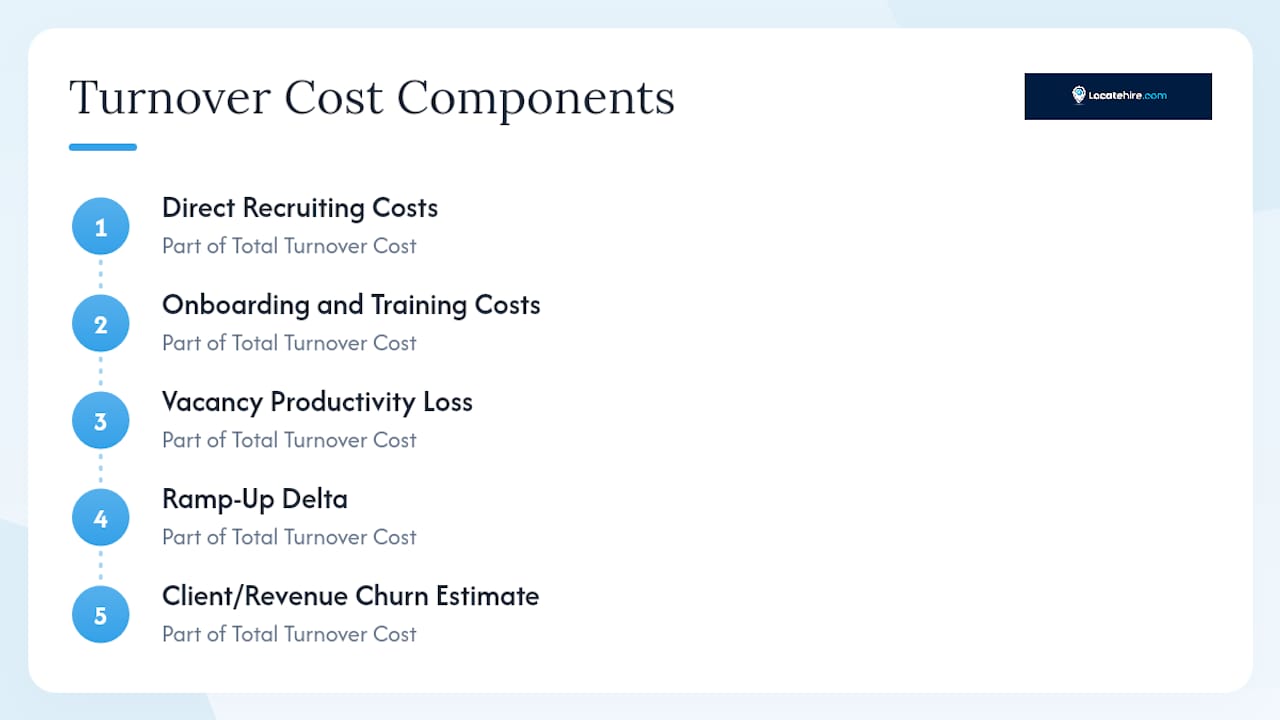
Total Turnover Cost = Direct Recruiting Costs + Onboarding and Training Costs + Vacancy Productivity Loss + Ramp-Up Delta + Client/Revenue Churn Estimate
Three worked examples:
Entry-level / hourly role ($18/hour, $37,440 annual salary)
| Cost Category | Conservative | Aggressive |
|---|---|---|
| Background check | $50 | $100 |
| Onboarding and training | $500 | $1,000 |
Mid-level specialist ($55,000 annual salary, e.g., HVAC technician)
| Cost Category | Conservative | Aggressive |
|---|---|---|
| Interview time (owner + manager, 10 hrs) | — | $1,000 |
| Client churn estimate | — | $8,000 |
Senior / technical role ($90,000 annual salary, e.g., operations manager)
| Cost Category | Conservative | Aggressive |
|---|---|---|
| Background check and assessments | $200 | $500 |
| Onboarding and training | — | $10,000 |
| Vacancy productivity loss (6 weeks) | $10,385 | $20,769 |
| Ramp-up delta (12 weeks at 50% output) | $20,769 | $31,154 |
| Client/project churn estimate | — | $20,000 |
| Total | $60,854 | $107,423 |
Pro Tip: Start with conservative inputs and document your assumptions. After your first full replacement cycle, compare actual costs to your estimate. The gap between your first estimate and reality is exactly where your biggest cost-reduction opportunity lives.
4. Benchmarks and national-scale figures that put the problem in context
Understanding where your numbers sit relative to industry averages helps you make the case to ownership or a board, and it gives you a sanity check on your own calculations.
Gallup estimates that voluntary turnover costs U.S. businesses approximately $1 trillion per year, with replacement costs running 0.5x–2x an employee's annual salary across most roles. For senior or highly specialized positions, that multiplier can reach 200% of annual salary.
The Bureau of Labor Statistics (BLS) tracks monthly job openings and labor turnover data across industries. Separation rates vary significantly by sector: leisure and hospitality consistently post among the highest annual turnover rates, while professional and business services tend to run lower. Retail and service trades, the core industries Locatehire serves, typically see annual turnover rates well above the national average.
Industry cost multipliers and time-to-productivity ranges:
| Industry / Role Type | Typical Replacement Cost (% of salary) | Avg. Time to Full Productivity |
|---|---|---|
| Retail / hourly service | 50%–75% | 4–8 weeks |
| Skilled trades (HVAC, plumbing, electrical) | 75%–125% | 8–16 weeks |
| Healthcare (nursing, clinical) | 75%–200%+ | 12–26 weeks |
| Mid-level management | 100%–150% | 12–20 weeks |
| Senior / technical | 150%–200% | 20–52 weeks |
The systematic review of nursing turnover found replacement costs per nurse ranging from roughly 0.31x to 3x average salary, with orientation, training, and vacancy coverage as the largest cost drivers. That range illustrates how much role complexity and training investment amplify the baseline cost.
For seasonal hiring contexts common in retail and pool service, turnover costs compound because departures often coincide with peak demand, when vacancy costs are highest and replacement candidates are scarcest.
5. When costs actually hit: the departure lifecycle
Most business owners assume the biggest cost is the vacancy period between one employee leaving and the next one starting. NBER research challenges that assumption directly: a large share of productivity losses from turnover occur before the employee's last day and during the new hire's onboarding period, not primarily while the role sits open.
The departure lifecycle has four distinct cost phases:
- Announcement phase: Once an employee decides to leave (even before they tell you), their output drops. They disengage from long-term projects, reduce discretionary effort, and may begin recruiting colleagues.
- Notice period: Managers spend time in transition planning, knowledge transfer, and recruiting instead of their core work. Team members pick up slack and morale begins to slip.
- Vacancy period: The role is open. Work either goes undone, gets redistributed to already-stretched colleagues, or requires overtime pay to cover.
- Onboarding and ramp-up: The new hire is present but not yet productive. Mistakes, slower output, and manager coaching time all represent real costs during this phase.
Practical monitoring signals to catch departures earlier:
- Rising support tickets or customer complaints tied to a specific employee's accounts
- Missed internal deadlines or declining output quality
- Increased manager time spent in external interviews or reference calls
- Unusual spikes in PTO usage or schedule change requests
Catching the signals early gives you a window to intervene with a stay conversation before the decision is final. Gallup's research shows that many voluntary departures could have been prevented by manager action, which makes the announcement phase the highest-leverage moment in the entire cycle.
6. High-impact strategies to reduce turnover and lower replacement costs
Reducing turnover is not one initiative. It is a set of targeted actions ranked by speed and expected return. The list below is ordered by typical impact for small businesses.
1. Manager coaching and stay conversations
The single highest-leverage action. A manager who holds regular one-on-ones and asks direct questions about workload, career direction, and satisfaction can identify flight risks weeks before a resignation. Train managers to ask: "What would make your work here better?" and actually act on the answers.

2. Structured onboarding with 30/60/90 checklists
Poor onboarding is one of the fastest routes to early turnover. A written 30/60/90 day plan sets clear expectations, reduces new-hire anxiety, and shortens time-to-productivity. SHRM's guidance consistently points to structured onboarding as a high-ROI retention investment.
3. Improving offer acceptance rates
A declined offer restarts the clock and adds weeks to your vacancy period. Tactics that improve offer acceptance include faster decision-making, transparent compensation conversations, and a warm candidate experience between offer and start date.
4. Pay benchmarking and compensation review
You do not need to be the highest payer in your market. You need to be competitive. A quarterly review of local wage data for your key roles costs almost nothing and can prevent a departure triggered by a $2/hour gap.
5. Employee referral programs
Referred hires tend to stay longer and ramp up faster because they arrive with realistic job expectations. A referral program with a modest bonus ($250–$500 for a successful 90-day hire) costs far less than an agency fee and builds a pipeline of pre-vetted candidates.
6. Career path clarity
Employees who cannot see a future at your company will look for one elsewhere. Even a simple two-tier structure (technician → lead technician → supervisor) gives people a reason to stay and develop.
7. Recognition and feedback cadence
Formal recognition programs are not required. A consistent habit of specific, timely positive feedback from managers costs nothing and measurably improves engagement scores.
Pro Tip: Pick one of the tactics above and run a 60–90 day pilot on your highest-turnover role. Measure the departure rate before and after. A single prevented departure in a skilled trades role typically saves more than the cost of a full quarter of manager coaching time.
For businesses in trades like plumbing or HVAC, staffing best practices specific to those industries can sharpen which tactics deliver the fastest payback.
7. How a structured hiring system reduces replacement costs
Better recruiting does not just fill roles faster. It reduces the frequency of bad hires, which are themselves a major driver of early turnover. Avoiding bad hires starts with a structured process, and an applicant tracking system (ATS) is the infrastructure that makes that process repeatable.
Metrics an ATS improves and how they connect to turnover costs:
- Time-to-fill: Fewer vacancy days means less productivity loss and less overtime paid to cover the gap.
- Cost-per-hire: Automated job posting to multiple boards reduces the need for expensive agency placements.
- Quality-of-hire: AI candidate matching and structured scoring reduce the chance of a poor fit that leads to early departure.
- Offer-acceptance rate: Faster, more organized candidate communication reduces drop-off between offer and start.
Sample ROI calculation for a small business:
Assume a retail or service business with 20 employees and an annual turnover rate of 30% (six departures per year). Average replacement cost per departure: $8,000 (conservative estimate for hourly/entry-level roles).
- Current annual turnover cost: 6 departures × $8,000 = $48,000
- ATS subscription cost (annual): ~$1,200–$2,400 (typical SMB tier)
- Expected improvement: A 20% reduction in turnover through better hiring quality and faster fills saves approximately $9,600 per year.
- Net ROI: $9,600 saved minus $2,400 subscription = $7,200 net annual savings, not counting reduced agency fees.
60–90 day ATS pilot checklist:
- Select one high-turnover role as the pilot.
- Post the role through the ATS to at least three job boards simultaneously.
- Use structured interview scorecards for every candidate.
- Track time-to-fill and cost-per-hire against your last three hires for that role.
- At 90 days, compare the new hire's 30/60/90 performance against the previous hire's ramp-up timeline.
- Calculate the cost difference and decide whether to expand the system to additional roles.
Pro Tip: Reducing time-to-hire by even five days on a mid-level role saves hundreds of dollars in vacancy productivity loss. Track this metric from your first pilot hire.
8. How to decide where to invest first
With limited budget and time, you need a decision rule for choosing between competing retention investments. The framework below takes about 30 minutes to run.
Decision checklist:
- Calculate your current cost-per-departure for the role in question (use the formula in Section 3).
- Estimate the program cost for each option you are considering (raise, training, ATS subscription).
- Estimate the expected reduction in turnover for each option, expressed as a percentage.
- Calculate the payback period: Program cost ÷ (Annual turnover cost × Expected % reduction).
- Compare payback periods and prioritize the option with the shortest one.
Example comparison for a five-person HVAC crew with 40% annual turnover:
| Investment Option | Annual Cost | Expected Turnover Reduction | Annual Savings | Payback Period |
|---|---|---|---|---|
| 5% pay raise (avg. $55K salary) | — | 15% | $4,950 | 2.8 years |
| Manager training program | — | 20% | $6,600 | 0.4 years |
| ATS subscription + structured hiring | $2,400 | 20% | $6,600 | 0.4 years |
The math here is not a guarantee, but it illustrates why manager training and structured hiring systems tend to outperform pay raises as retention investments for small businesses. A raise addresses one reason people leave. Better management and hiring address many.
When to escalate to a full retention program:
- Annual turnover exceeds 30% in any single role category
- Two or more departures in the same team within 90 days
- A departure triggers a client loss or a safety incident
- Replacement costs for one role exceed 100% of that role's annual salary
For businesses comparing onshore versus offshore staffing costs, global hiring cost benchmarks can provide useful context for the cost-per-hire side of this calculation.
Key Takeaways
High employee turnover is a measurable financial drain, and for most small businesses, preventing even one departure per quarter pays for every retention investment many times over.
| Point | Details |
|---|---|
| Turnover costs 0.5x–2x salary | Gallup puts replacement cost at 0.5x–2x annual salary; senior roles can reach 200%. |
| Hidden costs exceed direct costs | Pre-departure productivity loss and ramp-up lag typically outweigh recruiting fees for mid-level and senior roles. |
| Most losses happen before departure | NBER research shows a large share of productivity loss occurs before the employee's last day, not during the vacancy. |
| Manager action prevents most departures | Stay conversations and consistent one-on-ones are the highest-ROI retention tactic for SMBs. |
| Locatehire reduces time-to-fill and cost-per-hire | An ATS pilot on one high-turnover role typically saves more than its subscription cost by preventing a single bad hire. |
The cost you are probably still underestimating
The conventional wisdom on turnover cost focuses on the recruiting invoice. That is the wrong place to look first.
The real money is in the 60 days before an employee hands in their notice and the 90 days after a new hire starts. Those two windows, not the vacancy gap between them, account for the majority of the financial damage. An employee who has mentally checked out but is still on your payroll is costing you full salary for partial output. A new hire who is still learning your systems, your clients, and your processes is doing the same.
What most small business owners miss is the compounding effect. One departure in a five-person crew does not just cost you the replacement expense. It raises the workload on the remaining four, which raises their own flight risk. Two departures in quick succession can destabilize a team that took years to build.
The fix is not to spend more on recruiting. It is to invest earlier in the relationship, before the decision to leave is made. That means manager training, stay conversations, and a hiring process that selects for fit and longevity, not just availability. An ATS does not replace good management, but it does remove the friction that causes good candidates to drop out and bad hires to slip through.
The businesses that treat turnover as a financial metric, not an HR problem, are the ones that stop the cycle. Calculate the number. Show it to your leadership team. Then decide what it is worth to prevent.
Pilot a smarter hiring process with Locatehire
Cutting replacement costs starts with hiring better candidates faster. Locatehire is built specifically for small businesses in trades, retail, and services that hire repeatedly and cannot afford a bad hire or a long vacancy. The platform posts jobs to major boards and social media simultaneously, uses AI candidate matching and smart scoring to surface the best applicants first, and gives your team a structured process that reduces the guesswork that leads to early turnover.
The pilot scope is simple: pick your highest-turnover role, run your next hire through Locatehire, and track time-to-fill and cost-per-hire against your last three hires for that role. Most small businesses see the subscription pay for itself within the first prevented departure. Start your Locatehire trial and run your first structured hire in under a week.
Useful sources and further reading
The figures and recommendations in this article draw from the following sources. Each is worth reading directly if you want to build a more detailed turnover cost model for your business.
- This Fixable Problem Costs U.S. Businesses $1 Trillion
- State of the Global Workplace
- Estimating the costs of employee turnover (NBER working paper)
- The impact of nursing turnover on care processes and outcomes (systematic review)
- The True Costs of Employee Turnover
- Calculating The Cost of Employee Turnover
- Estimating the Costs of Employee Turnover
- To have and to hold (SHRM)