

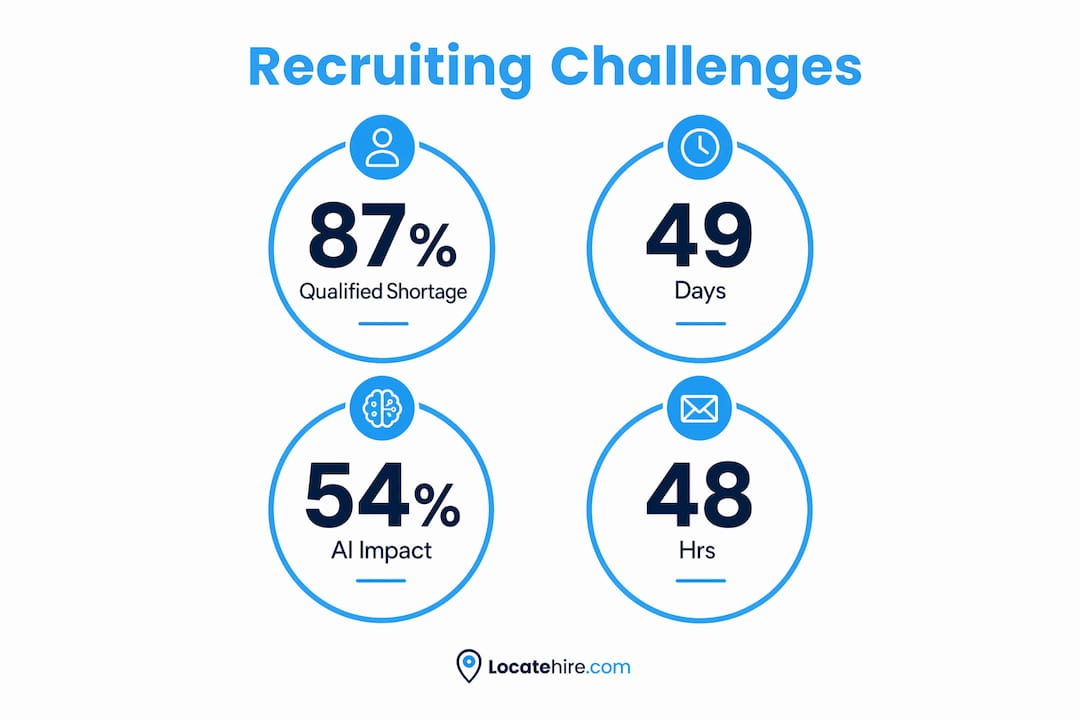
Small businesses struggle recruiting primarily because of a severe shortage of qualified applicants, compounded by structural HR limitations and competitive disadvantages that larger employers simply do not face. As of April 2026, 34% of small business owners report unfilled job openings, with 87% receiving few or no qualified applicants. That figure sits well above the 24% historical average, meaning this is not a temporary dip. It reflects a structural gap between what small businesses can offer and what today's candidates expect. The industry term for this challenge is "talent acquisition," and understanding where it breaks down is the first step toward fixing it.
Why small businesses struggle recruiting: the root causes
The core problem is not a lack of effort. It is a mismatch between hiring demand and the resources available to meet it. 47% of small business leaders say finding skilled talent is harder than the previous year, yet only 12% report having the talent they need for high-priority projects. That gap between confidence and capability is where most hiring failures begin.
Limited HR capacity creates compounding delays
Small businesses with fewer than 10 employees often lack the HR infrastructure needed for thorough application review and structured hiring processes. In a pool service company or HVAC firm, the owner is frequently the hiring manager, the interviewer, and the person running the day-to-day operation. When owner time becomes the bottleneck for approvals and interviews, delays compound through every stage of the hiring funnel. A candidate who applied on Monday may not hear back until the following week, and by then, they have accepted another offer.

Slower hiring cycles push candidates toward larger employers
Time-to-fill averages 49 days in small businesses with fewer than 100 employees, compared to the national average of 41 days. Eight extra days may not sound significant, but in a competitive labor market, it is the difference between landing a skilled electrician and losing them to a regional contractor with a dedicated HR team. Larger employers move faster because they have dedicated recruiters, pre-approved job templates, and automated screening tools already in place.
Brand visibility and budget constraints limit applicant reach
Brand visibility and recruiting budgets consistently limit small business ability to attract qualified applicants compared to large firms. A national retail chain can spend thousands on sponsored job listings across Indeed, LinkedIn, and ZipRecruiter simultaneously. A local janitorial company or plumbing shop typically cannot. The result is fewer applicants at the top of the funnel, which makes every other recruitment challenge worse.
The barriers to hiring in small firms tend to cluster into three categories:
- Capacity: No dedicated HR staff to manage the full recruitment cycle
- Speed: Slower decision-making and communication compared to larger competitors
- Visibility: Limited budget and brand recognition to attract applicants at scale
Pro Tip: Build a simple hiring checklist before you post any job. Define the role, set a response deadline of 48 hours, and identify who approves the hire. This alone eliminates the most common source of delay in small business recruiting.
How candidate expectations and technology complicate hiring
The recruitment environment has shifted in ways that specifically disadvantage small businesses. Candidates now expect faster communication, and AI-generated applications have flooded inboxes with volume that looks like activity but rarely signals quality.
Nearly half of job seekers expect to hear back within three days of applying. For a small business owner juggling service calls and payroll, a three-day response window is not always realistic without a system in place. When a strong candidate does not hear back, they do not wait. They move on, and they remember the experience. That memory shapes how they talk about your company to others, which directly affects your employer brand.
The AI application problem compounds this further. 54% of small business leaders say AI-generated applications have made hiring more difficult because the resumes look polished and similar, making it hard to identify genuine candidates. This means the validation burden has shifted from volume filtering to quality detection, a task that requires tighter screening criteria and faster human review.
Here is how the AI application challenge plays out in practice:
- Volume increases without a corresponding increase in candidate quality, overwhelming small business owners who review applications manually.
- Homogeneous resumes make it harder to distinguish candidates who actually have the skills from those who used AI to describe skills they do not have.
- Screening time rises precisely when owner bandwidth is already stretched, creating a bottleneck that slows the entire process.
- Qualified candidates get buried under a pile of AI-polished applications, causing small businesses to miss the people they actually need.
The solution is not to reject technology. It is to use applicant screening tools that apply role-specific filters before applications reach your inbox. For a pool service company hiring a technician, that means screening for certifications, local availability, and physical requirements before a human ever reads the resume.
Key stat: 49% of job seekers expect a response within three days. If your hiring process takes longer than that to send even an acknowledgment, you are losing candidates before the first conversation starts.
Why onboarding and retention are part of the recruiting problem
Most small business owners treat recruiting and onboarding as separate problems. They are not. Incomplete onboarding programs lead to 30% higher new-hire attrition, which means every gap in your onboarding process sends you back to the top of the hiring funnel faster. For a retail shop or electrical contractor that hires seasonally or continuously, this creates a revolving door that drains time and money.
The connection between recruiting and retention is direct. A new hire who feels confused, unsupported, or disconnected in their first 30 days will leave. When they leave, you post the job again, screen again, interview again, and lose another 49 days. The real cost of poor onboarding is not just turnover. It is the repeated recruitment cost that follows.
Pro Tip: Create a one-page "first week" guide for every new hire. Include who they report to, what tools they will use, and what success looks like in the first 30 days. This costs nothing to create and significantly reduces early attrition.
Small businesses that build a structured hiring process that extends into onboarding see measurable improvements in retention. The key elements that matter most are:
- A clear first-day schedule so new hires know what to expect
- An assigned point of contact for questions during the first two weeks
- A 30-day check-in to address concerns before they become resignation decisions
- Compliance documentation completed before day one, not scrambled together after
Structured onboarding also reinforces your employer brand. A candidate who has a smooth, professional onboarding experience tells others. In industries like HVAC, plumbing, and janitorial services where word-of-mouth referrals drive a significant share of applicants, that reputation compounds over time.
How small businesses can compete and win on recruiting
Small businesses carry real advantages in recruiting that most owners underestimate. Candidates at larger companies often describe feeling invisible, managed by process rather than people. A small business can offer direct access to leadership, faster career growth, and a mission that feels personal rather than corporate. The challenge is communicating those advantages clearly and reaching the right candidates efficiently.
| Competitive challenge | Small business advantage |
|---|---|
| Slower hiring process | Faster decisions once a system is in place |
| Lower brand visibility | Hyper-local targeting reaches motivated local candidates |
| Smaller benefits budget | Flexibility, autonomy, and leadership access that large firms cannot match |
| Limited HR staff | Owner involvement signals genuine investment in each hire |
The practical strategies that close the gap between small business limitations and candidate expectations include:
- Speed up communication by setting automated acknowledgment messages the moment an application is received. Candidates feel seen, and you buy time to review properly.
- Use hyper-local job platforms like Nextdoor, local Facebook groups, and trade-specific boards alongside national platforms. For pool service or janitorial companies, local reach often outperforms national reach.
- Highlight your culture explicitly in job postings. Phrases like "you will work directly with the owner" or "no corporate bureaucracy" resonate with candidates who have been burned by large-company anonymity.
- Invest in your candidate experience at every touchpoint. The hiring process is your first product demo. If it is disorganized, candidates assume the job will be too.
A clean, organized workplace also signals professionalism to candidates during interviews and site visits. Research on workplace environment and talent attraction confirms that physical environment shapes candidate perception before a single word is spoken in an interview.
Key takeaways
Small businesses lose recruiting battles not because they lack good jobs to offer, but because limited HR capacity, slow processes, and poor onboarding create a cycle that continuously undermines talent acquisition.
| Point | Details |
|---|---|
| Qualified applicant shortage | 87% of small business owners receive few or no qualified applicants for open roles. |
| HR capacity is the core barrier | Firms under 10 employees lack the infrastructure to run consistent, high-touch hiring processes. |
| Speed determines outcomes | 49% of candidates expect a response within three days. Slow follow-up loses top talent before interviews begin. |
| AI applications raise the screening burden | 54% of small business leaders say AI-generated resumes have made it harder to identify genuine candidates. |
| Onboarding drives retention | Incomplete onboarding increases new-hire attrition by 30%, forcing repeated recruitment cycles. |
What I have learned watching small businesses hire
I have spent years watching small business owners approach recruiting the same way they approach everything else: by doing it themselves, on instinct, when they have time. That approach works fine when labor markets are loose. It fails badly when they tighten, and right now, they are tight.
The pattern I see most often is not a lack of effort. It is a lack of system. An HVAC company owner posts a job on Indeed, gets 40 applications, reviews them over three days while running service calls, calls two candidates, and finds out both already accepted other offers. They conclude that "nobody wants to work anymore." The real problem is that their process took 72 hours to produce a phone call, and the market moved faster than they did.
What actually works is building the minimum viable hiring process before you need to hire. That means a job post template, a screening question set, an automated acknowledgment, and a committed 24-hour review window. It does not require an HR department. It requires 90 minutes of setup and the discipline to follow it.
The onboarding piece is where I see the most underinvestment. Owners celebrate the signed offer letter and then hand the new hire a uniform and a work order on day one. Six weeks later, the person is gone. The cost of that failure is not just the lost hire. It is the lost productivity, the re-posting fee, and the owner's time spent starting over. A one-page first-week guide and a 30-day check-in call would have prevented most of it.
Small businesses that treat recruiting as an ongoing process rather than a crisis response consistently outperform those that hire reactively. The tools to do this affordably exist. The question is whether you build the habit before the next opening forces your hand.
— Jeff
How Locatehire helps small businesses hire faster and smarter
Locatehire is an AI-powered recruitment platform built specifically for small businesses with ongoing hiring needs, including pool service companies, janitorial services, HVAC contractors, electricians, plumbers, and retail operators. It handles applicant tracking, automated screening, and candidate communication so that owners spend time on interviews, not inbox management. Locatehire applies role-specific filters that cut through AI-generated application noise and surface the candidates most likely to show up, perform, and stay. If your business hires more than a few times a year and you are still managing applications through email, Locatehire is the system that closes the gap between where your hiring process is and where it needs to be.
FAQ
Why do small businesses struggle to find qualified applicants?
87% of small business owners report receiving few or no qualified applicants for open roles, driven by skills shortages, limited brand visibility, and recruiting budgets that cannot compete with larger employers.
How long does it take a small business to fill a job opening?
Time-to-fill averages 49 days for small businesses with fewer than 100 employees, eight days longer than the national average, which costs them competitive candidates who accept faster offers elsewhere.
How does AI affect small business recruiting?
54% of small business leaders report that AI-generated applications have made hiring harder by increasing volume while reducing the ability to identify genuinely qualified candidates.
What is the fastest way to speed up small business hiring?
Setting automated acknowledgment messages, using role-specific screening questions, and committing to a 24-hour review window are the three changes that most directly reduce time-to-fill for small businesses without requiring additional staff.
Does poor onboarding really affect recruiting outcomes?
Incomplete onboarding increases new-hire attrition by 30%, which forces small businesses back into the recruiting cycle faster and compounds the cost of every hire they make.