

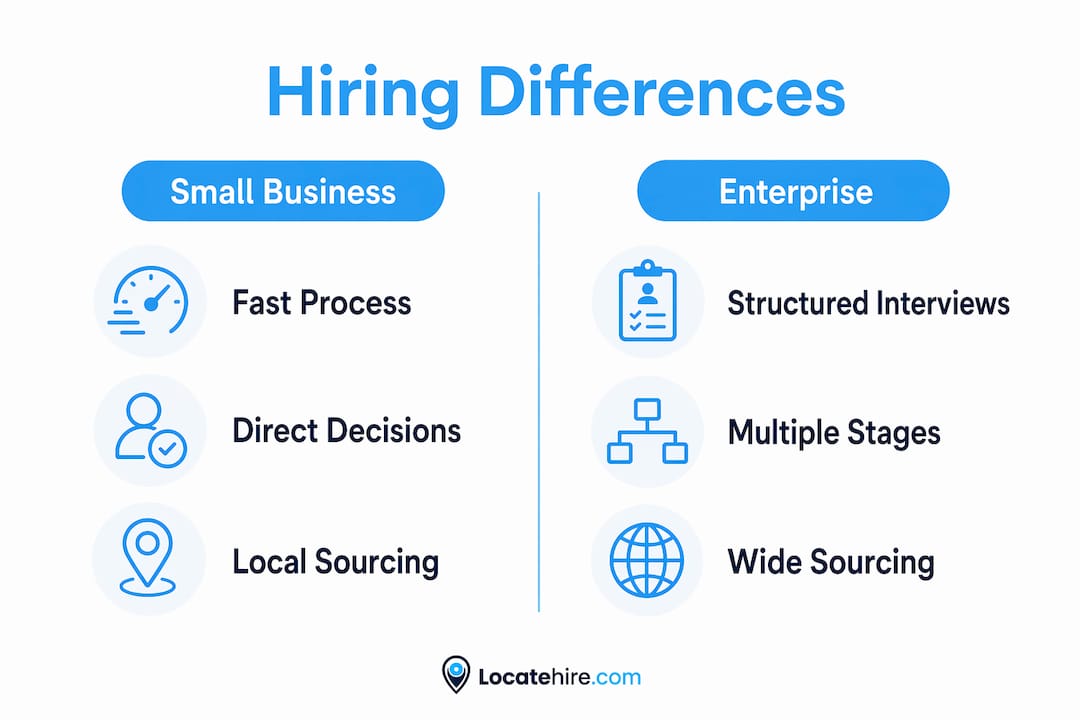
Small business hiring is defined by speed, direct decision-making, and lean processes, while enterprise hiring relies on multi-layered approvals, structured compliance, and dedicated HR departments. Understanding how small business hiring differs from enterprise recruiting is the difference between losing a qualified HVAC technician to a competitor and landing them before the week ends. Small businesses employ 62.3 million people, nearly 46% of all private sector workers, yet most operate without the HR infrastructure that Fortune 500 companies take for granted. The gap is real, but it cuts both ways. Small service businesses in pool care, janitorial, electrical, and plumbing have structural advantages that large enterprises simply cannot replicate.
How small business hiring differs from enterprise: speed and process complexity
The single biggest gap between small and enterprise hiring is time. Hiring teams now conduct 42% more interviews per hire than in 2021, with average time to hire increasing 24% to 41 days, driven largely by enterprise approval chains. That 41-day average is a ceiling for large companies and an opportunity for small ones.
Small businesses can move from application to offer in days, not weeks. A plumbing company owner can interview a candidate on Tuesday and extend an offer by Thursday. An enterprise doing the same hire routes the decision through a recruiter, a hiring manager, a department head, and sometimes an HR compliance review. Each layer adds days.

Speed matters more than most owners realize. 49% of job seekers expect to hear back within 3 days of applying, and candidates who go silent after that window are often already committed elsewhere. For service businesses with ongoing hiring needs, slow communication is not just frustrating. It is a direct cause of empty positions.
Key differences in process complexity between small businesses and enterprises:
- Decision authority: Small business owners make offers directly. Enterprise hiring requires sign-off from multiple stakeholders.
- Interview rounds: Small firms typically run one to two interviews. Enterprises average three to five stages.
- Compliance overhead: Large companies maintain dedicated legal and HR compliance teams that review every offer. Small businesses move without that friction.
- Onboarding speed: Small businesses can onboard a new technician in days. Enterprise onboarding programs often span two to four weeks.
Pro Tip: Set a 24-hour response rule for every application you receive. Candidates who hear back the same day are significantly more likely to stay engaged through the offer stage.
What structured interviewing looks like at the enterprise level, and how you can use it
Enterprise hiring practices are not just slower. They are also more consistent. Google's approach to structured interviewing defines four core components that drive better hiring outcomes: vetted role-relevant questions, standard scoring rubrics, trained interviewers, and a calibrated review process. The result is a hiring system that reduces gut-feel decisions and produces more predictable hires.
The practical payoff is significant. Structured interviews save 40 minutes per interview and reduce demographic disparities in hiring outcomes. For a small business owner who conducts every interview personally, that time savings adds up fast across a year of ongoing hiring.
Small businesses do not need to replicate the full enterprise system. They need the core of it. Here is how to apply structured interviewing without the bureaucracy:
- Write three to five role-specific questions before every interview. For a pool technician role, ask about chemical handling experience and how they have handled an unhappy customer on-site.
- Create a simple scoring guide. Rate each answer from one to four. This removes the "I liked them" bias that leads to bad hires.
- Use the same questions for every candidate in the same role. Consistency is what makes the comparison meaningful.
- Debrief immediately after the interview. Notes taken within an hour are far more accurate than impressions recalled a day later.
Structured interviewing is a practical way for small businesses to gain enterprise-level hiring fairness without adding headcount or process layers. You can build a hiring process around these principles in an afternoon and use it for every hire going forward.
How candidate sourcing and screening vary between small and large companies
Enterprise talent acquisition teams cast wide nets. They post on LinkedIn, Indeed, Glassdoor, and niche boards simultaneously, then use applicant tracking systems with AI filters to manage thousands of applications per role. Small service businesses recruit differently by necessity, focusing on hyper-local channels, referrals, and targeted job boards that reach trade workers rather than office professionals.
The sourcing gap is widening in 2026. 54% of small business leaders say AI-generated applications complicate hiring due to homogeneity and authenticity issues. When every resume looks polished and every cover letter sounds identical, screening becomes a verification problem rather than a selection problem. Enterprises have dedicated teams to handle this volume. Small businesses do not.
The table below shows how sourcing and screening approaches compare across business sizes:
| Factor | Small business | Enterprise |
|---|---|---|
| Primary sourcing channels | Local job boards, referrals, trade-specific platforms | LinkedIn, Indeed, Glassdoor, campus recruiting |
| Application volume | Low to moderate | High to very high |
| Screening method | Owner or manager review, phone screens | ATS filters, recruiter screens, skills assessments |
| AI application challenge | High impact, limited resources to verify | Managed by dedicated screening teams |
| Staffing partner use | Common for overflow hiring | Used for contract and specialized roles |
84% of small businesses report effectiveness from staffing partners when managing increased screening burdens. That number reflects a real shift: outsourcing the first screening pass to a staffing firm lets a janitorial company owner focus on final interviews rather than sorting through 60 applications to find three worth calling.
Pro Tip: Treat AI-generated resumes as a verification problem. Add one work-sample question to your application, such as "Describe the last piece of equipment you repaired and what the fix required." Generic AI responses will stand out immediately.
Tools like ZipRecruiter offer AI-assisted sourcing that can generate up to 8x more quality applicants while reducing cost per hire. For small businesses without a recruiter on staff, that kind of reach changes the math on sourcing entirely. You can also review applicant screening best practices to sharpen your process before volume picks up.
What advantages small businesses have in attracting and engaging talent
The conventional wisdom says enterprises win on compensation and benefits. The reality in 2026 is more complicated. 94% of small businesses offer hybrid work arrangements compared to 83% of large companies, and smaller firms approve those arrangements faster. For a candidate weighing two offers, the ability to get a flexible schedule confirmed in one conversation rather than waiting for an HR policy review is a real differentiator.
Small service businesses hold several structural advantages that enterprises cannot easily replicate:
- Direct leadership access: A new electrician at a small firm talks to the owner. At a large company, they report to a supervisor who reports to a regional manager. Candidates who want to grow quickly recognize the difference.
- Culture impact: One person joining a 12-person team changes the culture visibly. That sense of contribution matters to candidates who feel invisible at large organizations.
- Faster offer customization: Small business owners can adjust start dates, schedules, and compensation on the spot. Enterprise offers go through compensation bands and approval workflows.
- Mission clarity: A family-owned pool service company has a story. Candidates connect with that story in ways they rarely do with a corporate employer brand.
Hiring speed and constant candidate communication are more decisive than compensation for many candidates choosing between a small and enterprise offer. This means your follow-up cadence, your tone in the offer call, and the clarity of your onboarding plan carry more weight than you might expect. Reviewing your candidate pipeline management approach is a practical starting point for tightening that experience.
Key takeaways
Small businesses win on hiring speed and flexibility, but only when they pair those advantages with enough structure to evaluate candidates consistently.
| Point | Details |
|---|---|
| Speed is your primary advantage | Respond within 24 hours and move to offer within days to retain candidates before enterprises engage them. |
| Structured interviews reduce bad hires | Use role-specific questions and a simple scoring rubric to remove gut-feel bias without adding process layers. |
| AI applications require verification | Add work-sample questions to your screening process to distinguish authentic candidates from AI-generated submissions. |
| Small businesses lead on hybrid flexibility | 94% of small businesses offer hybrid arrangements vs. 83% of large companies, making flexibility a genuine recruiting edge. |
| Staffing partners offset screening burden | 84% of small businesses report effectiveness from staffing partners when application volume exceeds internal capacity. |
Where I'd put my money if I were hiring for a service business right now
Running a service business means you are hiring constantly. Pool routes expand in spring. Janitorial contracts add headcount overnight. HVAC season hits and you need certified technicians before your competitors poach the available pool. The hiring pressure is not occasional. It is structural.
Most of the advice aimed at small businesses borrows from enterprise playbooks and strips out the parts that require a full HR team. What gets left behind is usually the structure, and that is a mistake. I have seen small business owners conduct 20 interviews for a single role and still make a hire they regret, purely because every conversation was different and there was no consistent basis for comparison.
My honest recommendation is to take two things from the enterprise world and leave the rest. Take structured questions. Take a scoring rubric. Write them down before your next hire and use them for every candidate. That one change will improve your decision quality more than any sourcing tool or job board upgrade.
The second thing I would do is stop treating hiring speed and hiring quality as opposites. The fastest hires I have seen go wrong are the ones where speed replaced evaluation entirely. You can move fast and still ask the right questions. You can make an offer in 48 hours and still know why you made it. That combination is what separates the small businesses that build strong teams from the ones that cycle through the same roles every six months.
— Jeff
How Locatehire helps small service businesses hire smarter
Small service businesses do not need enterprise-grade complexity. They need tools built for the way they actually hire: fast, ongoing, and without a dedicated HR team managing the process.
Locatehire is an applicant tracking system built specifically for businesses like yours. Whether you run a pool service route, a janitorial operation, or an electrical contracting company, Locatehire handles candidate communication, application tracking, and AI-assisted sourcing in one place. You get the structure that improves hire quality without the overhead that slows enterprises down. If your hiring is ongoing and your time is limited, Locatehire is built for exactly that situation.
FAQ
How does hiring speed differ between small businesses and enterprises?
Small businesses can move from application to offer in two to five days. Enterprises average 41 days due to multi-stage approvals, compliance reviews, and layered interview processes.
What is structured interviewing and can small businesses use it?
Structured interviewing uses consistent, role-relevant questions and scoring rubrics for every candidate. Small businesses can apply the core method with three to five questions and a simple one-to-four rating scale, without any additional HR staff.
Why are AI-generated applications a bigger problem for small businesses?
Small businesses lack the dedicated screening teams that enterprises use to filter high application volumes. With 54% of small business leaders reporting that AI applications complicate hiring, work-sample questions are the most practical verification tool available.
Do small businesses really offer better flexibility than large companies?
Yes. 94% of small businesses offer hybrid arrangements compared to 83% of large companies, and small firms approve those arrangements faster because there is no policy approval chain to navigate.
What sourcing tools work best for small service businesses?
ZipRecruiter's AI-powered tools, local trade-specific job boards, and employee referral programs are the most effective channels for small service businesses. Staffing partners are a practical option when application volume exceeds what one manager can screen.