

Hiring the wrong person costs you more than just money. When you build a hiring process for your small business without a clear structure, you end up repeating the same painful cycle: post a job, interview whoever shows up, make a gut-call offer, watch them leave in 60 days. For service businesses like HVAC, plumbing, pool service, or janitorial companies, that cycle kills productivity and drains your margins. A structured approach fixes that. This guide walks you through every stage, from preparation to onboarding, so you stop hiring reactively and start building a team that sticks.
Table of Contents
- Key takeaways
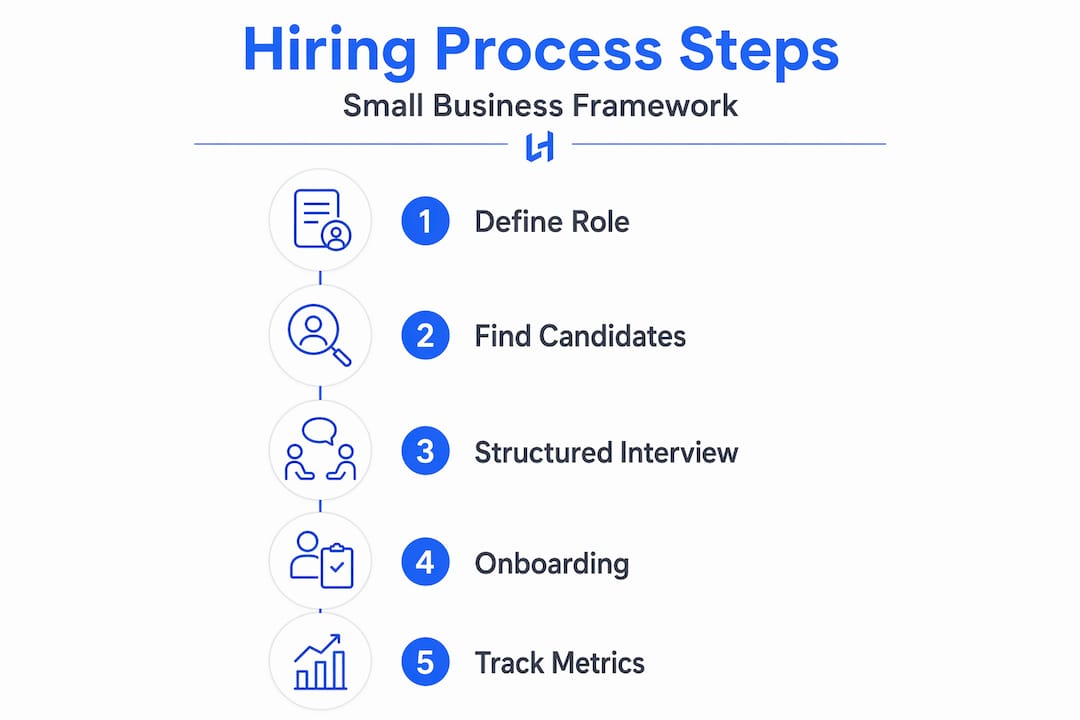
- How to build a hiring process for your small business
- Running an interview process that actually works
- Onboarding: the part most small businesses skip
- Tracking metrics and improving over time
- My honest take on small business hiring
- How Locatehire makes small business hiring easier
- FAQ
Key takeaways
| Point | Details |
|---|---|
| Prepare before you post | Define the role clearly and complete compliance steps before recruiting a single candidate. |
| Structure your interviews | Consistent questions and rating rubrics make hiring decisions more accurate and legally defensible. |
| Move fast on offers | Top candidates accept elsewhere fast. Extend offers within 24 to 48 hours of the final interview. |
| Onboard with a 90-day plan | Skipping onboarding pushes 20% of new hires out the door within 45 days. |
| Track what matters | Time-to-hire, cost-per-hire, and 90-day retention reveal where your process breaks down. |
How to build a hiring process for your small business
Before you post a single job listing, you need a foundation. Most small business owners skip this part and pay for it later with mismatched hires and wasted interviews.
Define the role before you write the job post
Start by writing down exactly what this person will do on their first day, their first week, and their first 90 days. Not a generic title. Specific tasks. For a pool service tech, that means chemical testing, equipment checks, customer communication, and route management. For a janitorial crew lead, it means supply inventory, team supervision, and client walkthroughs. When you know the job that precisely, writing a clear job description takes 20 minutes instead of two hours.
Job seekers decide to apply within 14 seconds of seeing a listing. If your post is vague or generic, you lose qualified candidates before they even read the requirements.
Compliance you cannot skip
Before your first hire, three things must be in place. You need an Employer Identification Number (EIN) from the IRS, state registration for payroll taxes, and workers' compensation coverage. Form I-9 is due by Day 3 of employment, and new hire state reports must be filed within 20 days. Skipping any of these creates legal exposure that no small business can afford.
| Preparation step | What it involves | Why it matters |
|---|---|---|
| EIN registration | Apply through IRS.gov | Required for payroll and tax filings |
| State registration | Register with your state labor agency | Enables legal payroll withholding |
| Workers' comp coverage | Purchase through a licensed carrier | Legally required in most states |
| Job description | Write role-specific tasks and requirements | Attracts the right candidates faster |
| Sourcing channels | Identify referral networks and job boards | Reduces time-to-fill and cost-per-hire |
Where to find candidates
57% of small businesses hire through referrals, and for good reason. Referred candidates show up faster, fit the culture better, and stay longer. Tell your current team you are hiring before you post anywhere else. Local trade schools, community colleges, and industry associations are also underused sources for service businesses.
Pro Tip: Set up a simple employee referral incentive. Even a $200 bonus paid at the 90-day mark costs far less than a bad hire and signals to your team that you value their input.
Running an interview process that actually works
The interview is where most small business hiring falls apart. Without structure, you end up comparing gut feelings instead of actual qualifications.

Why structured interviews outperform gut instinct
Structured interviews use consistent criteria and behaviorally anchored rating scales, which makes them significantly more predictive of job performance than unstructured conversations. They also reduce your legal exposure under EEOC standards because every candidate answers the same questions and gets scored the same way.
| Factor | Structured interview | Unstructured interview |
|---|---|---|
| Questions | Predetermined, role-specific | Varies by interviewer |
| Scoring | Numeric rubric per answer | Subjective impression |
| Legal defensibility | High | Low |
| Predictive validity | Significantly higher | Inconsistent |
| Candidate experience | Consistent and fair | Can feel random |
How to run a structured interview for your small business
Follow these steps to set up your interview process small business owners can repeat every time:
- Write five to seven role-specific questions before the first interview. Mix behavioral questions ("Tell me about a time you handled an unhappy customer on-site") with hypothetical ones ("If your truck breaks down mid-route, what do you do?").
- Create a simple scoring rubric. Rate each answer on a 1 to 4 scale with brief descriptions for each score. This takes about 30 minutes to build and saves hours of debate later.
- Keep the interview panel consistent. If two people are interviewing, both should be present for every candidate. Rotating interviewers makes comparison impossible.
- Take notes during the interview, not after. Memory fades fast, and your notes become your legal record if a hiring decision is ever challenged.
- Extend your offer within 24 to 48 hours of the final interview. Top candidates in skilled trades and service roles are often talking to multiple employers at once.
Shifting from vacancy-driven hiring to a pipeline built on structured interviews improves both the quality of hires and long-term retention. That shift starts with these five steps.
Pro Tip: Ask every finalist the same closing question: "What would make you turn down this offer?" The answers reveal compensation gaps, schedule concerns, or culture mismatches you can address before losing the candidate.
Onboarding: the part most small businesses skip
You spent weeks finding the right person. Now is not the time to hand them a uniform and wish them luck.
20% of new hires leave within 45 days when onboarding is skipped, and a failed hire costs between $15,000 and $50,000 when you factor in recruiting, training, and lost productivity. For a 10-person service company, one bad retention outcome can set you back months.
The 90-day onboarding framework
A solid onboarding plan does not require an HR department. It requires a schedule and follow-through. The 90-day onboarding bridge includes four phases:
- Pre-boarding (before Day 1): Send paperwork digitally, confirm the start date, and assign a buddy or mentor. New hires who feel welcomed before they walk in are far less likely to ghost.
- Days 1 to 30 (orientation and basics): Cover safety protocols, introduce the team, walk through tools and equipment, and explain how success is measured in the role.
- Days 31 to 60 (role training and independence): Reduce supervision gradually. Let the new hire handle tasks solo with check-ins every Friday.
- Days 61 to 90 (culture and performance feedback): Have a formal 90-day review. Ask what is working, what is not, and what support they need. This conversation alone prevents most early exits.
Pro Tip: Schedule the 30, 60, and 90-day check-ins on the employee's calendar during their first week. When these meetings are already on the books, they actually happen.
Measure onboarding success with two numbers: 90-day retention rate and time to full productivity. If either number is poor, look at your onboarding plan before blaming the hire.
Tracking metrics and improving over time
A hiring process you never measure is a hiring process you cannot fix.
Tracking time-to-hire, cost-per-hire, and 90-day retention reveals exactly where your recruitment funnel breaks down. Time-to-hire tells you if your sourcing or interview stages are too slow. Cost-per-hire shows whether referrals or job boards are delivering better value. Ninety-day retention is your ultimate quality check on both hiring and onboarding.
Key metrics to watch
| Metric | What it measures | Target range |
|---|---|---|
| Time-to-hire | Days from job post to accepted offer | 14 to 28 days |
| Cost-per-hire | Total recruiting spend per filled role | Varies by role and industry |
| 90-day retention | % of new hires still employed at 90 days | 85% or higher |
| Referral hire rate | % of hires sourced through employee referrals | 40 to 50% with a formal program |
The typical hiring process for a small business runs 14 to 28 days from posting to offer, with founders investing 15 to 25 hours per hire. The total first-year cost of a hire lands at roughly 112 to 125% of base salary when you include recruiting, training, and ramp time. Knowing those numbers changes how seriously you take process improvement.
Building a talent pipeline
Reactive hiring, where you post only when someone quits, keeps you permanently behind. A talent pipeline means you are always lightly recruiting. Keep a short list of people who interviewed well but were not hired. Stay connected with local trade schools. Let your referral program run year-round, not just when you have an opening.
Structured employee referral programs can increase referral hires from 10% to 40 to 50% of total hires and cut acquisition costs by 50 to 70%. For service businesses with ongoing hiring needs, that math is hard to ignore.
Small businesses can also compete on dimensions that large corporations cannot match. Candidates value meaningful responsibilities and the ability to see their direct impact on the business, often more than a higher salary. Lead with that in your job posts and interviews.
My honest take on small business hiring
I've spent a lot of time watching small business owners in service industries hire the same way over and over, expecting different results. The pattern is predictable. Someone quits, panic sets in, the first warm body who interviews gets the job, and three months later you're back to square one.
What I've learned is that the biggest mistake isn't the hiring decision itself. It's the absence of any structure around it. When you have no rubric, no defined questions, and no onboarding plan, you're not really hiring. You're guessing. And guessing at $15,000 to $50,000 a miss adds up fast.
I've also seen owners obsess over salary when candidates care more about whether they'll be treated with respect, given real responsibility, and shown a path forward. A plumbing tech who feels like a valued part of the team will stay longer than one who got a $2 higher hourly rate but never hears from the owner.
The mindset shift that actually works is thinking about talent architecture instead of just filling seats. That means building a referral culture, keeping your interview process consistent, and treating onboarding as the start of a long-term relationship. The businesses I've seen get this right don't scramble every time someone leaves. They have a process that runs.
— Jeff
How Locatehire makes small business hiring easier
Building a structured hiring process takes time to set up, but you don't have to manage it all manually.
Locatehire is an applicant tracking system built specifically for small businesses with ongoing hiring needs, including pool service, HVAC, plumbing, electrical, janitorial, and retail. It gives you a repeatable system for posting jobs, tracking candidates, and moving people through your hiring stages without losing anyone in a spreadsheet or email thread. If you're ready to stop reinventing your process every time you hire, see how Locatehire works and get your hiring running like a system instead of a scramble.
FAQ
How long does it take to build a hiring process?
Most small business owners can build a functional hiring process in one to two weeks. The core steps include writing job descriptions, setting up compliance requirements, creating interview questions, and drafting an onboarding plan.
What is the biggest mistake in small business recruitment?
Skipping structured interviews and onboarding are the two most costly mistakes. Unstructured interviews lead to poor hiring decisions, and missing onboarding causes 20% of new hires to leave within 45 days.
How do small businesses compete for skilled workers?
Small businesses compete effectively by emphasizing flexible schedules, meaningful work, direct access to leadership, and clear growth paths. Candidates often value these factors as much as or more than salary alone.
What metrics should I track to optimize my hiring process?
Track time-to-hire, cost-per-hire, and 90-day retention. These three numbers tell you whether your sourcing, interview process, and onboarding are working or where they need adjustment.
When should I extend a job offer after an interview?
Extend offers within 24 to 48 hours of the final interview. Waiting longer risks losing top candidates to competitors, especially in skilled trades where demand for qualified workers is high.