

Most small business owners think candidate experience only affects the people they actually hire. That misunderstanding is expensive. Why candidate experience matters goes far beyond your final selection. Every applicant who contacts your company forms an opinion about your brand, tells their network what it was like, and decides whether to refer others or return when a better role opens up. For businesses with ongoing hiring needs in fields like HVAC, pool service, janitorial work, retail, and plumbing, those opinions accumulate fast and shape your ability to attract anyone at all.
Table of Contents
- Key Takeaways
- Why candidate experience matters more than you think
- The real benefits of a strong candidate experience
- Common pitfalls small businesses keep running into
- Best practices that actually work for small businesses
- How better candidate experience changes your whole recruiting funnel
- What I've actually seen working with small businesses on hiring
- How Locatehire helps small businesses improve candidate experience
- FAQ
Key Takeaways
| Point | Details |
|---|---|
| Experience affects non-hires too | Rejected candidates with positive experiences still refer others and consider reapplying later. |
| Communication speed is a differentiator | Candidates who wait more than one week without updates assume they've been ghosted. |
| Simpler applications fill faster | Nearly 6 in 10 candidates abandon long or confusing applications before finishing. |
| Satisfaction drives offer acceptance | Candidates satisfied with the process are 38% more likely to accept your offer. |
| Consistency beats perfection | Process inconsistency, not any single bad moment, is what makes companies look disorganized to applicants. |
Why candidate experience matters more than you think
The formal industry term for what most people call "candidate experience" is applicant experience. In practice, HR professionals use both interchangeably, but the concept covers every single interaction a person has with your company from the moment they see a job posting to the moment they start work or receive a rejection notice. According to IBM, that includes all touchpoints, not just the hiring decision itself.
For small businesses, this scope creates a specific challenge and a specific opportunity. You are not recruiting from an unlimited national pool. You are often hiring from the same neighborhoods, the same trade schools, and the same social networks over and over. That means every person who applies to your pool service company or electrical contracting business is either a future employee, a future referral source, or someone who tells their friends to avoid applying altogether.
The importance of candidate experience shows up in three direct ways for small employers:
- Employer brand reputation. Word travels fast in skilled trades and service industries. A dispatcher who had a bad interview experience at your HVAC company will tell every technician she knows.
- Talent pipeline health. Rejected candidates who felt respected are more likely to reapply when their situation changes, keeping your future pipeline fuller without extra recruiting spend.
- New hire retention. When candidates understand the role, the culture, and the expectations before they start, the reality of the job matches what they signed up for. That alignment reduces early turnover dramatically.
The real benefits of a strong candidate experience
Improving how candidates feel during your hiring process produces measurable returns, not just goodwill. Here is what the data actually shows.
| Benefit | Impact |
|---|---|
| Higher offer acceptance | Candidates satisfied with the process are 38% more likely to accept your offer |
| Better referrals | Providing specific feedback increases candidate willingness to refer others by 69% |
| Lower recruiting costs | Well-organized processes reduce time-to-fill and cut overall hiring costs |
| Stronger talent pipeline | Positive experiences keep rejected candidates willing to reapply in future hiring cycles |
The offer acceptance rate impact deserves attention. When you are hiring a plumber or a retail shift lead and they have two offers in front of them, your process itself becomes part of the pitch. A slow, confusing application signals a disorganized workplace. A fast, respectful process signals a company worth joining.
The referral stat is equally striking. When you give a candidate specific, honest feedback after they do not get the job, their willingness to send friends your way jumps by 69%. For service businesses that run lean and cannot afford expensive job boards month after month, that kind of organic referral activity is free recruiting.
Pro Tip: Send a brief, personalized rejection message within five business days of your decision. It takes less than two minutes and converts a disappointed candidate into a potential advocate.
Common pitfalls small businesses keep running into
Most candidate experience problems in small businesses are not caused by bad intentions. They are caused by inconsistent processes and no one owning the communication timeline. Understanding how candidate experience affects hiring means recognizing where the process breaks down.

Nearly 6 in 10 candidates abandon applications they find too long or confusing. That number should stop every business owner in their tracks. You can spend money on job board postings and get solid interest, then lose more than half your applicants before they ever finish applying. The culprit is almost always an application form that asks for redundant information or requires too many steps on mobile.
Silence after interviews is the other major problem. 34% of candidates believe they have been ghosted after just one week without contact. In the context of small businesses, this is not malicious. The owner is on a job site. The office manager is handling payroll. Nobody sent the follow-up email. But the candidate's experience is the same regardless of the reason.
Process inconsistency, not any single bad moment, is what actually makes organizations look disorganized and unfair to applicants. One candidate gets a call the next day. Another waits two weeks. There is no written timeline, no standard questions, no template messages. That inconsistency signals to applicants that the company itself might be just as unpredictable to work for.
Here is where to start fixing it:
- Set a written timeline. Tell every candidate at the end of their interview exactly when they will hear back and by what method.
- Use templated status messages. You do not need to personalize every update. A short, clear email saying "We are still reviewing candidates and will be in touch by Friday" is enough to prevent candidates from assuming the worst.
- Assign one person to own candidate communication. Even if that person is you, put it on your calendar like a task.
Pro Tip: Building a structured hiring process before your next busy hiring season reduces the chaos that causes communication gaps in the first place.
Best practices that actually work for small businesses
Candidate experience best practices do not require a dedicated HR department. They require discipline and a repeatable system.
- Shorten the application. Ask only for what you need to screen the candidate for that specific role. Name, contact info, relevant experience, and one or two qualifying questions. That is usually enough. SHRM recommends simplifying application processes and providing timely feedback as the two highest-impact improvements any employer can make.
- Confirm receipt immediately. An automated confirmation message takes seconds to set up and tells candidates their application was received. Silence at this stage already creates doubt.
- Set stage-specific timelines. Tell candidates what happens next at every step. After the phone screen: "We will schedule in-person interviews within three business days." After the interview: "You will hear from us by end of day Thursday."
- Train interviewers. This matters more than most small business owners realize. An inconsistent or unprepared interviewer sends a message that the company does not take hiring seriously. A one-page structured interview guide with consistent questions takes thirty minutes to create and improves fairness immediately.
- Ask for feedback. A two-question survey sent to all applicants after the process closes tells you exactly where the experience breaks down. Most candidates will answer honestly when they feel the request is genuine.
Here is a quick comparison of what low-effort versus structured candidate experience looks like in practice:
| Experience element | Unstructured approach | Structured approach |
|---|---|---|
| Application length | Full resume upload plus lengthy form | Short form with 2 to 3 qualifying questions |
| Interview consistency | Casual conversation, varies by interviewer | Written question guide used by all interviewers |
| Post-interview communication | Whenever someone remembers | Templated email within 48 hours |
| Rejection notification | Often never sent | Brief, respectful message within five business days |
Affordable applicant tracking tools make the structured column achievable without hiring an HR coordinator. Locatehire covers types of recruitment software built specifically for small business budgets and hiring volumes.
How better candidate experience changes your whole recruiting funnel
The benefits of improving candidate experience are not limited to the final hiring decision. They compound across every stage of your recruitment funnel.
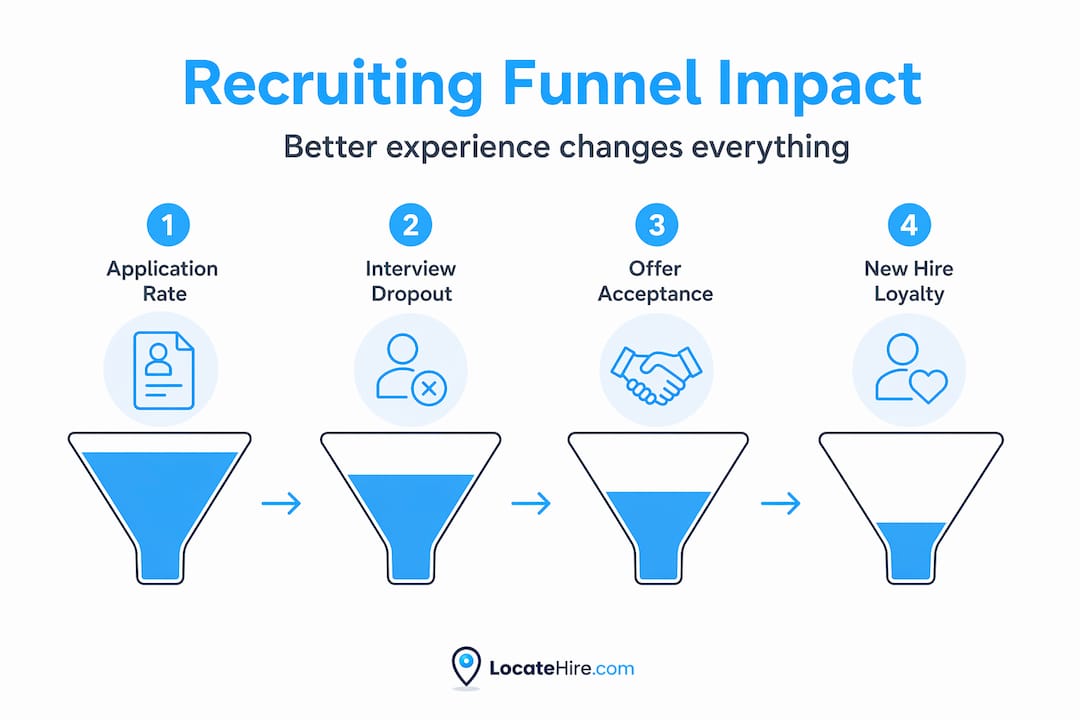
At the top of the funnel, a strong employer reputation built through positive candidate experiences increases your application volume without increasing your ad spend. Candidates seek out companies they have heard good things about.
In the middle of the funnel, clear communication and a respectful process reduce dropout. Candidates who feel ignored between the phone screen and the in-person interview accept competing offers or simply disengage. Consistent updates keep them warm and reduce the chance that your best candidate accepts another offer before you get to them.
At the bottom of the funnel, aligned expectations produced by a transparent process mean your new hires show up on day one knowing what the job actually involves. That alignment is one of the strongest predictors of 90-day retention.
Here are the metrics worth tracking if you want to measure candidate experience satisfaction over time:
| Metric | What it tells you |
|---|---|
| Application completion rate | Whether your application form is too long or confusing |
| Offer acceptance rate | Whether candidates value the overall experience enough to say yes |
| Time-to-fill | Whether your process moves fast enough to compete for in-demand candidates |
| Candidate survey scores | Direct feedback on communication, clarity, and fairness at each stage |
Even tracking just two of these consistently will tell you more than most small businesses currently know about where they are losing candidates.
What I've actually seen working with small businesses on hiring
I have watched small businesses lose good candidates to larger companies not because of pay, not because of benefits, but because the hiring process itself communicated chaos. A janitorial contractor loses an experienced crew lead to a competitor paying the same hourly rate. Why? The competitor called back within 24 hours. The janitorial contractor took nine days and never sent a confirmation that the application was received.
Most small business owners underestimate how much the hiring process signals what working there will be like. Candidates are reading everything. The speed of your response. Whether your job description is clear. Whether the interviewer showed up on time. Whether you sent a follow-up. These signals matter more than owners realize.
Here is my honest take: you do not need to build a perfect process. You need a consistent one. I have seen businesses with one-page interview guides and a single templated email sequence outperform much larger companies in offer acceptance rates simply because candidates felt respected and informed at every step.
Treating rejected candidates well is the one investment almost no small business makes, and it pays off more than any other single change. A pool service company that sends a thoughtful rejection to a candidate who did not quite have the right certification will often get that same person back six months later after they got certified. They remembered how they were treated.
Consistent, respectful communication is not a soft skill. It is a recruiting strategy.
— Jeff
How Locatehire helps small businesses improve candidate experience
Running a pool service, HVAC, or retail operation means hiring is never really finished. You need a system that keeps communication consistent without adding hours to your week.
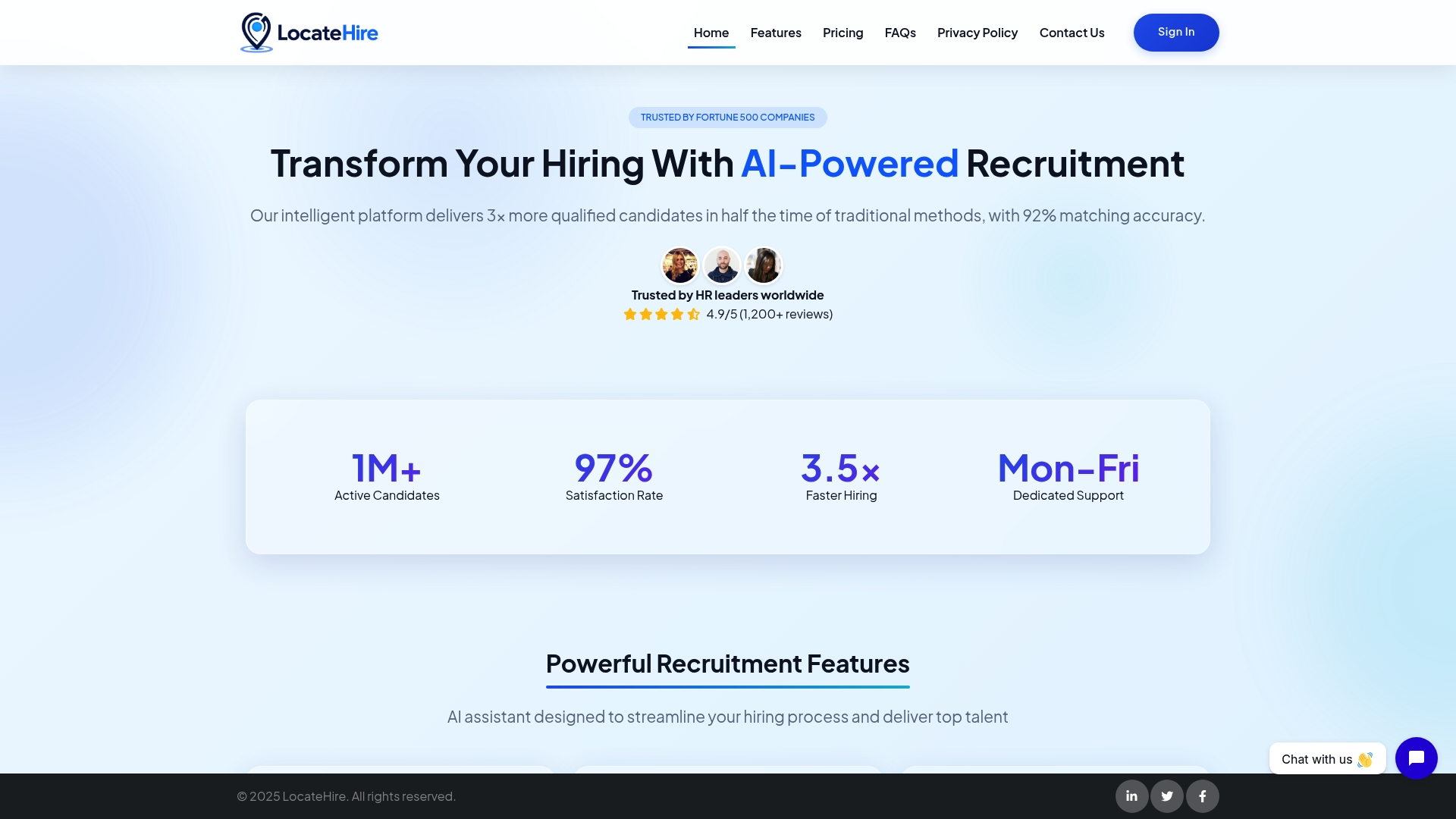
Locatehire is an AI-powered recruitment platform built specifically for small businesses with ongoing hiring needs. It automates confirmation messages, sends status updates at every stage, and keeps your pipeline organized so candidates never fall through the cracks. No more forgotten follow-ups. No more candidates wondering what happened to their application. You can also check out the Locatehire blog for practical guidance on speeding up your hiring process without sacrificing the quality of your candidate interactions.
FAQ
Why does candidate experience matter beyond those who get hired?
Every applicant forms an opinion about your company and shares it with their network. Rejected candidates who had a positive experience are more likely to reapply later and refer qualified people they know.
How does candidate experience affect offer acceptance rates?
Candidates satisfied with the application and interview process are 38% more likely to accept your job offer, making the experience itself a competitive advantage when salary alone cannot close the deal.
What is the biggest candidate experience mistake small businesses make?
Inconsistent communication is the top offender. When candidates do not receive timely updates, many assume after just one week that they have been ghosted, which damages both the hire rate and your employer reputation.
How can a small business measure candidate experience satisfaction?
Track your application completion rate, offer acceptance rate, time-to-fill, and post-process candidate surveys. Even two of these metrics tracked consistently will reveal where your process loses candidates.
What is the fastest improvement a small business can make to candidate experience?
Set a written communication timeline and stick to it. Telling every candidate exactly when they will hear back and by what method eliminates most of the uncertainty that drives negative candidate sentiment.