

Slow hiring costs you more than just time. When a position at your pool service, HVAC company, or retail shop sits open for weeks, you're losing productivity, burning out your existing team, and watching good candidates accept offers from competitors who moved faster. The good news is that the best ways to speed up hiring process don't require you to lower your standards or buy expensive software. They require you to fix the process itself. This article breaks down exactly what to change, stage by stage, so you can hire faster without hiring wrong.
Table of Contents
- Key Takeaways
- 1. Ways to speed up hiring process: audit your timeline first
- 2. Build structured interviews that move fast
- 3. Use technology that solves one problem at a time
- 4. Keep candidates warm throughout the process
- 5. Build a reusable talent pipeline
- 6. Standardize your offer and onboarding intake
- 7. Treat quick recruitment as an ongoing discipline
- My take on what actually moves the needle
- How Locatehire helps you hire faster without the complexity
- FAQ
Key Takeaways
| Point | Details |
|---|---|
| Audit your hiring stages first | Map where delays actually happen before changing anything, so you fix the right problems. |
| Structured interviews save time | Consistent questions and scoring rubrics make decisions faster and predictions more accurate. |
| 24-hour feedback SLAs cut delays | Setting firm feedback deadlines reduces idle time by 3 to 7 days per hire. |
| Pre-approve salary bands | Having offer ranges ready in advance removes approval bottlenecks that stretch hiring by up to 10 days. |
| Technology should simplify, not complicate | Choose tools that consolidate your workflow rather than add more steps to manage. |
1. Ways to speed up hiring process: audit your timeline first
Before you change anything, you need to know where time is actually disappearing. Most small business owners assume the problem is in sourcing candidates. Usually, it is not. Multiple small delays compound across every stage, and the gap between final interview and decision is often the worst offender.
Pull your last five to ten hires and map out how long each stage took:
- Time from posting to first application review
- Time from application to first contact
- Time from first contact to interview scheduled
- Time from interview to internal feedback collected
- Time from feedback to offer sent
Once you see it laid out, the bottlenecks become obvious. If screening takes two days but feedback takes eight, that is where you start.
Set hard time limits per stage. Not suggestions. Actual deadlines. A simple rule like "all applications reviewed within 48 hours, all interviews scheduled within three business days" gives your hiring process a spine. Without those limits, urgency evaporates.

Also take a hard look at your job requirements. If you list 12 qualifications for a service technician role and only three are genuinely required to do the job, you will screen out good candidates and slow yourself down chasing a perfect profile that does not exist. Define your must-haves and move everyone who meets them forward quickly.
Pro Tip: Involve your decision-makers in the audit. If the owner, supervisor, or department lead is not aligned on the timeline from the start, approvals will stall regardless of how well the rest of the process runs.
2. Build structured interviews that move fast
Unstructured interviews feel natural but waste enormous amounts of time. You end up in long conversations that go off-track, and then your interviewers cannot agree on who to hire because everyone asked different questions and formed different impressions. Structured interviews predict job performance twice as well as unstructured ones, and they take about 50 minutes to set up initially.
Here is how to set one up quickly:
- Identify three to five core competencies the role actually requires (reliability, technical skill, customer communication, etc.)
- Write two to three questions per competency
- Create a simple 1 to 5 scoring guide for each answer so interviewers know what a strong answer looks like
- Use the same format for every candidate
Beyond the structure itself, you need to limit your interview rounds. Two rounds is enough for almost every hourly and skilled trade role. Three rounds maximum for anything more senior. Every additional round adds days to your timeline and increases the chance a strong candidate drops out.
Set a 24-hour feedback rule. Every interviewer submits their scorecard within 24 hours of the interview. No exceptions. This single SLA cuts delays by three to seven days on average. Pair it with a calendar reminder or an automated nudge so people actually follow through.
Pro Tip: Designate a single person as the final decision-maker per role before the process starts. When everyone thinks someone else will make the call, nobody does. Clear decision rights are the fastest fix most small businesses never use.
Here is a quick comparison of structured versus unstructured interview approaches:
| Factor | Unstructured | Structured |
|---|---|---|
| Predictive accuracy | Low | High |
| Time to decision | 5 to 10 days | 1 to 3 days |
| Consistency across candidates | None | High |
| Interviewer prep time | Minimal | 50 minutes (one-time) |
| Risk of bias | High | Reduced |
Shared scorecards with anchored rubrics convert subjective impressions into comparable scores, which means your team spends less time debating and more time moving forward.
3. Use technology that solves one problem at a time
Technology can absolutely help you accelerate the hiring process. It can also turn into a time sink if you adopt tools that require heavy configuration, training, or maintenance. The rule for small businesses is simple: pick tools that remove a step, not tools that add a layer.
Here is where technology delivers the most impact at small scale:
- Centralized candidate tracking. When applicants live in your email inbox, on a sticky note, and in a spreadsheet, you lose people. A basic applicant tracking system (ATS) keeps everyone in one place and prevents candidates from falling through the cracks.
- Automated scheduling. Automated scheduling runs 26% faster than manual coordination, and the time savings compound when you have multiple interviewers to coordinate.
- Communication templates. Pre-written messages for application confirmation, interview invitations, and status updates eliminate the time you spend writing the same email fifteen times a week.
- AI-assisted screening. AI screening tools improve speed and candidate engagement when you keep a human in the review loop for final calls. They work well for filtering out clearly unqualified applications quickly.
Pro Tip: Do not adopt three new tools at once. Pick the one that addresses your biggest bottleneck, use it for 30 days, and then evaluate. Tool sprawl is a real problem for small business hiring teams.
The best fit for most small service businesses is an all-in-one platform that handles tracking, communication, and scheduling without requiring a dedicated HR team to manage it. Process design fundamentals like clear roles and SLAs drive speed gains more than any single tool. Technology supports a good process. It cannot replace one.
4. Keep candidates warm throughout the process
Speed on your end means nothing if candidates disappear because they felt ignored. When you compress your timeline, communication becomes even more critical. A candidate who does not hear from you for four days after an interview will likely accept another offer. And they should.
Transparent communication across multiple channels builds trust and reduces the anxiety that causes candidates to drop out. Here is what that looks like in practice:
- Send a confirmation message within one hour of receiving an application
- Give candidates a specific timeline at every touchpoint ("We will be in touch by Thursday")
- Use text and email together, not just one channel. Texts get read faster for time-sensitive updates
- If you need more time, say so. A quick message saying "We are still reviewing and will have an update by Monday" keeps candidates from going dark
On the offer side, pre-approving salary ranges and giving your hiring manager authority to extend offers within that band can reduce approval time by four to ten days. That is not a small improvement. That is the difference between landing the candidate and losing them.
Run your reference checks in parallel with the final interview rather than waiting until after you decide. Parallelizing reference checks removes an unnecessary waiting period without cutting corners on verification. By the time you are ready to make an offer, your references are already done.
5. Build a reusable talent pipeline
Most small businesses hire reactively. Someone quits on Friday and the job gets posted Monday. That reactive cycle adds two to three weeks to every hire before you even start the process. Building a simple pipeline eliminates that cold-start problem.
You do not need a complex system to do this. Keep a short list of candidates from previous searches who were strong but not selected. Stay connected with past applicants who impressed you. For roles you hire repeatedly, like HVAC technicians, cleaning staff, or retail associates, keep your job posting live at a low-cost or free level year-round so applications come in continuously.
When you do need to hire, you already have a bench. Instead of starting from zero, you start from a pool of people who already expressed interest and have already been screened at a basic level. That shift alone can cut two weeks off your time-to-fill.
Pro Tip: Tag candidates in your ATS by role type and skill set so you can search your existing pool first before posting externally. Many efficient hiring strategies start with people you have already met.
6. Standardize your offer and onboarding intake
The offer stage is where many small businesses lose candidates they worked hard to find. The hiring decision gets made quickly, but then the offer letter takes three days, the background check form goes to the wrong email, and first-day logistics never get communicated clearly. The candidate starts doubting whether the company is organized enough to work for.
Standardize everything that happens after "yes." Create an offer letter template that only requires you to fill in the name, role, start date, and compensation. Set up a one-page onboarding checklist that goes out the moment the offer is accepted. Decide in advance who handles which step so nothing sits waiting for someone to figure out ownership.
Fast onboarding communication also affects retention. A new hire who knows exactly what to expect on day one shows up prepared and confident. That confidence translates into faster ramp-up and lower early turnover, which means you hire less frequently over time.
7. Treat quick recruitment as an ongoing discipline
The biggest mistake small business owners make is treating fast hiring as a one-time project. They fix the process when they are desperate to fill a role, then let it drift back to chaos when the urgency passes. Small businesses benefit most from simple, reusable frameworks they actually maintain.
Schedule a 30-minute review after every hire. Ask two questions: where did we lose time, and what would we do differently? That review does not need to be formal. It can be a notes file or a quick conversation with your supervisor. Over six months, those reviews will surface patterns you can permanently eliminate.
Track your time-to-hire as a number, not a feeling. If you do not measure it, you will not improve it. Even a basic spreadsheet tracking the date posted, the date hired, and the stage where the most time was lost gives you enough data to make real decisions.
My take on what actually moves the needle
I have seen a lot of small business owners go straight to technology when they want to hire faster. They sign up for a new platform, spend two weeks setting it up, and wonder why nothing changed. Here is what I have actually found: the fastest improvements come from fixing who decides and when.
In my experience, the single most common cause of slow hiring in small businesses is not a lack of tools. It is a lack of clarity about who has final say and when that decision has to happen. When two people both think the other one is deciding, nothing moves. When the owner has to approve every offer but is on job sites all week, offers sit unsigned for days.
Enforcing decision rights and setting feedback SLAs will do more for your hiring speed than any software purchase. I have watched companies cut their time-to-hire in half just by assigning a named decision-maker per role and adding a 48-hour feedback deadline. No new tools. Just a rule and accountability.
That said, I am not against technology. I am against using technology as a substitute for fixing the underlying process. Get your process right first. Then find tools that support it, not tools that force you to work around them.
The other thing I will say is this: speed and quality are not opposites. A disciplined, fast process produces better hires than a slow, chaotic one. When you move quickly with clear criteria and structured feedback, you make sharper decisions, not rushed ones.
— Jeff
How Locatehire helps you hire faster without the complexity
If you are running a pool service route, a janitorial crew, or an HVAC operation, you need to fill roles quickly and keep them filled. Locatehire is built specifically for small business hiring needs like yours, with tools that handle candidate tracking, interview scheduling, and team collaboration in one place without requiring a dedicated recruiter to manage it.
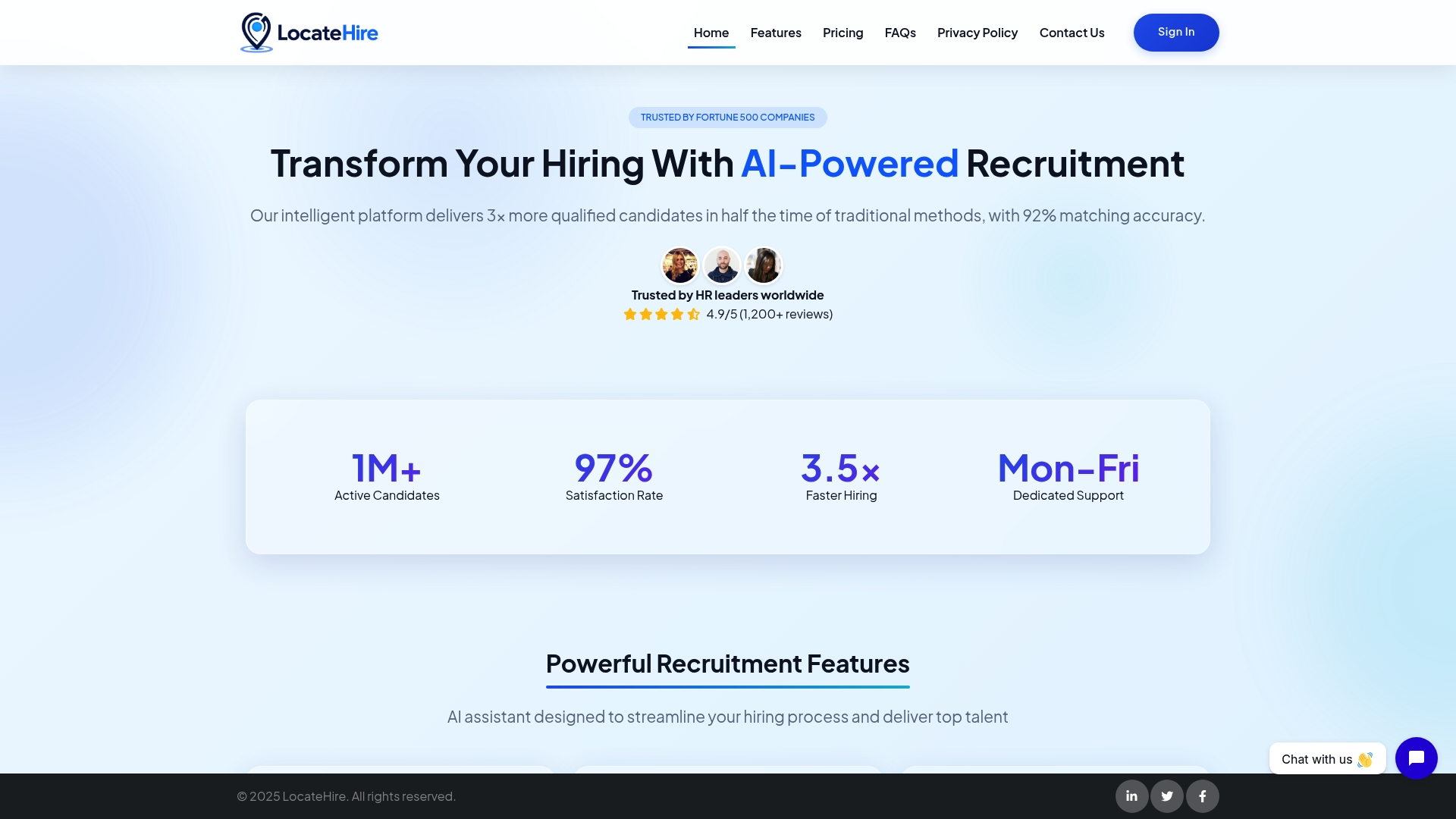
Locatehire keeps all your applicants organized, automates your follow-up messages, and gives your team a shared scorecard so decisions happen faster. No complex setup. No feature overload. Just a cleaner hiring process that gets you from application to offer in less time, with less back-and-forth. If you are ready to stop losing candidates to delays you could have prevented, Locatehire is worth a look.
FAQ
How long should the hiring process take for a small business?
For most hourly and skilled trade roles, a well-run hiring process should take seven to fourteen days from posting to offer. The key is setting time limits at each stage and sticking to them.
What is the fastest way to reduce time-to-hire?
Setting a 24-hour feedback deadline for interviewers and pre-approving salary bands before the process starts are the two changes that cut the most time with the least effort.
Do I need an ATS to speed up hiring?
Not necessarily. A basic applicant tracking system helps keep candidates organized and prevents people from slipping through the cracks, but process improvements like structured interviews and clear decision rights matter more than the tools you use.
How do I keep candidates from dropping out during a fast process?
Send a confirmation within one hour of receiving an application, give candidates a specific follow-up date at every stage, and use both text and email so your messages get read quickly. Candidate communication best practices show that transparency reduces dropout significantly.
Should I use AI to screen resumes as a small business?
AI screening can help when you are handling a high volume of applications for the same role repeatedly, which is common in service businesses. Keep a human in the loop for any final review, and make sure the tool is simple enough that it does not require constant configuration to run correctly.