

Writing a job description sounds simple until you're staring at a blank page trying to explain a role that you've never formally defined. For small business owners in industries like HVAC, pool service, janitorial, or retail, this challenge is real. The wrong words attract the wrong people, or nobody at all. This article gives you concrete examples of effective job descriptions across common roles, a comparison of the best formats to use, and practical tips to help you hire faster and smarter without needing an HR department to do it.
Table of Contents
- Key takeaways
- 1. What makes a great job description for small businesses
- 2. Job description examples for common small business roles
- 3. Comparison of job description formats and templates
- 4. Common mistakes that kill your job postings
- My honest take on job descriptions after years of watching small businesses hire
- How Locatehire helps you write and post better job descriptions
- FAQ
Key takeaways
| Point | Details |
|---|---|
| Clarity drives better applicants | A focused job title and concise summary filter in qualified candidates before they even apply. |
| Inclusive language expands your pool | Gender-neutral job descriptions attract up to 42% more responses than biased postings. |
| Outcomes beat task lists | Describing what success looks like in 90 days is more useful than listing 15 daily duties. |
| Format matters by role type | High-volume roles need shorter posts; technical or specialized roles need more structure and detail. |
| Avoid common pitfalls | Long must-have lists, vague language, and missing reporting structure all reduce application quality. |
1. What makes a great job description for small businesses
Before you look at any job description examples, you need a framework. Without one, you'll borrow the wrong things from templates and wonder why applicants still don't fit.
Job title and summary. Your title should match what candidates actually search for. "Field Technician" works better than "Service Hero" if you want people to find your posting. The position summary should explain why the role exists and how it contributes to your business. Two to four sentences is enough.

Behavior-based requirements. Instead of "must be a team player," write "coordinates daily with dispatch to manage service routes." Specific behaviors are easier to screen for and reduce the guesswork in interviews. They also signal to candidates what the job actually looks and feels like.
Measurable responsibilities. List five to eight core duties, each tied to a visible outcome. "Completes 6 to 8 residential service calls per day" tells a candidate far more than "performs service work." Aligning responsibilities to outcomes also helps you write better interview questions later.
Reporting structure. Specifying who the role reports to prevents confusion, especially in small businesses where everyone wears multiple hats. One line is all it takes: "Reports to the Operations Manager."
Qualifications. Separate must-haves from nice-to-haves. If a driver's license is required, say so. If two years of experience is preferred but not required, say that too. Keeping this section lean invites more qualified people to apply.
Pro Tip: Review your job descriptions every six months. Roles evolve, especially in growing small businesses, and an outdated posting will attract candidates who don't match where you are today.
2. Job description examples for common small business roles
These are not full postings. They are structured snapshots you can expand and adapt. Each one includes a summary, key responsibilities, and qualifications.
Customer Service Representative (Retail or Service Business)
Summary: You'll be the first voice our customers hear. This role handles inbound calls, schedules service appointments, and resolves basic billing questions for a growing pool service company.
Key responsibilities:
- Answers 40 to 60 inbound calls daily and logs all interactions in our CRM
- Schedules and confirms service appointments within a two-hour window
- Resolves billing questions by coordinating with the billing team within 24 hours
Qualifications: High school diploma or equivalent; one year of customer-facing experience; comfort with basic scheduling software.
Administrative Assistant (HVAC or Plumbing Company)
Summary: You'll keep the office running while our technicians focus on the field. This role manages scheduling, vendor communication, and basic bookkeeping for a 10-person HVAC company.
Key responsibilities:
- Coordinates technician schedules and updates dispatch board daily
- Processes invoices and tracks accounts payable using QuickBooks
- Orders parts and supplies, maintaining stock levels set by the operations manager
Qualifications: Two years of administrative experience; proficiency in Microsoft Office; QuickBooks experience preferred.
Sales Associate (Retail)
Summary: You'll help customers find what they need and feel good about their purchase. This role focuses on floor sales, product knowledge, and maintaining a clean, organized store environment.
Key responsibilities:
- Greets and assists customers within 60 seconds of entry
- Meets a monthly sales target of $15,000 in individual revenue
- Restocks shelves and maintains product displays per weekly planogram
Qualifications: No degree required; prior retail experience preferred; strong communication skills.
Pro Tip: Copy the structure of these examples, not the words. Your culture, pay range, and specific expectations will make your posting stand out far more than borrowed phrasing.
A clear call to action at the end of each posting, such as a direct "Apply now" button or a specific email address, measurably improves application rates. Don't bury it.
3. Comparison of job description formats and templates
Not every role needs the same format. Choosing the right structure is one of the most overlooked parts of crafting job descriptions that actually work. Here's a breakdown of the five most useful formats for small businesses.
| Template Format | Best For | Ideal Length | Key Strength |
|---|---|---|---|
| Outcome-based | Professional or supervisory roles | 500 to 700 words | Attracts goal-oriented candidates |
| Day-in-the-life | Hands-on trade roles (HVAC, plumbing) | 400 to 600 words | Sets realistic expectations upfront |
| Inclusive language | Any role where diversity matters | 400 to 600 words | Expands applicant pool significantly |
| High-volume | Seasonal or repeat hiring (retail, janitorial) | 300 to 400 words | Maximizes application volume |
| Technical role | Electricians, IT, specialized trades | 600 to 800 words | Screens for specific credentials |
Job descriptions under 700 words consistently outperform longer ones. For high-volume roles like janitorial or retail, postings under 400 words can increase applications by more than 8%. The tradeoff is less filtering upfront, so your screening process needs to compensate.
The day-in-the-life format works especially well for trade roles because it answers the question candidates actually have: "What will I be doing at 9 a.m. on a Tuesday?" This reduces early turnover because new hires aren't surprised by the reality of the job.
The inclusive language format is worth using for any role. Inclusive job descriptions raised the share of female applicants from 34.1% to 40% in documented studies. That's not a small shift. For small businesses with limited applicant pools, every percentage point matters.
4. Common mistakes that kill your job postings
Even well-intentioned job descriptions drive away good candidates. Here are the most common errors and how to fix them.
Overloading the requirements list. Candidates abandon postings with too many must-haves. If you list 12 required skills, you're not filtering for quality. You're just reducing volume. Cap your hard requirements at five and move the rest to "preferred."
Using gendered or vague language. Words like "aggressive," "dominant," or "rockstar" skew male and reduce female applications. Words like "collaborative" and "supportive" skew female and may reduce male applications. Neutral, behavior-based language serves everyone. Inclusion is an engineering problem, not just a values statement. Solving it means using neutral language that describes what the person will actually do.
Leaving out the reporting structure. Small businesses often skip this because "everyone knows everyone." But as you grow, this creates real confusion. One line prevents it.
Ignoring work conditions. If the job involves outdoor work in summer heat, lifting 50 pounds, or being on call on weekends, say so. Candidates who aren't prepared for those conditions will quit within 30 days. Transparency saves you a rehire.
Writing for compliance instead of candidates. Many small business owners copy legal boilerplate and call it done. A job description should read like a conversation, not a contract. Write to the person you want to hire, not to a lawyer reviewing it.
Pro Tip: Run your draft through a free readability tool like Hemingway App before posting. If it reads above a 10th-grade level, simplify it. Most job seekers skim postings quickly, and dense writing loses them fast.
My honest take on job descriptions after years of watching small businesses hire
I've reviewed hundreds of job postings from small businesses in trades, retail, and services. The pattern I see most often is this: the owner writes the description based on what they wish the last person had done, not what the next person actually needs to do. That's a backward approach, and it shows.
The best job descriptions I've seen treat the posting as an internal decision tool first. Before you worry about attracting candidates, get clear on what success looks like in 90 days. Write that down. Then build the posting around it. When you do that, the interview questions write themselves, and you stop hiring people who look good on paper but can't deliver what you actually need.
I've also seen what happens when small businesses commit to inclusive language. One janitorial company I worked with rewrote their postings to remove experience requirements that weren't truly necessary and replaced vague phrases with specific behaviors. Their application volume doubled in 60 days. They didn't change the pay. They changed the words.
Treat your job description like a strategic document. It's the first thing a candidate reads about your company. If it's sloppy, generic, or intimidating, the best candidates move on. The ones who don't have other options stay.
— Jeff
How Locatehire helps you write and post better job descriptions
Writing a strong job description is only half the work. Getting it in front of the right candidates, tracking applications, and moving people through your hiring process efficiently is where most small businesses lose time.
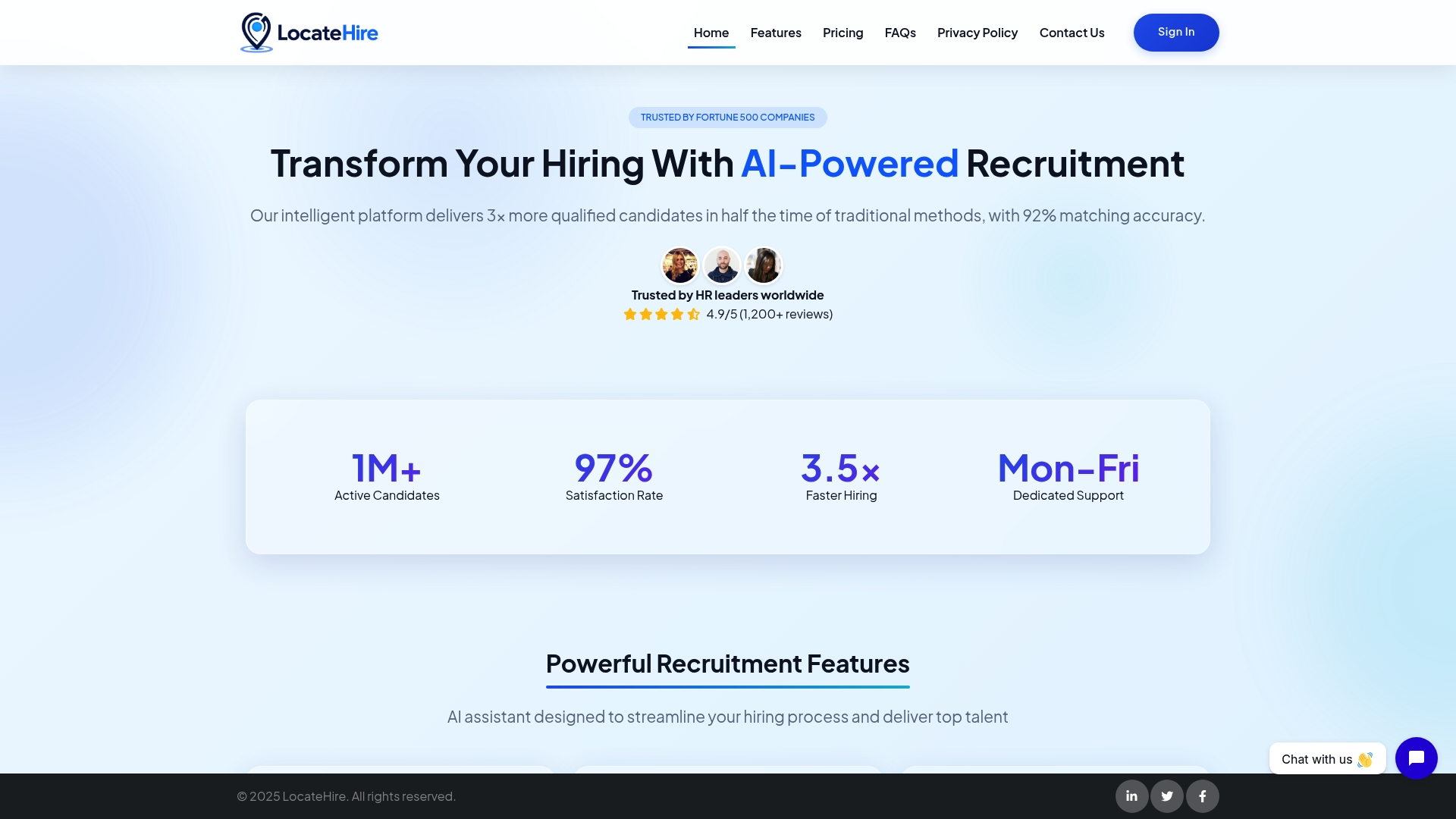
Locatehire is an applicant tracking system built specifically for small businesses with ongoing hiring needs, including pool service, HVAC, janitorial, electrical, plumbing, and retail. It includes job description templates you can customize, language guidance to keep your postings clear and neutral, and a simple pipeline to manage every applicant from first click to first day. If you're hiring more than a few people a year, having a system built for your scale makes a real difference. AI-powered recruitment tools like Locatehire take the guesswork out of writing and posting so you can focus on running your business.
FAQ
What are the key elements of an effective job description?
An effective job description includes a clear job title, a two-to-four sentence summary, five to eight measurable responsibilities, a concise qualifications list, and the reporting structure. Adding work conditions and a direct call to action improves both clarity and application rates.
How long should a job description be for a small business?
For most small business roles, 300 to 700 words is the right range. High-volume roles like retail or janitorial perform better at the shorter end, while technical or supervisory roles may need closer to 700 words to screen candidates properly.
How do I write a job description that attracts more applicants?
Use neutral, behavior-based language, keep your requirements list short, and describe what success looks like rather than just listing tasks. Inclusive language alone can increase responses by up to 42%, according to documented research.
What is an outcome-based job description?
An outcome-based job description focuses on what the person will achieve in the role rather than just what they will do day to day. It typically includes 90-day or six-month success benchmarks and is most effective for professional or supervisory positions.
Should I include salary in my job description?
Yes, when possible. Postings that include a pay range consistently attract more applicants and reduce time spent screening candidates who have mismatched salary expectations. Even a range is better than nothing.