

Most small business owners think hiring means posting a job and picking the best resume. That's not how it works. Understanding how recruitment funnel works reveals why some roles get filled in two weeks while others drag on for three months with no good candidates. The recruitment funnel models every step a candidate takes from first hearing about your opening to accepting your offer. When you know what happens at each stage, you stop guessing and start fixing the right problems.
Table of Contents
- Key takeaways
- How the recruitment funnel works, stage by stage
- Measuring funnel performance with the right metrics
- How technology improves your job candidate pipeline
- Practical ways to optimize your recruitment funnel
- Misconceptions that trip up small business owners
- What I've learned watching small businesses hire
- Take the guesswork out of your hiring
- FAQ
Key takeaways
| Point | Details |
|---|---|
| Funnel stages are sequential | Candidates move from awareness to hire, and drop-off at each stage is normal and measurable. |
| Metrics tell the real story | Tracking conversion rates between stages shows exactly where your hiring process breaks down. |
| Speed wins qualified candidates | Candidates drop out when more than 48 hours pass between screening and the next step. |
| Technology cuts hidden costs | Automating screening and scheduling reduces cost per hire without sacrificing quality. |
| Fix the biggest leak first | Focus improvement on the stage with the worst conversion rate before touching anything else. |
How the recruitment funnel works, stage by stage
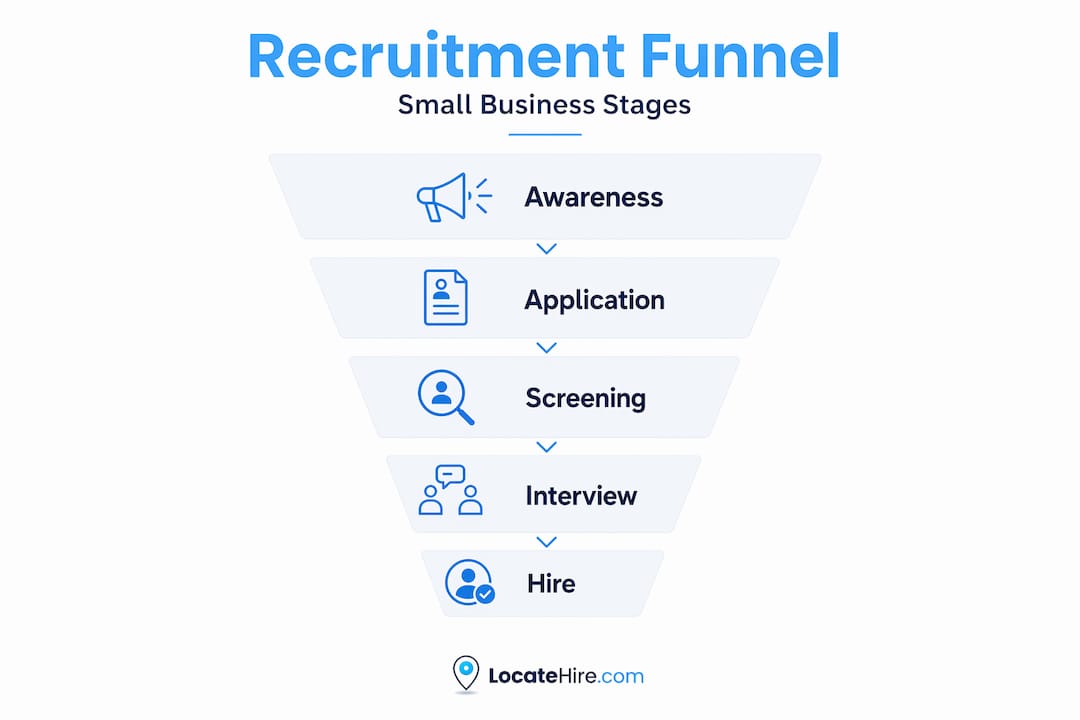
The recruitment funnel narrows candidates from a wide pool of potential applicants down to one hired person. Think of it as a series of filters, each one smaller than the last. The shape is literal. You start wide at the top and finish narrow at the bottom.
Most hiring funnels follow six core stages:
- Awareness — A potential candidate learns your job exists. This happens through job boards, social media, referrals, or word of mouth. No awareness means no applicants, regardless of how great the job is.
- Attraction — The candidate reads your listing and decides whether to apply. Your job description, company reputation, and listed pay all influence this decision in seconds.
- Application — The candidate submits their information. A long or confusing application form kills conversion here. Keep it short.
- Screening — You review applications and filter out candidates who don't meet your baseline requirements. Phone screens and knockout questions happen at this stage.
- Interview — Qualified candidates meet with you or your team. This is where fit, skills, and personality get assessed in detail.
- Offer and hire — You extend an offer, negotiate if needed, and close the hire.
What makes the funnel concept powerful is the drop-off between stages. Not every applicant becomes a screened candidate. Not every screened candidate becomes an interviewee. Most recruiting funnels have 5 to 7 stages, and success depends on managing conversion at every step rather than hoping for the best at any single one.
For a pool service company hiring technicians or a janitorial business replacing a crew member, the funnel might be shorter and faster. But the same core principles apply. You still need to attract the right people, filter quickly, and close before a competitor does.
Measuring funnel performance with the right metrics
You can't fix what you can't measure. The phases of hiring process each produce data you can actually use, but most small business owners never look at it.
Here are the metrics that matter most:
| Metric | What it measures | Typical benchmark |
|---|---|---|
| Application rate | Job views that turn into applications | 8 to 12% |
| Screen-to-interview ratio | Screened candidates invited to interview | 20 to 30% |
| Interview-to-offer ratio | Interviewed candidates who receive an offer | 30 to 50% |
| Time in stage | Days a candidate spends at each step | Varies by role |
| Time to hire | Days from first contact to accepted offer | 14 to 30 days |
The screen-to-interview ratio and interview-to-offer ratio are particularly telling. If you're screening 50 people but only interviewing 2, your screening criteria may be too tight or your job description is attracting the wrong applicants. If you're interviewing 10 people but only offering to 1, something is misaligned at the interview stage.

SHRM recommends using multiple recruiting metrics including time-to-hire and source-of-hire to locate bottlenecks rather than relying on any single number. Time-to-hire is an output metric. It tells you the funnel is slow, but not why. You need stage-by-stage data to find the actual problem.
Pro Tip: Start by tracking just two numbers: how many applications you get per job post, and how many of those you actually screen. If the ratio is off, your job description or posting channel is the first thing to fix.
The concept of a "funnel leak" is worth understanding. A leak is any stage where you're losing more candidates than expected, or where good candidates are dropping out before you want them to. Slow response time is one of the most common leaks. Candidates drop out when the gap between screening and interview exceeds 48 hours. That's especially punishing in trades and service industries where skilled workers have multiple offers at any given time.
How technology improves your job candidate pipeline
An applicant tracking system, or ATS, is the backbone of a well-run candidate pipeline. It keeps every applicant organized, tracks where they are in the process, and prevents good candidates from getting lost in an email inbox. For a small business running ongoing hiring, an ATS is not a luxury. It's how you stay functional.
Technology helps at multiple points in the funnel:
- Automated screening questions filter out unqualified applicants before you spend a minute reviewing them. A simple yes/no question about certifications or availability can cut your screening pile in half.
- Interview scheduling tools eliminate the back-and-forth that adds days to your process. Candidates pick a time from your calendar, and it's done.
- Automated messaging keeps candidates informed at every stage so they don't assume they've been ghosted and accept another offer.
- Analytics dashboards show you conversion rates by stage, so you can see exactly where your funnel is leaking without building a spreadsheet.
SHRM highlights ATS, scheduling tools, and analytics as core components of a modern recruiting operation. The benefit isn't just speed. It's consistency. Every candidate goes through the same process, which makes your evaluations more reliable and your hiring decisions easier to defend.
Automating screening and scheduling can reduce cost per hire significantly by cutting the hidden labor cost of manual phone screens and calendar management. For a small business owner doing their own hiring, that time savings is real money.
Pro Tip: Video in your hiring process can replace a phone screen with something more revealing and faster to evaluate. A two-minute recorded introduction from a candidate tells you more than a resume in most service-role scenarios.
The one thing technology can't replace is judgment. Use automation for the repetitive and administrative work. Save your attention for the evaluation and conversation parts that actually require a human.
Practical ways to optimize your recruitment funnel
Understanding recruitment funnel stages is step one. Fixing them is step two. Here's how to approach optimization in a way that actually moves the needle for a small business.
-
Tighten your job description. Vague descriptions attract unqualified applicants and waste your screening time. Be specific about hours, physical demands, pay range, and required experience. Early-stage filtering works best when your job post already filters out poor fits before they apply.
-
Add knockout questions to your application. Ask one or two questions that immediately disqualify applicants who don't meet your non-negotiables. "Can you lift 50 pounds regularly?" or "Do you have a valid driver's license?" takes seconds for the applicant and minutes off your screening time.
-
Respond within 24 hours to qualified candidates. Speed is your competitive advantage as a small business. You can move faster than a corporate HR department if you decide to.
-
Use structured interviews. Ask every candidate the same questions in the same order. This makes comparison easier and your decision faster. It also reduces the chance that you hire based on how comfortable the conversation felt rather than how qualified the person is.
-
Disclose compensation early. Candidates who reach the offer stage only to find out the pay doesn't work have wasted your time and theirs. Put the range in the job post or confirm it at the first contact.
-
Review your funnel data monthly. Pick the stage with the worst conversion rate and focus your improvement there for 30 days before moving to the next problem. High-performing recruiting teams optimize across multiple stages systematically rather than making random changes all at once.
Pro Tip: For trades and service businesses, referrals convert at dramatically higher rates than job board applicants. Track your source-of-hire metric and you'll likely find that one or two channels produce nearly all your best hires.
Misconceptions that trip up small business owners
Several beliefs about the job candidate pipeline actively hurt hiring outcomes. Knowing them saves you from repeating the same mistakes.
- More applicants means better results. It does not. A flood of unqualified applicants creates screening overload and can cause you to miss the two or three strong candidates buried in the pile. A targeted job post that generates 15 good applicants beats one that generates 200 poor ones.
- Early drop-off is a failure. Candidates who opt out at the application stage after reading your listing were probably not right for the role. That's the funnel working correctly. Early filtering is efficient, not discouraging.
- The offer stage is a formality. It is not. Candidates at this stage are often still evaluating competing offers. Slow offer delivery or vague terms lose people who were already sold on the role.
- Small businesses can't compete with larger employers. Speed, direct communication, and a clear sense of what the job actually is are advantages large companies struggle to match. Use them.
"Recruitment funnel results are system outputs requiring comprehensive stage-by-stage diagnosis." — Kevin Connolly, Ashby
The biggest mindset shift for small business owners is seeing hiring as a system rather than a series of one-off decisions. Viewing metrics as outputs of an interconnected system changes how you diagnose problems. Instead of blaming a bad hire on bad luck, you look at the stage where the process failed and fix it.
What I've learned watching small businesses hire
I've watched a lot of small business owners approach hiring the same way for years. Post a job. Get a pile of resumes. Pick someone. Wonder why they quit in 60 days. Then repeat.
What changed outcomes every single time was getting people to look at their funnel data honestly. Not obsessively, just honestly. One client running an HVAC company had a strong application volume but a terrible interview-to-offer ratio. He assumed the candidates were bad. The data showed he was taking 9 days on average between the phone screen and scheduling the in-person interview. Analytics and structured criteria removed that subjectivity and delay. We cut the gap to 48 hours and his offer acceptance rate doubled in two months.
The funnel is not complicated. It's just uncomfortable to look at when it exposes something you've been doing wrong. My advice is simple: pick one metric, measure it for 30 days, and fix the worst number you find. You don't need a full HR department to do this. You need a spreadsheet, or better yet, a tool that does it for you.
— Jeff
Take the guesswork out of your hiring
Running a small business with ongoing hiring needs means your recruitment funnel never really closes. Whether you're a pool service company replacing a tech, a janitorial company scaling a crew, or an electrical contractor adding field staff, the same funnel problems slow you down every time.
Locatehire is built specifically for businesses like yours. It tracks every candidate through each stage of your funnel, automates your screening questions and scheduling, and gives you a clear dashboard so you can see exactly where you're losing good people. You stop relying on memory and start making decisions based on what the data actually shows. If you're ready to see how it works, Locatehire can be running for your next open role in less time than it takes to write a job post.
FAQ
What is a recruitment funnel?
A recruitment funnel is a model that tracks candidate progression from first learning about a job to receiving a hire offer. Each stage filters the pool smaller until one qualified person is selected.
How many stages does a recruitment funnel have?
Most recruitment funnels include 5 to 7 stages: awareness, attraction, application, screening, interview, and offer. Small businesses may combine or shorten stages depending on the role.
What is a good conversion rate between funnel stages?
A healthy screen-to-interview ratio is 20 to 30%, and a solid interview-to-offer ratio falls between 30 and 50%. Rates outside these ranges signal a bottleneck worth investigating.
How do I know where my recruitment funnel is broken?
Track the number of candidates entering and exiting each stage. The stage with the largest percentage drop is your biggest leak and the best place to start fixing your process.
How can small businesses speed up their hiring funnel?
Respond to qualified candidates within 24 hours, use automated scheduling tools, and add knockout questions to your application to filter unqualified applicants before they reach your inbox.