

If you run a small business or manage HR for one, you've probably asked what does hire rate mean at some point — and gotten a muddy answer. The term gets used in two very different contexts: as a government labor market statistic tracked by the U.S. Bureau of Labor Statistics, and loosely in internal recruiting conversations. Confusing the two leads to misread data, poor planning, and missed hiring opportunities. This article clears up both definitions, shows you how to calculate hire rate, and explains how to turn that knowledge into a smarter recruitment strategy.
Table of Contents
- Key takeaways
- What hire rate actually means: the economic definition
- What hire rate trends reveal about the job market
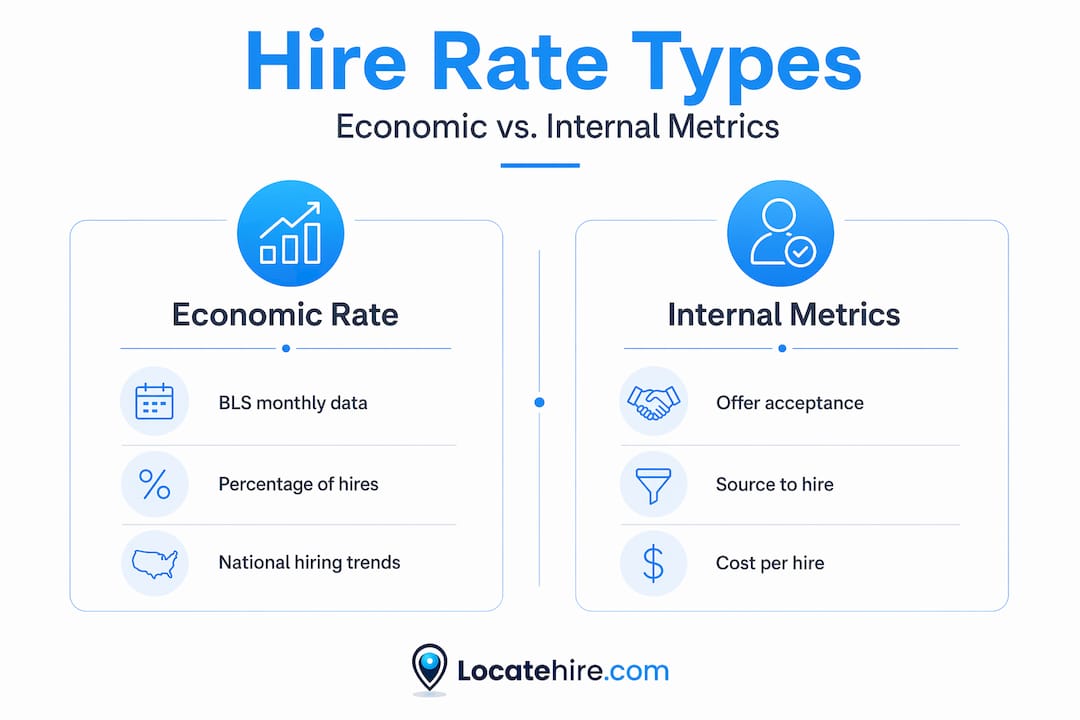
- Hire rate vs. internal recruiting metrics
- How to put hire rate knowledge to work
- My take on what most small businesses get wrong
- How Locatehire helps you hire smarter
- FAQ
Key takeaways
| Point | Details |
|---|---|
| Hire rate has two meanings | The BLS economic definition and internal recruiting usage are distinct and should not be confused. |
| National hire rate was 3.5% in March 2026 | This figure represents total hires divided by total employment, including rehires and recalls. |
| Sector context matters | National averages can mask industry-level volatility, so always compare within your sector. |
| Internal metrics complete the picture | Pair macro hire rate data with source to hire rate and time-to-fill for real recruiting clarity. |
| Small businesses can act on this data | Use hire rate benchmarks alongside your own tracking tools to time hiring and set realistic goals. |
What hire rate actually means: the economic definition
The hire rate, at its most precise level, is a labor market metric published monthly by the U.S. Bureau of Labor Statistics as part of the JOLTS report (Job Openings and Labor Turnover Survey). The formula is straightforward.
| Term | Definition |
|---|---|
| Total hires | All additions to payroll during the month, including new employees, rehires, and recalls |
| Total employment | The number of employees on payroll at the start of the measurement period |
| Hire rate formula | (Total hires ÷ Total employment) × 100 |
As of March 2026, the national hires rate came in at 3.5%, up from 3.1% in February 2026. That number means that for every 100 people already employed, approximately 3.5 new additions were made to payrolls across the country that month.
One part of the hire rate definition that surprises most people: the BLS counts rehires and recalls as hires. That means if you laid someone off in January and brought them back in March, that return counts in the national figure. This broader definition is worth keeping in mind when you compare your own internal data to government benchmarks.
Pro Tip: Use percentage-based hire rates, not raw counts, when comparing your hiring pace across seasons or against competitors. As the BLS notes, rate metrics outperform raw counts for cross-industry comparison because they account for workforce size differences.
Hire rate is also a lagging indicator. It reflects actual hiring activity, not employer intent. Job openings tell you what employers want to do. Hire rate tells you what they actually did. That distinction matters when you are trying to read the market.
What hire rate trends reveal about the job market
A single hire rate number tells you something. A trend in hire rate numbers tells you a lot more. When hire rates are rising, employers are actively filling seats, labor demand is strong, and workers have more options. When hire rates are falling, the market is tightening in a different way. Employers are holding on to existing staff and moving slowly on new additions.
The current economic environment has been described by labor economists as a low-hire, low-fire economy. In December 2025, the national hiring rate sat at 3.3% while the firing rate was just 1.1%. That combination creates a labor market where:
- Workers feel less pressure to move, because layoff risk is low
- Employers post openings but fill them slowly, because qualified candidates are not rushing to switch jobs
- Competition for active job seekers intensifies, because the pool of people actively looking is smaller
- Small businesses feel it harder, because they cannot offer the salary buffers that large employers use to attract the rare candidate who is willing to move
"In a low-hire, low-fire economy, worker confidence and mobility decline, affecting recruitment and retention strategies at the business level." — St. Louis Federal Reserve
This matters for your planning. If the national hire rate is low and stable, do not expect a flood of applicants when you post a job. Budget more time per open position, focus on sourcing rather than waiting for inbound applications, and strengthen your retention efforts so you are not contributing to your own vacancy problem.
Another layer worth understanding: the national hire rate masks significant sector-level variability. Hospitality, retail, and field service industries like HVAC and janitorial services tend to have hire rates that swing wider than the national average. A 3.5% national figure might coexist with a 6% or 7% rate in your specific sector. Looking only at the national number can give you false confidence or unnecessary alarm.

Hire rate vs. internal recruiting metrics
Here is where the confusion gets expensive. Many small business owners and HR managers hear "hire rate" in a recruiting conversation and assume it refers to how well their internal hiring process is working. It does not. The macro hire rate tells you nothing about whether your job postings are effective, whether your interviews are converting, or whether your offer acceptance rate is healthy.
These are the internal recruiting metrics that actually measure your process:
| Metric | What it measures |
|---|---|
| Offer acceptance rate | Percentage of job offers accepted by candidates |
| Source to hire rate | Which sourcing channels produce actual hires |
| Time to fill | Days from job opening to accepted offer |
| Application to interview rate | How many applicants make it to a screen |
The source to hire rate is particularly useful. It tells you whether your money and effort on job boards, referrals, or social sourcing is actually producing employees, not just resumes. A high application volume from a job board means nothing if none of those applicants convert.
Small businesses often mistake the macro hire rate for a reflection of their own recruiting performance. That mistake leads to misplaced conclusions. If your hiring is slow and the national hire rate is also low, it is tempting to blame the market entirely. But your internal metrics might reveal that your time-to-fill is three times longer than it should be, or that 40% of your candidates drop off after the first interview.
Pro Tip: Track both macro hire rate trends and your internal metrics side by side. When they diverge, that gap usually points directly to a fixable process problem inside your own recruiting funnel.
What does cost per hire mean in this context? Cost per hire is another internal metric that tracks total recruiting spend divided by number of hires made. It sits alongside source to hire rate and offer acceptance rate as part of your operational recruiting picture. It is separate from the macro hire rate, which is an economic indicator, not a cost measure.
How to put hire rate knowledge to work
Understanding hire rate is only useful if it changes how you operate. Here is how to translate hire rate awareness into concrete steps for your business.
-
Set hiring timelines based on market conditions. When the national hire rate is trending down, plan for longer fill times. If you run a pool service company and need to hire five technicians before summer, start recruiting in February, not April. A tight market does not care about your busy season.
-
Benchmark against your sector, not the nation. Pull industry-specific JOLTS data for your category. Retail and field service businesses should compare against hospitality and trade labor rates, not the overall 3.5% national figure. Your real competitive reality lives in sector-level data.
-
Use hire rate trends to time your retention investments. When hire rates are climbing, workers have more options and turnover risk rises. That is the moment to review compensation, scheduling flexibility, and employee experience. Do not wait for people to leave before you act.
-
Combine macro data with your ATS data. Your applicant tracking system captures source to hire rate, time to fill, and application conversion. Cross-referencing that with labor market trends gives you context for why your numbers look the way they do and where to adjust.
-
Adjust sourcing strategy when the market shifts. In a low-hire environment, passive candidates are abundant but not browsing job boards actively. Shift some of your sourcing effort toward direct outreach, employee referrals, and community hiring events rather than relying on inbound applications alone.
Pro Tip: For AI-powered recruiting tools, the real advantage is not speed. It is the ability to surface qualified candidates from multiple channels simultaneously and rank them before you spend time on manual review. In a tight market, that sorting function saves hours per open role.
My take on what most small businesses get wrong
I've watched small business owners get paralyzed by labor market data they don't quite trust, and equally, I've seen others ignore it completely and wonder why their job posts sit empty for six weeks. Neither approach works.
What I've found consistently is that hire rate, both the economic version and the internal recruiting interpretation, is most valuable as a directional tool, not a precision instrument. When the national hire rate dropped to 3.3% in late 2025, the right response was not to declare a hiring freeze or panic about labor shortages. It was to adjust expectations, tighten up sourcing strategies, and double down on keeping the people you already have.
The businesses I've seen handle this well are the ones who combine macro awareness with disciplined internal tracking. They know their source to hire rate. They know their offer acceptance rate. And they use the national hire rate as a backdrop that helps them interpret those internal numbers more accurately.
One more thing: I think the obsession with understanding hire rate in isolation misses the point. The metric is a piece of context, not a decision-maker. Use it to inform your strategy, not to replace your judgment. The businesses that win at hiring are the ones who show up consistently, move faster than their competitors, and build a reputation as a good place to work. No metric replaces that.
— Jeff
How Locatehire helps you hire smarter
If tracking hire rate trends and internal recruiting metrics sounds like a lot to manage on top of running your business, you are right. That is exactly what Locatehire was built to solve.
Locatehire is an applicant tracking system built specifically for small businesses with ongoing hiring needs. Whether you run an HVAC company, a janitorial service, a pool maintenance crew, or a retail operation, Locatehire keeps your hiring organized, your sourcing visible, and your metrics clear. You can see which sources are producing actual hires, how long each role is taking to fill, and where candidates are dropping out of your funnel. That is the internal data you need to make the national hire rate numbers actually mean something for your business. No enterprise software complexity. No steep learning curve. Just clean, useful recruiting data built for the way small businesses actually hire.
FAQ
What does hire rate mean in labor market terms?
Hire rate is the total number of hires during a period divided by total employment, expressed as a percentage. The BLS reported the U.S. hire rate at 3.5% in March 2026.
What counts as a hire in the BLS definition?
The BLS counts any addition to payroll as a hire, including new employees, rehires, and workers recalled from temporary layoffs, making it broader than typical internal HR definitions.
How is hire rate different from cost per hire?
Hire rate is a macroeconomic indicator measuring labor market flow. Cost per hire is an internal recruiting metric that tracks total recruiting spend divided by the number of hires made.
How do I calculate hire rate for my business?
Divide the number of people added to your payroll in a given period by your total employee count at the start of that period, then multiply by 100 to get the percentage.
Why does the national hire rate matter for my small business?
It signals whether the labor market is active or stagnant, helping you set realistic timelines, adjust sourcing strategies, and time retention investments before turnover becomes a problem.