

HR in a small business is defined as the set of processes that manage compliance, hiring, onboarding, employee relations, and compensation for teams of 5–50 employees. Most owners treat it as paperwork. The ones who treat it as an operating system build companies that scale. The role of HR in small business does not require a dedicated department to deliver real results. What it requires is structure, the right tools, and clarity about which tasks carry the most risk.
Most small businesses can handle core compliance and administrative HR tasks with software costing $100–$200 per month, while a full-time HR hire runs $65,000–$100,000 annually. That cost gap makes the case for a systems-first approach. Federal thresholds matter here too. The Family and Medical Leave Act (FMLA) generally applies at 50 employees, but I-9 verification, labor law poster requirements, and anti-discrimination rules apply from the first hire. Ignoring these early is where small businesses get into trouble.
What are the essential HR functions small businesses must prioritize?
Eight core HR functions exist in every small business, regardless of headcount. Not all of them carry equal urgency. Compliance, onboarding, HR administration, and compensation top the priority list because they carry the highest legal and operational risk.
The eight functions break down like this:
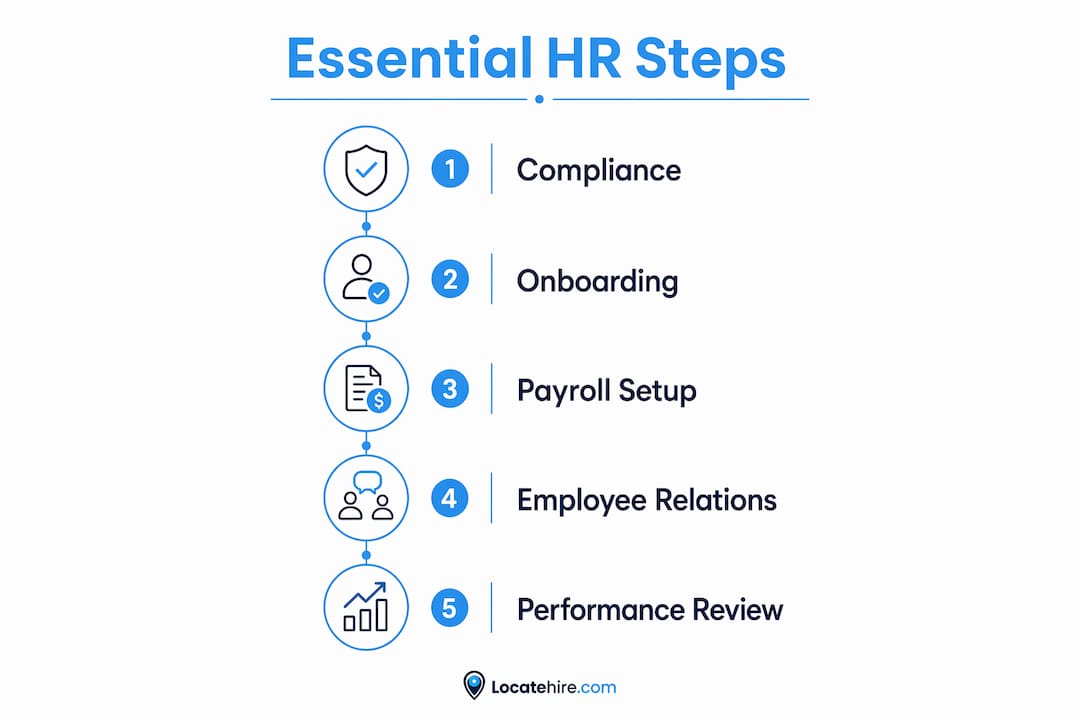
- Compliance: Following federal and state labor laws, maintaining I-9 records, posting required notices, and staying current on wage and hour rules.
- Onboarding: Structuring the first 30–90 days so new hires become productive and feel connected to the team.
- Training and development: Building skills that match your business needs and reduce turnover from boredom or stagnation.
- Performance management: Setting clear expectations, giving regular feedback, and documenting issues before they become legal problems.
- Compensation and benefits: Paying competitively, managing payroll accurately, and offering benefits that attract the people you need.
- Employee relations: Handling conflicts, grievances, and sensitive conversations with fairness and consistency.
- HR administration: Maintaining personnel files, tracking time off, and keeping records that protect you in a dispute.
- Recruitment: Finding, screening, and hiring the right people efficiently. Avoiding common job posting mistakes here saves time and money downstream.
Compliance and onboarding deserve your attention first. A missed I-9 or a poorly documented termination can cost far more than any HR software subscription.
Pro Tip: Build a simple HR checklist for each new hire that covers I-9 completion, payroll setup, equipment assignment, and a 30-day check-in. It takes 20 minutes to create and prevents months of headaches.
How can small businesses manage HR without a dedicated HR department?
The biggest misconception in small business HR is that you need a full-time HR professional before you can run HR well. You do not. The key is separating administrative tasks from judgment-intensive work.

Administrative tasks like payroll processing, benefits enrollment, and recordkeeping are repeatable and rule-based. Software handles these well. Payroll and benefits outsourcing from the start frees founders to focus on the work that actually requires human judgment: managing a difficult employee, designing a compensation structure, or deciding when to let someone go.
For businesses that need more than software but cannot justify a full-time hire, two options stand out. Fractional HR consultants work part-time or on retainer, typically for a few hundred to a few thousand dollars per month depending on scope. Professional Employer Organizations (PEOs) co-employ your workforce and handle payroll, benefits, and compliance on your behalf. PEOs work best for businesses with 5–150 employees who need solid HR infrastructure without the overhead.
The 50-employee threshold is the clearest signal that dedicated HR capacity becomes necessary. At that point, FMLA obligations kick in, the complexity of employee relations increases, and the cost of a compliance mistake rises sharply. Before you reach that number, a combination of HR software and fractional support covers most needs.
Pro Tip: When evaluating HR software, check whether it handles your state's specific wage and hour rules. Federal compliance is the floor, not the ceiling.
What HR challenges arise without proper HR systems?
About 50% of small business employees report that the absence of a dedicated HR function contributes to a toxic workplace. Nearly half of small business owners admit their HR structure is unprofessional. Those numbers reflect a real pattern: informal HR creates inconsistency, and inconsistency breeds resentment.
Without documented processes, onboarding becomes whatever the busiest manager has time for that week. Performance expectations stay in someone's head instead of on paper. When a conflict arises, there is no policy to point to, so decisions feel arbitrary. That perception of unfairness drives turnover faster than low pay does.
Culture dilutes without deliberate management. As small teams grow from 5 to 25 employees, informal norms that worked when everyone sat in the same room stop scaling. The founder who "just knows" everyone's performance becomes a bottleneck. Proactive culture management through regular, genuine conversations outperforms formal surveys for improving employee experience in teams under 25.
The risks compound over time. Neglecting early HR systems increases legal exposure and hurts retention. A wrongful termination claim, a wage dispute, or a harassment complaint without documentation can cost a small business tens of thousands of dollars in legal fees alone. The fix is not complicated, but it requires doing the work before the crisis arrives.
Here is what proactive HR practices look like in practice:
- Schedule monthly one-on-one conversations with every employee, not just when problems surface.
- Document performance issues in writing at the time they occur, not during a termination meeting.
- Build a simple employee handbook that covers your attendance policy, conduct expectations, and complaint process.
- Review your compensation structure annually against market data so you are not losing good people to a $2-per-hour gap.
Workplace equality best practices also belong in this conversation. Small businesses that build fair, consistent people practices early retain employees longer and attract better candidates.
How do you build practical HR strategies for small business growth?
Building HR systems does not require a consultant or a big budget. It requires deciding what matters and doing it consistently. Hiring for cultural fit, embedding continuous feedback, and prioritizing internal growth opportunities are the three HR practices with the clearest impact on retention in small businesses.
Start with your hiring process. Standardize your interviews so every candidate for the same role answers the same core questions. This reduces bias and makes it easier to compare candidates fairly. A structured hiring process also protects you legally if a rejected candidate ever questions your decision.
Next, automate what you can. Onboarding checklists, document collection, and compliance training can all run through HR software without anyone managing them manually. Centralizing personnel records in one place, even a shared folder with consistent naming conventions, eliminates the scramble when you need documentation fast.
Here is a practical sequence for building HR infrastructure from scratch:
- Document your hiring process. Write down every step from job posting to offer letter. Identify where you lose candidates and where you make inconsistent decisions.
- Create an onboarding checklist. Cover the first day, first week, and first 30 days. Assign owners for each task.
- Set up a personnel file system. Store I-9s, offer letters, performance notes, and disciplinary records for every employee.
- Write a basic employee handbook. Cover attendance, conduct, time-off requests, and how employees can raise concerns.
- Schedule regular feedback conversations. Quarterly is the minimum. Monthly is better for teams under 20.
- Review compensation annually. Use free salary data from the Bureau of Labor Statistics or industry surveys to check your ranges.
Pro Tip: Build your HR systems to handle twice your current headcount. If you design for 10 employees when you have 5, you will not be scrambling to rebuild everything when you hit 15.
Inclusive talent pipeline practices also strengthen your hiring outcomes. Small businesses that build diverse candidate pools from the start make better hires and reduce the risk of groupthink as the team grows.
HR functions in small business evolve as the company scales. What starts as administrative compliance becomes workforce planning and employer branding. Owners who build the foundation early do not have to rebuild it under pressure later.
Key Takeaways
The most effective HR approach for small businesses combines structured processes, affordable technology, and human judgment reserved for decisions that carry real risk.
| Point | Details |
|---|---|
| Compliance comes first | I-9, labor law posters, and anti-discrimination rules apply from your first hire, not at 50 employees. |
| Software beats a full-time hire early on | HR software at $100–$200 per month covers most administrative needs before you reach 50 employees. |
| Informal HR creates legal risk | Undocumented processes lead to inconsistent decisions that expose you to costly disputes. |
| Culture requires active management | Regular one-on-one conversations outperform formal surveys for teams under 25 employees. |
| Build systems ahead of your headcount | Design HR processes for twice your current team size so growth does not break your operations. |
Why I think most small businesses get HR backwards
Most owners I have seen build HR reactively. They hire someone, something goes wrong, and then they write a policy. They lose a good employee, and then they think about compensation. They face a compliance audit, and then they scramble to find their I-9 files. The pattern is consistent, and it is expensive.
The owners who build HR early do not do it because they love paperwork. They do it because they understand that every person they hire is a compounding decision. A bad hire at employee number three can shape the culture for the next 20 people who join. A missing document at year two can become a six-figure legal problem at year five.
HR is the operating system of a small business. That framing changed how I think about it. You would not run your business on a broken accounting system. Running it without documented people processes is the same category of mistake.
The practical reality is that building HR infrastructure is not expensive or complicated at the 5–50 employee stage. A few hundred dollars a month in software, a few hours building your onboarding checklist, and a commitment to having honest conversations with your team covers most of what you need. The cost of not doing it is far higher than the cost of doing it right.
— Jeff
Locatehire helps small businesses hire with less friction
Hiring is the most time-consuming HR function for most small business owners, and it is also the one with the highest cost of error. Locatehire is an applicant tracking system built specifically for small businesses with ongoing hiring needs, including pool service companies, HVAC contractors, janitorial services, electrical and plumbing firms, and retail operations.
Locatehire simplifies job posting, organizes your candidate pipeline, and keeps your hiring process consistent across every role. You get the structure of a professional hiring process without the overhead of an enterprise platform. For small business owners who want to hire faster and make fewer mistakes, Locatehire is built for exactly that.
FAQ
What is the role of HR in a small business?
HR in a small business manages compliance, hiring, onboarding, employee relations, and compensation. These functions apply from the first hire, regardless of whether you have a dedicated HR person.
When does a small business need a dedicated HR department?
The FMLA threshold at 50 employees marks the clearest trigger for dedicated HR capacity. Before that point, HR software and fractional HR support cover most needs at a fraction of the cost.
What HR functions should small businesses prioritize first?
Compliance, onboarding, HR administration, and compensation carry the highest legal and operational risk. Address these four before investing time in training programs or formal performance review systems.
How much does HR cost for a small business?
HR software runs $100–$200 per month for most small businesses. A full-time HR hire costs $65,000–$100,000 annually. Fractional HR consultants and PEOs offer middle-ground options for businesses that need expert support without full-time overhead.
What happens when small businesses ignore HR?
About 50% of small business employees report that the lack of HR contributes to a toxic workplace. Undocumented processes increase legal exposure, hurt retention, and create founder bottlenecks that slow growth.