

Job description quality is defined as the degree to which a written role posting accurately reflects the position's requirements, communicates expectations clearly, and attracts candidates who are genuinely qualified. For small business owners and HR managers, the role of job description quality is not a minor formatting concern. It is the single biggest variable in whether your next hire works out or costs you weeks of wasted time. A poorly written posting repels strong candidates, invites unqualified applicants, and creates confusion that follows a new employee all the way through onboarding. Tools like Grammarly can catch surface errors, but the deeper work is structural and strategic.
What is the role of job description quality in hiring outcomes?
A quality job description is the foundation of every good hire. It defines what you are looking for before you start looking, which means every step after it, from screening to interviewing to onboarding, runs on cleaner information. A job description shapes what you search for, how you evaluate candidates, and what you use to persuade the right person to accept your offer. That is three jobs in one document.
The industry term for this function is "job specification," though most small business owners simply call it a job posting. Both terms refer to the same thing: a written document that defines the role, its requirements, and its context. The distinction matters because treating it as a specification, rather than a formality, changes how seriously you approach writing it.
What are the essential components of a high-quality job description?
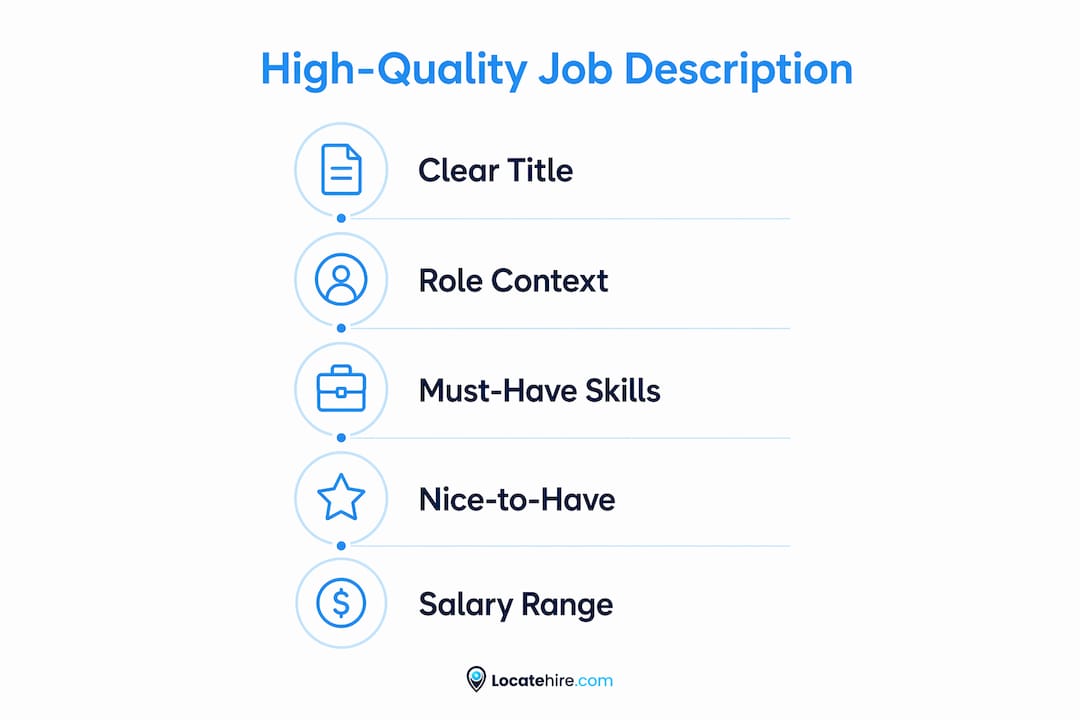
A high-quality job description contains six core elements: a clear and searchable job title, a brief explanation of the team context and role purpose, a separated list of must-have and nice-to-have requirements, a salary range and benefits summary, impact-focused expectations, and a short company description. Each element serves a specific function. Remove any one of them and the posting becomes less useful for both you and the candidate.

The requirement list is where most small business job descriptions fall apart. Most ineffective postings list 20 or more requirements when only 5–7 are true must-haves. Overloading the list repels qualified candidates who assume they are underqualified. Separating must-have skills from nice-to-haves broadens your candidate pipeline without lowering your standards.
The difference between a typical job description and a quality one is visible in structure and language:
| Element | Typical posting | Quality posting |
|---|---|---|
| Job title | "Operations Specialist" | "HVAC Service Technician, Residential" |
| Requirements | 15+ bullet points, no priority order | 5–7 must-haves, 3–4 nice-to-haves |
| Expectations | "Responsible for daily tasks" | "You will complete 6–8 service calls per day" |
| Salary | Not listed | "$22–$26/hr plus overtime" |
| Role context | None | "You report to the service manager and work a 4-day schedule" |
Pro Tip: Write the job title the way a candidate would search for it on Indeed or Google. "Technician" outperforms "Specialist" for trade roles because that is the word candidates actually type.
Candidates increasingly care about role mandate and context, not just a list of tasks. A pool service company that explains "you will manage 40 residential accounts and train one junior tech per quarter" will attract more serious applicants than one that writes "responsible for pool maintenance."
How does job description quality impact recruitment outcomes and bias?
Job description quality directly affects who applies and who gets hired. The effect on gender diversity is one of the most documented and least discussed problems in small business hiring. Women tend to apply only when they meet 100% of listed requirements, while men apply at around 60% match. That gap means a long, inflated requirement list quietly filters out a large portion of qualified female candidates before you ever see their resumes.
Ambiguous job requirements cause divergent hiring judgments, especially in small and medium businesses where multiple people may review the same applicant. When two managers read the same vague posting, they form different mental pictures of the ideal candidate. That inconsistency introduces bias into the process without anyone intending it.
A well-written job description solves this by acting as a shared reference point. SME hiring accuracy increases when job descriptions provide a stable, consistent standard that prevents subjective bias in assessments. Every interviewer evaluates candidates against the same written criteria, not against their own assumptions.
Every unnecessary requirement filters out qualified candidates. Structured job descriptions also improve the accuracy of AI-assisted applicant screening, which matters if you use an applicant tracking system to manage volume. The practical result is a smaller, better-matched applicant pool that takes less time to review. For a small business owner hiring a plumber or a retail shift lead, that time savings is real money.
What best practices keep job descriptions accurate over time?
Job descriptions go stale faster than most small business owners realize. A role that existed two years ago may have shifted significantly, especially in trades and service businesses where technology, regulations, or team structures change. The recommended practice is to review job descriptions every 12–24 months or immediately after a significant role change. This prevents "description drift," which is the gap between what the posting says and what the job actually requires.
A practical review process looks like this:
- Pull the current job description and compare it to what the person in that role actually does each week.
- Ask the direct supervisor to flag any duties that have been added, removed, or changed.
- Update the requirement list to reflect current tools, certifications, or skills the role now demands.
- Confirm the salary range still reflects the current market for that role in your area.
- Check that the posting language is free of terms that unintentionally exclude qualified candidates.
Linking job descriptions to onboarding is the step most small businesses skip. Strong job descriptions serve as the onboarding blueprint, connecting recruitment directly to a new hire's 30-60-90 day plan and early training. When a new HVAC technician reads the same expectations in their offer letter, their onboarding checklist, and their first performance review, there is no confusion about what success looks like.
Pro Tip: Before posting a new role, sit down with the hiring manager for 20 minutes and ask: "What would make this hire a failure at 90 days?" That answer usually reveals the real must-have requirements the posting was missing.
Treating job descriptions and onboarding plans as separate documents is one of the most common small business mistakes. Linking them reduces early turnover because new hires know exactly what they signed up for.
How do quality job descriptions save small businesses time and money?
The upfront investment in a well-written job description pays back quickly. Spending 90 minutes crafting a job description significantly reduces the time wasted screening unqualified candidates, compared to a rushed 15-minute posting. For a business owner who is also the hiring manager, that difference can mean hours saved per open role.
The most effective framing is to treat a job description as a sales document for your role. You are competing for the same electricians, janitors, and retail workers that every other business in your area is trying to hire. A posting that explains the schedule, the pay, the team, and the growth path will outperform a generic list of duties every time.
Practical ways quality job descriptions reduce hiring time include:
- Fewer unqualified applicants. Clear requirements filter out candidates who are not a fit before they apply.
- Faster screening. When the posting is specific, resume review takes minutes instead of hours because the match criteria are obvious.
- Better interview prep. Interviewers can build questions directly from the job description instead of improvising.
- Shorter time to offer. When everyone agrees on what the role requires, decisions move faster.
Reviewing effective job description examples built for small businesses gives you a concrete starting point rather than a blank page. Avoiding common job posting mistakes is equally valuable, since the same errors show up repeatedly across service industries. The combination of a strong template and a short checklist of pitfalls to avoid can cut your posting time in half while improving results.
Key Takeaways
Job description quality is the most controllable factor in small business hiring effectiveness, and improving it requires structure, specificity, and regular maintenance.
| Point | Details |
|---|---|
| Limit requirements to what matters | List 5–7 true must-haves and 3–4 nice-to-haves to avoid filtering out qualified candidates. |
| Use job descriptions as shared criteria | Consistent written standards reduce bias and improve hiring accuracy across interviewers. |
| Review every 12–24 months | Update postings after role changes to prevent description drift and misaligned expectations. |
| Link postings to onboarding | Connect job description expectations to 30-60-90 day plans to reduce early turnover. |
| Treat the posting as a sales document | Specific, honest postings attract better candidates faster than generic duty lists. |
What I have learned from watching small businesses hire the hard way
Most small business owners I have seen struggle with hiring are not struggling because they lack good candidates in their market. They are struggling because their job posting is doing the opposite of what they think it is doing. A janitorial company owner once showed me a posting that listed 22 requirements for a part-time cleaning role. He could not understand why he was getting zero applications. The posting read like a corporate compliance document, not an invitation to work.
The uncomfortable truth is that a rushed job description signals to candidates that the company is disorganized. Top candidates, the ones with options, read your posting and make a judgment about your business before they ever meet you. A vague, bloated, or poorly structured posting tells them the job will be just as unclear once they start.
What I have found actually works is treating the job description as the first conversation you have with a candidate. Write it the way you would explain the role to someone you respect. Be specific about the schedule, the pay, and what a good day looks like. That level of honesty attracts people who are genuinely interested and filters out those who are not, which is exactly what you want before you spend time interviewing.
Small businesses also have a real advantage here that they rarely use. You can offer context that large employers cannot: the owner's name, the team size, the culture, and the real growth path. A plumbing company that writes "you will work directly with the owner and have a path to lead tech within 18 months" is offering something a large franchise cannot match. That specificity is free to include and worth more than any job board premium placement.
— Jeff
How Locatehire helps small businesses hire with confidence
Locatehire is an applicant tracking system built specifically for small businesses with ongoing hiring needs, including pool service, HVAC, electrical, plumbing, janitorial, and retail. The platform helps you post jobs and manage applicants without the complexity of enterprise HR software.
Locatehire gives you the tools to build consistent, structured job postings and track candidates from application to hire. If you are spending too much time reviewing unqualified applicants or starting from scratch every time a role opens, Locatehire is built to fix that. Learn more about writing job postings that attract applicants and how the platform supports your full hiring process.
FAQ
What makes a job description high quality?
A high-quality job description includes a clear job title, 5–7 must-have requirements, a salary range, role context, and impact-focused expectations. It reads as a specific invitation to qualified candidates, not a generic list of duties.
How does job description quality affect who applies?
Women apply only when they meet 100% of listed requirements, while men apply at around 60% match. Inflated requirement lists quietly reduce the diversity and quality of your applicant pool.
How often should small businesses update job descriptions?
Job descriptions should be reviewed every 12–24 months or immediately after a significant role change. Regular updates prevent description drift and keep postings aligned with what the job actually requires.
Can a better job description reduce hiring bias?
Yes. Consistent, structured job descriptions give all interviewers the same evaluation criteria, which reduces subjective judgment and improves hiring accuracy, particularly in small businesses where multiple people review candidates.
How does a job description connect to onboarding?
A strong job description serves as the foundation for a new hire's 30-60-90 day plan. Linking the two documents creates role clarity from day one and reduces early turnover.