

An effective job posting is a targeted recruitment document that communicates role impact, compensation, and culture clearly enough that the right candidate self-selects before applying. Small service businesses, from HVAC companies to janitorial services, lose qualified applicants every day to postings that bury salary details, use vague titles, or read like legal disclaimers. The good news: you can write job posting content that attracts applicants by applying a handful of proven techniques. Tools like ZipRecruiter and applicant tracking systems (ATS) such as Locatehire amplify reach, but the words in your posting do the real filtering work.
What key elements make a job posting attractive to applicants?
A compelling job posting opens with the "why" before the "what." Candidates look for purpose and impact in the first sentence, so lead with what the role accomplishes, not just what it requires. A plumbing company that opens with "You'll keep residential customers' homes running safely" lands harder than one that starts with "Duties include pipe installation and repair."
Job title clarity
Your title is the first filter. Job titles under 70 characters receive four times more applications than longer, cluttered ones. That means "HVAC Technician" beats "Experienced HVAC/R Service and Maintenance Specialist II." SEO-friendly, standard titles also improve search visibility on job boards, so candidates searching for exactly what you offer can actually find you.

Salary and benefits transparency
This is the single highest-leverage change most small business owners can make. Job postings with salary details are 2.7 times more likely to attract quality candidates. That number reflects a real behavioral shift: applicants skip postings without pay ranges because they assume the worst. Beyond quantity, 27.1% of job seekers report feeling more valued when salary is disclosed upfront. Seventeen states plus Washington D.C. now require pay transparency by law, so disclosure is increasingly not optional.
Outcome-based responsibilities
List what the person will accomplish, not just what they will do. Outcome-based job descriptions attract high-performing applicants who want ownership and accountability. For a pool service company, "Maintain customer satisfaction scores above 90% on assigned routes" tells a motivated candidate far more than "Clean pools and check chemical levels." Check out these effective job description examples built specifically for small service businesses to see this in practice.
Here is a quick checklist of elements every effective job advertisement should include:
- A clear, standard job title under 70 characters
- A two to three sentence opening that explains role purpose and impact
- Salary range or hourly pay disclosed upfront
- Responsibilities framed around outcomes, not just tasks
- A split list of must-have qualifications versus nice-to-have qualifications
- Benefits, schedule, and location details
- Inclusive language that widens your talent pool and reduces unintentional bias
Pro Tip: Separate your requirements into two columns: "Required" and "Preferred." Research consistently shows that candidates, especially women, will not apply if they do not meet every listed requirement. Splitting the list signals that you are open to strong candidates who are not a perfect match on paper.
How to structure and format job postings for clarity and engagement
Format is not cosmetic. Candidates browse job ads on mobile devices, and short paragraphs with bullet points help them make fast decisions about whether to keep reading. A wall of text signals disorganization, and disorganized postings attract disorganized applicants.
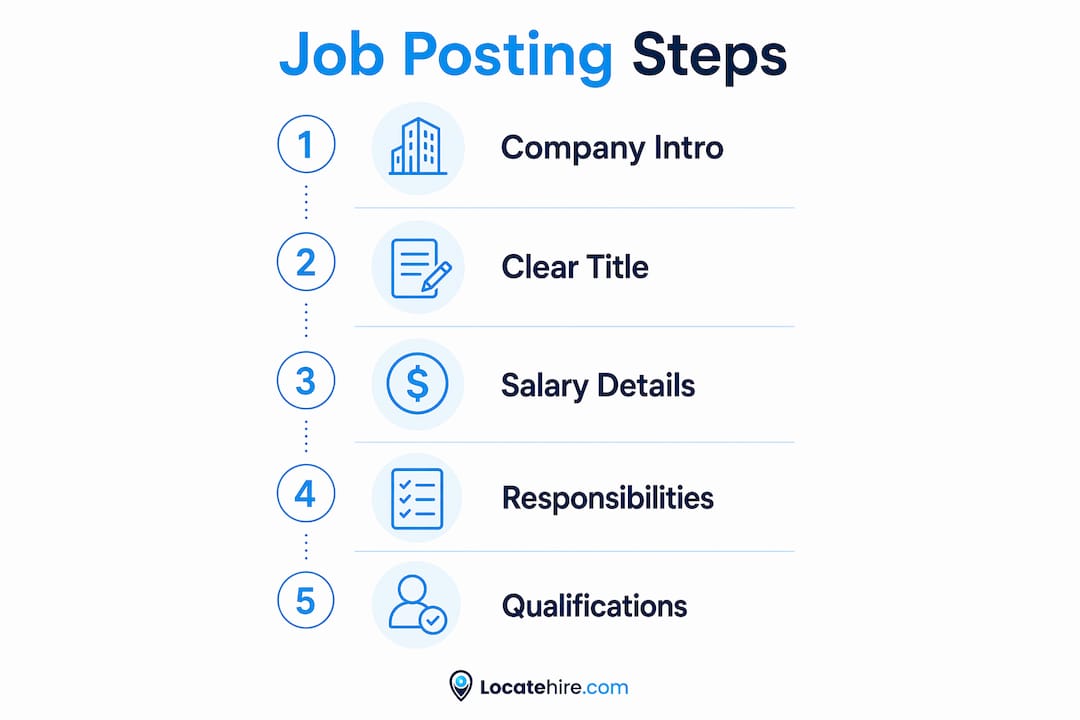
The structure that works best for service industry roles follows a consistent pattern. Open with a one-paragraph company and role summary. Follow with a bulleted responsibilities section. Then list qualifications in two tiers. Close with compensation, schedule, and application instructions. This order mirrors how candidates actually read: they want to know what the job is, whether they can do it, and what they will earn, in that sequence.
ATS optimization matters even for small businesses. Locatehire and similar platforms scan postings for keywords that match candidate searches. Use the exact job title candidates type into search bars, not internal company titles. "Electrician" ranks. "Field Energy Solutions Associate" does not.
Keep your qualifications list tight. Posting ten required credentials for a janitorial supervisor role will cut your applicant pool by more than half, including many people who could do the job well. Three to five genuine requirements perform better than eight aspirational ones.
Pro Tip: Write your application instructions as a numbered list. Candidates who follow multi-step instructions demonstrate attention to detail before they ever walk through your door. It also filters out applicants who skim.
Here is what a well-formatted posting structure looks like in practice:
- Company summary (2-3 sentences, culture and mission)
- Role summary (2-3 sentences, purpose and impact)
- Key responsibilities (5-7 bullet points, outcome-focused)
- Required qualifications (3-5 items maximum)
- Preferred qualifications (2-4 items, clearly labeled optional)
- Compensation and benefits (salary range, health, PTO, schedule)
- Application instructions (numbered steps, clear deadline)
What common mistakes do small business owners make in job postings?
Most small business job postings fail at the same five points. Recognizing them is faster than learning from experience.
-
Using generic buzzwords. Phrases like "self-starter," "team player," and "dynamic environment" appear in so many postings that candidates read past them without processing. Michael Cramer, CEO of Adagio Teas, advises that avoiding generic buzzwords makes ads more authentic and appealing. Replace "self-starter" with a specific behavior: "You manage your own daily route without supervisor check-ins."
-
Omitting pay, location, or schedule. Candidates treat missing information as a red flag. If your electrical company requires travel within a 50-mile radius, say so. If the schedule is Tuesday through Saturday, say so. Surprises in the interview stage waste everyone's time and damage your reputation as an employer.
-
Using gimmicky or internal job titles. "Happiness Engineer" and "Rockstar Technician" do not appear in any job board search. Candidates cannot find you, and the ones who do may question your professionalism. Use the title the industry recognizes.
-
Listing exhaustive requirements. A retail store manager posting that requires an MBA, five years of management experience, bilingual fluency, and POS system certification will sit unfilled for weeks. Limit hard requirements to what is genuinely non-negotiable on day one.
-
Leaving out the hiring timeline. Being upfront about hiring timelines attracts candidates who match your urgency. If you need someone in two weeks, say "We are targeting a start date of date]." Candidates with competing offers will prioritize you if they know you move fast. For more on tightening your full process, read this guide on how to [reduce time to hire for small businesses.
How can job postings strengthen your employer brand?
Every job ad you publish is a public statement about your company. Hiring is brand building, and a poorly written posting erodes your reputation just as surely as a bad Google review. Service businesses compete for the same technicians, cleaners, and crew members, so your posting needs to give candidates a reason to choose you over the company posting next to yours.
The most effective employer branding in a job posting is specific, not aspirational. "We offer health insurance" is forgettable. "We cover 80% of your health insurance premium from day one, with no waiting period" is memorable. Specificity signals that you actually deliver on what you promise.
"Candidates are not just evaluating the job. They are evaluating whether your company is worth their time. A job posting that reads like a legal document tells them the answer is no."
Employers who clarify benefits, culture, and career growth attract applicants who are already aligned with company values, which reduces turnover after hire. For a pool service company, that might mean mentioning that technicians move to senior routes after six months, or that the company provides all equipment and a company vehicle. Growth paths matter to candidates even in trade roles.
Here is what to include when writing job announcements that double as employer brand content:
- One sentence on company mission or values, written in plain language
- Specific benefits with actual numbers (coverage percentages, PTO days, bonus amounts)
- A career progression path, even if it is one step: "Technicians who perform well are considered for lead roles within 12 months"
- A note on team culture that is honest, not promotional: "Our crew of 12 works independently but meets weekly to solve problems together"
- A professional online presence that backs up your claims. A credible web presence for local services reinforces everything your posting says about your company
Understanding how to distribute your job posting across the right channels is the next step after you have the content right.
Key takeaways
Writing a job posting that attracts qualified applicants requires salary transparency, outcome-focused responsibilities, and a clear format that respects the candidate's time.
| Point | Details |
|---|---|
| Disclose salary upfront | Postings with pay details are 2.7x more likely to attract quality candidates. |
| Use standard, short job titles | Titles under 70 characters receive four times more applications on job boards. |
| Frame responsibilities as outcomes | Outcome-based descriptions filter for motivated, accountable candidates. |
| Limit required qualifications | Keep hard requirements to 3-5 genuine must-haves to avoid cutting your pool. |
| Treat the posting as a brand asset | Specific benefits and culture details attract candidates aligned with your values. |
What I have learned writing job postings for small service businesses
After working with dozens of small service businesses on their hiring content, the pattern I see most often is this: owners write job postings the way they write contracts. Dense, defensive, and focused on what they need rather than what they offer. That approach works fine for legal documents. It kills job postings.
The businesses that hire fastest are the ones willing to be specific and a little vulnerable in their postings. They say what the job actually pays. They admit the work is physical and the hours are early. They explain why someone would want to work there beyond a paycheck. That honesty does not scare off good candidates. It attracts them, because good candidates are evaluating you just as hard as you are evaluating them.
The other thing I have seen consistently: small businesses treat job postings as one-time documents. They write one, post it, and reuse it for years without testing anything. The businesses that improve their hiring outcomes treat postings like any other marketing asset. They test different titles, adjust the opening paragraph, and track which version gets more applications. That discipline, applied even quarterly, compounds into a real hiring advantage over competitors who never update their ads.
If you are running a service business and struggling to attract qualified applicants, the posting itself is almost always part of the problem. Fix the posting before you spend more on distribution.
— Jeff
How Locatehire helps you post smarter and hire faster
Writing a strong job posting is step one. Getting it in front of the right candidates at scale is step two. Locatehire is an AI-powered recruitment platform built specifically for small service businesses with ongoing hiring needs, from pool service and HVAC to janitorial and electrical. It helps you create optimized job ads, distribute them across multiple job boards simultaneously, and manage incoming applications without the spreadsheet chaos.
If you are ready to stop rewriting the same posting every few months and start building a hiring process that works, Locatehire gives you the tools to do it without a dedicated HR team. Small businesses using the platform report faster time-to-hire and better applicant quality because the system handles distribution and tracking while you focus on running your business.
FAQ
How long should a job posting be?
Most effective job postings run between 300 and 700 words. Shorter postings lack the detail candidates need to self-qualify; longer ones lose mobile readers before they reach the application link.
Should I always include salary in a job posting?
Yes. Postings with salary details are 2.7 times more likely to attract quality candidates, and 17 states plus Washington D.C. now require pay transparency by law. Disclosing pay upfront saves time for both sides.
What job title format gets the most applications?
Use the standard industry title candidates search for, kept under 70 characters. "Plumber" or "Licensed Plumber" outperforms creative internal titles on every major job board.
How do I make my job posting stand out from larger competitors?
Be specific about benefits, culture, and growth paths. Large companies post generic ads. A small business that lists exact insurance coverage, team size, and a realistic career path signals authenticity that corporate postings rarely match.
How often should I update my job postings?
Review active postings every 60 to 90 days. Track application volume and quality, and test one change at a time, such as the title or opening paragraph, to identify what drives better results.