

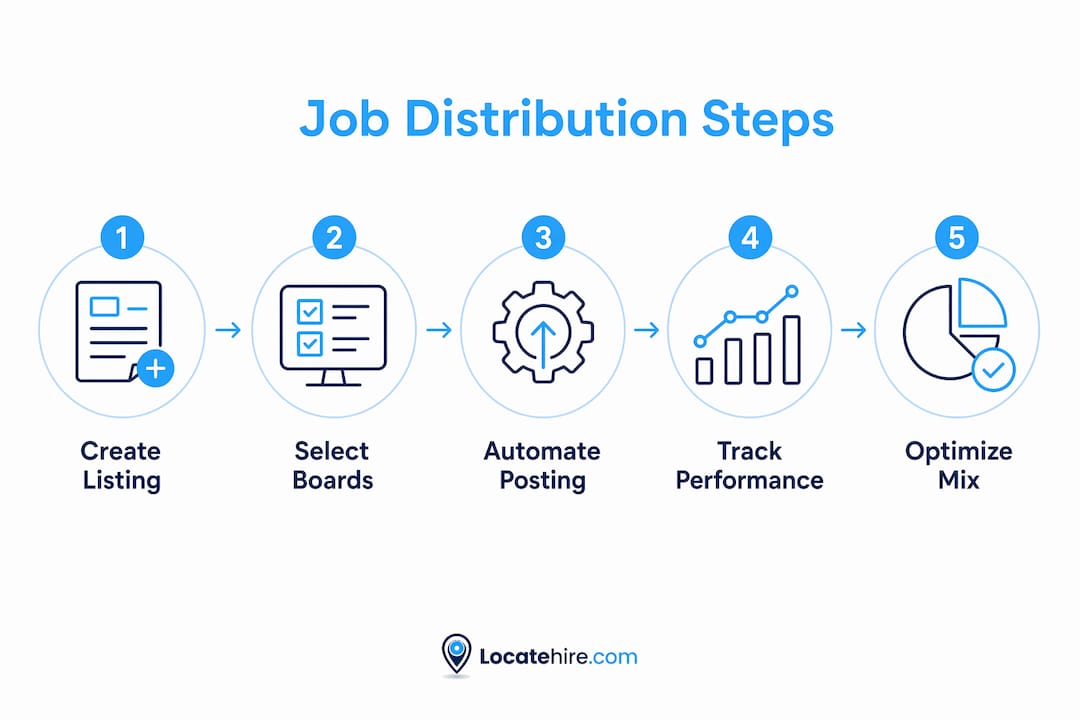
Job posting distribution is the automated process of broadcasting a single job listing across multiple job boards, social networks, and search engines simultaneously from one centralized platform. For small businesses in pool service, HVAC, plumbing, retail, and similar trades, this process is the difference between filling a role in two weeks and watching it sit open for two months. Platforms like Broadbean, SmartRecruiters, and Foundire have made multi-board posting accessible beyond enterprise recruiting teams. The core benefit is simple: one posting reaches dozens of candidate pools without logging into a single extra platform.
Job posting distribution explained: what it is and why it matters
Job distribution, the recognized industry term for this practice, refers to the structured syndication of job listings across a defined network of channels. The informal phrase "job posting distribution" captures the same idea and is how most small business owners search for it. Both terms describe the same workflow: write one job ad, push it everywhere relevant, and track where your best applicants come from.
For a business running five service trucks and needing to hire a technician every quarter, manual posting is a real cost. Logging into Indeed, ZipRecruiter, LinkedIn, and three niche trade boards separately takes hours per requisition. Automated distribution cuts that time from a median of two to four hours per posting down to under 60 seconds for organizations that have adopted it. That time savings compounds fast when you hire repeatedly throughout the year.

The broader strategic value is reach. No single job board captures the entire candidate market. Indeed dominates general search volume, but trade-specific boards like iHireConstruction or Jobsite attract candidates who self-select into skilled labor. Distributing across both categories means your posting finds active job seekers and passive candidates who browse niche communities.
How do job distribution platforms work?
Job distribution platforms operate from a single dashboard where you write your job description once, select your target boards, and publish with one click. The platform handles formatting, account authentication, and posting confirmation for each channel. Centralized recruiting software also enforces consistent employer branding across every board, so your company looks the same on LinkedIn as it does on a local trade board.
The core features that matter most for small businesses include:
- Single-interface publishing: Write once, post to 15 or more boards without switching tabs or re-entering credentials.
- Real-time confirmation: The platform reports which boards accepted the listing and flags any errors immediately, so you know your posting is live.
- ATS integration: Candidates who apply on any board feed directly into your applicant tracking system, eliminating manual resume collection.
- Automated expiration: When a role is filled, the platform removes the listing from all boards simultaneously, preventing stale postings from damaging your employer brand.
- Branding standardization: Job titles, descriptions, and company logos appear consistently across every channel.
Pro Tip: Before selecting a distribution platform, confirm it integrates natively with your ATS. Platforms that require manual CSV exports to transfer candidates add friction that defeats the purpose of automation.
SmartRecruiters, for example, automates posting rules based on predefined business logic like department, location, and job type, so a retail manager opening does not get posted to the same boards as a plumbing apprentice role. That kind of rule-based routing is where distribution platforms move from useful to genuinely powerful for multi-location or multi-trade businesses.
What is the right number of job boards to use?
The research on this is specific: posting to 12 to 18 boards per listing is the recognized best practice. Below 12 boards, you miss meaningful candidate pools. Above 18, the incremental applicant volume rarely justifies the added cost or administrative overhead. That range gives you coverage without waste.
The mix of boards matters as much as the count. A general-to-niche ratio of roughly 60/40 works well for most trade and service businesses. General boards like Indeed and ZipRecruiter deliver volume. Niche boards deliver quality. For specialized roles, adding two to three specialty boards can increase candidate quality by 34% compared to general boards alone. That is a meaningful difference when you are hiring a licensed electrician or a certified HVAC technician.
| Board type | Best for | Candidate quality | Cost range |
|---|---|---|---|
| General boards (Indeed, ZipRecruiter) | High volume, entry-level and skilled trades | Moderate | Free to paid |
| Professional networks (LinkedIn) | Supervisory and management roles | High | Paid |
| Trade-specific boards (iHireConstruction, Jobsite) | Licensed technicians, skilled labor | Very high | Low to moderate |
| Local/regional boards | Geographic targeting, hourly roles | Variable | Low |
| Company career page | Brand-aware candidates | High | Free |
Cost tracking by source is where many small businesses leave money on the table. If your distribution platform cannot tell you which board produced your last five hires, you are spending budget without data. Tracking cost per qualified applicant, not cost per click, is the metric that tells you which boards deserve more budget and which ones to cut. Source-of-hire analytics give you that visibility and let you reallocate spend dynamically based on actual results.
When should you schedule and trigger job postings?
Timing your distribution is not guesswork. Posting between 10 AM and 2 PM on Tuesdays through Thursdays increases first-day applicant volume by 23% compared to off-peak times. Candidates browse job boards during work breaks and lunch hours, so hitting those windows puts your listing at the top of search results when attention is highest.
Setting up a timing strategy takes about five steps:
- Define your trigger: Decide whether postings go live automatically when a requisition is approved, when a recruiter manually initiates them, or on a scheduled delay to hit peak hours.
- Set your time window: Configure your distribution platform to publish between 10 AM and 2 PM in the local time zone of the role's location.
- Schedule for Tuesday through Thursday: Avoid Monday mornings when candidates are catching up on email, and avoid Fridays when engagement drops.
- Set a refresh interval: Most boards deprioritize listings older than 14 days. Schedule automatic refreshes at day 10 to maintain visibility without re-posting manually.
- Set an expiration trigger: Connect your ATS so that when a candidate is marked as hired, the posting closes on all boards within 24 hours.
Pro Tip: Stale postings suffer 67% less engagement on Indeed, and 18% of filled positions remain live for 12 or more days unnecessarily. Automating expiration is not optional. It protects your employer brand and your budget.
Synchronizing distribution to all boards at the same moment also catches passive candidates who browse multiple platforms. A candidate who sees your posting on Indeed at 11 AM and then on LinkedIn at 11:05 AM is more likely to apply than one who sees it on Indeed on Monday and LinkedIn on Thursday.
How does ATS integration and analytics improve your results?
Tight integration between your distribution platform and your applicant tracking system is what separates effective job distribution from the "spray and pray" approach. Without ATS integration, automated posting floods your inbox with unqualified applicants and creates more work than it saves. With integration, every applicant from every board lands in one place, tagged by source, ready for screening.
The analytics layer is where your job distribution strategy gets smarter over time. The metrics worth tracking are:
- Cost per qualified applicant: Total spend on a board divided by the number of applicants who passed your initial screen. This is a sharper signal than cost per click.
- Time to fill by source: Which boards produce hires fastest? Faster boards deserve more budget during urgent hiring cycles.
- Hire quality by source: Track 90-day retention by source board. A board that produces applicants who leave in 60 days is not actually performing well, regardless of volume.
- Application completion rate: If candidates from a specific board start applications but do not finish, the board may be attracting the wrong audience or your posting needs revision.
Google for Jobs adds another layer of visibility worth understanding. Google aggregates job listings from employer websites that include valid JobPosting structured data, specifically JSON-LD markup with title, description, datePosted, salary, and location fields. Your distribution platform or career page needs to implement this markup correctly for your listings to appear in Google search results. This is free visibility that many small businesses miss entirely because their career pages lack the technical setup.
Treating distribution as a performance system rather than a one-time setup means auditing your channel mix quarterly. Cut boards that consistently produce low-quality applicants. Increase budget on boards where your cost per qualified hire is lowest. This discipline is what separates businesses that fill roles efficiently from those that perpetually struggle with hiring.
Key takeaways
Effective job posting distribution combines the right channel mix, precise timing, and tight ATS integration to produce qualified applicants at the lowest cost per hire.
| Point | Details |
|---|---|
| Automate multi-board posting | Distribution platforms reduce posting time from hours to under 60 seconds per requisition. |
| Use 12 to 18 boards per listing | Below 12 misses candidate pools; above 18 rarely justifies the added cost. |
| Post Tuesday through Thursday, 10 AM to 2 PM | This timing window increases first-day applicant volume by 23%. |
| Integrate with your ATS | Without ATS integration, automated posting creates more work than it saves. |
| Track cost per qualified applicant | This metric identifies which boards deserve more budget and which ones to cut. |
What I have learned running distribution for small hiring teams
The biggest mistake I see small business owners make is treating job distribution as a one-time setup. They connect a platform, post to 20 boards, and check the box. Six months later they are paying for boards that have not produced a single hire. The platform is running, but the strategy is not.
The second mistake is the opposite: under-distributing because the process feels complicated. I have worked with HVAC and plumbing companies that posted to two boards and wondered why they could not find licensed technicians. The candidate pool for skilled trades is genuinely thin in most markets. You need to be on every relevant channel, including trade-specific boards that your competitors are probably ignoring.
What actually works is treating your channel mix like a small advertising budget. You test, you measure, and you cut what does not perform. A well-structured hiring process that connects distribution to screening to offer makes the whole system faster and less stressful. The businesses I have seen hire consistently well are not the ones with the biggest budgets. They are the ones who know exactly which two or three boards produce their best technicians and put their money there every time.
One more thing: do not neglect your own career page. Candidates who find you through a job board and then visit your website to learn more are higher-intent applicants. If your career page lacks structured data for Google for Jobs, you are invisible to a significant share of job seekers who search directly on Google. That is a fixable problem that costs nothing except a developer's afternoon.
— Jeff
See how Locatehire simplifies job distribution for small businesses
Running a pool service company or a janitorial crew means you are hiring constantly, and every week a role sits open costs you real money. Locatehire is an AI-powered recruitment platform built specifically for small businesses with ongoing hiring needs. It connects job distribution directly to applicant tracking, so every candidate from every board lands in one place and moves through your screening process automatically.
You get multi-board posting, source tracking, and automated expiration without the enterprise price tag. If you want to understand all your software options before committing, the recruitment software overview on the Locatehire blog breaks down exactly what each tool type does and who it is built for. The goal is fewer open roles, better candidates, and a hiring process that does not consume your week.
FAQ
What does job posting distribution mean?
Job posting distribution is the automated process of publishing a single job listing across multiple job boards, social networks, and search engines simultaneously from one platform. It eliminates manual posting and expands your candidate reach without extra time investment.
How many job boards should I post to?
Best practice is 12 to 18 boards per listing. Below 12 misses meaningful candidate pools, and above 18 the added cost rarely produces proportional results.
What is the best time to post a job listing?
Post between 10 AM and 2 PM on Tuesdays through Thursdays. This timing window produces 23% more first-day applicants compared to off-peak posting times.
Why do I need to integrate job distribution with an ATS?
Without ATS integration, automated posting floods your inbox with unsorted applicants and creates manual work. Integration routes every candidate into one system, tagged by source, ready for screening.
What is Google for Jobs and how do I get listed?
Google for Jobs aggregates job listings from employer websites that include valid JobPosting structured data with JSON-LD markup. You cannot post directly to Google. Your career page or distribution platform must implement the correct technical markup for your listings to appear in Google search results.