

Most hiring managers think applicant screening is just reading resumes. It's not. Understanding how applicant screening works means recognizing it as a structured, multi-stage process that filters dozens of applicants down to a handful of people actually worth your time in an interview. Done right, the applicant screening process protects you from wasted hours, bad hires, and legal exposure. This article breaks down every stage, the tools that help, and the practices that separate businesses that hire well from those that are always starting over.
Table of Contents
- Key takeaways
- How applicant screening works: stages and methods
- Best practices for screening applicants fairly and legally
- Technology's role in screening and its challenges
- Practical steps to build an effective screening process
- My take on what actually makes screening work
- Locatehire makes screening manageable for small teams
- FAQ
Key takeaways
| Point | Details |
|---|---|
| Screening is not interviewing | Screening filters applicants before interviews; it's a separate, earlier stage with its own methods. |
| Structure reduces bias and cost | Using scorecards and defined criteria cuts evaluator inconsistency and strengthens legal defensibility. |
| Async video saves serious time | Replacing phone screens with async video can cut recruiter time by up to 90% without losing candidate signal. |
| Skills tests beat resumes alone | 78% of candidates misrepresent their experience, making skills assessments a more reliable filter. |
| Technology needs human oversight | AI tools must be validated, monitored for bias, and paired with human judgment to stay compliant and fair. |
How applicant screening works: stages and methods
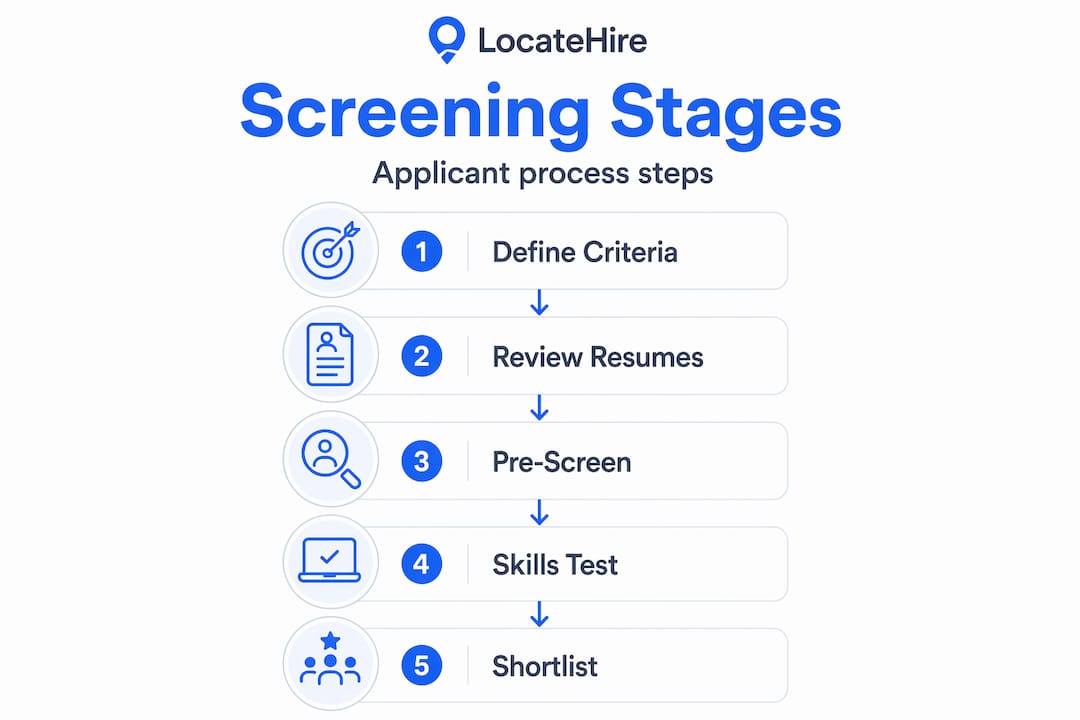
Applicant screening is the process of reviewing applications and conducting initial phone or video interactions to decide whether a candidate warrants a full interview. Think of it as a funnel. At the top you have everyone who applied. At the bottom you have three to five people genuinely worth sitting across from.
The stages typically follow this order:
- Application receipt: Collecting submissions through a job board, career page, or applicant tracking system.
- Resume review: Scanning for minimum qualifications, relevant experience, and red flags.
- Pre-screening: A short phone call or async video prompt to confirm basics like availability, pay expectations, and location.
- Skills assessment: A task or test that measures whether the candidate can actually do the job.
- Shortlisting: Ranking qualified candidates and selecting who moves to the interview stage.
The methods used at each stage vary. Resume screening is the most common starting point, but it's also the weakest signal on its own. Application questions, phone screens, async video pre-screening, and skills tests each add a different layer of information. Structured screening reduces errors and hiring costs while improving the quality of candidates who advance.
Technology plays a big role here. Applicant tracking systems (ATS) can automatically sort and tag applications. AI tools can parse resumes for keywords and rank candidates. But these tools have real limitations, which we'll cover later.
Pro Tip: Don't confuse screening with interviewing. Screening answers "Is this person qualified enough to interview?" Interviewing answers "Is this the right person for the role?" Mixing the two wastes everyone's time.
Best practices for screening applicants fairly and legally
The biggest mistake in screening is starting without a clear definition of what you're looking for. Before the first application comes in, write down your must-have criteria and your nice-to-have criteria. This single step eliminates most of the inconsistency that plagues small business hiring.

Structured scorecards are one of the most underused tools in small business hiring. A scorecard assigns numerical ratings to specific criteria, things like years of relevant experience, required certifications, or demonstrated skills. Every screener uses the same rubric, which means every candidate gets evaluated on the same terms.
Legal compliance is not optional. Equal employment laws apply to your screening process just as much as your interviews. A few things to keep front of mind:
- Avoid criteria that aren't directly tied to job performance. Requiring a college degree for a role that doesn't need one can create disparate impact.
- Never factor in names, schools, or zip codes as proxies for protected characteristics.
- Provide reasonable accommodations for disabled applicants throughout the screening process, including accessible testing formats and alternative assessment options. Failing to do this may constitute discrimination under the ADA.
- Document every screening decision. If you ever face a challenge, your records are your defense.
"Consistent criteria, applied consistently, documented consistently. That's the entire legal compliance framework for screening in three steps."
Bias shows up in subtle places. A candidate with a name that sounds unfamiliar gets less time. A resume from a less recognizable school gets skimmed. These patterns are well-documented and they cost businesses qualified people. Scorecards don't eliminate bias entirely, but they create accountability that makes it harder to act on.
Technology's role in screening and its challenges
AI and automation have genuinely changed what's possible in applicant screening. Resume parsing tools can extract structured data from unformatted documents in seconds. Candidate ranking algorithms can score hundreds of applications against your criteria before you've had your morning coffee. Async video platforms let candidates record answers to your pre-screening questions on their own time, and you review them when it works for you.
Here's a comparison of common screening technologies and what they actually do:
| Tool | What it does | Key risk |
|---|---|---|
| Resume parser | Extracts structured data from resumes | May miss non-standard formats |
| AI ranking algorithm | Scores candidates against defined criteria | Can encode historical bias |
| Async video platform | Records candidate responses for async review | Accessibility barriers for some applicants |
| Skills testing platform | Measures job-relevant abilities directly | Must be validated for the specific role |
| ATS workflow automation | Routes candidates through stages automatically | Reduces human touchpoints too early |
The risks are real. Online hiring technologies are increasingly common, but improper use can lead to unlawful discrimination. An algorithm trained on historical hiring data might systematically downrank candidates from certain backgrounds, not because they're less qualified, but because past hiring patterns were biased.
Job analysis is the foundation of any compliant AI screening tool. Before deploying an algorithm, you need to verify that every input it uses is tied to actual job requirements. Without that validation, you risk screening out qualified candidates in ways that violate EEOC standards.
Pro Tip: Run an adverse impact analysis on your screening results every quarter. If one demographic group is being screened out at a significantly higher rate than others, your criteria or tools need review regardless of intent.
AI tools require ongoing monitoring, accommodation pathways for disabled applicants, and thorough documentation. Technology makes screening faster. It doesn't make it automatically fair.
Practical steps to build an effective screening process
Here's how to build a screening process that actually works, whether you're hiring your fifth employee or your fiftieth.
-
Define your criteria before applications open. Split requirements into must-haves and nice-to-haves. Must-haves are non-negotiable. Nice-to-haves inform your ranking but don't disqualify.
-
Add screening questions to your application. Two or three targeted questions can filter out unqualified applicants before you read a single resume. Ask about availability, specific certifications, or willingness to work certain hours if those are real requirements.
-
Replace phone screens with async video. Async video pre-screening can reduce recruiter time by 85 to 90% compared to phone screens. You get the same information, candidates answer on their schedule, and you review on yours.
-
Add a skills assessment before interviews. Skills-based assessments have been shown to cut time-to-hire by up to 50% and improve quality of hire when used before interviews. For a plumber, that might be a short scenario-based test. For a retail manager, it might be a situational judgment exercise.
-
Score every candidate on your rubric. Use your scorecard for every applicant who makes it past the application stage. No exceptions. This is what makes your process defensible and consistent.
-
Shortlist three to five candidates. Shortlisting more than five for an individual contributor role usually signals that your screening criteria aren't tight enough. If you have twelve people you can't choose between, your filter isn't working.
-
Document everything. Keep records of who applied, who advanced, who didn't, and why. This protects you legally and helps you improve the process over time.
Speed matters more than most small business owners realize. Candidates in trades, retail, and service industries are often talking to multiple employers at once. A screening process that takes two weeks loses people to employers who move in three days.
My take on what actually makes screening work
I've seen a lot of small businesses treat screening as a checkbox. Post the job, read the resumes, call the ones that look good. That approach works fine when you have five applicants. When you have fifty, it falls apart fast, and the decisions get inconsistent in ways that create real problems.
What I've found is that the businesses that hire well aren't necessarily using fancier tools. They're using clearer criteria. They know exactly what they need before they open the application, and they don't deviate from it because someone's resume looks impressive in a vague way.
The shift to skills-based screening is real and it matters. Resumes tell you what someone claims. A skills test tells you what they can do. For a janitorial company hiring a crew lead, a short scenario about handling a client complaint reveals more than three pages of work history.
I'm also skeptical of teams that automate everything and then wonder why their hires don't work out. Technology handles volume. Humans handle judgment. The best screening processes I've seen use automation to filter and humans to decide. When those two roles get reversed, quality drops.
The honest truth is that most small businesses can build a solid screening process in a weekend. Define your criteria, write three application questions, set up an async video prompt, and create a one-page scorecard. That's it. You don't need an enterprise HR system. You need a clear process and the discipline to follow it.
— Jeff
Locatehire makes screening manageable for small teams
If you're running a pool service company, an HVAC operation, or a retail store, you're not hiring once a year. You're hiring constantly, and every bad hire costs you real money and real time. The steps in this article work, but they work even better when your tools are built for the way you actually hire.
Locatehire is an applicant tracking system built specifically for small businesses with ongoing hiring needs. It handles AI resume parsing, async video pre-screening, candidate ranking, and scorecard-based evaluation in one place. You get the structure of an enterprise screening process without the overhead of managing one. If your current hiring process relies on email threads and gut instinct, it's worth seeing what a purpose-built system actually looks like.
FAQ
What is applicant screening?
Applicant screening is the process of reviewing applications and conducting initial phone or video interactions to determine whether a candidate should advance to a full interview. It is the filtering stage that comes before formal interviewing.
How does screening differ from interviewing?
Screening answers whether a candidate meets minimum qualifications. Interviewing goes deeper to assess fit, judgment, and culture. Mixing the two wastes time and produces inconsistent results.
What are the main steps in applicant screening?
The core steps are defining criteria, reviewing applications, pre-screening with questions or video, conducting skills assessments, and shortlisting three to five qualified candidates for interviews.
How do you screen applicants without bias?
Use structured scorecards with defined criteria tied directly to job requirements, avoid factors unrelated to job performance, and run periodic adverse impact reviews to catch patterns you might not notice otherwise.
Can small businesses use AI for applicant screening?
Yes, but AI tools must be validated against actual job requirements and monitored for adverse impact. They work best as a filter for volume, not as a replacement for human judgment in final decisions.