

A bad hire costs a small business at least 30% of that employee's first-year salary in direct replacement costs, with total losses reaching 200% when you factor in lost productivity and team disruption. For a $50,000 role, that means anywhere from $15,000 to over $170,000 gone. The good news: you can avoid bad hire small business disasters without an HR department or expensive software. What you need is a structured hiring system built around defined roles, skills-based evaluation, and objective interviews. This guide gives you that system, step by step.
How to avoid bad hires in your small business before you post a job
The most common hiring mistake starts before you ever read a single resume. Small business owners often post vague job descriptions, attract the wrong candidates, and then wonder why no one fits. The fix is to define the role precisely before you open applications.

Write job descriptions around specific skills and tasks, not credentials. Instead of "5 years of experience required," list the actual work: "Routes 15 service calls per day, diagnoses HVAC faults on-site, and logs work orders in a mobile app." This approach filters candidates by capability, not by resume length. Vague postings attract vague applicants. Specific postings attract people who can actually do the job. Review common job posting mistakes before you write your next listing.
Beyond the job description, you need three tools in place before your first interview:
- Structured interview template: A fixed set of questions tied to 3–5 core competencies for the role
- Scoring rubric: A 1–5 scale for each answer so every candidate gets rated the same way
- Reference check script: Behavioral questions that go beyond "Was this person reliable?" to uncover real performance patterns
One more prerequisite that most small business owners skip: hire based on measurable workload, not emotional pressure. Hiring should be triggered by 20 or more hours per week of tasks you can delegate, not by the feeling that you are overwhelmed. Hiring out of desperation leads to rushed decisions and costly mistakes.
Pro Tip: Spend 50 minutes before your first interview to write your questions and scoring rubric. That one-time investment protects you from a mistake that could cost $15,000 or more.
| Tool | Purpose | When to use |
|---|---|---|
| Structured interview template | Standardizes questions across all candidates | Before the first interview |
| Scoring rubric (1–5 scale) | Removes subjectivity from evaluations | During and right after each interview |
| Skills assessment | Tests real-world capability beyond the resume | Before or after the first interview |
| Reference check script | Uncovers behavioral patterns from past employers | After shortlisting finalists |
How do structured interviews improve hiring decisions?
Structured interviews predict job performance about twice as well as unstructured conversations. That is not a small edge. It is the difference between a confident hire and a costly guess.
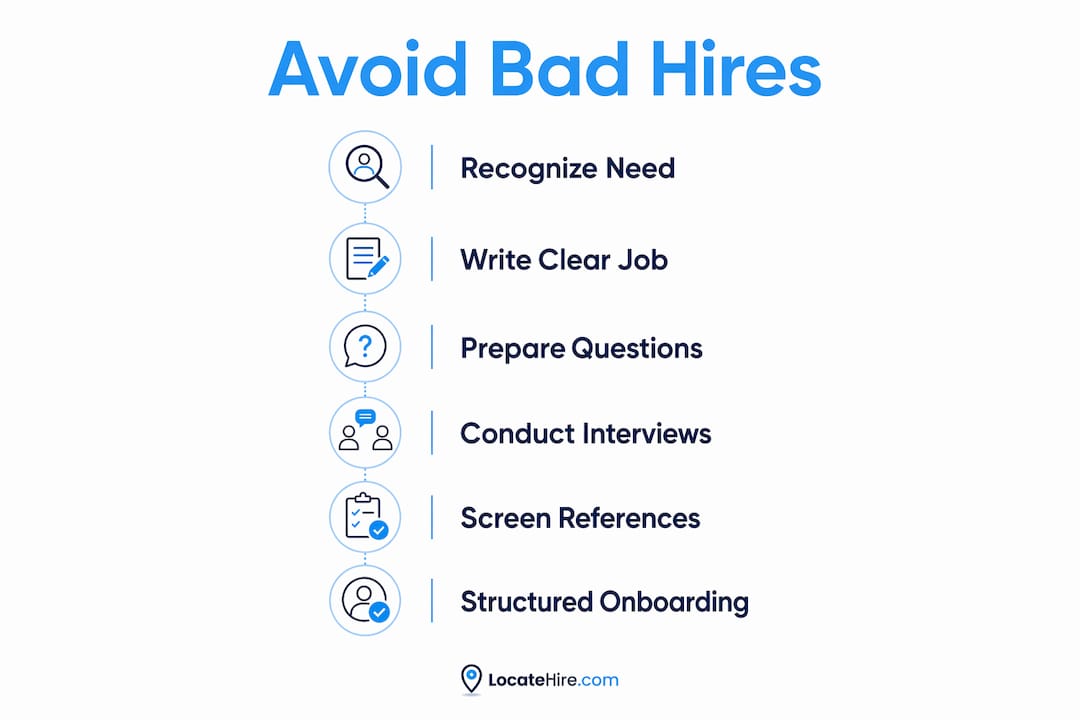
Here is how to build one. Start by identifying 3–5 competencies that matter most for the role. For a plumbing technician, those might be: technical troubleshooting, customer communication, time management, safety compliance, and tool accountability. For a retail associate, swap in product knowledge, conflict resolution, and cash handling. Every question in your interview should map directly to one of these competencies.
Use the same questions in the same order for every candidate. This is not about being robotic. It is about creating a fair comparison. When you ask different questions to different people, you are measuring different things. You cannot compare those results objectively.
Score each answer immediately after the interview, before you talk to anyone else about the candidate. Completing scorecards within 30 minutes post-interview improves accuracy and reduces the memory bias that creeps in when you wait. Use a simple 1–5 scale: 1 means the candidate gave no relevant answer, 5 means they gave a specific, detailed example with a clear outcome.
Pro Tip: Ask behavioral questions using the STAR format: Situation, Task, Action, Result. "Tell me about a time you had an unhappy customer. What did you do?" This forces candidates to give real examples, not rehearsed answers.
| Interview type | Prediction accuracy | Bias risk | Prep time needed |
|---|---|---|---|
| Unstructured (gut feel) | Low | High | None |
| Structured with rubric | High (2x better) | Low | ~50 minutes |
| Panel without scoring | Medium | Medium | Low |
The legal benefit is worth noting too. Structured processes provide the best defense against hiring challenges by documenting objective criteria and consistent scoring. A legal dispute over a hiring decision can cost more than the bad hire itself.
What screening and verification steps actually prevent a bad hire?
Resumes are marketing documents. They show what a candidate wants you to believe, not necessarily what they can do. Skills-based evaluations such as work samples or scenario questions predict actual job performance far better than credentials alone. This matters especially in trades and service businesses where the work is hands-on.
For a pool service technician, ask them to walk you through how they would diagnose a pump that is not priming. For a janitorial applicant, give them a 10-minute timed cleaning task on a small area. For a retail candidate, run a mock customer interaction. These tests take 10–15 minutes and tell you more than a 30-minute resume review. Learn more about how applicant screening works for small businesses before you finalize your process.
Reference checks are where most small business owners go wrong. Asking "Would you rehire this person?" gets you a yes or no. Instead, ask behavioral questions:
- "Tell me about a time this person had to handle a difficult customer. How did they respond?"
- "What type of manager or environment did this person work best in?"
- "What is one area where this person still has room to grow?"
These questions get past the scripted answers and reveal real patterns. A reference who pauses, hedges, or gives vague praise is telling you something. Gut feel hiring favors charismatic candidates over qualified ones. Structured screening with behavioral reference questions corrects that bias before it costs you money.
Balance experience with potential. A candidate with three years of direct experience and a track record of learning fast often outperforms a candidate with ten years of experience and no growth. Look for evidence of adaptability, not just tenure.
How should you structure onboarding to protect your hiring investment?
Hiring the right person is only half the job. If your onboarding is weak, even a great hire can fail in the first 90 days. Structured onboarding increases new hire retention by 58% over three or more years. That number represents real money saved on re-recruiting, retraining, and lost productivity.
Build a 90-day onboarding plan using these steps:
- Day 1–7: Complete all paperwork, provide system access, introduce the team, and assign an onboarding buddy who can answer day-to-day questions without pulling you away from operations.
- Week 2–4: Shadow experienced team members, complete any required certifications, and review performance expectations in writing.
- Day 30 check-in: Sit down for a 20-minute conversation. Ask what is going well and where the new hire feels uncertain. Address gaps before they become habits.
- Day 60 check-in: Review early performance against the metrics you defined in the job description. Adjust workload or training if needed.
- Day 90 review: Conduct a formal performance conversation. Confirm the hire is on track or identify whether a course correction is needed.
Pro Tip: Assign an onboarding buddy on day one. This person does not manage the new hire. They answer the small questions that new employees are afraid to ask their boss, which speeds up the learning curve significantly.
Skipping this process is expensive. Staff turnover accounts for 55% of the total cost of a bad hire. A structured 90-day plan is your best tool for catching problems early and turning a shaky start into a solid long-term employee.
What are the most common hiring mistakes small businesses make?
Most small business hiring mistakes fall into three categories: rushing, guessing, and skipping steps. All three are avoidable.
- Hiring under pressure: Hiring under pressure leads to costlier bad hires than taking an extra week to find the right person. When you are short-staffed and stressed, every candidate looks better than they are. Build your hiring process before you need it, not during a crisis.
- Relying on gut feel: Gut feel favors people who are likable and confident, not necessarily competent. Replace instinct with scorecards. Independent scores completed before group discussion improve fairness and decision quality.
- Vague job postings: A job posting that says "team player with good communication skills" attracts everyone and filters no one. Specific task-based descriptions attract candidates who can actually do the work.
- Skipping reference checks: Most business owners skip references because they feel like a formality. They are not. A 10-minute reference call using behavioral questions can surface a pattern of tardiness, conflict, or dishonesty that no interview will reveal.
- No structured process: Building a hiring process before you need it is the single highest-return investment you can make in your business operations.
Key takeaways
A structured hiring process is the most cost-effective tool a small business has to prevent bad hires and protect its bottom line.
| Point | Details |
|---|---|
| Cost of a bad hire | A bad hire costs at least 30% of first-year salary, reaching 200% with indirect losses. |
| Structured interviews work | Structured interviews predict job performance twice as well as unstructured conversations. |
| Skills beat resumes | Work samples and scenario questions reveal real capability that credentials alone cannot. |
| Onboarding drives retention | A 90-day structured onboarding plan increases retention likelihood by 58%. |
| Avoid pressure hiring | Base hiring decisions on measurable workload thresholds, not emotional urgency. |
What I have learned from watching small businesses hire the wrong way
I have seen the same pattern repeat itself across dozens of small businesses in trades, retail, and services. The owner gets busy, a team member quits, and suddenly they are posting a job and interviewing candidates in the same week. They hire the person who seems the most confident in the interview. Six weeks later, that person is gone, and the owner is back at square one, now more exhausted and more behind than before.
The uncomfortable truth is that most bad hires are not caused by bad candidates. They are caused by a bad process. When you do not define what you need, you cannot evaluate whether someone can deliver it. When you do not score candidates consistently, you are just picking the person you liked most that day.
What I find most encouraging is how little it actually takes to fix this. You do not need an HR team. You do not need expensive software. You need 50 minutes to write a structured interview template, a one-page scoring rubric, and a 90-day onboarding checklist. That is it. The businesses that do this consistently make better hires, keep employees longer, and spend less time re-hiring.
Treat hiring as a core business function, not an interruption. The owners who do that stop losing $15,000 to $170,000 on preventable mistakes and start building teams that actually grow their business.
— Jeff
How Locatehire helps small businesses hire smarter
Running a pool service, HVAC company, or retail operation means you are hiring constantly. Every bad hire slows you down and costs you money you cannot afford to lose.
Locatehire is an AI-powered recruitment platform built specifically for small businesses with ongoing hiring needs. It supports structured candidate screening, tracks applicants across multiple roles, and keeps your hiring process consistent whether you are filling one position or ten. Instead of managing candidates through email threads and spreadsheets, Locatehire gives you one place to screen, score, and hire. If you are ready to stop guessing and start hiring with a repeatable system, Locatehire is built for exactly that.
FAQ
What does a bad hire actually cost a small business?
A bad hire costs at least 30% of the employee's first-year salary in direct costs, with total losses reaching 200% when you include lost productivity and team disruption. For a $50,000 role, that is $15,000 to over $170,000.
How do structured interviews reduce bad hires?
Structured interviews predict job performance about twice as well as unstructured conversations by using consistent questions and a scoring rubric that removes subjective bias from the decision.
When should a small business start the hiring process?
Hire when you have 20 or more hours per week of delegatable tasks, not when you feel overwhelmed. Hiring based on measurable workload thresholds prevents premature or emotionally driven decisions.
How long should small business onboarding last?
A 90-day onboarding program with scheduled check-ins at 30, 60, and 90 days increases new hire retention by 58% and reduces the cost of early turnover significantly.
What is the fastest way to screen candidates effectively?
Use a short skills-based task or scenario question relevant to the role. A 10 to 15-minute work sample reveals real capability faster and more accurately than reviewing a resume alone.