

If you run a pool service company, HVAC business, or retail shop, you already know that an open position costs you money every single day. The industry term for your target is "time-to-hire," and the national median is 44 days for non-executive roles, at around $1,200 per hire. For small businesses, that window is brutal. You cannot wait six weeks to get a technician on the road or a cashier behind the register. This guide breaks down exactly where your recruitment cycle stalls and what you can do to reduce time to hire employees without dropping your standards.
Table of Contents
- Key Takeaways
- How to reduce time to hire employees by finding your bottlenecks
- Writing better job posts and automating early screening
- Cutting interview scheduling delays and running tighter interviews
- Building a talent pipeline and shortening your offer process
- My take on what actually makes hiring faster
- How Locatehire helps small businesses hire faster
- FAQ
Key Takeaways
| Point | Details |
|---|---|
| Diagnose before you fix | Map each hiring stage and measure where days are actually lost before changing anything. |
| Job descriptions drive speed | Clear pay, schedule, and role details reduce unqualified applicants and speed up early screening. |
| Scheduling is the biggest lever | Interview scheduling delays are the single most controllable bottleneck in most small business hiring cycles. |
| Pipelines prevent restarts | Maintaining a candidate pool means you never start a search from zero when a position opens. |
| Technology needs process first | Automating a broken workflow just produces broken results faster. Fix the process, then add the tools. |
How to reduce time to hire employees by finding your bottlenecks
Most small business owners assume their hiring is slow because they cannot find good candidates. The real culprit is almost always hiding somewhere between the steps. The biggest contributor to long time-to-hire is the dead time between stages: waiting for a manager to review a resume, finding a mutual calendar slot, or chasing down interview feedback.
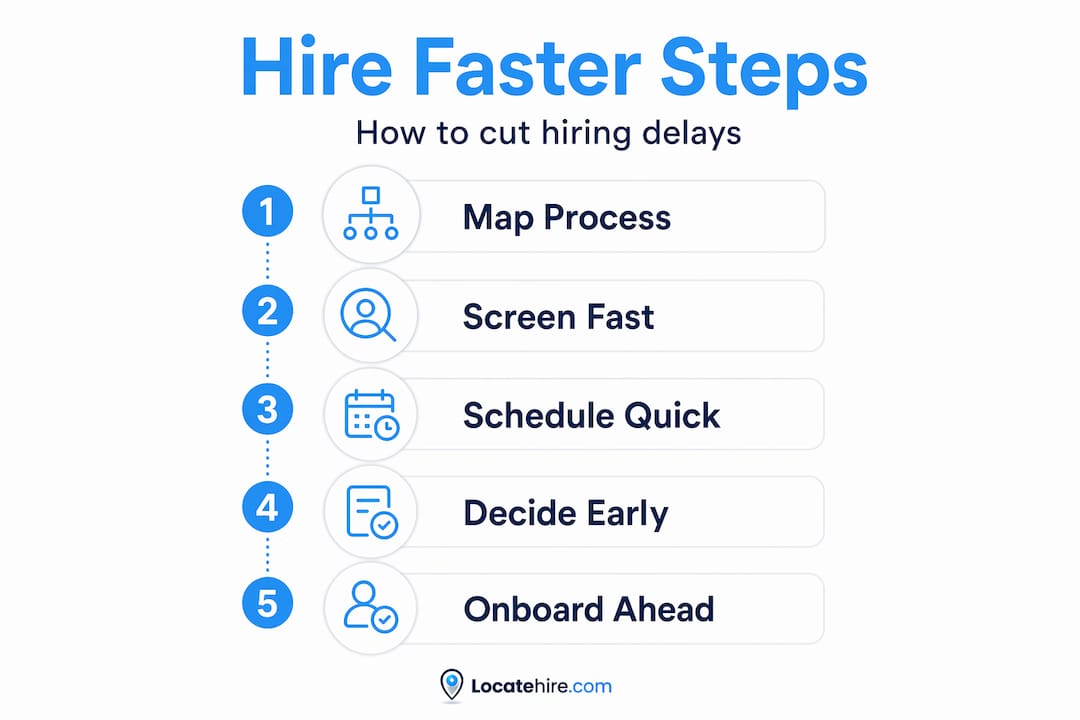
Start by mapping out your current hiring stages and attaching a timestamp to each one. A basic breakdown looks like this:
| Stage | Typical time spent | Common delay cause |
|---|---|---|
| Job posting to first application | 2 to 5 days | Slow approval or vague description |
| Application review | 3 to 7 days | No screening criteria defined |
| Interview scheduling | 2 to 6 days | Manual back-and-forth coordination |
| Interview to decision | 2 to 5 days | Unclear scoring or missing feedback |
| Offer to acceptance | 1 to 4 days | Slow internal approval chain |
Once you see the numbers laid out, the problem usually becomes obvious. For most small businesses in trades and service industries, the scheduling and feedback stages eat the most time.
Common bottlenecks worth auditing right now:
- No pre-defined screening criteria, so every applicant gets full manual review
- Interview scheduling handled entirely by email or phone tag
- Hiring decisions requiring multiple manager approvals with no deadline
- Onboarding paperwork delivered only after the start date
Pro Tip: Set a service-level agreement for each hiring stage. For example, commit to reviewing applications within 24 hours and scheduling interviews within 48 hours of qualification. Just writing these down and sharing them with your team cuts delays significantly.
Writing better job posts and automating early screening
Your job description is doing more work than you think. A vague posting attracts a flood of unqualified applicants, and you end up spending hours filtering through resumes that should never have arrived. A specific posting, one that clearly states pay range, schedule, physical requirements, and must-have certifications, acts as a natural filter before anyone even applies.
Here is a practical sequence for tightening your job description and early screening to speed up hiring:
- State the pay range upfront. Candidates self-select out when the pay does not fit, saving you and them time.
- List non-negotiables clearly. For an HVAC tech role, that might be an EPA 608 certification. For a pool service route, a valid driver's license. Put these in the first paragraph.
- Keep the application short. Half of candidates abandon applications that feel too long or complicated. Three to five targeted questions beat a 20-field form every time.
- Make it mobile-friendly. Most hourly and trade applicants apply from their phones. If your form does not load cleanly on mobile, you are losing good people before they finish.
- Add knockout questions. A simple yes-or-no question like "Do you have a valid driver's license?" automatically filters your pool without any manual review.
Using an applicant screening system that applies these knockout criteria automatically means qualified candidates surface at the top of your list within minutes of applying, not after hours of manual sorting.
Pro Tip: Test your own application on a phone before publishing it. If it takes more than four minutes to complete, candidates are dropping off. Shorten it.
Cutting interview scheduling delays and running tighter interviews
Interview scheduling is where small business hiring processes genuinely fall apart. You find a solid applicant on Tuesday, play email tag for three days, and by Friday they have already accepted an offer somewhere else. Scheduling lead time is one of the most controllable delays in the entire recruitment cycle, and it is the one most businesses have not fixed yet.

The table below shows how traditional scheduling compares to technology-assisted approaches:
| Method | Average scheduling time | Candidate experience |
|---|---|---|
| Phone and email back-and-forth | 2 to 5 days | Frustrating, high dropout |
| Online calendar links | 4 to 24 hours | Better, still some friction |
| Conversational AI scheduling | Under 4 minutes | Fast, professional, consistent |
That last row is not a stretch. Dutchman Hospitality Group used automated scheduling tools and moved 58% of qualified candidates directly into interviews in under four minutes. ISS North America deployed conversational AI and achieved an 85% reduction in time-to-hire, recovering over 10,000 recruiter hours in the process.
Beyond scheduling, the interview itself needs structure. Structured interview protocols improve decision speed because every interviewer uses the same questions and scoring criteria. There is no ambiguous "gut feel" discussion afterward. The decision is faster, and it is more defensible.
Key moves to reduce friction in your interview process:
- Give interviewers a one-page scoring sheet before the call
- Limit first-round interviews to 20 to 30 minutes with a fixed set of questions to ask during hiring
- Require interviewers to submit feedback within two hours, not two days
- Empower your frontline managers to make hire or pass decisions independently
That last point matters more than most owners realize. When a manager has to escalate every decision upward, you add days. Giving managers the authority to move fast at their level is one of the most practical ways to accelerate your hiring strategy without spending a dollar on technology.
Pro Tip: Record a short video of your work environment and include it in the interview invitation. Candidates who see the actual job show up more prepared and drop out less. It sets expectations and saves you from wasting time on poor fits.
Building a talent pipeline and shortening your offer process
The most expensive hiring situation for a small business is starting from scratch every time a position opens. You post, wait, screen, interview, and hire, all under pressure because the role has been empty for two weeks. A candidate pipeline changes that dynamic entirely.
A well-maintained candidate pipeline means you have a pool of pre-screened, interested applicants you can contact the moment a role opens. For businesses like janitorial services or retail that see regular turnover, this is not optional. It is how you stay staffed.
Here is what a functional pipeline looks like in practice:
- Keep applicants who were a "yes but not right now" in a tagged folder in your applicant tracking system
- Send a brief check-in message every 60 to 90 days to warm candidates
- Promote internally before posting externally, so your pipeline includes current employees first
- Collect applications even when you are not actively hiring, using an evergreen job posting
Once you have the right candidate, a slow offer process can undo all your speed gains. The offer stage is often ignored in optimization of the hiring timeline, but it matters. Getting internal sign-off on compensation often takes longer than the interview itself.
Practical steps to cut offer delays:
- Pre-approve salary bands before you post the job, not after you find the candidate
- Use digital offer letters that candidates can sign on their phones
- Set a 24-hour internal approval deadline for offers
- Send onboarding paperwork the same day the offer is accepted
| Onboarding action | Traditional timing | Accelerated timing |
|---|---|---|
| Paperwork sent | First day of work | Same day as offer acceptance |
| System access granted | First day | Day before start |
| First week schedule shared | Morning of start | Week before start |
Faster employee onboarding is not just about speed. It directly impacts whether new hires show up on day one ready to contribute or spend their first week in confusion.
My take on what actually makes hiring faster
I have worked with a lot of small business owners who buy recruiting software thinking it will solve their hiring speed problem on its own. It rarely does, at least not right away. What I have seen consistently is this: technology amplifies whatever process is already in place. If your process is chaotic, the software just makes the chaos happen faster.
The first thing I always tell owners is to measure before you change anything. Pull up your last five hires and write down how many days each stage took. Most people have never done this. When they do, they almost always find the same thing: the interviews were fine, the interviews happened quickly, but the week between "we liked this person" and "we sent the offer" is where everything died.
The second thing I push back on is the instinct to add more interview rounds when you are unsure about a candidate. More rounds do not increase confidence. Structured evaluation criteria do. A second interview is often a signal that your first interview lacked focus, not that the candidate needs more scrutiny.
What I have found actually works is combining three things at once: a tighter job description that screens for real requirements, a scheduling tool that removes calendar friction, and a hiring authority structure that lets managers say yes without escalating to ownership. Get those three things right, and you will cut your recruitment cycle by half without needing any other changes.
— Jeff
How Locatehire helps small businesses hire faster
If you are running a pool service route, a plumbing crew, or a janitorial operation, you are not hiring once a year. You are hiring constantly, and every open position affects your ability to serve customers and grow.
Locatehire is an AI-powered recruitment platform built specifically for small businesses with ongoing hiring needs. It handles the pieces of hiring that eat your time: automated candidate screening with knockout questions, interview scheduling that moves candidates forward in minutes, and digital offer workflows that get signatures the same day. The platform is designed for owners and managers who are not HR professionals. You do not need a recruiter on staff to run a tight, fast hiring process. You just need the right system behind you. See how Locatehire can cut your recruitment cycle and keep your team fully staffed.
FAQ
What is a good time-to-hire benchmark for small businesses?
The national median for non-executive roles is 44 days, but small businesses in trades and service industries should target 10 to 20 days by cutting scheduling delays and pre-approving offer terms before posting.
What causes the most hiring delays in small businesses?
Interview scheduling lead time and slow internal offer approvals are the two biggest controllable delays. Fixing these two stages alone typically reduces your overall cycle by 30 to 50 percent.
How does a candidate pipeline speed up hiring?
A pipeline gives you pre-screened candidates to contact the moment a role opens, so you skip the posting and waiting period entirely. This is especially useful for businesses with regular turnover, like retail or janitorial services.
Do structured interviews actually save time?
Yes. Structured interview protocols reduce the need for follow-up interviews by giving every interviewer a consistent scoring framework. Decisions happen faster because there is nothing left to debate after the call.
Why do candidates drop out before the interview stage?
32% of candidates drop out between scheduling and the actual interview, most often because of poor communication and unclear next steps. Sending a confirmation with logistics, a schedule, and a short video of the workplace dramatically reduces this dropout rate.