

Most HR professionals in small to mid-sized businesses have a resume folder somewhere. Maybe it's a spreadsheet, maybe it's a stack of applications from the last job post. They call it their "pipeline." Understanding what does candidate pipeline mean, in the truest sense, reveals why that folder isn't a pipeline at all. A real candidate pipeline is a living, relationship-driven system of pre-screened, warm candidates you keep engaged over time. It's the difference between scrambling every time a technician quits and having three qualified people ready to call on Monday morning.
Table of Contents
- Key takeaways
- What does candidate pipeline mean, exactly?
- Why pipelines outperform traditional recruiting
- How to build a candidate pipeline that actually works
- Common pipeline pitfalls and how to prevent leakage
- Measuring whether your pipeline is actually working
- My take on pipelines for small business HR
- Locatehire makes pipeline management simple for SMBs
- FAQ
Key takeaways
| Point | Details |
|---|---|
| Pipeline vs. database | A candidate pipeline is dynamic and nurtured, not a static list of old resumes. |
| Proactive beats reactive | Building a pipeline before roles open reduces time-to-fill and improves hire quality. |
| Governance keeps it alive | Monthly status reviews and quarterly persona calibration prevent pipeline decay. |
| Simplicity wins | Fewer pipeline stages reduce bottlenecks and cognitive fatigue for small hiring teams. |
| Automation is the multiplier | AI-powered tools eliminate the manual friction that causes top candidates to go cold. |
What does candidate pipeline mean, exactly?
The candidate pipeline definition that most textbooks offer sounds clean: a structured group of potential candidates at various stages of the hiring process. But the meaning of candidate pipeline goes deeper than that.
A candidate pipeline is proactive, relationship-driven, and segmented. It requires three things to function properly: named ownership (someone is responsible for each segment), a segmentation structure (candidates grouped by role, skill, or geography), and an engagement cadence (you're actively touching candidates on a schedule, not just storing their contact info).
Here's the table that clarifies where a pipeline sits relative to similar concepts:
| Concept | Nature | Activity level | Purpose |
|---|---|---|---|
| Candidate pipeline | Dynamic, segmented | Active, nurtured | Fill current and future roles faster |
| Talent pool | Broad, general | Passive to semi-active | Long-term workforce planning |
| Resume database | Static, unstructured | Passive | Store historical applicant records |
For a pool service company running 15 routes, a resume database is a folder of people who applied two summers ago. A talent pool might be every certified pool technician in your metro area. A candidate pipeline is the six technicians you've already screened, stayed in touch with monthly, and can call the moment someone gives notice.
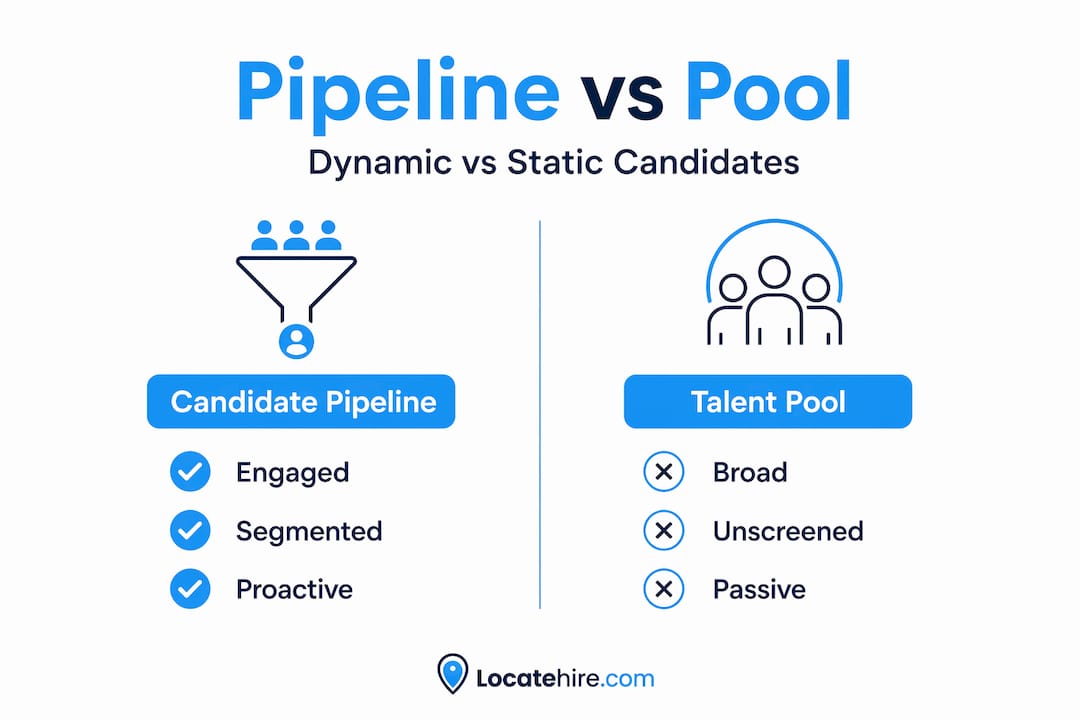
That distinction matters because talent acquisition builds long-term relationships matched to organizational goals, not just immediate vacancy coverage. If your recruiting process only activates when someone quits, you're always behind.
Why pipelines outperform traditional recruiting
Traditional recruiting is reactive. A role opens, you post, you pray, you interview whoever applies in the next two weeks. That cycle is expensive in time, quality, and morale. Candidate pipeline management breaks that cycle.
The strategic advantages are real and measurable:
- Faster hiring: When a role opens, you already have warm candidates. There's no cold sourcing phase. Employer branding and structured pipelines reduce hiring time by 30% and cut turnover by half.
- Better quality of hire: You're comparing multiple pre-screened candidates instead of choosing the best of whoever applied this week. Structured pipelines improve quality of hire by up to 40% when paired with consistent interview processes.
- Stronger candidate experience: Candidates who hear from you regularly, even when there's no open role, develop trust. Clear communication reduces candidate anxiety and keeps people in your pipeline longer instead of accepting a competitor's offer.
"Shifting from 'posting and praying' to proactive talent pipelining is a critical mindset shift for recruiters who want sustainable hiring success."
For an HVAC company that loses two technicians every August, a pipeline means you're never surprised. You've been nurturing a short list of candidates all spring. When July hits, you make calls instead of posting emergency job ads. That's the real importance of candidate pipeline thinking for small businesses.
The employer brand benefit compounds over time. Candidates who had a positive, communicative experience with your company talk about it. In trade industries like plumbing, electrical, and janitorial services, that reputation travels fast through local professional networks.

How to build a candidate pipeline that actually works
Candidate pipeline explained simply: build it in stages, govern it deliberately, and let technology handle the tedious parts. Here's a practical sequence for small to mid-sized businesses:
- Define your hiring personas. Before sourcing anyone, get specific. What does your ideal HVAC tech look like? What certifications, experience range, and location fit your needs? Write it down. Personas give your sourcing direction and your segmentation logic.
- Source candidates before you need them. Use job boards, LinkedIn, referrals, trade school partnerships, and past applicants. Cast a wide net, but filter early. You want people who would realistically say yes to a role at your company.
- Screen and segment. Run a basic screen, whether that's a short call, a skills assessment, or a structured application. Then sort candidates into segments: ready now, ready in 3 to 6 months, longer term. This is candidate sourcing strategy made practical.
- Set an engagement cadence. Decide how often you'll touch each segment. Ready-now candidates might hear from you monthly. Longer-term candidates might get a quarterly check-in or a relevant industry article. The goal is staying warm without being annoying.
- Assign pipeline ownership. Every segment needs a person responsible for it. Without named ownership, candidate pipelines drift into the same static list problem they're supposed to solve.
- Review and calibrate regularly. Monthly reviews to update candidate statuses and quarterly calibration to keep target personas aligned are the governance rhythm that separates living pipelines from decaying ones.
Pro Tip: When designing your pipeline stages, resist the urge to add granularity. Grouping interview rounds into single stages reduces bottlenecks. Over-engineering pipeline stages creates cognitive overload for small hiring teams who are often also doing the job they're hiring for.
The technology layer matters here. An applicant tracking system built for small businesses should give you a visual, Kanban-style pipeline view so you can see exactly where every candidate stands without digging through email threads. Learning how applicant screening works for businesses like yours is a good starting point if you haven't formalized that step yet.
Common pipeline pitfalls and how to prevent leakage
Pipeline leakage is the quiet killer of candidate pipeline management. It happens when strong candidates go cold because no one followed up, or when a promising applicant from three months ago gets lost in a spreadsheet. For small businesses without a dedicated recruiting team, this is extremely common.
The main causes of pipeline leakage are:
- Manual, fragmented tools. When candidate information lives in email, spreadsheets, and sticky notes simultaneously, follow-ups fall through. Administrative friction is the leading cause of pipeline decay.
- No stale-candidate alerts. If a candidate hasn't been contacted in 45 days and there's no system to flag it, they disappear. Automated stale-candidate alerts prevent high-potential talent loss that manual tracking misses entirely.
- Too many pipeline stages. Ironically, complexity causes leakage too. When hiring managers face 12 pipeline stages, they slow down. Candidates wait too long between steps and accept other offers.
- No engagement between openings. The biggest leakage point for SMBs is the gap between hiring cycles. If you only talk to pipeline candidates when a role is open, they've forgotten you, or worse, they've taken a job elsewhere.
The fix isn't complicated, but it does require a system. A unified platform that tracks candidate status, sends automated reminders, and surfaces who needs attention eliminates the manual burden. When your retail store is gearing up for holiday hiring in October, you want to know which candidates from your spring pipeline are still available, without emailing 40 people individually.
Measuring whether your pipeline is actually working
Knowing how to build a candidate pipeline is step one. Knowing whether it's working is step two. These are the metrics that matter for SMB hiring teams:
| Metric | What it measures | Why it matters |
|---|---|---|
| Time-to-fill | Days from role opening to accepted offer | Shows pipeline readiness and sourcing efficiency |
| Candidate engagement rate | Response rate to outreach messages | Indicates pipeline warmth and relationship quality |
| Quality of hire | 90-day retention and performance scores | Measures whether pipeline candidates outperform cold hires |
| Pipeline coverage ratio | Active candidates per open role | Signals whether you have enough depth in each segment |
An AI-powered CRM with visual pipeline interfaces can cut time-to-fill to as low as 14 days by eliminating platform switching and automating scheduling and status tracking. For a janitorial company filling 10 positions a year, that's not a luxury. It's the difference between a full crew and running shorthanded through winter.
Build pipeline reviews into your regular rhythm. A 30-minute monthly check to update statuses and a quarterly hour to revisit your hiring personas will prevent the slow decay that makes pipelines useless. Pair this with effective job descriptions that keep attracting the right candidates into the top of your pipeline consistently.
My take on pipelines for small business HR
I've worked with enough small and mid-sized businesses to see the same pattern repeat. An HR manager hears "candidate pipeline," assumes it means a spreadsheet of applicants, builds one, and then wonders why hiring still feels like putting out fires.
The mindset shift is harder than the mechanics. Moving from reactive recruiting to proactive pipeline building feels slow at first. You're investing time in candidates you can't hire yet. That friction is real, and it's why most SMBs never fully commit to it.
What I've learned is that the businesses that succeed at this aren't the ones with the most elaborate systems. They're the ones that simplify ruthlessly and automate the repetitive parts. Two or three pipeline segments. Monthly outreach that takes 20 minutes. An ATS that surfaces stale candidates automatically. That's it.
The relationship element is what most process-focused guides miss entirely. A candidate pipeline works because people remember how you made them feel during the process. Clear communication, honest timelines, and consistent follow-through build the kind of reputation that makes top tradespeople call you first when they're ready to move. That's not a metric. But it compounds faster than any sourcing strategy I've ever seen.
— Jeff
Locatehire makes pipeline management simple for SMBs
Running a pipeline manually while also managing a crew of electricians or a retail floor is unrealistic. That's exactly why Locatehire built its platform around the realities of small business hiring.
Locatehire gives you a visual, Kanban-style candidate pipeline so you can see every applicant's status at a glance, without toggling between email and spreadsheets. Automated follow-up reminders and stale-candidate alerts mean no one falls through the cracks between hiring cycles. For businesses in pool service, HVAC, plumbing, janitorial, retail, and similar industries, Locatehire's AI-powered recruitment tools are built to help you hire faster and smarter, without adding hours to your week. See how it works for your business at locatehire.com.
FAQ
What does candidate pipeline mean in recruiting?
A candidate pipeline is a proactive, structured system of pre-screened, engaged candidates organized by role or skill segment and nurtured over time. It differs from a resume database because it's active, not passive.
How is a candidate pipeline different from a talent pool?
A talent pool is a broad group of potential candidates with no defined engagement. A candidate pipeline is a smaller, segmented group with named ownership, active outreach, and defined pipeline stages.
How do you build a candidate pipeline from scratch?
Start by defining your hiring personas, then source and screen candidates before roles open. Segment them by readiness, set an outreach cadence, assign ownership, and review the pipeline monthly to keep it current.
What causes candidate pipeline leakage?
Pipeline leakage happens when manual tools, no follow-up reminders, and gaps between hiring cycles allow strong candidates to go cold. Automated alerts and a unified platform are the most effective fixes.
How do you measure candidate pipeline success?
Track time-to-fill, candidate engagement rates, quality of hire at 90 days, and your pipeline coverage ratio. These four metrics give you a clear picture of whether your pipeline is healthy or stagnating.