

Most small business owners treat reference checks like a closing formality. You get the job offer ready, ask for a few names, make a quick call, and move on. That mindset is costing you. The role of reference checks in hiring goes well beyond rubber-stamping a decision you've already made. Done right, they surface the kind of information no resume or interview will ever reveal, and they can be the difference between a great hire and a costly mistake you spend months trying to undo.
Table of Contents
- Key takeaways
- The real role of reference checks in hiring
- How to conduct effective reference checks
- Benefits and limitations of reference checks
- Pitfalls and legal considerations to watch for
- My honest take on reference checks for small businesses
- Build a stronger hiring process with Locatehire
- FAQ
Key takeaways
| Point | Details |
|---|---|
| Checks verify, not investigate | Reference checks confirm employment facts and signal red flags, not uncover deep performance histories. |
| Structure beats casual calls | Standardized questions make checks consistent, legally defensible, and far more useful. |
| Timing and role matter | Checks are most valuable for leadership and sensitive roles; in high-volume entry-level hiring, pair them with assessments. |
| Legal compliance is non-negotiable | Written consent, consistent questions, and documented notes protect you from discrimination claims. |
| Fraud is a real threat | Independently verify reference identities through LinkedIn or company directories, not just candidate-supplied contact info. |
The real role of reference checks in hiring
Reference checks are frequently lumped together with background checks and employment verification, but they serve a different purpose. A background check confirms facts through records. A reference check involves an actual conversation with someone who worked alongside your candidate and can speak to how they showed up every day.
The core function is verification. Reference checks confirm dates of employment, job titles, and whether a candidate is eligible for rehire. What they are not designed to do is give you a detailed disciplinary history or deep performance critique. Most companies have legal policies that prevent managers from sharing anything beyond basic facts, so expecting full performance commentary from a reference call is setting yourself up for disappointment.

That said, what you can learn is still significant. You can detect inconsistencies between what a candidate told you and what their former employer confirms. You can pick up on hesitation, vague answers, or conspicuous enthusiasm. And you can ask questions structured around behavior that predict how someone will perform in your specific role.
Here is what reference checks in recruitment actually accomplish for a small business:
- They verify the core facts on a resume before you commit to a salary
- They reveal how the candidate behaved in a structured workplace setting
- They signal cultural fit problems before they become your problem
- They demonstrate due diligence, which matters if a hire goes wrong and you face a legal dispute
- They protect your team by screening out candidates who misrepresented themselves
One legal point worth knowing: reference checks are separate from federally regulated background checks. However, consistent questioning and documentation are required to avoid Equal Employment Opportunity violations, even in informal reference conversations.
"Reference checks are verification tools, not investigative ones. The absence of detailed performance information isn't a failure of the process. It's the norm. Build your decisions around a structured framework that treats reference checks as one signal among many."
How to conduct effective reference checks
A good reference check is not a casual conversation. It is a structured process with defined goals. Here is how to do it properly, even if you are running a small pool and plumbing operation with no HR department.
-
Request the right number and type of references. The standard practice is to ask for at least three professional references, including a minimum of two direct supervisors. Peers can speak to personality and teamwork, but supervisors speak to accountability, reliability, and performance under pressure. For a technician role in HVAC or electrical work, you want someone who managed the candidate in the field.
-
Get written consent before you call. Have candidates sign a reference authorization form before you contact anyone. This is not federally required, but it protects you legally and signals to candidates that your process is professional. Keep a copy of that authorization in your hiring file.
-
Use structured, standardized questions. Do not wing it. Prepare five to seven questions you ask every reference for the same role. Questions like: "How did this person handle a difficult customer?" or "Would you rehire this person without reservation?" yield far more useful answers than "So, was she a good worker?"
-
Verify the reference is who they say they are. Reference fraud is increasingly sophisticated. Candidates can use paid services to create fake employment histories and fake references who answer calls posing as former supervisors. Before you call, cross-check the reference's name against the company's LinkedIn page or official directory. Do not just dial the number the candidate gave you.
-
Schedule reference checks at the right stage. The most defensible and useful time is post-conditional offer. This means you have extended an offer contingent on satisfactory references, rather than running checks on five candidates simultaneously. It saves time and respects everyone's privacy.
-
Know how to read between the lines. When a reference gives short, clipped answers or says only "I can confirm dates of employment," that itself is information. Neutral or limited feedback can signal a previous employer who has concerns but is constrained by policy. Ask a follow-up like, "Is there anything that would help us set this candidate up for success?" Sometimes that question opens the door.
Pro Tip: If a candidate cannot provide two direct supervisors after several years in the workforce, ask why. Gaps in supervisory references are worth exploring in a follow-up conversation with the candidate before you proceed.
Benefits and limitations of reference checks
The evidence for the importance of reference checks is real, but so are the limits. Understanding both helps you use this tool correctly.
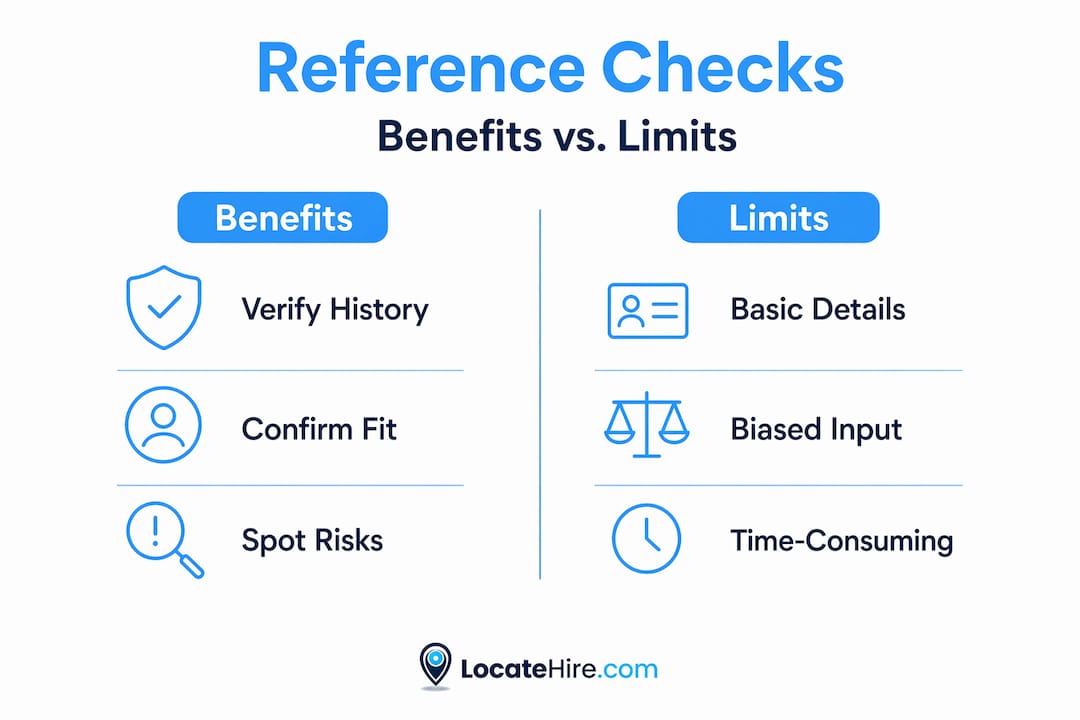
Where reference checks genuinely add value
According to a 2022 SHRM survey, 87% of employers conduct some form of reference check, but the depth and quality vary dramatically. The businesses getting value from this process are the ones treating it as structured intelligence gathering, not box-checking.
For roles that touch customers, money, or your shop's reputation, thorough reference checking is worth every minute. Leadership roles and sensitive positions justify deeper inquiry into behavioral patterns across multiple contacts. A service manager at your janitorial company who handles client relationships and employee schedules deserves a more rigorous check than a seasonal hire.
| Situation | Value of reference check |
|---|---|
| Leadership or management hire | High. Verify behavioral patterns, decision-making, and team impact. |
| Customer-facing service role | High. Confirm reliability, attitude, and prior complaints or praise. |
| Skilled trades (HVAC, plumbing, electrical) | Medium to high. Verify licensing claims and safety behavior. |
| High-volume entry-level or seasonal hire | Lower standalone value. Pair with skills assessments and probationary periods. |
Where the limits show up
Reference checks produce limited value in high-volume entry-level hiring, especially when candidates have sparse work histories. If you run a pool service operation and hire ten seasonal workers every spring, running full reference checks on all of them may create a bottleneck that costs you the good candidates while the slower ones wait around.
In those scenarios, skills assessments, structured working interviews, and paid trial periods often predict performance better than a phone call to a former boss who barely remembers the person. The impact of reference checks is highest when there is a real work history to examine and a structured set of questions to guide the conversation.
The other limit is the information problem. Most reference givers stick to confirming basic facts because their company's legal team told them to. You will rarely get candid negative information, which means you have to treat the absence of enthusiasm as cautiously as a confirmed red flag.
Pitfalls and legal considerations to watch for
Small businesses are not exempt from employment law. A poorly conducted reference check process can create discrimination claims, privacy violations, or even defamation liability. Here is what to watch for.
- Ask only job-relevant questions. Questions about a candidate's family situation, health, or personal life are off-limits regardless of how casually they come up in conversation. Stick to questions about work behavior, attendance, and performance.
- Apply your process consistently. If you run reference checks for one candidate in a role, run them for every candidate in that role. Inconsistency is one of the fastest ways to create a discrimination claim, even when the intent was innocent.
- Document everything. Write down what was asked and what was said during each reference call. Proper documentation is what protects you if a rejected candidate later claims bias. Retain these notes according to your record-keeping policy, typically at least one year.
- Do not act on unverified negative claims. If a reference says something alarming but vague, such as "I'd be careful with that one," do not reject a candidate based solely on that comment. Follow up with a second reference or bring the concern back to the candidate for clarification.
- Handle candidate data carefully. The contact information candidates provide for references is personal data. Do not share it beyond the people running your hiring process, and do not retain it longer than necessary.
Pro Tip: Create a one-page reference check form with your standard questions and a notes section. Using the same form for every role makes your process consistent, documented, and far easier to defend if your decision is ever questioned.
My honest take on reference checks for small businesses
I've seen reference checks done well and done terribly, and the gap between the two is almost always about expectations. The small business owners who get the most out of this process are the ones who stop hoping a reference will tell them something dramatic, and start treating each call as a structured data point.
What I've learned is that the most valuable part of a reference check is often not what was said but what wasn't. A lukewarm recommendation from a direct supervisor, delivered in a flat tone with one-word answers, tells you plenty. You just have to be listening for it.
The mistake I see most often is skipping the structure. Owners call a reference, chat for five minutes, and hang up feeling good because the conversation was friendly. Friendly is not the same as informative. Build a process, even a simple one, and use it every time.
My advice for any small business is to view the reference check process as a standard operating procedure, not a last-minute task. The businesses that treat it seriously are the ones that hire better, turn over less, and spend less time and money cycling through the wrong people.
— Jeff
Build a stronger hiring process with Locatehire
If you are running a pool route, a cleaning crew, an electrical shop, or any service-based operation with ongoing hiring needs, you already know that losing a good employee costs far more than the time it takes to check references properly. Locatehire is built specifically for businesses like yours. It gives you an organized, repeatable hiring workflow that keeps reference checks and candidate evaluations in one place so nothing falls through the cracks. You can track candidates, document reference notes, and move faster without cutting corners. See how Locatehire's hiring tools help small businesses hire smarter and reduce costly turnover.
FAQ
What is the role of reference checks in hiring?
Reference checks verify that a candidate's employment history and resume claims are accurate, and they help predict how that person will perform on the job. They work best as one part of a broader hiring process that includes interviews and assessments.
How many references should I ask for?
The recommended standard is at least three professional references, with a minimum of two direct supervisors. This gives you enough perspective to spot patterns rather than relying on a single opinion.
Are reference checks legally required for small businesses?
Reference checks are not federally required, but running them consistently with documented questions and written candidate consent protects you from discrimination claims and demonstrates due diligence in your hiring process.
What questions should I ask during a reference check?
Focus on job-relevant topics: reliability, how the candidate handled difficult situations, their relationships with coworkers and customers, and whether the reference would rehire them. Avoid anything touching on personal characteristics protected by employment law.
When in the hiring process should I conduct reference checks?
The most practical and legally defensible timing is after you have extended a conditional job offer. This limits checks to your final candidate, saves time, and respects the privacy of candidates still in your pipeline.