

Employee referral programs are the single most cost-effective hiring channel available to small businesses, delivering faster fills, stronger retention, and lower cost-per-hire than job boards or agencies. The industry term is "employee referral program" (ERP), though HR professionals and small business owners often search for why referral programs work hiring to understand the mechanics behind these results. According to 2026 data from Wifitalents, Lever, and Express Employment Professionals, referred candidates are hired roughly 55% faster, stay 25% longer, and cost up to $3,000 less per hire than candidates sourced through traditional channels. For a pool service company, HVAC contractor, or retail operation running on tight margins, those numbers are not abstract. They directly affect payroll, productivity, and profit.
Why referral programs work in hiring: the core mechanics
Referral programs succeed because employee pre-vetting replaces the blind screening that consumes most of a recruiter's time. When a current technician refers a friend for an open HVAC role, that technician already knows whether the candidate can handle the physical demands, show up reliably, and get along with the crew. That informal knowledge transfer is something a resume and a LinkedIn profile cannot replicate.
Referrals act as informal references that reduce hiring friction at every stage of the funnel. The hiring manager receives a candidate with context already attached, which shortens the discovery phase of interviews and accelerates the decision. For small businesses where the owner or HR manager is also handling operations, that time savings is significant.

The speed advantage is measurable. Referrals average 29 days to start versus 39 to 45 days for candidates from career sites, cutting time-to-fill by roughly 40%. Every open position carries a vacancy cost in lost productivity, overtime for remaining staff, and customer service gaps. Closing that gap two weeks faster has real dollar value.
90% of U.S. hiring managers say employee referrals make hiring more efficient, according to an Express Employment Professionals and Harris Poll survey from April 2026. That consensus is not sentiment. It reflects the operational reality that referred candidates require fewer sourcing hours, fewer screening rounds, and fewer interview cycles to reach an offer.
- Referred candidates arrive pre-screened for role fit and culture alignment
- Sourcing time drops because the pipeline is employee-generated, not ad-dependent
- Interview cycles shorten because context is already established
- Offer acceptance rates are higher because the candidate has realistic job expectations
Pro Tip: Build a standing referral candidate pool inside your applicant tracking system. When a position opens, you already have warm, pre-vetted names to contact before posting anywhere externally. This is one of the fastest ways to speed up your hiring process without increasing your recruiting budget.
Why referral hires tend to be higher quality and better cultural fits
Quality is where referral programs separate themselves most clearly from other sourcing channels. Referred candidates are pre-vetted for both role requirements and cultural alignment by someone who already lives inside the organization. That dual filter is something no job board algorithm can replicate.
The retention data makes the quality argument concrete. Referral hires show 25% higher retention than hires from other sources, and 45% of referred employees stay longer than four years compared to just 20% of job board hires. For a janitorial services company or retail operation where turnover is a constant drain on training budgets, that difference compounds quickly over time.
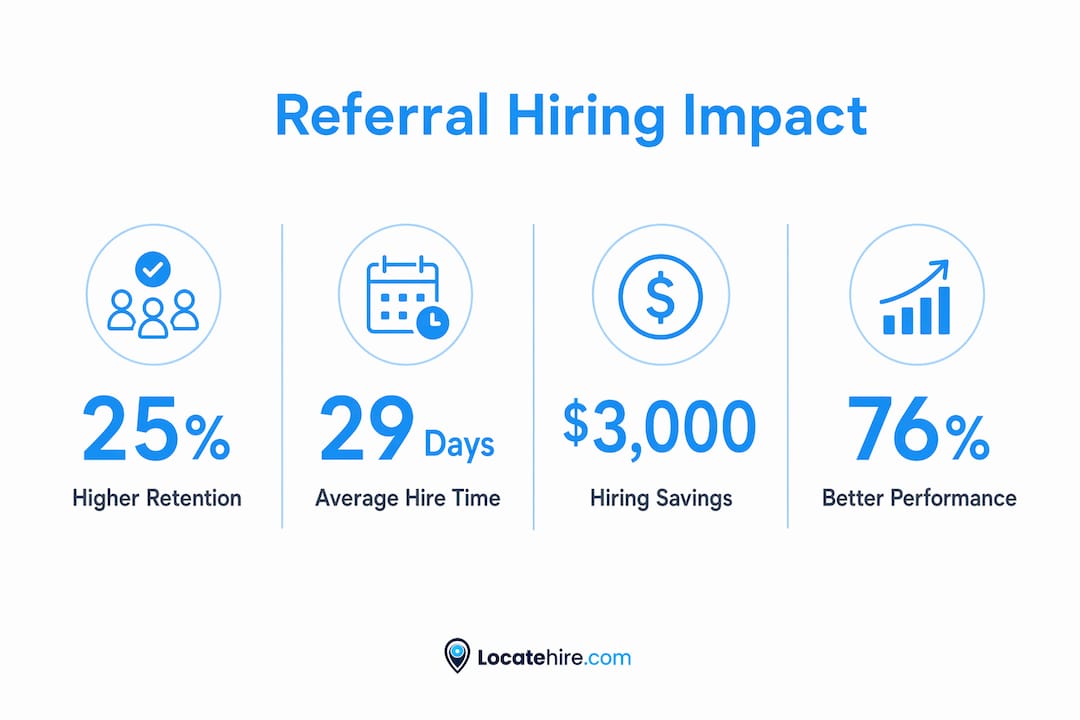
76% of hiring managers believe referred candidates perform the job better than candidates from other sources. This perception aligns with the structural reason referrals work: the referring employee's reputation is on the line. That social accountability creates a natural quality filter that no screening checklist can fully replicate.
| Metric | Referred hires | Job board hires |
|---|---|---|
| Average time to hire | 29 days | 39 to 45 days |
| Retention rate advantage | 25% higher | Baseline |
| Tenure beyond 4 years | 45% | 20% |
| Hiring manager quality rating | 76% rate as better performers | Baseline |
Pro Tip: When onboarding a referred hire, loop in the referring employee during the first 30 days. That peer connection accelerates cultural integration and reduces early turnover, which is the period when most new hires disengage. This also reinforces the referring employee's sense of ownership in the outcome.
The cultural fit advantage is not accidental. Employees refer people they trust, which means they are implicitly vouching for behavioral alignment with the team. For small businesses where one bad hire can disrupt an entire crew, that vouching function is worth more than any structured interview technique. Platforms like Lever and Jobvite are built to capture and track this referral context so it does not get lost between the submission and the interview.
How referral programs reduce hiring costs and increase ROI
The economic case for referral hiring is direct. Referral hiring saves up to $3,000 per hire and costs approximately $1,000 less on average than non-referral sourcing. For a small plumbing or electrical business hiring six to ten technicians per year, that represents $6,000 to $30,000 in annual savings before accounting for reduced vacancy costs.
The savings come from multiple directions at once. Job board postings on platforms like Indeed or ZipRecruiter carry per-post or subscription fees. Staffing agencies typically charge 15% to 25% of a placed candidate's first-year salary. Referral incentives, by contrast, are usually flat bonuses of $200 to $1,000 per successful hire, paid only when the hire is confirmed and retained past a probationary period.
| Cost factor | Traditional sourcing | Referral sourcing |
|---|---|---|
| Average cost per hire | $3,000 to $5,000+ | $1,000 to $2,000 |
| Agency fees | 15% to 25% of salary | None |
| Time-to-fill (days) | 39 to 45 | 29 |
| Retention beyond 4 years | 20% | 45% |
Incentives should be treated as an investment, not an expense. A $500 referral bonus that produces a hire who stays three years and performs well generates far more value than a $2,000 job board spend that produces a hire who leaves in six months. The math is straightforward, and the importance of employee referrals to the bottom line becomes clear when you calculate total cost of turnover rather than just cost per hire.
- Referral bonuses are paid only on successful, retained hires
- Reduced vacancy duration lowers overtime and productivity loss costs
- Shorter interview cycles reduce manager time spent on screening
- Higher retention reduces repeat hiring costs for the same role
What are common pitfalls and best practices for referral programs?
Referral programs underperform for one consistent reason: friction. Programs fail when employees do not understand the target candidate profile or when the submission process is complicated enough to discourage participation. A referral program that requires employees to fill out a five-page form or navigate a confusing HR portal will generate almost no referrals, regardless of the incentive size.
The fix is structural. Clear role descriptions, a one-click or one-email submission process, and visible confirmation that the referral was received are the minimum requirements for participation. Tools like Jobvite, Lever, and applicant tracking systems built for small businesses like Locatehire make this process trackable and transparent without adding administrative burden.
Ongoing program management including visible promotion, KPI tracking, and regular feedback loops is what separates programs that sustain results from those that spike once and fade. Treating a referral program as a one-time announcement is the most common mistake small business owners make.
Here are the referral program best practices that consistently produce results:
- Define the ideal candidate profile clearly before asking employees to refer anyone. Vague job descriptions produce vague referrals.
- Simplify the submission process to a single step. Email, a shared form, or a direct ATS submission link all work. Complexity kills participation.
- Communicate program status regularly. Monthly reminders and updates on open roles keep referrals top of mind without being intrusive.
- Diversify incentives beyond cash. Extra paid time off, public recognition, or a charitable donation in the employee's name can outperform cash bonuses for certain teams.
- Track KPIs consistently. Referral volume, time-to-hire for referred candidates, and 90-day retention rates tell you whether the program is working or needs adjustment.
- Close the feedback loop. Tell referring employees what happened with their referral. Silence after a submission is the fastest way to kill future participation.
Pro Tip: Run a quarterly "referral spotlight" in your team meeting. Recognize employees whose referrals were hired and are performing well. Public recognition costs nothing and generates more referrals than most cash bonuses.
How referral programs affect employee engagement and company culture
Referral programs do more than fill open roles. Employer brand and employee engagement improve when referral programs create a participative hiring culture where employees feel invested in who joins the team. That sense of ownership has measurable effects on morale and retention among existing staff, not just new hires.
When a pool service technician refers a friend and that friend gets hired, the technician's connection to the company deepens. They helped build the team. That psychological investment is qualitatively different from simply showing up to do a job. For small businesses where culture is often the primary competitive advantage over larger employers, this effect is worth cultivating deliberately.
The feedback cycle reinforces itself over time. Employees who make successful referrals are more likely to refer again. New hires who came through referrals are more likely to refer their own networks once they are settled. This compounding effect means a well-run referral program becomes a self-reinforcing hiring channel rather than a one-time tactic.
- Employees who refer candidates report feeling more valued and connected to company goals
- Referred new hires integrate faster because they already have a peer relationship inside the team
- Culture fit improves because peer recommendations carry implicit behavioral context
- Employer brand strengthens as employees become active advocates for the company
For small businesses in industries like HVAC, electrical, or retail, where word-of-mouth reputation drives both customer acquisition and talent attraction, a referral culture creates a compounding advantage that is difficult for competitors to replicate. Understanding how small business hiring differs from enterprise recruiting helps clarify why this channel punches above its weight at smaller scale.
Key takeaways
Referral programs work in hiring because employee pre-vetting reduces screening time, improves cultural fit, and delivers hires who stay longer and cost less to acquire than candidates from any other source.
| Point | Details |
|---|---|
| Speed advantage | Referred candidates are hired in 29 days versus 39 to 45 days for job board candidates. |
| Quality and retention | Referred hires show 25% higher retention and 45% stay beyond four years versus 20% for job board hires. |
| Cost savings | Referral hiring saves up to $3,000 per hire compared to traditional sourcing channels. |
| Program design matters | Clear role profiles, simple submission, and regular communication determine whether a program succeeds or stalls. |
| Culture multiplier | Employees who refer candidates feel more invested, creating a self-reinforcing cycle of engagement and advocacy. |
Why I think most small businesses underuse their best hiring asset
I have spent years watching small business owners post the same job on Indeed every three months for the same role, pay the same fees, and wonder why they keep getting the same mediocre results. The answer is almost always sitting in their own team, untapped.
The research is unambiguous. Referral programs deliver faster hires, better performers, and lower costs. But the reason most small businesses do not get those results is not lack of interest. It is lack of system. They announce a referral bonus once, get a few names, and then forget about it until the next vacancy. That is not a program. That is a one-time ask.
What actually works is treating referrals as a permanent, managed channel with the same discipline you would apply to any other part of your business. Set measurable goals. Track the numbers. Review what is working quarterly. Recognize the employees who participate. Use an ATS that makes submission and tracking frictionless, because if it is hard to submit a referral, your employees will not do it.
Small businesses have a structural advantage here that large enterprises do not. Your employees know each other, know the work, and know the community. A referred candidate in a 15-person plumbing company arrives with more contextual trust than a referred candidate at a 5,000-person corporation. That intimacy is an asset. Use it deliberately, not accidentally.
— Jeff
How Locatehire helps you run a referral program that actually works
Locatehire is an applicant tracking system built specifically for small businesses with ongoing hiring needs, including pool service, HVAC, electrical, plumbing, janitorial, and retail operations. It gives your team a simple, trackable way to submit referrals without adding paperwork or complexity to your hiring process.
With Locatehire, you can track referral submissions alongside all other candidates, measure time-to-hire by source, and see which employees are generating your best hires. That visibility turns a referral program from a vague perk into a measurable hiring channel. If you are ready to make referrals a consistent part of how you hire with Locatehire, the setup takes less time than your next job board posting.
FAQ
Why do referral programs work better than job boards?
Referral programs produce pre-vetted candidates with built-in cultural context, which job boards cannot provide. Referred hires are hired 55% faster and stay 25% longer than candidates sourced through career sites.
How much can a referral program save per hire?
Referral hiring saves up to $3,000 per hire on average compared to traditional sourcing methods like job boards and staffing agencies. The savings come from lower sourcing costs, shorter vacancy periods, and higher retention rates.
What makes a referral program fail?
Referral programs underperform when employees do not understand the target role or when the submission process is too complicated. Simplifying the process and communicating open roles regularly are the two most direct fixes.
How do you measure referral program success?
Track referral volume, time-to-hire for referred candidates, offer acceptance rate, and 90-day retention. Ongoing program analytics including these KPIs are what separate programs that improve over time from those that plateau.
Are referral incentives worth the cost?
A referral bonus of $200 to $1,000 is almost always less expensive than a job board fee or agency placement cost, and it produces a hire with higher retention. The incentive pays for itself when measured against total cost of turnover rather than just cost per hire.