

Your job offer acceptance rate is the percentage of formal offers candidates accept, calculated by dividing accepted offers by total offers extended. For small businesses competing against larger employers, this metric directly determines whether your recruitment effort converts into actual hires. A healthy acceptance rate falls between 85–90% across most industries, and rates below 70% signal a systemic problem worth fixing immediately. The good news is that most small businesses can improve job offer acceptance rate through faster decisions, better communication, and smarter candidate engagement — without raising salaries across the board.
What factors affect job offer acceptance rates?

Speed is the single biggest factor most small business owners underestimate. Delaying an offer by more than 48 hours after an interview drops acceptance rates by 20–30%. Candidates in active job searches rarely wait. They take the first reasonable offer that arrives, not necessarily the best one.
The factors that most directly affect whether a candidate says yes include:
- Timing of the offer. A slow decision cycle gives candidates time to accept competing offers or lose enthusiasm. Speed beats compensation as the top reason candidates accept another offer first.
- Compensation transparency. Including pay ranges upfront in job postings improves acceptance rates by 15–25%. Candidates who already know the range do not decline at the offer stage over salary surprises.
- Who delivers the offer. When the hiring manager personally extends the offer rather than routing it through HR or email, acceptance rates improve by 10–15%. A direct conversation signals respect and genuine interest.
- Candidate experience during interviews. Most acceptance decisions are actually made during interviews, not at the offer letter stage. Compensation, flexibility, motivation, and decision timeline signals all predict whether a candidate will say yes.
- Competing offers and counteroffers. Candidates in skilled trades, retail, and service industries often hold multiple offers simultaneously. Failing to address this reality before extending your offer leaves you exposed.
Understanding these factors gives you a clear map of where your process leaks candidates. The fix is rarely one thing. It is usually a combination of speed, communication, and relationship quality.
How to build a faster recruitment process that increases offer acceptance
A faster process is not about cutting corners. It is about removing unnecessary delays that cost you candidates without adding any value to your hiring decision.
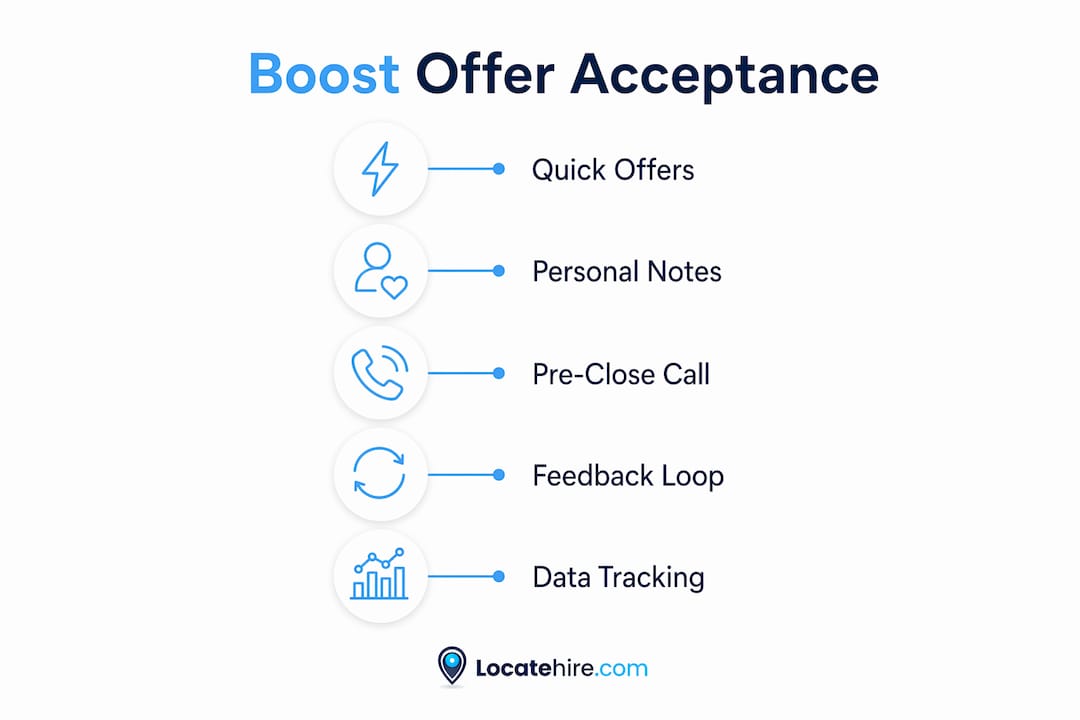
- Set internal SLAs for every stage. Define how many business days each step should take, from application review to interview scheduling to offer delivery. Without a written target, decisions drift. A 48-hour offer window after the final interview is a realistic and effective standard for most small businesses.
- Consolidate interview rounds. Two well-structured interviews beat four loosely organized ones every time. Each additional round adds days to your timeline and gives candidates more opportunities to accept elsewhere. Audit your current process and cut any round that does not produce a new hiring signal.
- Use technology to speed up offer creation. An applicant tracking system built for small businesses, like Locatehire, lets you move candidates through stages, generate offers, and communicate decisions without manual back-and-forth. The faster your internal workflow, the faster your offer lands. You can learn more about reducing time to hire with practical steps built specifically for small business hiring.
- Track why candidates decline. Every declined offer is data. Log the stated reason in a structured format, whether it is compensation, a competing offer, role clarity, or schedule concerns. Patterns across five or ten declines will show you exactly where your process breaks down.
- Run a quarterly process audit. Review your acceptance rate, your decline reasons, and your average time to offer every three months. Small adjustments made consistently produce better results than a single overhaul once a year.
Pro Tip: Set a calendar reminder for the first Monday of each quarter to pull your offer acceptance data. Fifteen minutes of review every 90 days will surface patterns you would otherwise miss entirely.
Strategies to build candidate relationships that boost offer acceptance
Candidates accept offers from employers they trust. Trust is built before the offer letter arrives, not during it.
- Have a pre-close conversation. Before sending a formal offer, call the candidate and talk through the role, the compensation range, and their current situation. Pre-close conversations result in 5–10% higher acceptance rates because they surface objections early enough to address them. You learn about competing offers, salary gaps, or schedule concerns while you still have time to respond.
- Prepare candidates for counteroffers. Candidates in HVAC, electrical, plumbing, and pool service often receive counteroffers from their current employer the moment they give notice. Walk candidates through this scenario before they accept your offer. Helping candidates mentally process counteroffer scenarios increases the likelihood they follow through with you.
- Tailor the offer beyond base pay. Flexible scheduling, paid training, uniform allowances, and clear advancement paths matter to trade and service workers. Ask candidates during the interview what matters most to them, then reflect those priorities in your offer conversation.
- Have the hiring manager make the call. Routing offers through an automated email or a third party removes the human connection that makes candidates feel valued. Treating hiring managers as active participants in relationship-building, not just evaluators, is one of the most effective and underused tactics available to small businesses.
- Communicate clearly and consistently. Candidates who hear nothing between their interview and their offer letter fill the silence with doubt. A brief check-in message two days after an interview costs you nothing and keeps candidates engaged.
Pro Tip: After every final interview, send a short personal note from the hiring manager within 24 hours. It does not need to be long. Three sentences confirming interest and setting a timeline for the decision is enough to hold a candidate's attention.
Building a strong hiring process from the start makes these relationship-building steps easier to execute consistently, especially when you are hiring repeatedly for the same roles.
How to use data and feedback to keep improving your acceptance rate
Measuring your acceptance rate once is useful. Measuring it systematically over time is what actually changes your results.
The most effective approach is to build a structured decline reason taxonomy. This means categorizing every declined offer into one of a fixed set of reasons: compensation, competing offer, schedule conflict, role clarity, location, personal reasons, or counteroffer accepted. Using 8–10 consistent categories and reviewing them quarterly gives you targeted insight into hiring obstacles rather than a vague sense that something is wrong.
| Metric to track | What it tells you |
|---|---|
| Offer acceptance rate by role | Which positions consistently lose candidates and why |
| Average time from interview to offer | Where your process slows down and costs you candidates |
| Verbal vs. signed acceptance gap | How many candidates say yes verbally but never sign |
| Decline reason frequency | Which objections appear most often across all offers |
| Acceptance rate by hiring manager | Whether specific managers need coaching on offer delivery |
Candidate feedback surveys add another layer. A short three-question survey sent to declined candidates, asking about their experience and decision, provides qualitative context that numbers alone cannot give you. Most candidates will respond honestly when the survey is anonymous and brief.
The verbal versus signed acceptance gap deserves special attention. A candidate who says yes on the phone but delays signing often has an unresolved concern. Following up within 24 hours of a verbal acceptance and asking directly if they have any questions closes this gap before it becomes a decline.
Key takeaways
Improving your job offer acceptance rate requires speed, personal communication, and a structured feedback loop working together across every stage of your hiring process.
| Point | Details |
|---|---|
| Speed is the top priority | Extend offers within 48 hours of the final interview to prevent candidates from accepting elsewhere. |
| Pre-close conversations work | Talking through concerns before the formal offer reduces late-stage declines by 5–10%. |
| Hiring managers should deliver offers | Personal outreach from the hiring manager improves acceptance rates by 10–15%. |
| Pay transparency reduces surprises | Posting salary ranges upfront eliminates compensation-related declines at the offer stage. |
| Track decline reasons systematically | Categorized decline data reviewed quarterly reveals the specific fixes your process needs. |
What I have learned about small business hiring after years of watching it up close
Small business owners often treat the offer stage as the finish line. It is not. By the time you send that offer letter, the candidate has already made up their mind based on everything that happened before it. The interview experience, the speed of your follow-up, the tone of your hiring manager, and whether you ever asked what they actually care about. Those are the real decision points.
The mistake I see most often is skipping the pre-close conversation because it feels awkward or presumptuous. Owners worry about seeming too eager. But candidates interpret silence as indifference. A direct conversation that says "we want you, here is what we are thinking, what questions do you have?" is not pushy. It is professional. It is also the single fastest way to find out if your offer has a problem before you formally extend it.
The other pattern worth naming is the tendency to blame compensation for every decline. Sometimes pay is the issue. But hiring decisions are made during interviews, not at the offer stage. If your acceptance rate is low, look upstream first. Are your interviews giving candidates a clear picture of the role? Are your hiring managers building genuine rapport? Are you moving fast enough to stay in the running? Fix those things, and your acceptance rate will follow.
— Jeff
How Locatehire helps small businesses win more offers
Small businesses hiring for pool service, HVAC, janitorial, electrical, plumbing, and retail need a hiring process that moves fast and stays organized without requiring a full HR team to run it.
Locatehire is an applicant tracking system built specifically for small businesses with ongoing hiring needs. It helps you move candidates through your pipeline quickly, keep communication consistent, and get offers out before candidates disappear. You can speed up your hiring process and reduce the delays that cost you your best candidates. Visit Locatehire to see how it fits your business.
FAQ
What is a good job offer acceptance rate?
A healthy acceptance rate falls between 85–90% for most industries. Rates below 70% indicate a systemic problem with your offer process, compensation, or candidate experience.
How long should you wait before extending a job offer?
Extend your offer within 48 hours of the final interview. Waiting longer than 48 hours drops acceptance rates by 20–30% as candidates accept competing offers or lose interest.
Does salary transparency actually improve acceptance rates?
Yes. Posting pay ranges upfront improves acceptance rates by 15–25% because candidates self-select early and compensation surprises at the offer stage are eliminated.
What is a pre-close conversation in recruiting?
A pre-close conversation is a call with the candidate before the formal offer letter is sent. It surfaces concerns, competing offers, and salary gaps early, resulting in 5–10% higher acceptance rates.
Why do candidates decline offers even after saying yes verbally?
Verbal acceptances fall through when candidates have unresolved concerns, receive counteroffers, or lose confidence during the delay between verbal and written offers. Following up within 24 hours of a verbal yes and asking directly if they have questions closes most of these gaps.