

The offer letter process is the step where an employer formally puts a job offer in writing, clearly stating employment terms to secure candidate acceptance and protect both parties legally. For small business owners in service industries like HVAC, janitorial, pool service, and electrical contracting, this step is not optional paperwork. It is the moment that separates a verbal handshake from a binding professional commitment. The role of offer letter process in your hiring workflow determines whether a great candidate shows up on day one or accepts a competing offer instead. Industry best practices recommend sending the written letter within 24 hours of a verbal offer, with a clear acceptance deadline attached.
What role does the offer letter process play in hiring?
The offer letter process formalizes a job offer in writing immediately after a verbal conversation, creating a documented record of agreed employment terms. HR professionals refer to this document as an employment offer letter or letter of offer, and it serves three distinct functions: legal protection, expectation setting, and candidate engagement. All three matter equally for small businesses where one bad hire or one disputed term can cost weeks of productivity.
A well-written offer letter is not just administrative. It is a trust builder that can tip candidates toward accepting your offer over a competing one. For a plumbing company or a retail shop hiring seasonal staff, that distinction is real. Candidates evaluate how professionally you communicate before they ever clock in.

The significance of job offer letters also shows up in dispute prevention. Clear, standardized letters reduce misunderstandings and litigation risk by confirming compensation, title, and responsibilities before the first day of work. A candidate who later claims they were promised a different salary has no ground to stand on when the offer letter says otherwise.
What key information should an effective offer letter contain?
A complete offer letter gives the candidate everything they need to make a confident decision. Missing even one element creates confusion, delays acceptance, or opens the door to disputes later. A job offer letter should clearly state job title, salary, start date, schedule, location, supervisor, benefits, employment classification, contingencies, and response deadline.
Every effective offer letter includes these core components:
- Job title and position description. State the exact title and a brief summary of primary responsibilities. Avoid vague labels like "general worker" that mean different things to different people.
- Compensation details. List base salary or hourly rate, pay frequency, any bonus structure, and a summary of benefits such as health insurance or paid time off.
- Work schedule and location. Specify days, hours, and the physical work site. For field service roles in HVAC or pool service, include whether travel between job sites is expected.
- Reporting structure. Name the direct supervisor or manager. This removes ambiguity on day one.
- Employment classification. Identify whether the role is full-time, part-time, or seasonal, and whether the employee is exempt or non-exempt under the Fair Labor Standards Act.
- At-will employment disclaimer. State clearly that employment is at-will and that the letter does not constitute a contract. This single line protects you legally in nearly every state.
- Contingencies. List any conditions the offer depends on, such as a background check, drug screening, or proof of license for trades roles.
- Acceptance deadline. Give the candidate a specific date to respond.
Pro Tip: Use a consistent offer letter template across all hires. Inconsistent language between letters for similar roles creates legal exposure and signals disorganization to candidates. You can find structured cover letter templates that illustrate how clear formatting builds candidate confidence.
Offer letter templates are particularly valuable for service businesses that hire repeatedly for the same roles. A pool service company hiring five technicians in march should send five letters that look and read identically, with only the candidate name and start date changed.
How does timing and communication affect offer acceptance?
Speed is the single biggest variable in whether a candidate accepts your offer or takes another one. Delays caused by manual approvals can add days to the process, and those days cost you candidates who are actively interviewing elsewhere.
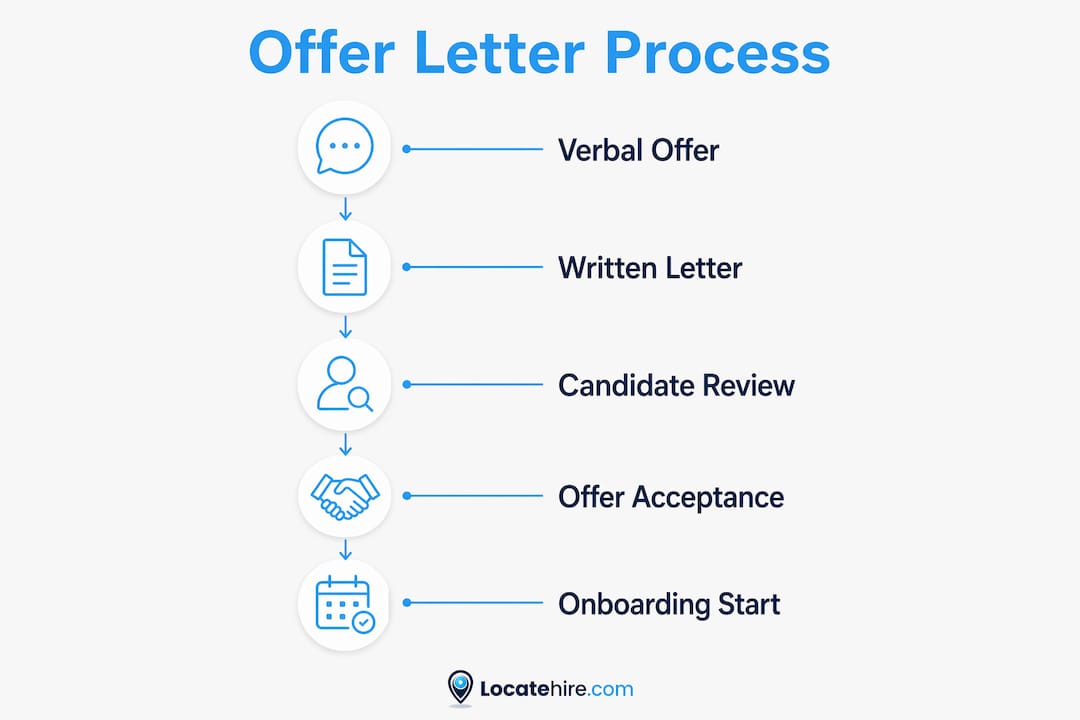
The steps in offer letter process that produce the highest acceptance rates follow this sequence:
- Make a verbal offer first. Call the candidate before sending anything in writing. The Verbal-First Protocol increases acceptance rates by enabling immediate engagement and giving the candidate a chance to ask questions before committing on paper.
- Send the written letter within 24 hours. Sending quickly after a verbal offer with a clear deadline reduces candidate loss. The momentum from a positive phone call fades fast.
- Set a realistic acceptance deadline. Standard practice is 3–7 business days for most roles. Senior or specialized positions can extend to 14 days. Shorter windows create pressure; longer ones invite competing offers.
- Follow up proactively at 48 hours. Candidates who go silent post-offer are often negotiating elsewhere. A brief check-in call or email at the 48-hour mark surfaces hidden objections and recovers potential acceptances before the deadline passes.
- Confirm acceptance in writing. Once the candidate signs, send a brief confirmation email with next steps and the start date. This closes the loop and begins the onboarding handoff.
Pro Tip: Never rely solely on email for the initial offer. A phone call before the letter signals that you value the candidate as a person, not just a form to fill out. That tone carries through to their first week on the job.
Automation tools that handle routing and approvals compress offer letter generation from days to hours. For a janitorial company hiring 20 workers a month, that compression is the difference between filling roles on schedule and running short-staffed.
What legal considerations does the offer letter process provide?
The offer letter process protects your business from implied contract claims, compensation disputes, and classification errors. Getting the legal elements right is not complicated, but skipping them creates real liability.
49 US states recognize at-will employment, making explicit disclaimers in offer letters critical to avoid implied contracts. Montana is the only exception. Without a clear at-will statement, certain language in your letter, such as "permanent position" or "long-term opportunity," can be interpreted as a promise of continued employment.
Key legal protections to build into every offer letter:
- At-will disclaimer. Use plain language: "Your employment is at-will, meaning either party may end the relationship at any time, for any reason, with or without notice."
- Distinction from a contract. State explicitly that the letter is not an employment contract. This prevents the letter from being used as evidence of a binding agreement.
- Conditional language for contingencies. If the offer depends on a background check or drug test, phrase it as: "This offer is contingent upon successful completion of a background screening."
- Avoid duration language. Phrases like "annual salary" are fine. Phrases like "you will be employed for one year" imply a fixed term and can void at-will status.
"A poorly drafted offer letter is a frequent source of disputes. Clarity and standardization are essential for an effective hiring strategy." — Offer Letter Format and Best Practices
For roles involving proprietary client lists, service routes, or trade knowledge, pair a simple at-will offer letter with a standalone confidentiality and invention assignment agreement to protect intellectual property without slowing the hiring process. Keeping these documents separate maintains the offer letter's clean, welcoming tone while adding legal depth where needed. Have HR or a labor attorney review your template at least once a year, especially if your state updates its employment laws.
How does the offer letter process connect recruitment and onboarding?
The offer letter is the handoff point between recruiting and onboarding. Once a candidate signs, your payroll team, operations manager, and HR coordinator all need the same information to prepare for day one. A complete offer letter delivers that information in one document.
The offer letter confirms mutual expectations before onboarding begins, which reduces delays caused by unclear terms or last-minute surprises. When your payroll team knows the exact salary, classification, and start date from the signed letter, they can set up direct deposit, tax withholding, and benefits enrollment without chasing down details. Learn more about how this handoff works in practice by reading about payroll in onboarding.
A well-managed offer letter process also builds candidate confidence during the gap between acceptance and start date. Candidates who receive a clear, professional letter feel committed to the role. Those who receive a vague or delayed letter start second-guessing their decision. For service businesses with high turnover risk, that psychological gap matters. The offer letter is also a natural place to introduce the new hire to company culture, pointing them toward an employee handbook or a welcome message from their manager.
If you are building a hiring process for your small business, the offer letter step belongs between final interview and first-day orientation, not as an afterthought but as a deliberate checkpoint that confirms both sides are aligned before work begins.
Key Takeaways
A complete, timely offer letter is the single most effective tool for converting a verbal agreement into a confirmed hire while protecting your business legally.
| Point | Details |
|---|---|
| Send within 24 hours | Sending the written letter quickly after a verbal offer reduces candidate dropout. |
| Include all nine core elements | Job title, salary, start date, schedule, location, supervisor, benefits, classification, and deadline must all appear. |
| Add an at-will disclaimer | Explicit at-will language protects employers in 49 states from implied contract claims. |
| Follow up at 48 hours | A proactive check-in after two days surfaces competing offers and recovers hesitant candidates. |
| Connect to onboarding | The signed offer letter gives payroll and HR the data they need to prepare for day one without delays. |
Why I think most small businesses underestimate this step
Most small business owners treat the offer letter as a formality. They send a quick email with a salary number and a start date, then wonder why the candidate ghosts them or shows up confused about their schedule. The offer letter is not a formality. It is the first real document your new hire receives from you, and it tells them exactly what kind of employer you are.
I have seen service companies lose solid technicians to larger competitors not because of pay, but because the larger company sent a clean, professional letter within hours and the small business sent a sloppy email three days later. Speed and presentation signal competence. Candidates read those signals before they ever meet the team.
The legal side matters just as much. A single vague phrase like "this is a permanent role" in an offer letter has cost small businesses real money in wrongful termination claims. The fix takes 30 seconds: add one sentence of at-will language and review your template once a year. That is not a legal burden. It is basic protection.
Automation helps, but do not let it replace the human touch entirely. Use a template and an approval workflow to get the letter out fast. Then pick up the phone and call the candidate to tell them it is on the way. That combination, speed plus personal contact, is what builds candidate trust and closes offers at a higher rate than either approach alone.
The offer letter process is where your hiring either gains momentum or loses it. Treat it accordingly.
— Jeff
How Locatehire helps you send better offer letters faster
Getting offer letters out within 24 hours is hard when approvals sit in someone's inbox for two days. Locatehire is an AI-powered applicant tracking system built specifically for small businesses in service industries like pool service, HVAC, electrical, and janitorial work.
Locatehire automates offer letter generation and approval workflows so your letters go out in hours, not days. The platform keeps candidate records, tracks acceptance status, and flags follow-up reminders so no candidate slips through the cracks. If you are hiring repeatedly for the same field service roles, Locatehire gives you the consistency and speed that professional hiring requires. See how it works for your business at Locatehire.com.
FAQ
What is the role of the offer letter process in hiring?
The offer letter process formalizes a verbal job offer in writing, confirming employment terms and protecting both the employer and candidate legally before the first day of work.
How soon should I send an offer letter after a verbal offer?
Send the written offer letter within 24 hours of the verbal offer. Delays increase the risk of losing the candidate to a competing offer.
What should every offer letter include?
Every offer letter should include job title, salary, start date, work schedule, location, supervisor, benefits summary, employment classification, contingencies, and an acceptance deadline.
Does an offer letter create a legally binding contract?
An offer letter is not a binding employment contract if it includes a clear at-will disclaimer and avoids language that implies a fixed employment term or duration.
How long should a candidate have to accept an offer?
Standard practice is 3–7 business days for most roles. Senior or specialized positions can extend the deadline to 14 days.