

Getting payroll wrong during onboarding is one of the most expensive mistakes a small business can make. The role of payroll in onboarding goes far beyond printing a first check. It touches legal compliance, employee trust, and your company's reputation from day one. Many small business owners treat payroll setup as a back-office afterthought, something to handle after the real onboarding work is done. That mindset leads to delayed paychecks, tax filing errors, and employees who start looking for the exit before they have finished their first month.
Table of Contents
- Key takeaways
- The role of payroll in onboarding: what it actually covers
- Compliance, trust, and what payroll errors actually cost you
- Technology options that actually prevent payroll errors
- Managing new hire expectations about payroll timing
- My take on payroll's place in onboarding
- How Locatehire helps you get onboarding right
- FAQ
Key takeaways
| Point | Details |
|---|---|
| Payroll onboarding is foundational | Collecting tax forms, banking info, and benefits data before day one prevents costly first-paycheck errors. |
| Errors have real consequences | Payroll mistakes trigger compliance penalties, wage disputes, and faster employee turnover. |
| Integration beats manual entry | Connected HR and payroll systems eliminate re-entry errors that plague paper-based processes. |
| Communication builds trust | Telling new hires exactly when and how they will be paid reduces anxiety and builds confidence. |
| Hidden costs add up fast | Total employment cost includes employer taxes, benefits, and software fees well beyond gross salary. |
The role of payroll in onboarding: what it actually covers
Most people think payroll onboarding means handing a new hire a stack of forms on their first day. In reality, payroll onboarding is a structured sequence of steps that must be completed accurately and on time to keep your business compliant and your employee paid correctly. Here is what that process actually looks like, in order.
-
Collect and verify tax documents. This means the W-4 for federal withholding, any state-equivalent forms, and the I-9 for employment eligibility. Every field matters. A missing allowance or a wrong filing status means the employee will owe money at tax time, and they will blame you.
-
Set up the pay schedule and payment method. Decide whether the employee is paid weekly, biweekly, or semimonthly and document it in writing. Then collect direct deposit information. Modern payroll systems now use direct bank-login integrations to verify banking details securely, replacing the old voided check method and cutting down on routing number errors.
-
Configure benefits deductions and tax withholdings. Health insurance premiums, 401(k) contributions, and any garnishments all need to be loaded into the payroll system before the first payroll run. Getting this wrong on check one creates headaches that take months to unwind.
-
Run a pre-payroll audit. Before the first paycheck processes, have someone review the employee's setup against the documents collected. Confirm the pay rate matches the offer letter, the withholding elections are captured correctly, and all deductions are accurate.
-
Review the first paycheck together. Walk the new hire through their first pay stub. Show them what was withheld and why. This single step, which takes about ten minutes, prevents the three panicked calls you would otherwise get asking why their check is less than they expected.
Pro Tip: Do not wait until the first day to start collecting payroll documents. Send new hires a digital packet at least three business days before their start date. You will have time to catch errors before the clock is running.
Compliance, trust, and what payroll errors actually cost you
The importance of payroll in onboarding becomes clearest when something goes wrong. And in small businesses, something often does.
The legal exposure alone is significant. Incorrect tax withholdings can trigger IRS penalties. Misclassifying an employee's status or failing to run payroll on time can violate state labor laws. These are not theoretical risks. They are the kind of violations that generate back-pay orders and government audits.
The employee trust problem is just as serious, if less visible. Payroll is a frontline signal of organizational competence. When a new hire gets a wrong or late paycheck in their first month, the message they receive is not "we made an administrative error." The message is "this organization cannot be trusted to handle something this basic." That impression sticks.
"Payroll is a key pillar of the employer-employee relationship and serves as the silent engine of employee satisfaction." — HR Certification Institute
The impact of payroll on new hires goes directly to retention. Consider what happens in practical terms:
- A new technician at an HVAC company gets paid two days late because their bank account info was entered incorrectly. They have rent due. They start texting a former employer.
- A retail worker's first check is short because benefits deductions were double-counted. HR fixes it in three days, but by then the employee has told two coworkers and posted about it.
- A janitorial services company misfiles a W-4 and the employee ends up owing $800 at tax time. They did not know, they did not consent to it, and they are furious.
Payroll errors impact morale, productivity, and create legal liability that small businesses often cannot afford. The fix is almost never quick, and the trust damage outlasts the correction.
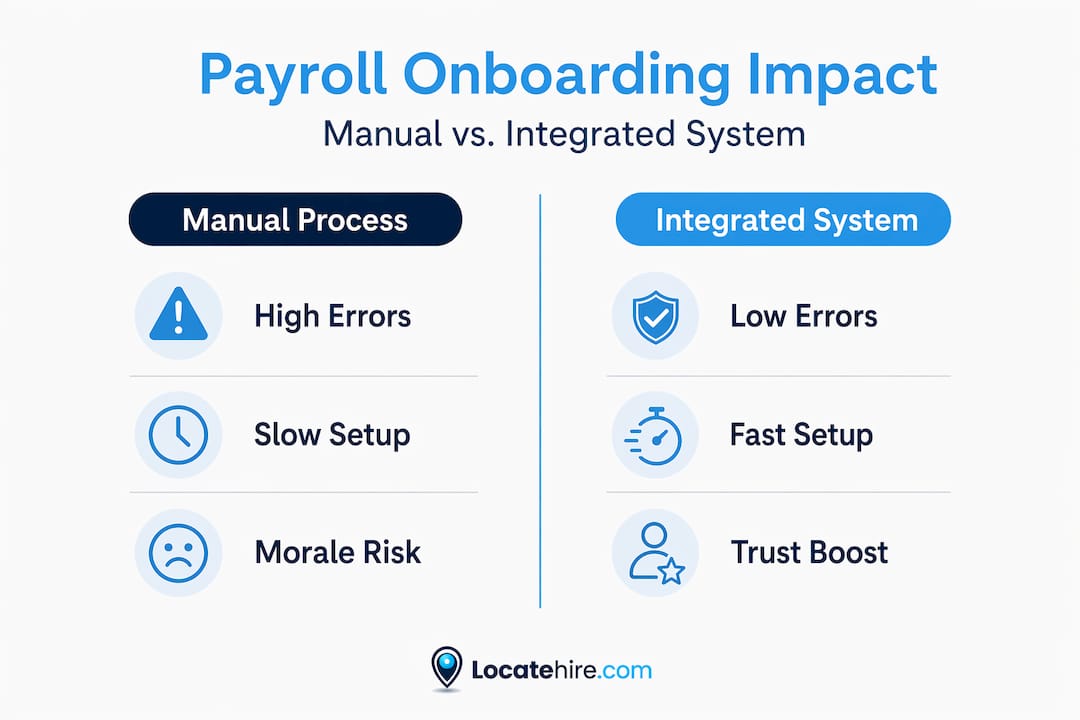
Separating HR and payroll functions makes all of this worse. Disconnected systems increase errors and inefficiencies, while integration improves data integrity across the board.
Technology options that actually prevent payroll errors
The gap between businesses that handle payroll onboarding well and those that do not often comes down to one thing: whether their systems talk to each other. Here is a direct comparison of how manual and integrated approaches stack up.
| Factor | Manual/paper process | Integrated HR and payroll system |
|---|---|---|
| Data entry errors | High. Information is typed twice, once into HR records and once into payroll. | Low. Data entered once syncs across both systems automatically. |
| First paycheck accuracy | Inconsistent. Depends on individual attention to detail. | High. Automated checks flag mismatches before payroll runs. |
| Tax form completion | Error-prone. Employees fill out paper forms without guidance. | Guided. Withholding wizards walk employees through every field. |
| Direct deposit setup | Requires voided check or manual entry of routing numbers. | Secure bank-login integration verifies account data in real time. |
| Compliance risk | Higher. Errors often caught after payroll has run. | Lower. Built-in rules and audit trails support compliance. |
Manual data re-entry from paper forms is one of the leading causes of payroll errors during onboarding. Automation solves this at the source.
When evaluating payroll systems in onboarding, look for these specific features: automatic tax table updates, built-in I-9 and W-4 wizards, direct deposit verification, and the ability to flag incomplete employee records before a payroll run processes. These are not luxury features. For a small business running lean, they are the difference between a clean first paycheck and a compliance problem.
One area many small business owners miss: employers should not give tax advice during onboarding, but they are responsible for making the right tools available. A payroll system with a built-in withholding wizard shifts the liability back where it belongs and removes you from an awkward conversation you are not qualified to have.
Pro Tip: When you build your hiring process, map out every payroll touchpoint before a new hire's first day. If you know what data you need and when, you can build a checklist that runs the same way every time, whether you are hiring one person or ten.
Managing new hire expectations about payroll timing
One of the most overlooked parts of the onboarding payroll process is the conversation about when the first paycheck actually arrives. New employees almost always expect to be paid within a week of starting. The reality is often different, and the gap between expectation and reality causes unnecessary stress.

Pay cycle cutoff dates can create a gap of several weeks between a hire date and the first direct deposit. A new employee who starts on the day after a payroll cutoff will not see money for nearly two full pay periods. That is not unusual. It is standard. But if no one explains it, that employee spends their first few weeks quietly worried and distracted.
The solution is transparency. Tell new hires the following during their first day:
- The exact pay schedule (weekly, biweekly, semimonthly)
- The cutoff date for the current pay period
- The expected date of their first deposit
- Who to contact if something looks wrong
Beyond timing, small business owners need to account for the full cost of bringing someone onto payroll. A new hire's gross salary is not the number that hits your bank account.
| Cost component | What it includes |
|---|---|
| Gross wages | The salary or hourly rate in the offer letter |
| Employer payroll taxes | Social Security, Medicare, and federal/state unemployment contributions |
| Benefits costs | Health insurance premiums, retirement match, paid time off accrual |
| Equipment and software | Devices, uniforms, tools, and any software licenses tied to the role |
| Training time | Hours spent onboarding that pull existing staff away from billable work |
Understanding total employment cost prepares you for the real cash impact of a new hire, not just the salary line. For pool service companies, HVAC shops, and other service businesses adding headcount seasonally, this math needs to happen before the offer letter goes out.
If you want to understand how hire rate decisions affect your overall budget, the connection between hiring costs and payroll planning is worth reviewing before you scale up.
My take on payroll's place in onboarding
I have worked with enough small businesses to know that payroll almost always gets treated like a finish line. You hire someone, you do the onboarding, and then you hand them off to "payroll." That split mindset is the root of most of the problems I see.
Payroll is not a separate department you hand off to. It is woven into every step of onboarding from the moment someone accepts an offer. In my experience, the businesses that get this right are not the ones with the fanciest software. They are the ones who treat a new hire's first paycheck with the same seriousness they treat the offer letter.
The financial and legal risks of getting payroll wrong are real. I have seen small HVAC companies face back-pay orders because someone miscategorized a technician. I have seen retail managers lose their best new hires in the first month because no one explained when the first check would arrive. These are preventable problems, every one of them.
What I have found works: treat the onboarding payroll process as a system with defined steps and owners, not a checklist that someone completes when they get around to it. Build it into your small business hiring process so that every new hire gets the same accurate, timely setup. When you do that, payroll stops being a source of anxiety and becomes one of the clearest signals that your organization knows what it is doing.
— Jeff
How Locatehire helps you get onboarding right
When you are running a pool service route, managing a janitorial crew, or scaling up an electrical team, payroll setup cannot fall through the cracks. Locatehire is an AI-powered applicant tracking system built specifically for small businesses with ongoing hiring needs. It is designed to keep your hiring and onboarding connected so the right data reaches payroll before the first check ever runs.
With Locatehire's recruitment tools, you collect candidate data during the application process that flows directly into onboarding. That means less manual re-entry, fewer errors, and a faster path from offer letter to first paycheck. The platform handles the administrative side so you can focus on getting your new hire productive, not chasing down W-4 forms.
If you are hiring regularly and tired of payroll surprises, Locatehire is built for exactly that problem.
FAQ
What is the role of payroll in onboarding?
Payroll in onboarding covers collecting tax documents, setting up direct deposit, configuring deductions, and verifying first paycheck accuracy. It is a legal and operational requirement that directly affects employee trust from day one.
Why do new hires sometimes wait weeks for their first paycheck?
Payroll cutoff dates determine when hours or salary are captured for a given pay period. If a new hire starts after the cutoff, their first check may not process until the following cycle, sometimes two or more weeks after their start date.
How do payroll errors affect employee retention?
Payroll errors erode trust quickly and push new employees to reconsider their decision to join. Incorrect or delayed paychecks are among the fastest ways to lose someone who just accepted your offer.
What documents are needed to set up a new hire in payroll?
At minimum, you need a completed W-4, a state withholding form if applicable, a signed I-9, and direct deposit banking information. Benefits enrollment forms and any garnishment orders should also be collected before the first payroll run.
Should HR and payroll be managed separately for small businesses?
No. Separating HR and payroll functions increases data entry errors and slows down onboarding. Integrated systems sync employee data automatically, reduce errors, and give you a clear audit trail for compliance purposes.