

Employer branding is the deliberate management of how your organization is perceived as a place to work. First defined by Tim Ambler and Simon Barrow as "the package of functional, economic, and psychological benefits provided by employment," the concept has since become a core discipline for any business competing for talent. You know it's working when you see three clear signals: higher-quality applicants arriving through referrals and direct channels, faster time-to-fill on open roles, and a positive trend in your review-site ratings on platforms like Glassdoor or Indeed.
The sections below cover the full picture: what employer branding is made of, who owns it, how to build it step by step, and how to measure whether it's delivering results.
Key Takeaways
A strong employer brand reduces cost-per-hire, improves 90-day retention, and gives small businesses a measurable edge in a competitive U.S. labor market.
| Point | Details |
|---|---|
| Define your EVP first | Draft three to five promise statements covering pay, growth, culture, and purpose before any external promotion. |
| Audit before you publish | Survey employees and review Glassdoor trends before finalizing EVP language to avoid credibility gaps. |
| Measure what matters | Track time-to-fill, offer acceptance rate, and 90-day retention as your core employer-brand KPIs. |
| Governance prevents drift | Assign one HR owner, brief hiring managers quarterly, and refresh the EVP annually. |
| Locatehire accelerates execution | The platform's career pages, auto-messaging, and analytics let small teams run employer-brand activities without adding headcount. |
Table of Contents
- What is employer branding and why does it matter for your business?
- What are the core components of an employer brand?
- Who actually owns employer branding in your organization?
- How to build or improve your employer brand step by step
- How do you measure employer branding success?
- Copyable EVP templates and examples you can use today
- Common employer branding mistakes and how to fix them
- How small businesses can run employer branding inside an ATS
- A practitioner's 90-day employer branding plan
- Locatehire makes employer branding faster for small business owners
- Sources
What is employer branding and why does it matter for your business?
Employer branding is the strategic process of creating and maintaining your company's reputation as a great place to work. It is distinct from your consumer brand, but the two must align. A plumbing company known for reliability with customers should project the same reliability to job seekers: clear expectations, fair pay, and a team that shows up.
The business case is direct. According to the CIPD, all organizations already have an employer brand whether they manage it or not. A strong one connects your values, people strategy, and policies to attract and retain the right people. A weak or ignored one lets candidates form their own conclusions, often from a single negative Glassdoor review or a poorly written job post.
The U.S. labor market remains competitive. BLS data on job openings per unemployed worker shows that employers in many sectors are still competing for a limited pool of available candidates, making differentiation as an employer a practical necessity, not a marketing exercise.
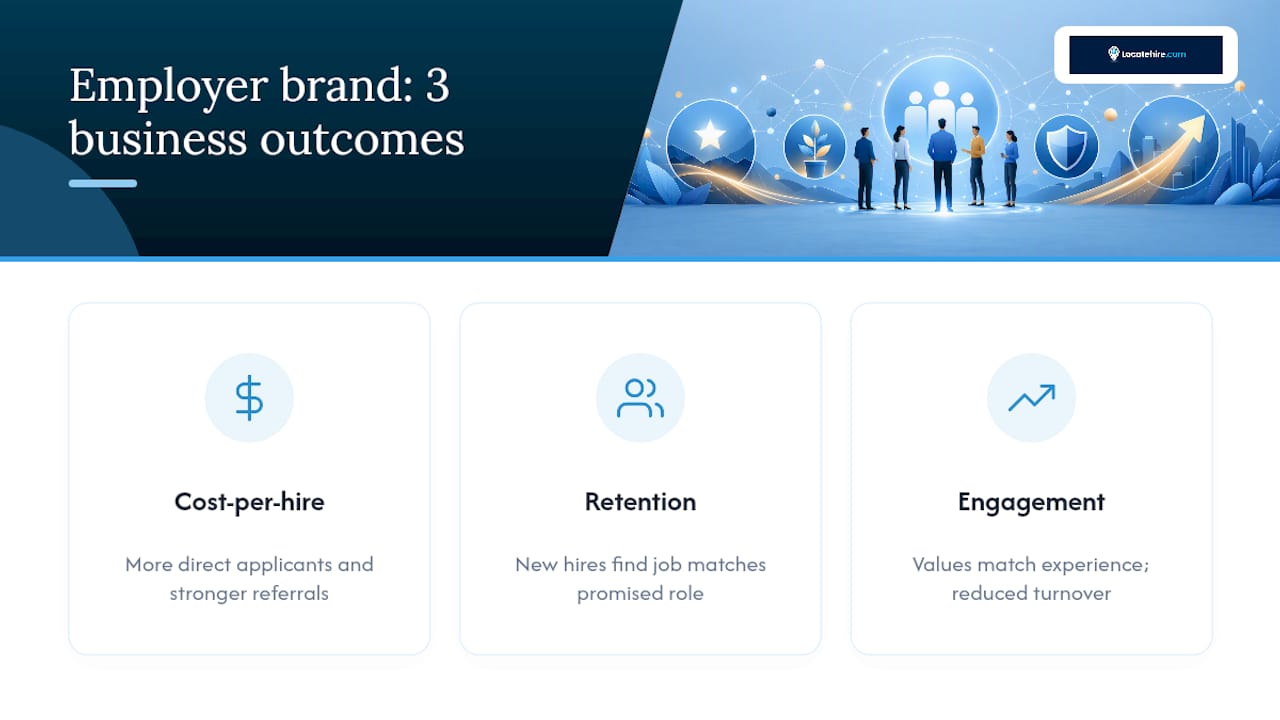
Three specific business outcomes follow from a well-managed employer brand. Lower cost-per-hire comes from more direct applicants and stronger referrals, reducing dependence on paid job boards. Improved retention follows when new hires find that the job matches what was promised during recruiting. Stronger engagement results when employees feel the company's stated values match their day-to-day experience, which SHRM guidance ties directly to reduced turnover and higher productivity.
What are the core components of an employer brand?
The Employer Value Proposition
The Employer Value Proposition (EVP) is the strategic foundation of your employer brand. It is the set of reasons a person chooses to work for you and stay. A strong EVP covers three dimensions drawn from Ambler and Barrow's original framework: functional benefits (the job itself, growth opportunities, tools), economic benefits (pay, benefits, stability), and psychological benefits (culture, purpose, belonging).
The "4 P's" framework maps cleanly onto those dimensions:
- People: The team, management style, and relationships at work
- Purpose: The mission, values, and social impact of the organization
- Place: The physical or remote environment and flexibility
- Product: What the company makes or does and why it matters
Primary touchpoints that shape perception
Every interaction a candidate or employee has with your company shapes your employer brand. The most influential touchpoints include:
- Your careers page (often the first destination after a job ad)
- Job descriptions (tone, clarity, and honesty signal culture immediately)
- Manager behavior during interviews and onboarding
- Employee reviews on Glassdoor, Indeed, and Google
- Social media content showing real team life
| Concept | What it is | Primary purpose |
|---|---|---|
| EVP | The promise you make to employees about what working here means | Strategic foundation and internal compass |
| Recruitment marketing | The tactics used to promote that promise to candidates | Attract applicants at the top of the funnel |
| Culture | The lived experience of working at the company | Deliver on the EVP promise internally |
Who actually owns employer branding in your organization?
Employer branding fails most often when no one owns it clearly. In practice, it requires three groups working together.
HR defines the EVP, manages the candidate experience, and tracks retention and engagement data. Marketing controls the visual identity, careers page design, and social content. Senior leaders model the values publicly and approve the EVP messaging. Hiring managers deliver the brand in every interview and onboarding conversation. Employees are the most credible voices and the engine of referral and advocacy.
A lightweight governance structure keeps this from collapsing. Assign one HR lead as the decision-maker for EVP language and brand standards. Marketing gets approval rights on any external content. Senior leadership reviews the EVP annually or after a significant culture shift. Hiring managers receive a one-page brief on EVP talking points before they interview. A simple RACI for this: HR is Responsible and Accountable; Marketing is Consulted on external assets; Leadership is Informed quarterly; hiring managers are Responsible for delivery in their interactions.
Cross-functional governance matters because credibility gaps open up when the promise and the experience diverge. Building a consistent hiring process is one of the fastest ways to close that gap at the operational level.
How to build or improve your employer brand step by step
Step 1: Audit your current reputation
Before writing a single word of EVP copy, find out what people actually think. Survey current employees with three questions: Why did you join? Why do you stay? What would you tell a friend considering applying? Review your last 12 months of Glassdoor and Indeed ratings. Check how your job posts read compared to competitors in your market.
Step 2: Define your EVP
Use the audit findings to draft three to five promise statements. Each one should name a specific benefit and include a proof point. The template below is fillable:
- We offer [specific benefit] because [proof point or policy].
- Our team is known for [cultural trait], which shows up in [specific practice].
- You'll grow here through [development opportunity], with [concrete example].
Step 3: Create core assets
Translate the EVP into a revised careers page, updated job description templates, and a short social media content bank. Writing job posts that reflect your EVP is one of the highest-leverage tasks at this stage.
Step 4: Promote externally
Post EVP-aligned content on LinkedIn, Facebook, and Glassdoor. Use job boards strategically to reach the right candidate pools. Ask employees to share open roles with their networks.
Step 5: Embed in people processes
Onboarding, performance reviews, and exit interviews should all reflect EVP language. Candidate experience at every stage, from application confirmation to offer letter, is a direct expression of your brand.
Step 6: Measure and iterate
Track the KPIs in the next section. Review EVP language every 12 months or after a major organizational change.
Pro Tip: Small businesses can see real results in two to four weeks by doing three things: rewriting the careers page with one clear EVP headline, standardizing job description language across all open roles, and giving hiring managers a two-page interview guide that reflects the company's values.
How do you measure employer branding success?
Measurement does not require a dedicated analytics team. Start with five KPIs that any small business can track:
- Time-to-fill: How long it takes to move from job post to accepted offer. A declining trend signals stronger candidate interest.
- Offer acceptance rate: The percentage of offers extended that candidates accept. Rates below 80% often indicate a disconnect between the candidate experience and expectations.
- Quality-of-hire proxy: Retention at 90 days and 12 months for new hires. High early turnover is a direct signal that the EVP promise is not matching reality.
- Candidate Net Promoter Score (cNPS): A one-question survey sent to all applicants after the process ends, regardless of outcome. Even rejected candidates who rate the experience positively become brand advocates.
- Review-site trend: Track your average Glassdoor or Indeed rating quarterly, not as an absolute score but as a directional trend.
For small teams, prioritize time-to-fill and 90-day retention first. Both are easy to pull from an ATS and give you a clear before-and-after signal when you change your EVP or hiring process. Add cNPS once you have a consistent volume of applicants to survey.
Employer branding strategies for SMEs consistently point to retention metrics as the most actionable starting point because they connect directly to the cost of a bad hire.
Copyable EVP templates and examples you can use today
Fillable EVP template
Use this structure to draft your EVP in under 30 minutes:
- Role clarity: "At [Company], every [role title] knows exactly what success looks like because [specific practice, e.g., 'we set 30-day goals in week one']."
- Compensation: "We pay [competitive/above-market/market-rate] wages and offer [specific benefit, e.g., 'health insurance after 60 days and paid time off from day one']."
- Growth: "You'll build real skills here through [specific opportunity, e.g., 'paid certifications, weekly team training, and a clear path to lead tech']."
- Culture: "Our team is [cultural trait, e.g., 'tight-knit and low-drama'] — you'll know your coworkers' names by the end of your first week."
- Purpose: "We're proud of [mission element, e.g., 'keeping families comfortable year-round'] and we hire people who take that seriously."
Two short EVP examples
Service business (HVAC/plumbing): "We pay above-market wages, cover your certifications, and run a crew that treats each other with respect. No surprise overtime, no micromanagement. If you want to grow into a lead tech role within two years, this is where you do it."
Professional-services firm: "Our team works on complex client problems with real autonomy. You'll get direct access to senior partners, a clear promotion track, and a culture that values deep work over performative busyness." For more on positioning a professional-services employer brand, this agency perspective on professional-services branding covers how to differentiate on trust and expertise.
Job description EVP paragraph
"At [Company], we're building a team that [core cultural trait]. You'll work alongside [team description] in a [environment description] where [specific cultural norm]. We offer [top 2–3 benefits] and a clear path to [growth outcome]. If [ideal candidate trait], we'd like to hear from you."
Careers page must-haves
- Company logo and EVP headline (one sentence, above the fold)
- Benefits snapshot (five to seven items, visual format)
- Team photos or a short video (real employees, not stock images)
- One or two employee quotes (genuine, attributed by first name and role)
- Clear "Apply Now" button on every job listing
Common employer branding mistakes and how to fix them
These are the failure modes that show up most often, especially in small businesses:
- Promising benefits you don't deliver. Fix: audit your actual benefits against your EVP before publishing it. Mismatched promises generate Glassdoor reviews that undo months of brand work.
- Focusing only on external marketing. Fix: run an internal pulse survey before launching any external campaign. If employees wouldn't endorse the EVP, candidates will find out.
- Ignoring manager behavior. Fix: include EVP talking points in every hiring manager brief. A single dismissive interview experience can generate a public negative review.
- Inconsistent messaging across channels. Fix: create a one-page brand standards document covering tone, key phrases, and approved benefits language for job posts, social media, and the careers page.
- Treating employer branding as a one-time project. Fix: schedule a quarterly 30-minute review of review-site trends and a full EVP refresh annually.
Common job posting mistakes often trace back to this last point: EVP language that was written once and never updated stops reflecting reality, and candidates notice.
How small businesses can run employer branding inside an ATS
An applicant tracking system does more than store resumes. For small businesses, it is the operational layer where employer-brand promises get delivered consistently at scale.
Key ATS-supported activities that reinforce your employer brand:
- Custom careers page: Publish your EVP headline, benefits snapshot, and team photos directly through the ATS, so every job listing lives inside a branded experience.
- Auto-response messaging: Set up EVP-aligned confirmation and status-update emails so every applicant receives a professional, on-brand touchpoint, even when you're busy on a job site.
- Candidate scoring and tracking: Use AI candidate matching and smart scoring to spend more time with the applicants most likely to fit your culture, not just your skills checklist.
- Hiring analytics: Track time-to-fill, source quality, and offer acceptance rates from a single dashboard so you can see which employer-brand investments are working.
Pro Tip: Template your job posts inside the ATS using your EVP language. When a new role opens, you post in minutes with consistent, on-brand copy rather than rewriting from scratch each time.
Small business hiring operates differently from enterprise, and the right ATS reflects that. Locatehire is built specifically for businesses with 5–50 employees in industries like HVAC, plumbing, electrical, janitorial, and retail, where hiring is ongoing and every bad hire has a direct impact on operations.
A practitioner's 90-day employer branding plan
Three recommendations stand out when advising small businesses on where to start.
First, fix the careers page. It is the single highest-leverage asset you control. A clear EVP headline, a real benefits list, and one or two genuine employee quotes will outperform any paid campaign. Do this in week one.
Second, run a two-week employee pulse. Ask five questions: Why did you join? Why do you stay? What's the best part of working here? What would you change? Would you refer a friend? The answers will either validate your EVP draft or tell you it needs a rewrite before you publish it anywhere.
Third, standardize your job posts. Every open role should use the same EVP language, the same benefits summary, and the same tone. Inconsistency signals disorganization to candidates.
The 90-day breakdown:
- Days 1–30: Complete the audit, draft the EVP, rewrite the careers page, and standardize job description templates.
- Days 31–60: Launch EVP-aligned job posts, activate employee referral programs, and send the first cNPS survey to recent applicants.
- Days 61–90: Review time-to-fill and 90-day retention data, adjust EVP language based on candidate and employee feedback, and brief hiring managers on updated talking points.
When you're seeing consistent offer rejections or your Glassdoor rating is declining despite process improvements, that's the signal to bring in outside help, whether a fractional HR consultant or an employer-brand agency.
Locatehire makes employer branding faster for small business owners
Hiring for a five-person HVAC crew or a 20-person janitorial operation means you need results fast, not a six-month brand project.
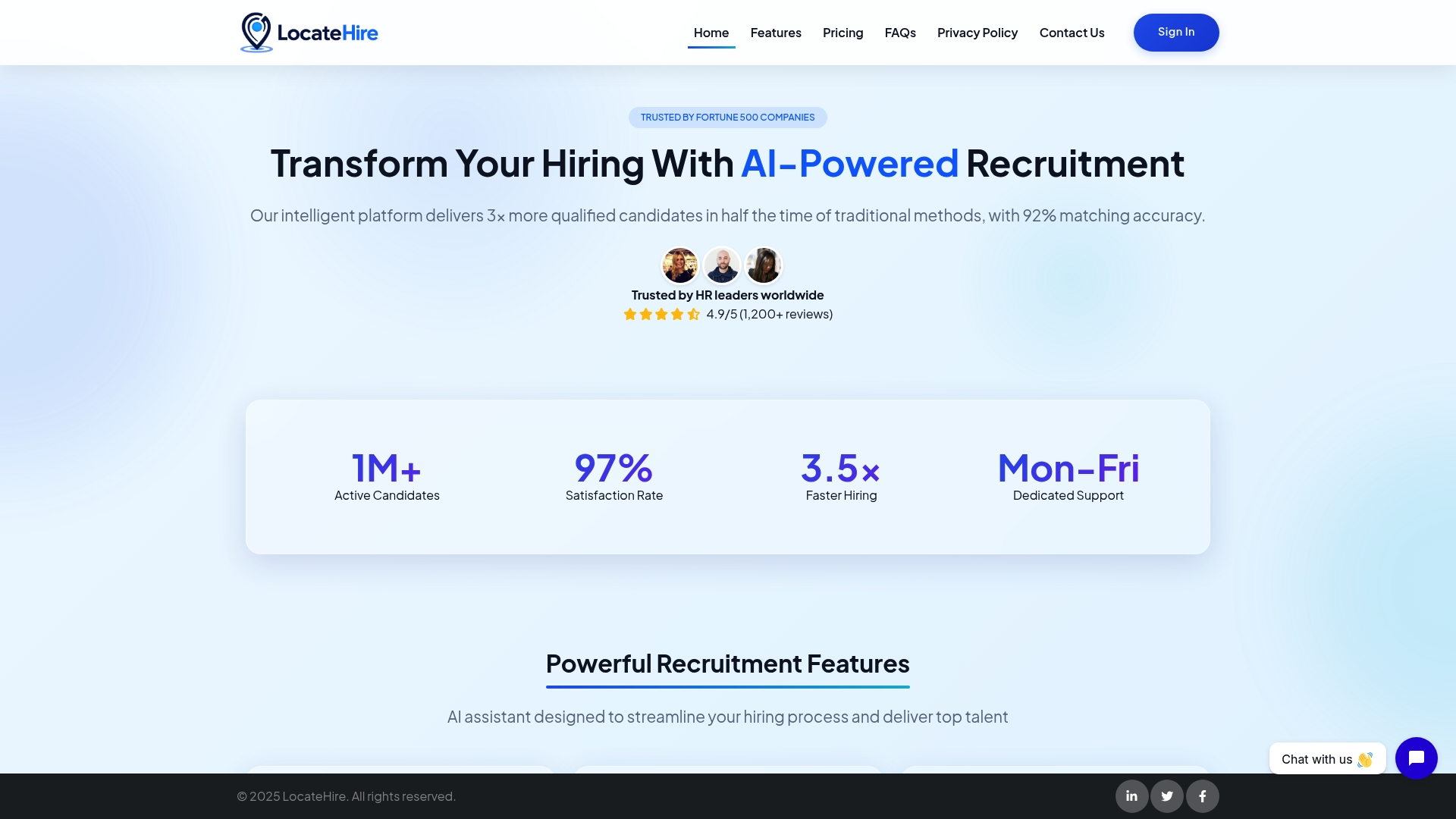
Locatehire gives small businesses a practical shortcut. The platform's custom career pages let you publish your EVP and benefits in minutes. Automated candidate messaging keeps every applicant informed with on-brand communication, without adding admin time. AI-powered candidate matching and advanced hiring analytics show you which sources and messages are driving your best hires, so you can double down on what works.
You get the employer-brand infrastructure that larger companies build entire teams to manage, at a price and complexity level built for a business your size. Start a trial at Locatehire and see how quickly you can put these steps into practice.
Sources
- What Is Employer Branding?
- Employer Brand | Factsheets | CIPD
- Using Employer Branding to Attract and Retain Top Talent
- Bls