

A job board is an online platform that connects employers with job seekers by letting companies post open positions and collect applications digitally. For small business owners in service industries like HVAC, plumbing, janitorial services, and pool maintenance, understanding how job boards work for employers is the difference between a flooded inbox and a qualified hire. Platforms like Indeed and LinkedIn dominate the general market, while niche boards serve trade and service sectors with more targeted candidate pools. This guide breaks down the full employer workflow, the real benefits, the honest limitations, and the strategies that actually improve your results.
How do job boards work for employers, step by step?
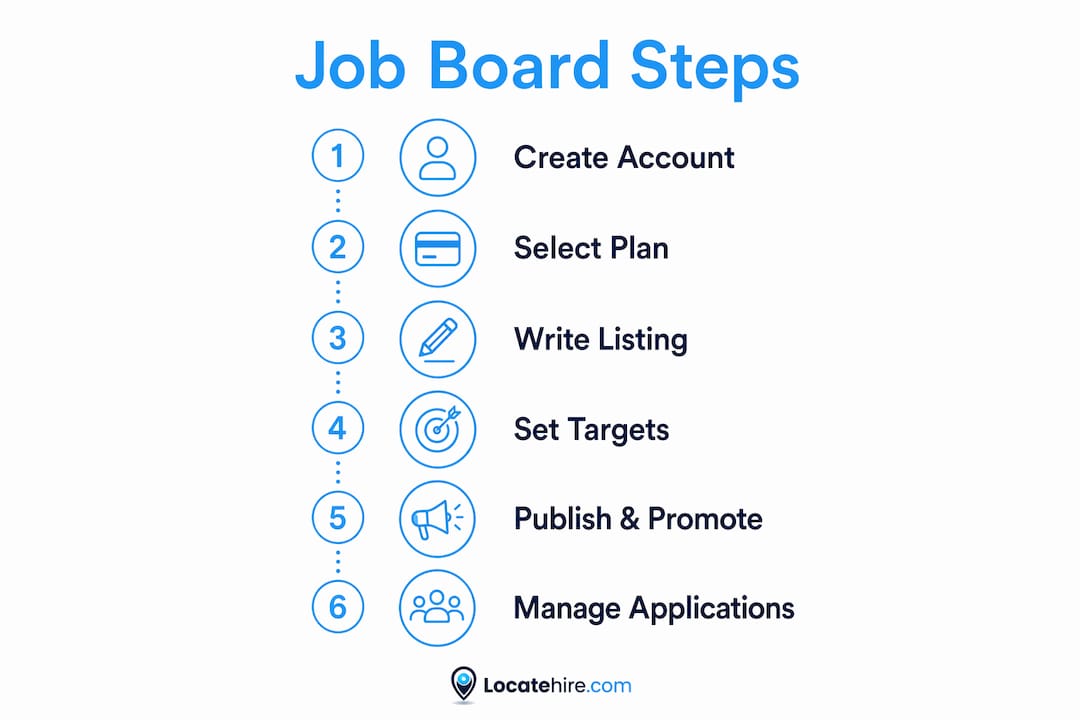
The standard employer workflow on a job board follows six stages: create an account, purchase or select a posting plan, write the listing, set targeting, publish, and manage incoming applications. Each stage has decisions that directly affect your results.
Step 1: Create an employer account. Most platforms ask for your business name, location, and contact details. Some require verification before your first post goes live.

Step 2: Choose a payment model. Job boards use three main pricing structures. Pay-per-post charges a flat fee for each listing. Subscription plans give you a set number of posts per month. Free tiers exist on platforms like Indeed but limit your visibility compared to sponsored listings.
Step 3: Write the job listing. This is where most small business owners lose candidates. Your listing needs a clear job title, specific duties, required qualifications, location, pay range, and schedule. Vague listings attract vague applicants.
Step 4: Set targeting and visibility options. Most boards let you filter by geography, job category, and experience level. Sponsored or featured placements push your listing higher in search results, which matters on high-traffic platforms.
Step 5: Publish and promote. Once live, your listing competes with every other open position in your category. Sponsored posts and cross-posting across platforms increase your reach without requiring separate accounts on every site.
Step 6: Manage applications. Applications arrive through the board's dashboard or get routed to your email or applicant tracking system (ATS). This is where organization becomes critical, especially if you run ongoing hiring for multiple roles.
Pro Tip: Set up a dedicated email folder or ATS inbox for each open role before you publish. Mixing applications across roles is the fastest way to lose a strong candidate in the noise.
What are the main benefits of job boards for service industry employers?
Job boards give small business employers access to a candidate pool they could never build on their own. Nearly 50% of all US hires come from job search engine traffic. That number tells you where job seekers are looking, and it tells you where your listing needs to be.
Here are the core advantages for service industry employers:
- Speed. A listing on Indeed or a trade-specific board goes live within hours. Compare that to word-of-mouth hiring, which can take weeks to produce even one candidate.
- Geographic targeting. You can limit applicants to your service area. An HVAC company in Phoenix does not need applications from candidates in Chicago.
- Cost control. Free and low-cost posting options exist on most major platforms. Even paid placements cost a fraction of what a staffing agency charges per hire.
- Niche board access. Service industry niche boards outperform general boards for trade roles because the applicant pool is pre-filtered by industry interest. A plumber searching a trade-specific board is more likely to be qualified than a general job seeker browsing Indeed.
- Application tracking. Most boards provide a basic dashboard where you can review, sort, and respond to applicants without leaving the platform.
For a janitorial company hiring part-time cleaners across multiple locations, job boards provide a repeatable, low-cost channel that scales with your hiring volume. You post once and let the platform distribute your listing to active job seekers in your area.
What limitations do employers face when using job boards?
Job boards are marketplaces, not screening services. Employers must vet candidates themselves. The platform's job is to connect you with applicants. Deciding who is qualified is entirely your responsibility.
This creates a real problem for small business owners who do not have a dedicated HR team. A single listing on a high-traffic platform can generate dozens or even hundreds of applications within the first 48 hours. Most of those applicants will not meet your basic requirements.
Common challenges employers face on job boards include:
- Unqualified application volume. General boards prioritize reach over relevance. You will receive applications from candidates who do not have the required license, experience, or location.
- No built-in screening. Unlike a staffing agency, job boards do not call candidates, verify credentials, or filter by skill. That work falls on you.
- Visibility without results. Paying for a sponsored post increases views but does not guarantee better applicants. A weak job description will still attract weak candidates regardless of placement.
- Platform fatigue. Managing applications across multiple boards without an ATS creates duplicate work and missed follow-ups.
ATS integration is essential for any employer dealing with consistent hiring volume. An ATS centralizes applications, automates initial screening questions, and keeps your pipeline organized across multiple open roles.
For employers with budget to invest, programmatic job advertising uses real-time performance data to shift spend toward the channels producing the best applicants. This approach delivers cost-per-applicant reductions of 25–50% compared to flat-fee postings. That is a meaningful savings for a small business running multiple hires per quarter.
Pro Tip: Before posting on a large general board, try a niche board specific to your trade first. You will likely see fewer applications but a higher percentage of candidates worth calling.
How do you optimize job board postings for better hires?
The quality of your hire starts with the quality of your listing. A well-written job posting filters out unqualified candidates before they apply, which saves you hours of screening time.
Write descriptions that do the filtering for you
State the non-negotiables in the first three sentences. If the role requires a valid driver's license, a specific certification, or availability on weekends, say so at the top. Candidates who do not qualify will self-select out. Avoid generic phrases like "team player" or "fast-paced environment." Replace them with specifics: "You will service 8–12 residential pools per day in the Phoenix metro area."
Use targeting features strategically
Most boards let you narrow your audience by zip code radius, job category, and experience level. Use all three. A retail employer hiring for a single location does not need national visibility. Tighter targeting means fewer irrelevant applications and lower cost per qualified applicant.
Here is a quick comparison of posting approaches:
| Approach | Best For | Trade-off |
|---|---|---|
| Free general board post | Testing a new role or market | Low visibility, high unqualified volume |
| Sponsored general board post | High-volume hiring fast | Higher cost, still broad applicant pool |
| Niche board post | Trade and service roles | Smaller reach, better applicant quality |
| Programmatic advertising | Ongoing multi-role hiring | Requires setup, delivers best cost efficiency |
Track cost per applicant, not just applications
Raw application count is a vanity metric. What matters is how many applicants you actually considered for an interview. Divide your total posting spend by the number of qualified applicants to get your real cost per applicant. Track this number across boards and adjust your budget toward the platforms that perform.
Cross-post without duplicating work
Posting across multiple platforms does not have to mean logging into five different accounts. Distribution tools and ATS platforms let you publish one listing to multiple boards simultaneously. This expands your reach without multiplying your administrative work.
Revisit your listing every 7–10 days. If applications have slowed or quality has dropped, update the title, adjust the pay range, or refresh the description. Job boards reward active listings with better placement in search results.
Key takeaways
Job boards are marketplaces that connect employers with candidates, and their value depends entirely on how well you post, target, and screen.
| Point | Details |
|---|---|
| Job boards are not screening tools | Employers are responsible for all candidate vetting; boards only deliver applicants. |
| Niche boards outperform general boards for trades | Service industry roles attract better applicants on trade-specific platforms. |
| ATS integration is non-negotiable for volume hiring | Centralized tracking prevents missed candidates and duplicate work across boards. |
| Programmatic advertising cuts cost per applicant | Real-time budget optimization reduces cost per applicant by 25–50% versus flat-fee posts. |
| Listing quality determines applicant quality | Specific, detailed job descriptions filter unqualified candidates before they apply. |
What i've learned after watching employers struggle with job boards
Most employers treat job boards like a vending machine. You put money in, candidates come out. That mental model is why so many small business owners end up frustrated after their first few postings.
The real issue is that job boards are built to maximize application volume, not hire quality. That is not a flaw in the system. It is the business model. Boards charge based on clicks and applications. They have no financial incentive to send you fewer, better candidates.
What I have seen work consistently for service industry employers is a two-part approach. First, get specific in your listing to the point where it feels almost too narrow. If you run a pool service company and you need someone who can drive a van, handle chemicals, and work independently without supervision, say exactly that. You will get fewer applications and more of the right ones.
Second, stop treating your ATS as optional. I have watched small electrical contractors and janitorial companies try to manage 40 applications per week through email folders. It falls apart within two weeks. An ATS like Locatehire is built for exactly this kind of ongoing, high-volume service industry hiring. It keeps your pipeline clean and your response time fast, which matters because good candidates in the trades do not wait around.
The employers who get the most value from job boards are the ones who treat them as one channel in a system, not the whole system.
— Jeff
How Locatehire makes job boards work harder for you
Job boards get your listing in front of candidates. Locatehire handles everything that happens next.
Locatehire is an applicant tracking system built specifically for small businesses with ongoing hiring needs, including pool service, HVAC, electrical, plumbing, janitorial, and retail. When applications come in from Indeed, niche trade boards, or any other platform, Locatehire centralizes them in one place, applies screening filters, and helps you move fast on the candidates worth calling. You can manage all your open roles without losing track of a single applicant. For service industry employers who hire repeatedly throughout the year, that kind of organized pipeline is what separates a smooth operation from a constant scramble.
FAQ
What is a job board and how does it work for employers?
A job board is an online platform where employers post open positions and job seekers search and apply. Employers create an account, write a listing, set targeting options, and manage incoming applications through the platform's dashboard or an integrated ATS.
Are job boards free for employers?
Most major job boards offer free basic postings, but paid or sponsored placements provide significantly more visibility. Platforms like Indeed allow free listings while charging for featured placement in search results.
How do job boards help employers in service industries?
Niche job boards tailored to trades and service roles deliver better-qualified applicants than general boards by attracting candidates already working in those fields. Geographic targeting also helps service employers limit applications to their actual coverage area.
Do job boards screen applicants for employers?
No. Job boards do not screen or filter candidates. They connect employers with applicants, but all qualification checks, interviews, and hiring decisions are the employer's responsibility.
What is the best way to manage high application volume from job boards?
Use an applicant tracking system to centralize and organize applications as they arrive. You can also screen applicants more efficiently by adding knockout questions to your listing that automatically filter out candidates who do not meet your minimum requirements.