

Employment screening methods are standardized tools and procedures employers use to evaluate job candidates' qualifications, skills, backgrounds, and fit before making hiring decisions. For small business owners running pool service companies, HVAC firms, janitorial operations, or retail stores, choosing the right mix of screening methods directly determines who walks through your door and stays. The best hiring decisions come from combining multiple validated methods, not relying on gut instinct or a single test. This guide covers every major method, its legal boundaries, and how to apply it at your scale.
What are the most common types of pre-employment tests?
Pre-employment tests fall into seven recognized categories, each measuring a different dimension of candidate suitability. Understanding what each test actually measures helps you pick the right ones for your roles instead of running every candidate through a battery of irrelevant assessments.
- Job knowledge tests measure what a candidate already knows about the role. An HVAC technician quiz on refrigerant handling or an electrician test on National Electrical Code standards tells you immediately whether someone can do the job without months of remedial training.
- Integrity tests assess honesty, reliability, and attitudes toward theft or rule-breaking. Retail and service businesses use these heavily because employee theft and no-shows are direct profit threats.
- Cognitive ability tests measure problem-solving speed and learning capacity. A plumber who can read a diagram and adapt on the fly is more valuable than one who needs step-by-step supervision on every job.
- Personality tests evaluate traits like conscientiousness, agreeableness, and openness. They predict cultural fit and teamwork potential, which matters when your crew works in customers' homes.
- Emotional intelligence tests measure how well a candidate reads social situations and manages stress. Customer-facing roles in retail or service businesses benefit most from this data.
- Skills assessment tests provide objective evidence of practical capability. Skills assessments are central to enterprise hiring and increasingly accessible to small businesses through online platforms.
- Physical ability tests measure strength, endurance, or dexterity. Pool service technicians hauling equipment and janitorial staff working overnight shifts need to meet physical standards before day one.
Pro Tip: Only use tests that are validated for the specific job role. Validated assessments must demonstrate criterion-related, content, or construct validity to hold up under legal scrutiny and actually predict job performance.
How do background checks and reference verifications enhance employment screening?

Background checks are the most widely used employment verification methods in American hiring. They confirm that what a candidate claims on a resume is actually true, and they surface information that protects your business, your customers, and your existing team.
Standard background checks in 2026 typically look back 7 years to cover criminal, driving, education, and employment records. That 7-year window is the legal standard in most states, though some states restrict it further for certain roles or salary levels.
Here are the most common types of background checks and what each one tells you:
- Criminal background screening covers misdemeanors, felonies, arrests, and pending cases. Legally, only certain convictions within defined timeframes apply post-offer, and you cannot automatically disqualify candidates based on arrest records alone.
- Employment verification confirms job titles, dates of employment, and whether a candidate is eligible for rehire. Fabricated work history is common, and a single phone call to a former employer catches it.
- Education verification confirms degrees, certifications, and licenses. For licensed trades like electrical or plumbing, this step is non-negotiable.
- Driving record checks are critical for any role where employees operate vehicles, including pool service routes and HVAC dispatch.
- Credit checks apply in limited contexts, typically roles involving financial responsibility. Most states restrict their use, so confirm your state's rules before running one.
- Reference checks verify work history and actual on-the-job performance. The reference checking process is often rushed or skipped entirely, which is a mistake. A direct conversation with a former supervisor reveals attitude, reliability, and real skill level in ways a resume never can.
One legal requirement most small business owners miss: when a background check result negatively affects a hiring decision, you must give the candidate a chance to respond to that information. Adverse action rules require a specific notification process before you finalize a rejection.
Pro Tip: Run background checks after a conditional offer, not before. Pre-offer checks create legal exposure in many states. Build your background check workflow into the post-offer stage of your hiring process.
What candidate screening methods work best for small businesses?
Small businesses and large enterprises use the same core screening tools, but the sequence, depth, and resources behind them differ significantly. Knowing where to invest your limited time makes the difference between a thorough process and an expensive shortcut.
| Screening Method | Small Business Fit | Enterprise Fit |
|---|---|---|
| Resume review | High, quick and low cost | High, often automated |
| Phone screening | High, personal and flexible | Low, inconsistent at scale |
| Structured digital assessments | Medium, growing adoption | High, standard practice |
| Video interviews | Medium, good for remote roles | High, widely used |
| Skills simulations | Low to medium, role-specific | High, especially for tech roles |
| Assessment centers | Low, resource-intensive | High, used for leadership roles |
Resume screening and application forms are your entry point. They filter out candidates who clearly lack required licenses, experience, or availability before you spend a minute on the phone. For a janitorial company hiring 10 people a month, a well-designed application form alone eliminates a large portion of unqualified applicants.
Phone screening works well for small businesses doing low-volume hiring, but it becomes inconsistent as you scale. Two different managers asking different questions produce incomparable results. Structured digital assessments solve this by asking every candidate the same questions in the same order, which makes comparison straightforward and defensible.
Video interviews and job simulations give you a deeper look at how a candidate actually behaves, not just what they say. For small business hiring, a short video interview asking a candidate to walk through how they would handle a difficult customer situation reveals more than any resume line.
Pro Tip: You do not need to run every method on every candidate. Map your screening steps to the risk level of the role. A seasonal retail hire needs a different process than a licensed electrician joining your permanent crew.
What are the emerging trends in employment screening for 2026?
The biggest shift in job candidate screening right now is the move away from informal, subjective methods toward structured, validated, and technology-supported workflows. This shift is not just about efficiency. It is about legal protection and hiring quality.
- Validated assessments are now the baseline standard. Unvalidated tools create legal risk under EEOC guidelines and the Uniform Guidelines on Employee Selection Procedures (UGESP). If a test has an adverse impact on a protected group and you cannot prove it predicts job performance, you are exposed.
- Situational judgment tests (SJTs) and simulations are gaining ground as advanced screening tools. Assessment centers and SJTs are especially useful for leadership roles or complex positions where cognitive tests alone do not capture the full picture.
- Structured digital workflows are replacing inconsistent phone screenings as businesses scale. Digital screening tools reduce bias by standardizing the evaluation process across every candidate.
- Candidate experience matters more than it used to. A slow, confusing screening process causes strong candidates to drop out before you even see their results. Keep your process clear, fast, and respectful of the candidate's time.
- AI-assisted screening is entering small business hiring through applicant tracking systems that flag qualified candidates automatically. The technology is useful, but human review of final candidates remains necessary.
- Privacy rules are tightening. Several states have added restrictions on what you can ask, when you can ask it, and how long you can retain candidate data. Staying current with your state's employment laws is not optional.
The best screening process is one your team actually follows consistently. A sophisticated assessment battery that gets skipped half the time is worse than a simple, standardized process applied to every candidate.
Pro Tip: Review your screening methods at least once a year. Employment laws change, new validated tools become available, and your hiring needs evolve as your business grows. Build a faster hiring process that stays current without sacrificing quality.
Key Takeaways
The most effective employment screening combines validated pre-employment tests, thorough background checks, and structured interviews applied consistently to every candidate for the same role.
| Point | Details |
|---|---|
| Use multiple methods | No single test predicts job performance. Combine skills, background, and behavioral screening. |
| Validate your assessments | Only use tools with proven criterion-related or content validity to stay legally defensible. |
| Time background checks correctly | Run criminal and employment checks after a conditional offer, not before, to reduce legal exposure. |
| Match methods to role risk | High-risk or licensed roles need deeper screening than seasonal or entry-level positions. |
| Standardize your process | Apply the same screening steps to every candidate for a given role to reduce bias and improve comparability. |
What I have learned from watching small businesses screen candidates
The most common mistake I see small business owners make is treating screening as a formality rather than a decision-making tool. They post a job, get a few applications, do a quick phone call, and hire the person who seemed friendliest. Then they wonder why turnover is high.
The businesses that hire well do one thing differently. They decide in advance what they are actually measuring and why. Before the first application comes in, they know which tests they will run, what a passing score looks like, and what background check results are disqualifying for that specific role. That clarity makes every hiring decision faster and more defensible.
I have also seen the opposite problem: small businesses that over-screen. They run every available assessment on every candidate, regardless of role. A part-time retail associate does not need a cognitive ability test, a personality inventory, and a credit check. That level of screening drives away good candidates and wastes your time.
The right answer is a tiered approach. Build a small business hiring process with two or three screening levels based on role complexity and risk. Apply the right level consistently. Document your reasoning. That combination protects you legally and produces better hires.
— Jeff
How Locatehire supports small business hiring
Running a thorough screening process takes time you often do not have when you are managing a pool service route or overseeing a janitorial crew. Locatehire is an applicant tracking system built specifically for small businesses with ongoing hiring needs, including trades, retail, and service industries.
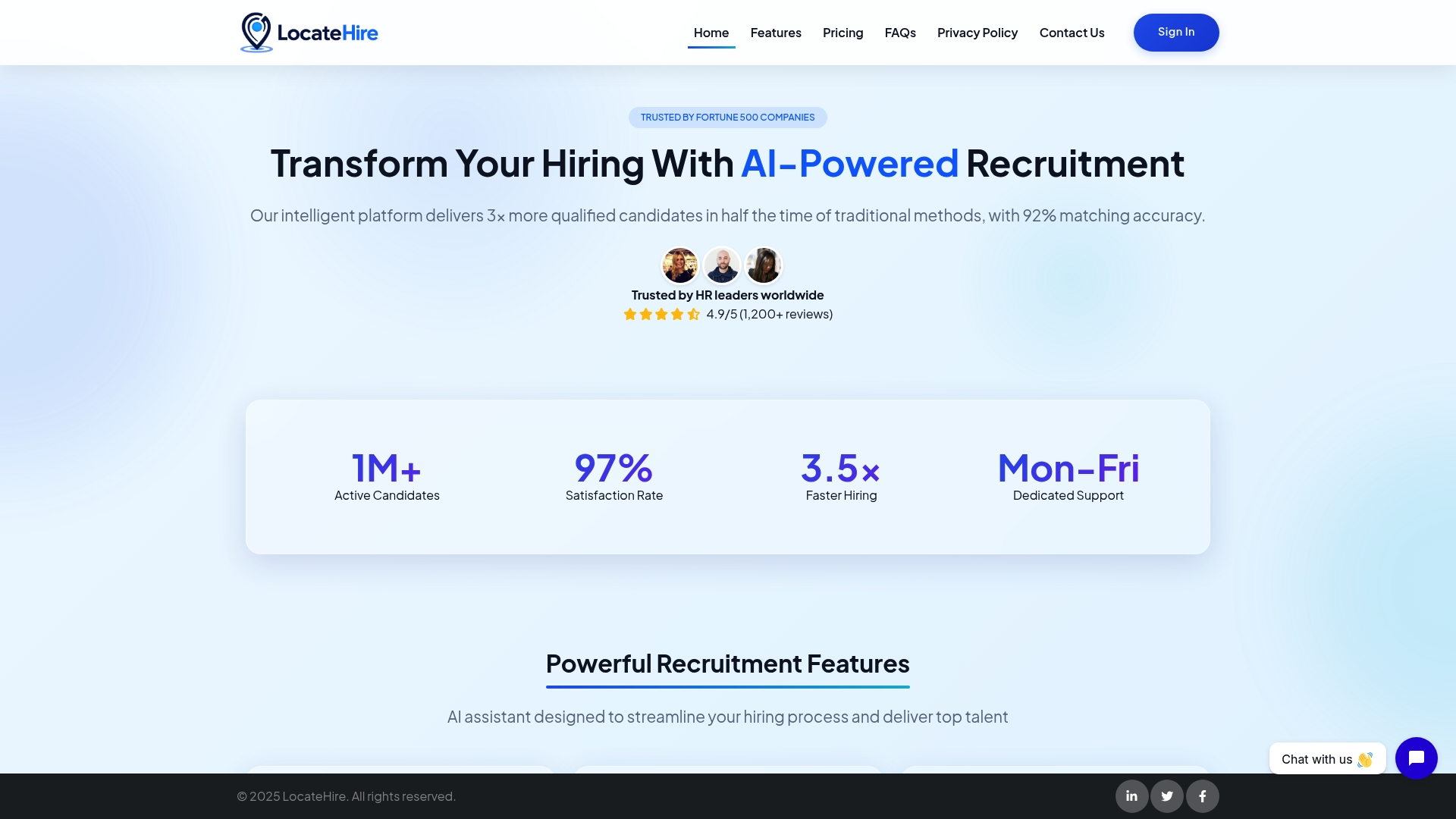
Locatehire brings your applicant screening workflow into one place, so you can collect applications, track candidates, and move qualified people through your process without losing anyone in a spreadsheet or email thread. The platform is designed for business owners who hire regularly but do not have a dedicated HR department. If you want a consistent, repeatable screening process without building one from scratch, Locatehire is built for exactly that.
FAQ
What are the main types of employment screening methods?
The main types include criminal background checks, employment and education verification, pre-employment tests (cognitive, skills, integrity, and personality), reference checks, and structured interviews. Most employers use a combination of these methods rather than relying on any single tool.
When should background checks be conducted in the hiring process?
Background checks should be conducted after a conditional job offer, not before. Running checks pre-offer creates legal exposure in many states, and adverse action rules require a specific notification process if check results affect the hiring decision.
Are pre-employment tests legal for small businesses to use?
Pre-employment tests are legal when they are validated for the specific job role and applied consistently to all candidates. Validated assessments must demonstrate they predict job performance to comply with EEOC guidelines and UGESP standards.
What is the standard lookback period for criminal background checks?
The standard lookback period is 7 years for most criminal, driving, education, and employment records. Some states apply shorter windows or additional restrictions depending on the role or compensation level.
How do skills assessments differ from cognitive ability tests?
Skills assessments measure practical, role-specific capabilities like coding, equipment operation, or customer service tasks. Cognitive ability tests measure broader problem-solving and learning speed, which predicts how quickly a candidate can adapt to new situations on the job.