

Background checks in hiring are the process of verifying a candidate's identity, qualifications, and history so employers can make safe, compliant, and informed decisions. Known formally as pre-employment screening, this process covers criminal records, employment history, education credentials, and identity verification. For small businesses in service industries like HVAC, janitorial services, plumbing, and retail, skipping or mishandling these checks creates real legal and operational risk. Laws like the Fair Credit Reporting Act (FCRA) and Equal Employment Opportunity Commission (EEOC) guidelines govern every step, and getting it wrong can cost far more than the check itself.
How background checks work in hiring: the core components
A background check is not a single search. It is a package of individual screenings, each designed to verify a specific category of information. Understanding what each component does helps you build a check that fits the role rather than running everything on everyone.
The most common components include:
- Identity verification via SSN trace. The SSN trace is the starting point, pulling address history that directs where jurisdiction-specific criminal and civil record searches should run. Without it, you may miss records from counties or states where the candidate previously lived.
- Criminal record searches. These pull from county, state, and national databases. A national database search is fast but incomplete. County courthouse searches are slower and more thorough. Most reliable packages combine both.
- Employment verification. Confirms job titles, dates of employment, and sometimes eligibility for rehire. This catches resume inflation, which is common in competitive service industry roles.
- Education verification. Confirms degrees and certifications. For licensed trades like electrical or HVAC, this step overlaps with license verification.
- Motor vehicle record (MVR) checks. Required for any role involving driving, from pool service routes to delivery. An MVR check reveals license status, violations, and suspensions.
- Credit reports. Used selectively for roles involving financial responsibility. Not appropriate for most field service positions and restricted by law in several states.
- Industry-specific checks. Healthcare roles may require OIG exclusion list searches. Finance roles often require FINRA checks. Know your industry's mandates before building a package.
The typical cost per candidate runs from $30 to $200 depending on which screenings you select. That range reflects the difference between a basic criminal check and a full package with employment, education, and MVR components. For a small business hiring frequently, those costs add up, which is exactly why role-based tailoring matters.
Pro Tip: Never run a credit check on a candidate unless the role directly involves handling money or financial data. Several states, including California, New York, and Illinois, restrict credit checks for most positions. Running one unnecessarily creates legal exposure and signals poor process to candidates.

What is the step-by-step background check process?
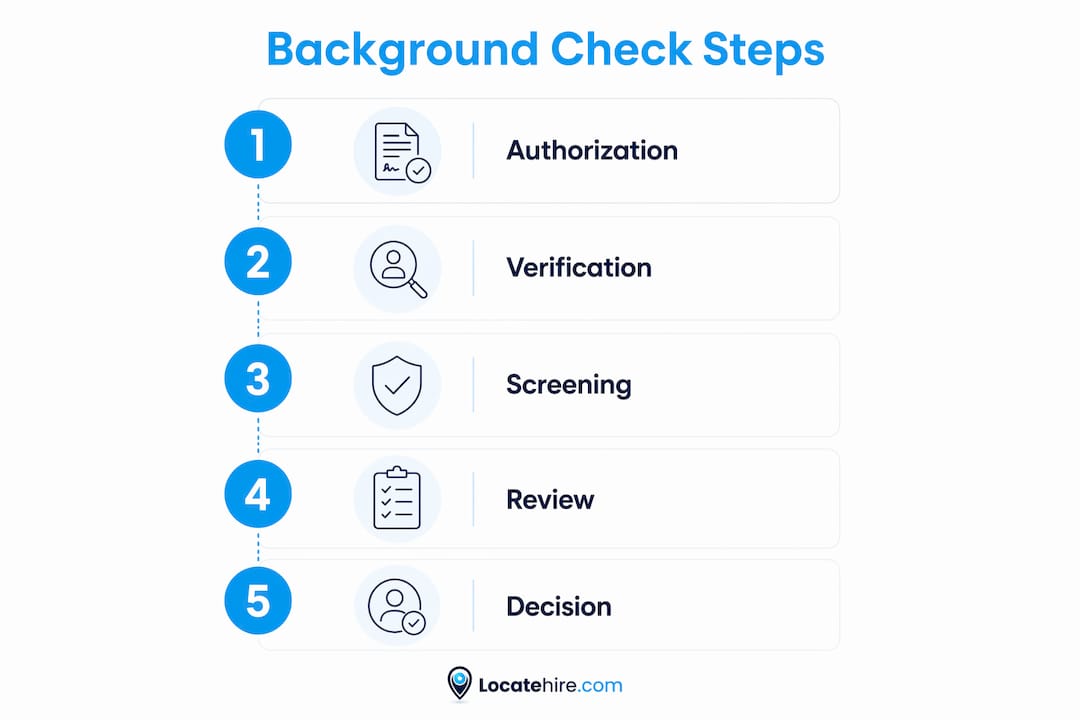
The background check process follows a specific sequence. Skipping steps or reordering them is where most small businesses run into compliance trouble.
- Extend a conditional job offer. Background checks should only begin after a conditional offer is made. Running checks before an offer violates FCRA requirements and triggers Ban the Box laws in many jurisdictions.
- Provide a standalone disclosure. The FCRA requires that candidates receive a clear, written disclosure that a background check will be conducted. This document must stand alone. It cannot be buried inside an application or onboarding packet.
- Obtain written authorization. The candidate signs a separate consent form. This is not optional. No authorization means no legal basis for the check.
- Select the appropriate screening package. Based on the role's risk profile, choose which components to run. A retail cashier and a licensed electrician working in client homes require different packages.
- Submit to a Consumer Reporting Agency (CRA). Third-party screening providers like background check vendors access databases, courthouse records, and verification sources. Standard turnaround runs two to four business days, though international verifications or manual courthouse searches can take longer.
- Review results using individualized assessment. The EEOC requires that employers evaluate criminal records individually, considering the nature of the offense, time elapsed, and relevance to the job. A blanket policy of rejecting anyone with a record is both legally risky and unnecessarily limiting.
- Follow adverse action procedures if needed. If a background check result leads you to reconsider the hire, FCRA mandates a specific process before you can act on it. See the compliance section below for details.
Pro Tip: Build a checklist for every hire that tracks each step in this sequence. When an FCRA complaint or EEOC inquiry arrives, documented process is your best defense. Locatehire's hiring process tools make this documentation automatic.
When should you run background checks during hiring?
Timing is one of the most misunderstood parts of the employment screening process. Running a check too early creates legal exposure. Running it too late slows your hiring and frustrates candidates.
The correct sequence is post-conditional offer, pre-start date. Here is why timing matters in practice:
- Ban the Box laws restrict when and how employers can ask about criminal history. Over 35 states and 150 cities have some form of Ban the Box legislation. Many of these laws prohibit criminal history inquiries until after a conditional offer is made.
- Pre-offer checks create disparate impact risk. If you screen candidates before offering, you may inadvertently filter out protected classes at a higher rate, which draws EEOC scrutiny even without discriminatory intent.
- Separating disclosure and authorization from other documents is not just a best practice. It is a legal requirement. Candidates must receive and sign these forms as standalone documents before any check begins.
- Candidate experience suffers when checks are delayed past the offer stage. Top candidates in trades and service industries receive multiple offers. A slow or confusing screening process pushes them toward competitors who move faster.
- Conditional offers protect both parties. The offer is contingent on the check results, so you are not legally committed to hire if a disqualifying finding surfaces. The candidate understands the process and is less likely to feel blindsided.
A practical approach for service industry hiring: send the disclosure and authorization forms digitally the same day you extend the verbal offer. This cuts one to two days off the process without compromising compliance. Locatehire's applicant screening workflow automates this step so nothing falls through the cracks.
How to choose the right background check package for each role
Not every role carries the same risk. A janitorial worker entering client offices after hours carries different risk than a retail stock associate. Matching the screening package to the actual risk profile of the position is both a cost-saving and a compliance strategy.
Role risk assessment starts with one question: what could realistically go wrong in this position? From there, you select the checks that address those specific risks.
| Role type | Recommended screenings |
|---|---|
| Retail associate (no driving, no finance) | SSN trace, county criminal search, national criminal database |
| Field service tech (HVAC, plumbing, electrical) | SSN trace, criminal search, employment verification, license verification, MVR |
| Janitorial or cleaning staff (client site access) | SSN trace, criminal search, employment verification |
| Finance or bookkeeping role | SSN trace, criminal search, employment verification, education verification, credit report |
| Healthcare support staff | SSN trace, criminal search, OIG exclusion list, employment verification, education verification |
Over-screening wastes money and slows hiring. Under-screening creates liability. A pool service company sending workers into residential backyards needs a criminal check and MVR. It does not need a credit report. Keeping packages lean and role-specific also reduces candidate dropout, since lengthy screening processes cause qualified candidates to withdraw.
Pro Tip: Document your screening criteria by role in writing before you hire. This creates a consistent, defensible standard that protects you if a hiring decision is ever challenged. Inconsistent screening across similar roles is one of the most common triggers for EEOC complaints.
What are the best practices for compliance and avoiding legal risk?
FCRA and EEOC compliance is not optional, and the penalties for violations are real. Here are the practices that keep small businesses protected:
- Use a standalone disclosure form. Bundling consent with other onboarding documents violates FCRA. The disclosure must be a separate document with no extraneous information.
- Follow the adverse action process exactly. If a background check result leads you toward rescinding an offer, FCRA requires a pre-adverse action notice, a waiting period of typically five business days (though this varies by state), and then a final adverse action notice. Skipping any step exposes you to litigation.
- Apply individualized assessment to criminal records. Do not reject candidates automatically based on any criminal record. Evaluate the offense type, how long ago it occurred, and whether it is relevant to the specific job duties.
- Document every decision. Keep records of which checks were run, what results were received, and how decisions were made. This documentation is your audit trail if a complaint is filed.
- Stay current on state and local law. Background check laws vary significantly by state. California, New York, Massachusetts, and Washington have some of the most restrictive rules. Standardizing your workflow with compliance checkpoints built in reduces the risk of missing a local requirement.
- Work only with FCRA-compliant Consumer Reporting Agencies. Not all background check vendors are equal. Confirm your provider is a certified CRA before using their reports for hiring decisions.
Employers who follow FCRA adverse action protocols consistently avoid the costly litigation that comes from inconsistent or careless screening practices.
Key takeaways
A compliant, role-specific background check process is the single most effective way for small businesses to reduce hiring risk without slowing down their pipeline.
| Point | Details |
|---|---|
| Run checks post-conditional offer | Initiating checks before an offer violates FCRA and triggers Ban the Box laws in most states. |
| Match screenings to role risk | Use MVR checks for drivers, criminal searches for site-access roles, and credit checks only for finance positions. |
| Use standalone disclosure forms | Bundling consent with other documents violates FCRA and creates grounds for legal action. |
| Apply individualized assessment | Evaluate criminal records by offense type, recency, and job relevance rather than applying blanket denials. |
| Document every step | Written records of criteria, results, and decisions are your primary defense against EEOC and FCRA complaints. |
What I've learned from watching small businesses get this wrong
I have seen service businesses with 10 employees and businesses with 200 employees make the same mistakes. The most common one is treating background checks as a checkbox rather than a workflow. They run a check, get a result, and make a decision without any documentation, any individualized assessment, or any adverse action process. Then a candidate files a complaint, and there is nothing to show a regulator except a printout from a screening vendor.
The second mistake is over-screening out of anxiety. I understand the instinct. You are sending workers into client homes, and you want certainty. But running a credit check on a pool technician or an education verification on a warehouse associate adds cost, adds days, and signals to the candidate that your process is disorganized. The best candidates in service industries have options. They will take the offer from the company that moves in five days, not the one that takes twelve.
The third mistake is ignoring state law. Federal FCRA is the floor, not the ceiling. If you hire in California, New York, or Illinois, your obligations are significantly more specific. A generic process built around federal minimums will get you into trouble in those states.
What actually works is a standardized, documented process tied to role risk. Build your screening packages by job type, not by candidate. Use technology to automate the disclosure and authorization steps. And treat the adverse action process as non-negotiable, every single time. Background checks are not a cost center. They are an investment in the quality and defensibility of every hire you make.
— Jeff
How Locatehire makes background checks work for small businesses
Running a compliant, role-specific background check process manually is time-consuming for any small business. Locatehire is an AI-powered recruitment platform built specifically for service industry businesses with ongoing hiring needs, including pool service, janitorial, HVAC, electrical, plumbing, and retail. The platform integrates screening workflows directly into the hiring process, so disclosure forms, candidate authorization, and check initiation happen automatically at the right stage. You get faster turnaround, built-in compliance safeguards, and a documented audit trail without adding administrative work.
If your business hires regularly and you want to reduce time to hire without cutting corners on compliance, Locatehire is built for exactly that workflow.
FAQ
What does a standard employment background check include?
A standard employment background check includes an SSN trace, county and national criminal record searches, and employment verification. Depending on the role, it may also include MVR checks, education verification, and license confirmation.
How long does a background check take for hiring?
Most background checks take two to four business days. Manual courthouse searches or international verifications can extend that timeline to a week or more.
When is the right time to run a background check during hiring?
Background checks should be initiated only after a conditional job offer is extended. Running checks before an offer violates FCRA requirements and conflicts with Ban the Box laws in most U.S. states.
What happens if a background check reveals a problem?
If a background check result leads you to consider rescinding an offer, FCRA requires you to send a pre-adverse action notice, wait the required period (typically five business days), and then send a final adverse action notice before making a final decision.
Do small businesses need to follow the same background check laws as large companies?
Yes. FCRA and EEOC requirements apply to all employers regardless of size. State and local laws, including Ban the Box ordinances, also apply to small businesses and carry the same penalties for non-compliance.