
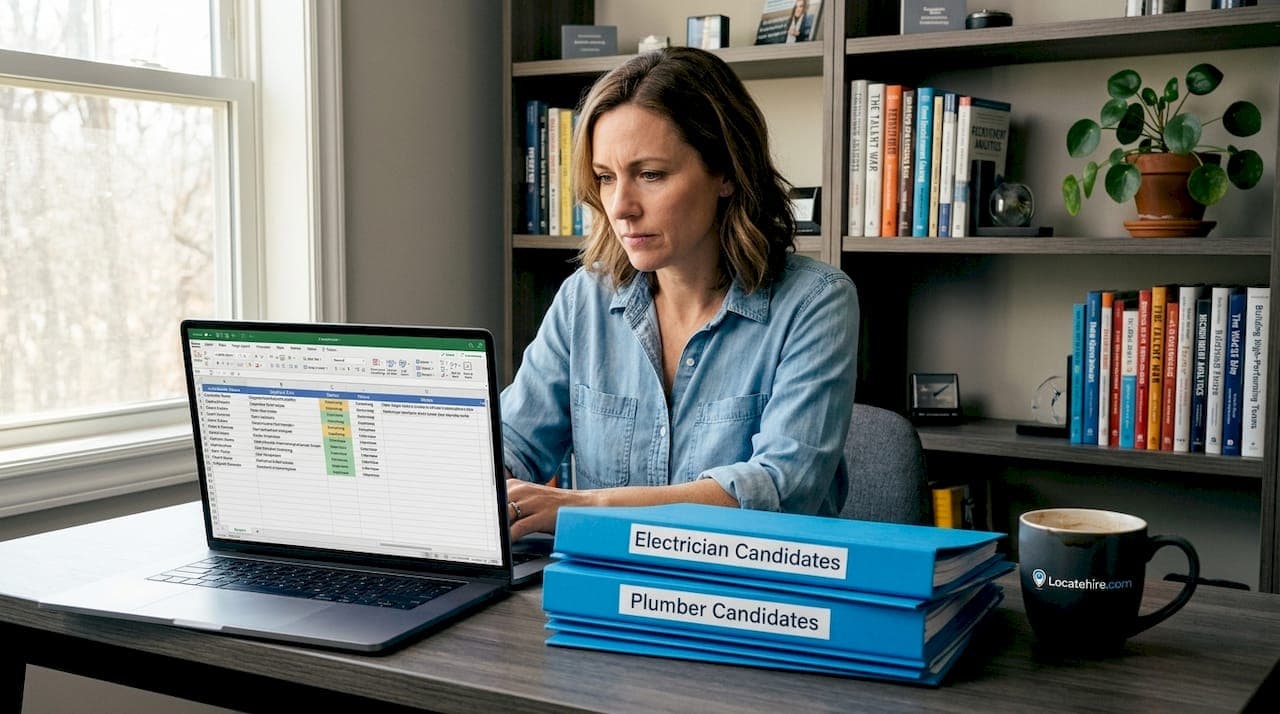
If you run an HVAC, plumbing, or electrical business and you're constantly struggling to fill open positions, the problem probably isn't the labor market. The signs your hiring process is broken are often sitting right in front of you. In talent acquisition terms, a dysfunctional recruitment process is one that wastes time, repels qualified candidates, and costs you more money per hire than the role ever justifies. This article breaks down the specific warning signs small service business owners miss most often, and what you can realistically do about each one.
Table of Contents
- Key Takeaways
- 1. Your time-to-fill keeps creeping past 44 days
- 2. Candidates stop hearing from you after they apply
- 3. Your interviews have no structure and no scoring
- 4. Your cost per hire keeps going up without better results
- 5. Your application is too long or too complicated
- 6. You keep losing candidates to a competitor after interviews
- 7. Your team disagrees constantly on who to hire
- My take on why broken hiring gets ignored
- How Locatehire helps you fix hiring before it costs more
- FAQ
Key Takeaways
| Point | Details |
|---|---|
| Time-to-fill is a real metric | If roles stay open past 44 days, your process has bottlenecks worth fixing immediately. |
| Silence kills your pipeline | Most candidates disengage after two weeks without updates, causing avoidable dropout. |
| Gut feel creates bad hires | Unstructured interviews with no scoring criteria produce inconsistent, biased decisions. |
| Cost per hire signals waste | Repeated rehiring and high turnover are direct symptoms of a flawed process upstream. |
| Application complexity loses candidates | 60% of applicants abandon long or complicated applications before they ever finish. |
1. Your time-to-fill keeps creeping past 44 days
The median time-to-fill for non-executive roles sits at 44 days. If your open positions routinely stretch well beyond that, you have a process problem. Not a market problem.
The breakdown of where those days go tells the real story. Approval delays alone average 14 days. Screening start lag adds another 8. Screening itself takes 8 days, interviewing 9, and final decision and offer another 6 days to close. Every one of those stages is a place where a slow handoff costs you a qualified technician.
In service trades, this matters more than in most industries. A skilled HVAC technician or licensed electrician is not sitting around waiting two months for you to make up your mind. Top candidates accept offers within about 10 days of hitting the market. If your hiring cycle runs three to six weeks, you are consistently losing your best applicants to competitors who move faster.
- Check whether every job opening requires manager approval before posting
- Identify if your team has a clear definition of what a qualified candidate looks like before they start reviewing
- Track the gap between application received and first contact made
Pro Tip: Break your hiring process into timed stages and record how long each one actually takes. Most owners are shocked at how many days disappear between "we got some applications" and "let's schedule interviews."
2. Candidates stop hearing from you after they apply
Poor candidate communication is one of the most common red flags in hiring, and it is one that service business owners rarely notice because it happens quietly. Your candidates just disappear. You assume they took another job. The truth is often that you ghosted them first.
53% of candidates report being ghosted at some point during a job search. The number jumps to 61% after interviews. Once you go two weeks without an update, 62% of applicants lose interest entirely.
Here is what fixing this looks like in practice:
- Send an automated confirmation within 24 hours of every application received
- Set a clear internal timeline for when candidates will hear back after screening
- Send a status update at every stage transition, even if the update is just "we're still reviewing"
- After interviews, communicate a decision or timeline within five business days
- When rejecting someone, send a brief, respectful message rather than silence
"Candidates who have a positive experience, even when rejected, are significantly more likely to reapply and to recommend your company to others." — RecruitBPM, 2026
Pro Tip: If you use any automated screening tools, be transparent about it. 50.5% of US job seekers have been rejected without any human feedback, and 63.8% believe AI made the decision. Candidates who know where they stand trust you more, not less.
3. Your interviews have no structure and no scoring
Walk into most small service business hiring conversations and you will find the same scene: the owner asks a few questions they came up with on the spot, talks about the company for 20 minutes, and then decides based on whether the person seemed like a good fit. That is an unstructured interview. And it is one of the clearest poor hiring indicators in the book.

Structured interviews with standardized questions and scoring rubrics consistently outperform unstructured conversations on predictive validity. They also reduce the influence of personal bias on the outcome.
The difference is not complicated. Here is what each approach looks like for a plumbing technician role:
| Approach | Example question | How decision gets made |
|---|---|---|
| Unstructured | "Tell me about yourself" | Owner's gut feeling |
| Structured | "Describe a time you diagnosed a leak under pressure. What steps did you take?" | Scored against a 1-4 rubric |
Panel disagreements and missing rubrics cause small business interviews to collapse into personality contests rather than assessments of job-relevant skill. Two interviewers walk out of the same conversation with completely different impressions, and neither can explain their reasoning in concrete terms.
- Write three to five consistent questions for each role before interviews start
- Score each answer on a simple numeric scale immediately after the interview
- Require all interviewers to submit individual scores before discussing as a group
This is not bureaucracy. It is a ten-minute fix that dramatically improves consistency.
4. Your cost per hire keeps going up without better results
The median cost per hire sits around $1,200 for non-executive roles. But that number only tells part of the story. The real cost of a broken recruitment process includes the hours your office manager spent posting and reposting the same job, the time you lost covering for an unfilled position, and the cost of training someone who quit in 90 days.
| Cost driver | What it signals |
|---|---|
| Repeated job postings for the same role | Candidates are not progressing or accepting offers |
| High early turnover (under 90 days) | Mismatch between job expectations and reality |
| Long onboarding ramp time | New hire was not properly screened for fit |
| Multiple rounds of interviews for the same candidate pool | No clear hiring criteria defined upfront |
High new hire turnover within 90 days often traces directly back to a disconnect between what was communicated during hiring and what the job actually involves. If you are selling the role during interviews rather than describing it honestly, you will keep losing people shortly after they start. That cycle is expensive. Learning to track hire rate trends over time is one of the fastest ways to spot this pattern before it drains your budget.
5. Your application is too long or too complicated
If qualified candidates are not even making it through your application, you have a funnel problem upstream of everything else. 60% of candidates abandon job applications midway through due to complexity or length. And 69% are less likely to apply if the process looks like it will take too long.
For an HVAC technician role, asking someone to upload a resume, fill in a multi-page work history form, write a cover letter, and answer five open-ended screening questions before a human being has even looked at their name is a fast way to lose your best candidates to a competitor with a three-question mobile form.
- Audit your current application by completing it yourself on a phone. Time how long it takes.
- Remove any question that is not essential for screening at this stage
- Make sure your job descriptions are clear and specific rather than generic
Also consider that vague or misleading job descriptions create their own dropout problem further down the process. When candidates reach an interview and discover the job looks nothing like what was posted, they leave. And they tell others. Fixing your job postings is one of the highest-leverage moves you can make for almost no cost.
6. You keep losing candidates to a competitor after interviews
If candidates are making it through your process and then disappearing or going cold after interviews, that is a specific recruitment process problem worth diagnosing separately. It is not just about speed. It is often about the experience they had.
55% of job seekers report frustration from receiving no response after applying. 44% report not hearing back after interviews. For a service business where word travels fast in the local trades community, this kind of reputation damage compounds. The electrician who had a bad experience talking to your company will mention it to the next two people they work with.
Understanding how your recruitment funnel works at each stage lets you see exactly where candidates are dropping out. If your drop-off spikes at the post-interview stage, the issue is likely speed of offer, unclear next steps, or a competitor who made a faster move. If it spikes at application, the issue is your posting or your form.
Track your stage-by-stage conversion numbers. Most small business owners have no idea how many people applied, how many got a screening call, and how many made it to an interview. Without those numbers, you are guessing.
7. Your team disagrees constantly on who to hire
This one goes deeper than a personality clash. If your leads, office manager, and you regularly walk away from the same interview with completely different opinions and no way to reconcile them, you do not have a disagreement problem. You have a process problem.
Without shared criteria, every hiring decision becomes a negotiation between competing preferences. One person liked how the candidate talked about customers. Another thought he seemed arrogant. Neither wrote anything down. Neither scored anything. The discussion goes in circles, the best candidate accepts another offer while you're still debating, and you eventually hire someone out of exhaustion.
Building a simple one-page rubric per role fixes this faster than any team conversation. It does not need to be elaborate. For a plumbing tech, it might score technical knowledge, customer communication, reliability indicators from prior jobs, and ability to work independently. When everyone scores the same dimensions, disagreement shrinks and decisions get made. You can build that process without a dedicated HR department.
My take on why broken hiring gets ignored
I've spent a lot of time looking at how small service businesses hire, and the pattern I see most often is this: owners know something is off, but they assume it's just the market. It's easier to blame the candidate pool than to audit your own process.
What I've learned is that the signs of weak recruitment are almost always internal. The jobs take too long to fill because approvals move slowly. The candidates disappear because no one followed up. The new hires quit in 60 days because the job description sold something the actual role couldn't deliver.
The frustrating part is that none of these fixes are expensive. Most of them cost nothing except about two hours of setup time and a commitment to measuring what you're doing. The businesses I've seen turn this around fastest are the ones that started tracking one metric, got uncomfortable with what it showed, and made one change at a time.
If you are hiring effectively, you should be able to tell me your average time-to-fill, your offer acceptance rate, and your 90-day retention rate. If you can't answer those three questions, that is where to start.
— Jeff
How Locatehire helps you fix hiring before it costs more
If several of these signs hit close to home, you're not alone. Most small HVAC, plumbing, and electrical businesses are running their hiring on spreadsheets, text threads, and memory. That works until it doesn't.
Locatehire is an applicant tracking system built specifically for small businesses with ongoing hiring needs. It automates candidate communication so no one falls through the cracks, tracks every stage of your hiring process so you can see exactly where you're losing people, and keeps your candidate pipeline organized without requiring a dedicated HR team. For service businesses that hire regularly, it removes the manual work that creates most of the delays and communication failures described above. If you're ready to stop guessing about where your hiring breaks down, explore Locatehire and see how it fits your business.
FAQ
What is considered a broken hiring process?
A broken hiring process is one where roles take too long to fill, candidates drop out before offers are made, hiring decisions are inconsistent, and cost per hire keeps rising without improving quality. These are signs your process has structural gaps rather than just bad luck with candidates.
How long should a hiring process take for a trades business?
The median time-to-fill for non-executive roles is 44 days, but top candidates typically accept offers within 10 days of entering the market. For trades roles like HVAC or plumbing technicians, you should aim to move from application to offer in two to three weeks.
Why do candidates ghost small businesses after interviews?
Most candidate ghosting after interviews traces back to slow follow-up from the employer. 62% of candidates disengage after two weeks without an update. Sending a clear timeline and a follow-up message within five business days dramatically reduces this.
What is the difference between structured and unstructured interviews?
A structured interview uses predetermined, job-relevant questions and a scoring rubric for every candidate. An unstructured interview relies on open-ended conversation and gut feel. Structured interviews produce more consistent, less biased hiring decisions.
How do I know if my cost per hire is too high?
If you are frequently refilling the same role within 90 days, spending significant time on duplicate postings, or losing new hires before they complete onboarding, your total cost per hire is almost certainly higher than the $1,200 median. Tracking turnover patterns by role is the fastest way to confirm it.