

The fastest way small plumbing shops win the talent competition is to run five recruiting channels in parallel and make employee referrals the centerpiece. The core tactics are: employee referral programs, trade-school and apprenticeship partnerships, DOD SkillBridge for transitioning service members, high-school career-tech outreach, adjacent-trade pivots, a faster 7–14 day hiring process, and an applicant tracking system to keep it all organized. Start this week by launching a referral bonus announcement to your current crew.
Top tactics at a glance:
- Employee referral program with a structured bonus
- PHCC/UA and community-college apprenticeship partnerships
- DOD SkillBridge internships (zero wage cost to you)
- High-school career-tech engagement starting junior year
- Adjacent-trade recruiting (HVAC techs, sprinkler fitters)
- Targeted social media ads and employer-brand content
- A standardized 7–14 day hiring pipeline
- An ATS to track candidates and automate follow-up
Stat: Employee referrals close hires 4–8x more effectively than paid job boards for plumbing roles. That gap alone is reason enough to build a referral program before spending another dollar on job boards.
Table of Contents
- Why does targeted plumbing recruiting outperform general job boards?
- What recruiting channels actually fill plumbing roles?
- How do you build a repeatable plumbing talent pipeline?
- How do you design an employee referral program that actually converts?
- How do you speed up hiring without losing quality?
- What credential checks does every plumbing hire need?
- How does strong onboarding reduce early turnover?
- What interview questions reveal coachability and fit?
- How does an ATS help small plumbing shops hire faster?
- What does it actually cost to hire a plumber, and how long does it take?
- Why do employee referrals outperform job boards, and how do you copy that success?
- Key Takeaways
- The real problem most plumbing shops won't admit
- Locatehire cuts the admin out of plumbing recruitment
- Useful sources and further reading
Why does targeted plumbing recruiting outperform general job boards?
Posting to a general job board and waiting is the least efficient way to fill a plumbing role. Targeted recruiting wins because it reaches candidates who already have relevant skills, understand the trade, and are more likely to accept an offer and stay.
When you post on a broad board, you compete with every other employer in every industry for attention. A targeted approach, whether through a trade-school partnership, a referral from a trusted tech, or a Facebook ad aimed specifically at HVAC technicians, delivers candidates who already understand physical work, odd hours, and the satisfaction of fixing something real. Conversion rates are higher because the candidate pool is pre-filtered.

Cultural positioning matters here too. Shops that present a visible pay ladder and clear career milestones attract employed candidates who are quietly looking for a better path. A candidate who sees "Helper → Apprentice → Journeyman → Lead Tech" with dollar figures attached to each step is far more likely to respond than one who sees a vague "competitive pay" line on Indeed.

The short-term ROI is real. Lower time-to-hire means fewer days running shorthanded. Better candidate fit means lower 90-day washout. Both translate directly to revenue and crew morale.
What recruiting channels actually fill plumbing roles?
Run these channels in priority order. Shops with four or more trucks benefit most from operating all five sources in parallel to avoid short-staffing within 18 months.
1. Employee referrals (highest priority, lowest cost)
- Pros: Pre-screened by someone who knows your culture; 4–8x higher close rate vs. paid boards; fast.
- Cons: Requires an active, incentivized program; limited reach if your team is small.
- Cost: Referral bonus only (typically $500–$1,500 per hire).
2. PHCC/UA and community-college apprenticeships
- Pros: Produces trained, motivated candidates; builds long-term pipeline; often subsidized.
- Cons: 6–18 month lead time before a hire is field-ready.
- Cost: Low to zero for outreach; some sponsorship costs (tool kits, guest lectures).
3. DOD SkillBridge
- Pros: Transitioning service members intern during their last 180 days of active duty; the military pays their wages, not you; conversion rates are strong when fit is right.
- Cons: Requires DoD approval and a structured internship plan; not every candidate will have plumbing background.
- Cost: Zero wage cost to the employer.
4. High-school career-tech programs
- Pros: Early relationship-building; low-cost sponsorships (a donated workbench or tool kit) open doors; engaging in junior year gives you 18 months of relationship before graduation.
- Cons: Long lead time; candidates need post-graduation training.
- Cost: Minimal. A sponsored workbench or guest lecture slot.
5. Adjacent-trade pivots (HVAC, sprinkler fitters)
- Pros: Candidates already understand physical systems, tools, and service culture.
- Cons: Some retraining required; may need licensing support.
- Cost: Targeted Facebook ads to sprinkler fitters run $80–$120 per qualified lead and convert at 30–40%.
6. Targeted social media and employer-brand content
- Pros: Gen Z evaluates company culture through TikTok and Instagram before applying; employee spotlights and day-in-the-life videos drive organic interest.
- Cons: Requires consistent content creation; results take 60–90 days to build.
- Cost: Low if organic; $500–$1,000/month for paid amplification.
7. Job boards (supplemental, not primary)
- Pros: Wide reach; fast to post.
- Cons: High ghosting rate; after accounting for washout, cost per actual hire can reach $1,500–$2,500.
- Cost: $200–$500/month in posting fees, plus hidden costs from ghosted interviews.
Pro Tip: Start with referrals and one trade-school partnership this quarter. Add SkillBridge and social media in quarter two. Job boards work best as a supplemental channel, not your primary source.
How do you build a repeatable plumbing talent pipeline?
Stop treating hiring as a crisis response. Run these partnership actions every quarter and you'll replace panic posting with a steady flow of apprentice and helper candidates.
Step-by-step setup (30 days):
- Identify your targets. List the PHCC chapter, UA local, community colleges, and high schools within 30 miles. Most states have a DOL apprenticeship program directory at dol.gov you can use to find registered programs.
- Make first contact. Email or call the program coordinator. Introduce your shop, mention your apprenticeship openings, and ask about their placement process. Keep it to five minutes.
- Offer something specific. Don't just say "we're hiring." Offer a guest lecture, a sponsored tool kit, or a field trip to your shop. Concrete offers get responses; vague interest does not.
- Set a calendar cadence. Visit each school or program once per semester. Put it on the calendar now.
- Apply for SkillBridge. Submit your employer application at the DoD SkillBridge portal. Approval typically takes 30–60 days. Once approved, you can receive interns at zero wage cost.
- Engage career-tech in junior year. The Department of Labor's $145 million apprenticeship investment announced in 2026 means more programs are funded and actively seeking employer partners. That's your opening.
30-day partnership checklist:
- List 3–5 local programs (PHCC, UA, community college, high school)
- Send outreach emails to each coordinator
- Schedule one in-person visit or virtual meeting
- Prepare a one-page "Why work here" sheet for students
- Submit DoD SkillBridge employer application
- Add quarterly school visits to your calendar
Pro Tip: Ask to join the advisory board of your local career-tech program. Advisory board members get first access to top graduates and shape the curriculum to match real job requirements. It costs nothing but a few hours per year.
How do you design an employee referral program that actually converts?
Employee referrals close hires 4–8x more effectively than paid job boards for plumbing roles. That performance gap comes from one simple fact: your best techs know other good techs, and a personal recommendation carries more weight than any job posting.
Implementation checklist:
- Set the bonus amount. $500–$1,500 per hire is the typical range for trades. Tiered payouts work well: $250 at 30 days, $500 at 90 days. This aligns the referrer's incentive with retention, not just placement.
- Define eligibility. All full-time employees qualify. The referred candidate must be a new hire (not a rehire within 12 months).
- Create a simple submission form. Name, phone, trade background, and the referring employee's name. A Google Form or your ATS referral module handles this in minutes.
- Fast-track referred candidates. Move them to a phone screen within 48 hours. Speed signals respect and keeps the referrer's credibility intact with their contact.
- Announce it clearly. Send a team text or post it at the shop: "Refer a plumber or helper who gets hired and stays 90 days — you earn $750."
- Track KPIs. Monitor referral-to-hire rate and 90-day retention for referred hires separately. If referred hires retain better (they almost always do), that's your proof to increase the bonus.
For referral program design best practices specific to small shops, the structure matters as much as the dollar amount. A program nobody knows about pays out nothing.
How do you speed up hiring without losing quality?
Cut your lead time by standardizing a 7–14 day pipeline. Candidates in the trades field multiple offers simultaneously, and a slow process is the most common reason small shops lose good candidates to larger competitors.
The 7–14 day hiring pipeline:
| Step | Action | Target Day |
|---|---|---|
| 1 | Text or email response to application | Day 1 |
| 2 | One-way video screen (3 questions, 5 min) | Day 2–3 |
| 3 | 30-minute phone screen | Day 4–5 |
| 4 | Paid trial day (ride-along or bench work) | Day 7–10 |
| 5 | Verbal offer | Day 10–12 |
| 6 | Written offer letter sent | Day 12–14 |
Phone screen script (30 minutes):
- "Walk me through your last plumbing role — what did a typical day look like?"
- "What's the most complex repair you've handled independently?"
- "What are you looking for in your next shop that you don't have now?"
- "Are you licensed? What state? Any certifications?"
- "What's your availability, and when could you start?"
Offer checklist (prevent counteroffers):
- Start date confirmed in writing
- Base pay and any overtime structure
- Pay progression schedule (month 6, month 12, month 18)
- Training plan and any certifications the shop will fund
- Benefits summary (health, PTO, truck/tool allowance)
Automate the follow-up. An ATS can send a text the moment an application arrives, schedule the video screen automatically, and remind the candidate 24 hours before the trial day. That alone eliminates the most common drop-off points. If your hiring process has broken steps, candidates notice before you do.
What credential checks does every plumbing hire need?
Verify credentials early in the process. A late-stage license rejection after a verbal offer wastes everyone's time and damages trust with the candidate.
Core checks for every plumbing hire:
- Journeyman or apprentice status — For DOL-registered apprenticeships, verify enrollment through the DOL apprenticeship directory.
Run the license check and driving record at the offer stage, before the written offer goes out. Background and drug screens typically follow a conditional offer. Consult your state's licensing board and an employment attorney to confirm the correct sequence for licensed trades work in your jurisdiction.
How does strong onboarding reduce early turnover?
Retention is the best recruiting tool you have. A tech who stays three years costs a fraction of what it takes to replace one who leaves at month four.
The key driver of early churn is a lack of visible career progression. Apprentices often quit because they can't see their earnings at month 18. A written pay ladder with specific milestones fixes that.
30/60/90 onboarding checklist:
- Day 1: Shop tour, safety orientation, tool issue, meet the team, review the pay ladder.
- Week 1: Ride-along with a senior tech, review service call procedures, set 30-day goals.
- Day 30: Check-in meeting. Review goals. Confirm licensing status and any training needs.
- Day 60: Skills assessment. Identify gaps. Assign any OSHA or certification training.
- Day 90: Performance review. Confirm pay progression schedule. Ask what's working and what isn't.
The pay ladder in practice: Post it on the wall in the shop and include it in the offer letter. A simple chart showing Helper ($X/hr) → Apprentice ($X+2/hr at month 6) → Journeyman ($X+5/hr at year 2) → Lead Tech ($X+8/hr at year 3) gives every new hire a reason to stay and a target to work toward.
Retention metrics to monitor:
- 90-day retention rate (target: 85%+)
- 12-month retention rate (target: 70%+)
- Promotion rate (how many techs advance on schedule)
When 90-day retention dips below 80%, the problem is almost always in the first two weeks. Review your onboarding checklist and add a structured week-one check-in. For a detailed plumbing tech onboarding playbook, the 30/60/90 framework is the most reliable starting point.
What interview questions reveal coachability and fit?
Hire for coachability and attitude. Technical skills can be trained with a structured program; a bad attitude cannot be fixed with a wrench.
This approach is especially valuable in a tight labor market where you may not find a fully licensed journeyman who also fits your culture. A motivated helper with the right mindset will outperform a technically skilled tech who resists feedback within six months.
Behavioral and situational questions for plumbing roles:
- "Tell me about a time you made a mistake on a job. What happened and what did you do?"
- "Describe a situation where a lead tech gave you feedback you disagreed with. How did you handle it?"
- "What's something you taught yourself to get better at in the last year?"
- "Walk me through how you'd handle a customer who is upset about a repair cost."
- "If you didn't know how to fix something on a job, what would you do?"
Simple 5-point scoring rubric:
| Score | What it looks like |
|---|---|
| 5 | Specific example, owns the outcome, shows what they learned |
| 4 | Good example, partial ownership, some reflection |
| 3 | Vague answer, deflects slightly, limited reflection |
| 2 | Blames others, no learning shown |
| 1 | Refuses to answer or gives a non-answer |
Score each behavioral question. A candidate who scores 4–5 on the coachability questions but only has two years of experience will often outperform a 5-year tech who scores 2–3. The rubric makes that call easier to defend to yourself and your team.
For skills-based pre-screening, trade-specific assessments can verify technical competency before the interview, so you spend the conversation on fit and mindset rather than basic knowledge checks.
How does an ATS help small plumbing shops hire faster?
An applicant tracking system reduces time-to-hire and prevents candidate leakage by automating the follow-up steps that fall through the cracks in a busy shop. You don't need an enterprise platform. You need a system built for small businesses with ongoing hiring needs.
Features to look for in an ATS for plumbing shops:
- Auto-text on application receipt. Candidates expect a response within hours, not days.
- One-way video screening. Replaces the first phone call and saves 20–30 minutes per candidate.
- Candidate tags and pipeline stages. Track where every candidate is without a spreadsheet.
- Referral tracking. Log who referred whom and trigger bonus payouts automatically at the 30- and 90-day milestones.
- Interview scheduling. Candidates self-schedule from a calendar link; no back-and-forth texting.
- Analytics dashboard. See time-to-hire, source-of-hire, and 90-day retention by channel.
- Job posting to major boards. Post once and distribute to Indeed, ZipRecruiter, and others simultaneously.
Evaluation criteria for choosing quickly:
- Time to implement: under one week for a small shop
- Monthly cost: transparent, subscription-based pricing
- Required training: minimal; your office manager or dispatcher should be able to run it
An ATS connects every tactic in this article. Referrals get logged and tracked. Pipeline candidates from trade schools get tagged by source. Auto-texts keep candidates warm between steps. Analytics tell you which channels are producing hires and which are wasting budget.
Stat: Shops that run five recruiting sources in parallel avoid frequent staffing shortfalls. An ATS is what makes managing five sources practical for a two-person office.
What does it actually cost to hire a plumber, and how long does it take?
Plan your recruiting budget around realistic numbers. The channel you choose determines both the timeline and the true cost per hire.
| Channel | Typical Time-to-Hire | Estimated Cost per Hire |
|---|---|---|
| Employee referral | 2–4 weeks | $500–$1,500 (bonus only) |
| Trade-school / apprenticeship | 6–18 months (pipeline) | Low; sponsorship costs vary |
| DOD SkillBridge | 3–6 months (internship period) | Zero wage cost; admin time only |
| Adjacent-trade (targeted ad) | 3–6 weeks | $80–$120/lead; 30–40% conversion |
| General job board | 4–8 weeks | $1,500–$2,500 after ghosting/washout |
Worked budget example: If you need to hire two journeymen this quarter and you're relying on job boards, budget $3,000–$5,000 in real cost after ghosted interviews and early washouts. Shift one of those hires to a referral program and you cut that cost to $750–$1,500 while improving 90-day retention.
Hidden costs to account for:
- Ghosted interviews: estimate 30–40% of scheduled interviews will not show.
- 90-day washout: on general boards, cost per actual plumber hire can reach $1,500–$2,500 once you factor in candidates who leave before 90 days.
- Reposting fees when a hire falls through.
Pacing advice: Launch referrals and one trade-school partnership immediately. They cost the least and return the most. Add targeted social ads and SkillBridge in quarter two. Keep job boards as a supplemental channel, not your primary spend.
Why do employee referrals outperform job boards, and how do you copy that success?
Referrals convert at 4–8x the rate of paid job boards for one structural reason: the referring employee has already pre-screened the candidate for culture fit and basic competency. They wouldn't put their name on someone who would embarrass them. That informal vetting step is something no algorithm replicates.
Step-by-step referral funnel:
- Announce the program. Send a group text and post a flyer in the shop. State the bonus amount, eligibility rules, and how to submit a referral.
- Set up a simple referral form. A Google Form with five fields (candidate name, phone, trade background, years of experience, referring employee name) is enough to start.
- Fast-track referred candidates. Contact them within 24 hours. Slow follow-up signals to the referrer that you're not serious, and they'll stop sending names.
- Run the paid trial day within 7 days. A one-day ride-along or bench evaluation gives both sides a realistic preview. Candidates who complete a trial day convert at significantly higher rates.
- Pay the bonus in two tranches. Half at 30 days, half at 90 days. This keeps the referrer invested in the new hire's success.
- Track and report back. Tell your team monthly how many referrals came in, how many converted, and who earned a bonus. Visibility drives participation.
Example team announcement text: "Know a good plumber or helper looking for a change? Refer them, they get hired, and they stay 90 days — you earn $750. Text [name] their info or fill out the form at [link]."
Example follow-up text to referred candidate: "Hi [Name], I'm [Your Name] at [Shop Name]. [Referrer] mentioned you might be open to a conversation about a plumbing role. We'd love to connect this week — does [Day] at [Time] work for a quick call?"
30-day experiment: Launch the referral announcement today. Set up the form. Fast-track any referred candidates into a paid trial within 7 days. After 60 days, compare your referral-to-hire conversion rate against your job-board conversion rate. The gap will tell you exactly how much to invest in the program going forward.
Key Takeaways
Winning the competition for plumbing talent requires running referrals, trade-school partnerships, and a fast 7–14 day hiring pipeline simultaneously rather than relying on job boards alone.
| Point | Details |
|---|---|
| Referrals are your best channel | Employee referrals close hires 4–8x more effectively than paid job boards; launch a bonus program this week. |
| Run five channels in parallel | Shops with four or more trucks that operate referrals, apprenticeships, SkillBridge, career-tech, and adjacent-trade recruiting avoid staffing shortfalls. |
| Speed wins candidates | A standardized 7–14 day pipeline from application to offer prevents losing candidates to faster competitors. |
| Visible pay ladders retain apprentices | A written pay ladder with milestones at specific intervals reduces early churn by showing long-term earnings potential. |
| Locatehire centralizes the process | Locatehire's ATS automates referral tracking, candidate follow-up, and analytics so small shops can manage multiple channels without extra admin. |
The real problem most plumbing shops won't admit
The "no good plumbing talent out there" story is almost always a positioning and process problem, not a supply problem. Shops that act like talent developers — with visible pay ladders, funded training, and a referral culture — attract employed candidates who weren't even looking. The ones that post on Indeed and wait are competing for the same small pool of active job seekers.
What most articles on this topic miss is that speed and culture are more powerful than compensation alone. A candidate who gets a text response within an hour, a phone screen the next day, and a trial day offer by day seven will choose your shop over a larger competitor who takes three weeks to schedule a second interview — even if the larger shop pays slightly more. The trades market rewards responsiveness in a way that office hiring does not.
The other underrated move: treating recruiting as a continuous activity, not a quarterly fire drill. Visit parts houses. Talk to vendors. Keep a warm list of candidates who weren't ready last time. The shops that win talent consistently are the ones where the owner or manager is always, quietly, recruiting. That habit costs nothing and compounds over time.
Locatehire cuts the admin out of plumbing recruitment
Plumbing shops that implement the tactics in this article — referral programs, trade-school pipelines, SkillBridge, faster offers — quickly run into the same bottleneck: too many candidates across too many channels for a two-person office to track manually. That's exactly the problem Locatehire solves.
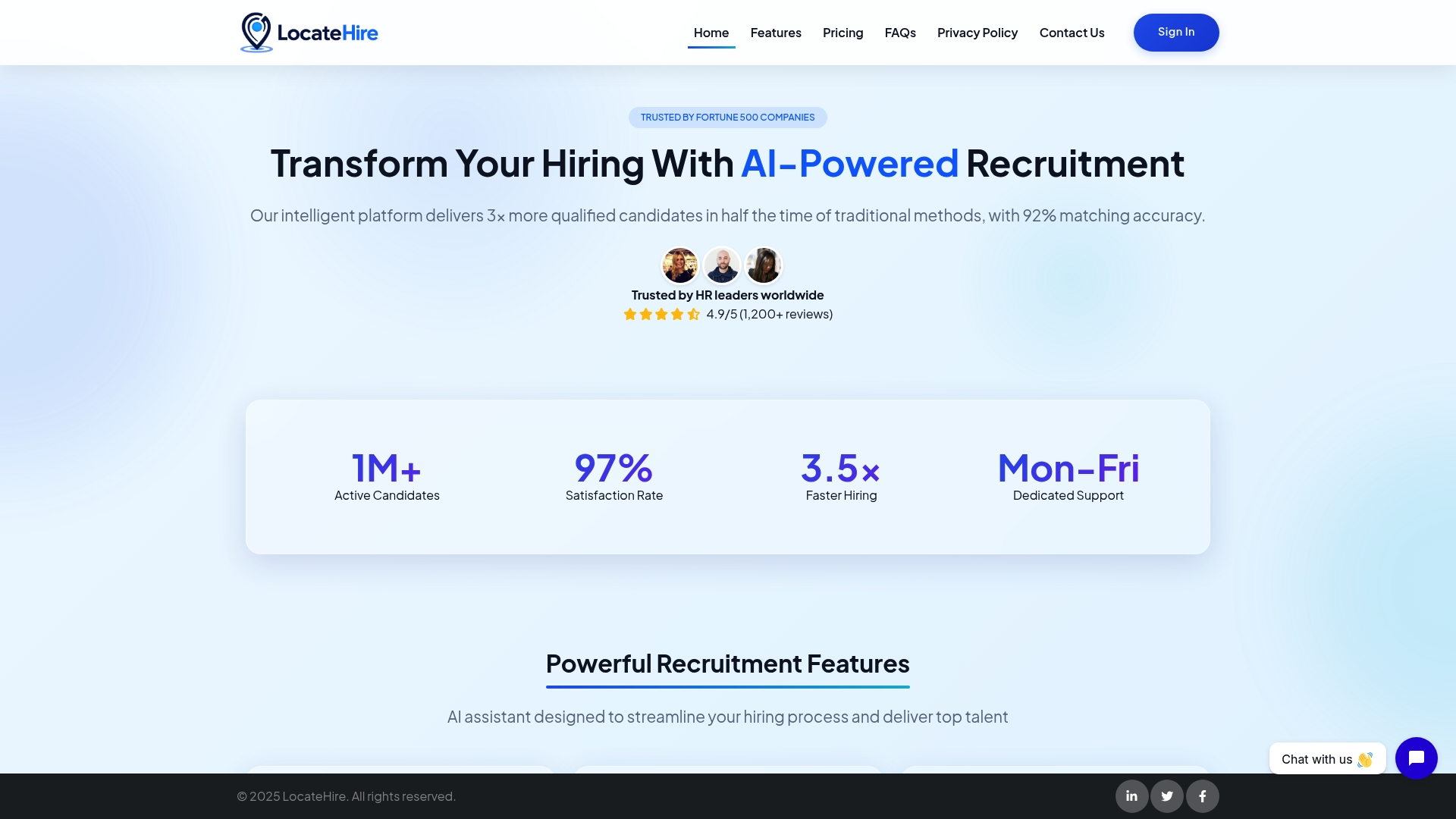
Locatehire is an AI-powered applicant tracking system built specifically for small businesses with ongoing hiring needs, including plumbing, HVAC, electrical, and similar trades. It posts your jobs to major boards and social media in one click, auto-texts candidates the moment they apply, tracks every referral from submission to bonus payout, and gives you a clear analytics dashboard showing which channels are producing hires. Setup takes less than a week. No enterprise contract, no IT team required.
What Locatehire does for plumbing shops:
- AI candidate matching and smart scoring surface the strongest applicants first
- Auto-text and interview scheduling eliminate the manual follow-up that causes ghosting
- Referral tracking logs submissions and triggers payout reminders at 30 and 90 days
- One-way video screening replaces the first phone call and saves hours per week
- Custom career pages let you showcase your pay ladder and shop culture to candidates before they apply
- Hiring analytics show time-to-hire and source-of-hire so you know where to invest next quarter
Start a trial at locatehire.com and see how much faster your next plumbing hire moves through the pipeline.
Useful sources and further reading
The research and guidance in this article draw from the following authoritative sources. Each is worth bookmarking for ongoing reference.
- Bureau of Labor Statistics — Plumbers, Pipefitters, and Steamfitters: The primary source for employment projections, median wages, and job outlook data for the plumbing trade in the U.S.
- How to win at recruiting in the trades — Plumber Magazine: Practical editorial on hiring for coachability, treating recruiting as a continuous activity, and building a warm candidate list.
- Successful tactics for finding new plumbing employees — Plumber Magazine: Covers social media employer branding, ride-and-decide shadowing, and outreach beyond standard job boards.
- Plumbing contractors need to rethink recruiting — PM Magazine: Focuses on next-generation recruiting, pay structure reform, and apprenticeship expansion for plumbing contractors.
- Attracting More Women to Plumbing — World Plumbing Council: Covers diversity initiatives including the Tools and Tiaras mentoring program, a practical model for broadening your candidate pool.
- Locatehire Plumbing Staffing Best Practices: Staffing frameworks and tactics tailored specifically to plumbing companies, including pipeline and retention guidance.
"Finding new employees is an ongoing challenge for plumbing companies, given public prejudice against the trades and the growing competition for new hires as the baby boomers retire. But it is still possible to attract the people you need, provided that you employ the right tactics to reach, hire and retain them." — Plumber Magazine