

The fastest reliable way to get a new plumbing tech productive is a structured, blended 30-60-90 program: pre-start digital modules assigned through your applicant tracking system, staged on-the-job shadowing with a senior tech, and a formal gatekeeper assessment before the new hire drives solo. That sequence, tracked inside a tool like Locatehire, is how blended onboarding gets new hires revenue-ready faster than informal sink-or-swim approaches.
TL;DR checklist:
- Pre-start: Send welcome email, collect I-9/W-4 via ATS, assign digital safety and FSM modules
- Day 1: Shop tour, safety briefing, trainer assignment, first ride-along
- Week 1: Short focused ride-alongs, daily debriefs, first low-risk tasks by day 3
- Week 2: FSM app drills, billing practice, software competency confirmed by day 14
- Day 30 gate: Formal review of numbers, customer feedback, and gatekeeper checklist before solo truck
Table of Contents
- How plumbing companies onboard new techs: the full timeline
- How do you prepare senior techs to actually teach?
- What software training should happen in the first two weeks?
- How should shadowing sessions be structured for fast progression?
- What admin and compliance items must be completed during onboarding?
- Which metrics tell you if onboarding is actually working?
- Ready-to-use templates for your onboarding library
- Key Takeaways
- The onboarding gap most owners never close
- Locatehire keeps your onboarding on track
- Useful sources
How plumbing companies onboard new techs: the full timeline
A written 30-day onboarding plan with clear weekly milestones prevents lost productivity and reduces the "onboarding tax" that drags down small teams.
Pre-start (days before day 1)
- Send a welcome email confirming start time, parking, dress code, and what to bring
- Collect I-9, W-4, and direct deposit authorization through your ATS
- Verify any required plumbing license or apprentice registration
- Assign two to three self-paced digital modules: company safety policy, FSM app overview, and your top five job-type checklists
- Provision FSM app login and company email before the first morning
Day 1 agenda
- Shop and truck tour, tool inventory, uniform issuance
- Safety briefing: PPE issuance, hazardous materials handling, emergency contacts
- Admin: confirm pay rate, payroll schedule, and first-paycheck date
- Trainer introduction and first ride-along briefing
- End of day: 10-minute debrief with hiring manager
Week 1: ride-alongs and first ownership
Focus on short, focused 1–2 hour ride-along blocks rather than passive full-day shadowing. By day 3, assign one low-risk task the new tech owns completely, such as a drain clean or a simple fixture swap.

| Day | Priority | Milestone |
|---|---|---|
| 1 | Orientation and safety | PPE signed off, FSM login active |
| 2–3 | First ride-along blocks | Observes two job types |
| 3 | First owned task | Completes one low-risk job with trainer present |
| 4–5 | Customer communication | Practices review request and job close script |
Week 2: software mastery target
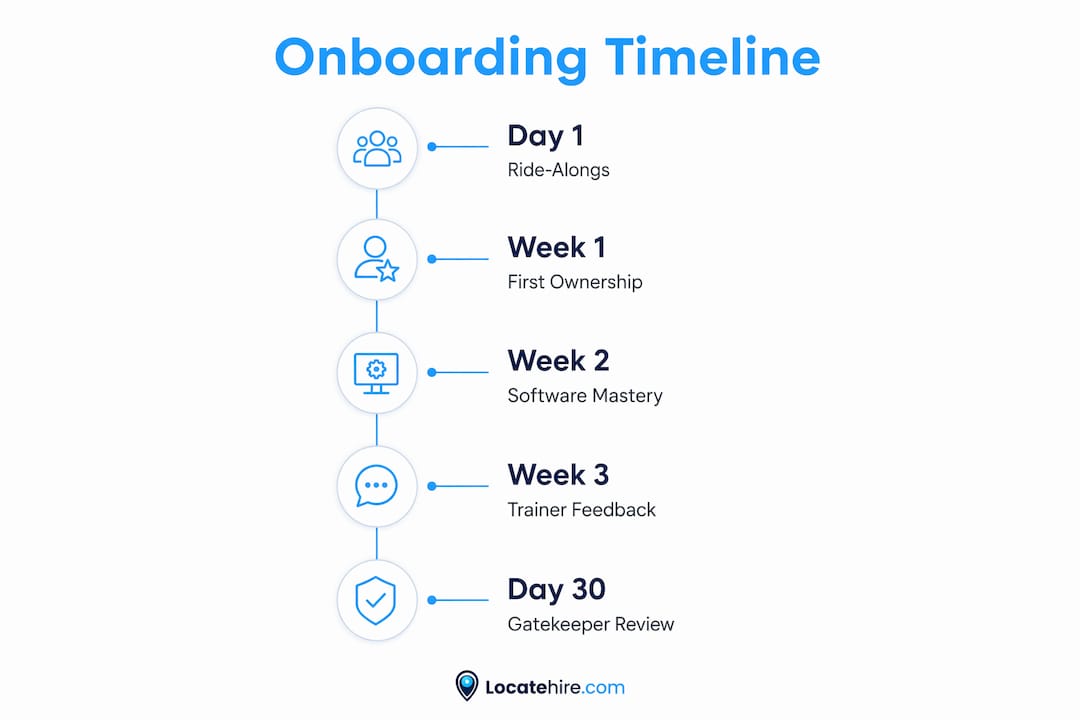
FSM and ATS fluency by end of day 14 is the concrete goal. Techs who miss this window create invoicing errors that directly reduce cash flow.
Pro Tip: Run billing drills on real backdated tickets in a sandbox environment. Require the new tech to finalize three clean invoices before week 2 closes.
30/60/90 milestones
- Day 30: Basic service calls solo, invoice accuracy confirmed, gatekeeper checklist passed
- Day 60: Diagnosis and quoting on standard job types, customer feedback score tracked
- Day 90: Full solo customer management, callback rate reviewed, retention conversation scheduled
How do you prepare senior techs to actually teach?
Experienced techs do not automatically know how to coach. Train-the-trainer failures are one of the most common reasons onboarding produces inconsistent results. Brief your senior techs before any ride-along begins.
Trainer pre-briefing checklist:
- Confirm the week's learning objectives with the trainer before Monday
- Hand the trainer a written list of skills to demonstrate and observe
- Clarify that the trainer's job is to coach, not to take over the job
What trainers should cover on each ride-along:
- Safety demo: PPE use, site hazard identification, lockout procedure
- Customer communication: greeting script, setting expectations, review request
- Photo standards: before, during, and after photos uploaded to FSM
- FSM data entry: job start, parts consumed, job complete, invoice finalized
- Debrief: what went well, one thing to improve tomorrow
By week 3, flip the roles. The trainee performs; the trainer observes and gives feedback only after the job closes.
Pro Tip: Require trainer sign-offs on specific skills in your ATS rather than an informal thumbs-up. A signed checklist creates accountability and a paper trail.
What software training should happen in the first two weeks?
Plumbing is as much about accurate data entry as it is about technical skill. Prioritize FSM proficiency early to protect billing accuracy and cash flow.
Core FSM tasks to certify by day 14:
- Clock in/out and time tracking
- Job start and job complete workflow
- Parts consumption logging
- Photo upload to job record
- Estimate and quote creation
- Invoice finalization and customer signature capture
Assign these as sequential micro-tasks inside your ATS. Each task gets a short quiz or a completion certificate before the next one unlocks. Mobile FSM apps give techs job history, parts lists, and communication templates at their fingertips, reducing office call-backs.
Common pitfalls to avoid:
- Assuming techs will learn the software by watching
- Leaving FSM setup until after field work begins
- Skipping sandbox practice and going straight to live tickets
Pro Tip: Use backdated or test jobs for billing drills. Require a completion certificate in the ATS before you increase the tech's independence on live tickets.
How should shadowing sessions be structured for fast progression?
Short, focused ride-along blocks outperform passive full-day shadowing every time. Design each block around one specific learning objective.
- Observe: Trainee watches the senior tech complete the full job workflow
- Assist: Trainee handles one defined task (parts logging, customer greeting) while trainer runs the job
- Perform with trainer present: Trainee runs the job; trainer stays visible but silent unless safety is at risk
- Perform with mentor nearby: Trainer is on the same street or available by phone
- Solo with gatekeeper sign-off: Full independence after the day-30 formal assessment
Assign specific job types to each block: drain clean, water heater diagnosis, meter reading, fixture install. Require a brief demonstration at the end of each block before moving to the next stage.
Pro Tip: If a tech fails a gatekeeper gate, assign two additional supervised sessions on that specific job type before re-testing. Document the remedial sessions in your ATS.
What admin and compliance items must be completed during onboarding?
Missing a compliance step early creates payroll errors, safety incidents, or liability exposure. Complete these before or on day 1.
HR and paperwork (via ATS before day 1):
- I-9 employment eligibility verification
- W-4 federal withholding form
- Direct deposit authorization
- State apprentice or journeyman license verification
- Signed offer letter and compensation confirmation
Safety checklist (day 1):
- PPE issuance and signed acknowledgment
- Hazardous materials handling training
- Site-specific hazard briefing
- Emergency contact and incident reporting procedure
Payroll and classification:
- Confirm pay rate and any training wage policy in writing
- Verify first-paycheck date and pay period
- Confirm worker classification (employee vs. contractor) with your payroll provider
Check your state's labor laws on training wages and worker classification. Consult your HR or payroll provider for your specific situation.
Pro Tip: Store signed compliance documents inside Locatehire so they are attached to the candidate record and retrievable during an audit.
Which metrics tell you if onboarding is actually working?
| KPI | Target | Why it matters |
|---|---|---|
| FSM module completion | FSM proficiency confirmed by day 14 | Incomplete training predicts billing errors |
| Invoice accuracy | ≥98% by day 30 | Errors reduce cash flow directly |
| Time to first billable job | ≤5 business days | Measures ramp-up speed |
| Trainer sign-off rate | all checklist items | Confirms skill transfer, not just attendance |
| Customer feedback score | Positive on first solo jobs | Early signal of customer-facing readiness |
Use your ATS reporting and FSM dashboard together. Set automated alerts when a module completion falls behind schedule or when an invoice error rate spikes. That combination catches problems in week 1, not week 6.
Ready-to-use templates for your onboarding library
Store these inside Locatehire as task templates attached to each new hire's record.
Welcome email template:
Day-1 agenda (printable):
- 8:00 AM: Shop and truck tour with office manager
- 8:30 AM: Safety briefing and PPE issuance
- 9:00 AM: Admin and payroll setup
- 9:30 AM: FSM app login and walkthrough
- 10:00 AM: First ride-along with assigned trainer
- End of day: 10-minute debrief with hiring manager
Trainer checklist:
- Safety demo completed and signed
- Customer greeting script practiced
- Photo standards demonstrated
- FSM data entry observed and corrected
- End-of-day debrief conducted
FSM module sequence (weeks 1–2):
- Module 1: Clock in/out and time tracking
- Module 2: Job start and complete workflow
- Module 3: Parts consumption and inventory
- Module 4: Photo upload standards
- Module 5: Estimate and invoice creation
Locatehire lets you attach these task lists directly to a candidate's onboarding record, so nothing falls through the cracks between offer and day 30. For a parallel example from another field service trade, the pool technician onboarding guide shows how the same checklist format applies across service roles.
Key Takeaways
Structured, blended onboarding with pre-start digital modules, staged shadowing, and a day-30 gatekeeper assessment is the most reliable way to get a new plumbing tech productive without disrupting your existing crew.
| Point | Details |
|---|---|
| Assign pre-start modules | Send FSM and safety modules before day 1 so the tech arrives ready to work. |
| Two-week software target | FSM competency by day 14 prevents invoicing errors that reduce cash flow. |
| Train the trainer first | Brief senior techs on objectives and debrief technique before any ride-along. |
| Day-30 gatekeeper assessment | Require a formal checklist review before assigning a solo truck. |
| Locatehire as your ATS hub | Use Locatehire to host offer letters, compliance docs, module assignments, and completion tracking in one place. |
The onboarding gap most owners never close
Most plumbing owners invest in hiring and almost nothing in the 30 days after. They hand a new tech a truck key, pair them with a senior tech who has never been told what to teach, and then wonder why callbacks spike in month two.
The written plan is not a formality. It is the difference between a tech who internalizes your billing process and one who guesses. A paid working interview before the offer reduces first-90-day turnover, but even a great hire fails without a structured first month. The trainer briefing is equally underrated. Telling a senior tech to "show the new guy the ropes" produces passive observation, not skill transfer.
The operators who get this right share one habit: they document their five most common job-type checklists before the new hire arrives. That documentation forces clarity on what "done correctly" actually looks like, and it gives the trainer something concrete to teach against. Measure invoice accuracy at day 30. If it is below 98%, the software training failed, not the tech.
Locatehire keeps your onboarding on track
Filling a truck is one problem. Keeping the new tech productive, compliant, and tracked through a 30-day plan is another. Locatehire is the ATS built for small service businesses that need both in one place.
With Locatehire, you can send offer letters, collect signed paperwork, assign pre-start training modules, and pull completion reports without switching between three different tools. Hiring managers at plumbing companies use it to centralize the entire onboarding workflow and measure time-to-productivity from day one. If you want a turn-key system that ties your plumbing staffing process to a trackable onboarding checklist, visit locatehire.com and see how it fits your operation.
Useful sources
- 30-Day Onboarding Plan for New Plumbing Techs — ClarityOpsEngine: primary source for the gatekeeper checklist, two-week FSM mastery target, and 30/60/90 milestone map
- How to Manage and Grow a Multi-Location Plumbing Service Team — Workiz: blended onboarding model and mobile FSM app benefits
- Employee Onboarding — FieldPulse: train-the-trainer briefing technique and welcome email best practices
- The Complete Guide to Plumbing Technician Hiring — Axionis: paid working interview data, job-type checklist documentation, and turnover reduction
- New Employee Training Guide for Plumbing Teams — Trainual: module sequencing and role-based onboarding structure
- Hiring Plumbers and Onboarding Program Blueprint — DigitalDreamHomes: 30-day roadmap framework and KPI tracking guidance