

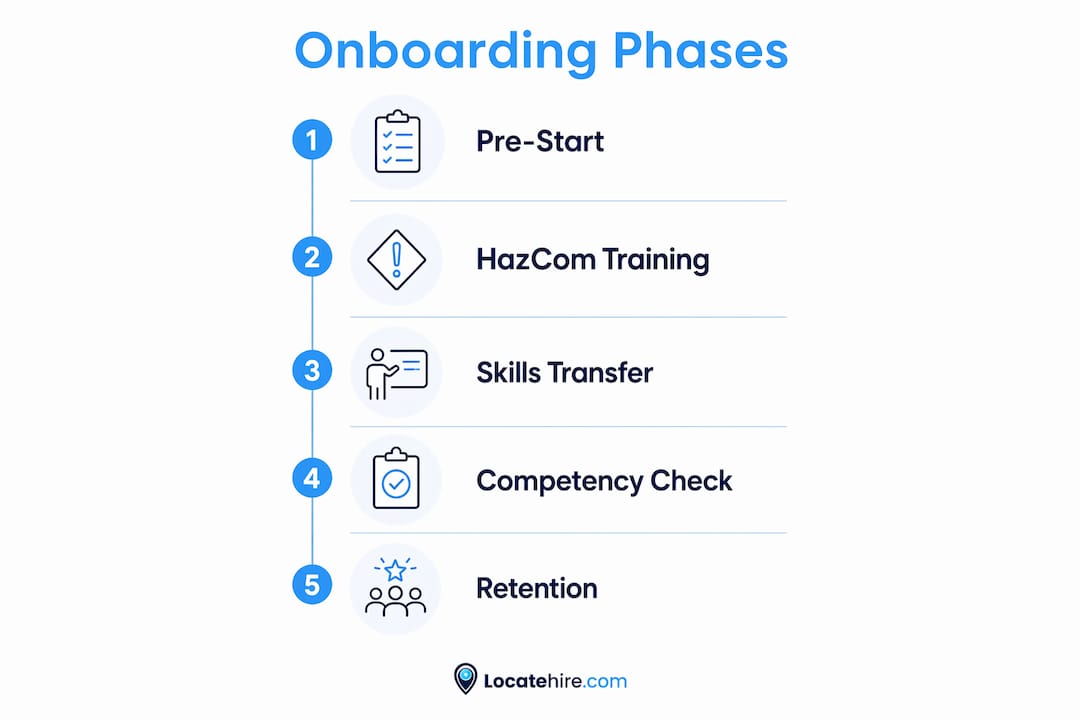
Onboarding pool technicians is a structured, four-phase process that moves a new hire from paperwork to independent route operation through documented compliance, safety training, and verified skill development. It is not a general orientation. Done correctly, it reduces chemical handling errors, protects your business from liability, and gives technicians a clear path to working solo with confidence.
Here is what the full process covers:
- Pre-start compliance: I-9 verification, licensing checks, insurance enrollment, and payroll setup before day one in the field
- Regulatory and safety orientation: OSHA Hazard Communication Standard (29 CFR 1910.1200) training on chemical hazards, Safety Data Sheets, and PPE before any chemical exposure
- Technical skills transfer: Hands-on training in water chemistry, equipment operation, and route documentation, typically through structured shadowing with a senior technician
- Competency verification: Documented sign-offs confirming a technician can perform tasks independently before solo route assignment
Getting all four phases right reduces first-90-day turnover by up to 50% compared to informal shadowing alone. For small pool service businesses, that difference shows up directly in callback rates, customer complaints, and recruiting costs.
1. Pre-start compliance and paperwork
Before a new technician touches a single pool, your administrative foundation needs to be solid. Gaps here create legal exposure that no amount of good training can fix later.
The core compliance checklist for every new hire includes:
- I-9 employment eligibility verification completed on or before the first day of work, per federal law
- Payroll tax setup for W-2 employees, including federal and state withholding, Social Security, and Medicare enrollment
- State license or certification documentation collected and verified before field assignment, particularly in states like California (C-53 license) or Florida (Chapter 489 requirements)
- Vehicle authorization and insurance enrollment if the technician will drive a company vehicle or use their own vehicle for routes
- Signed employment agreement covering compensation, route expectations, confidentiality, and company policies
- Benefits enrollment where applicable, including health insurance and any retirement plan options
Documentation at this stage is your liability protection. If a chemical incident or equipment damage claim surfaces later, auditors and insurers will look at your onboarding records first. Payroll compliance is also worth getting right from day one. The role of payroll in onboarding affects everything from tax filings to employee trust, and errors compound quickly.
Pro Tip: Create a pre-start checklist in a shared folder or your applicant tracking system so nothing gets missed between offer acceptance and the first day. Locatehire lets you track document collection status for each candidate before they ever arrive.

2. OSHA HazCom training and chemical safety orientation
Chemical safety training is the most legally consequential part of pool technician onboarding. The OSHA Hazard Communication Standard (29 CFR 1910.1200) requires employers to train workers on chemical hazards before initial exposure. For pool technicians, that means before they handle chlorine compounds, muriatic acid, or cyanuric acid on any job site.
This training must cover:
- Safety Data Sheet (SDS) literacy: Technicians must be able to read and interpret an SDS for every chemical they will use, including hazard categories, first aid measures, and storage requirements
- Chemical-specific hazard training: Sodium hypochlorite, muriatic acid, and cyanuric acid each carry distinct OSHA-defined hazard categories with different handling protocols
- Personal protective equipment (PPE): Correct glove selection, eye protection, and respiratory protection for each chemical type, with hands-on fitting and inspection
- Spill response procedures: Step-by-step protocols for containment, neutralization, and reporting, practiced before field exposure
- Confined space awareness: Relevant for technicians who access equipment rooms or underground vaults where chemical fumes can accumulate
Skipping or shortcutting this phase is not a minor compliance gap. OSHA violations in chemical handling carry real financial penalties, and the liability exposure from an untrained technician mishandling acid on a residential property is significant. The training must be documented, dated, and signed by both the trainer and the technician.
Pool service involves routine exposure to oxidizers and corrosives. That reality makes HazCom training a non-optional component of every onboarding program, regardless of a technician's prior experience.
3. Technical skills transfer: water chemistry and equipment training
This is where onboarding gets hands-on. Technical training covers the two core competencies every pool technician needs: water chemistry management and equipment operation. Neither can be learned from a manual alone.
Water chemistry fundamentals
Technicians learn to test and balance the six primary parameters: free chlorine (target range typically 1–3 ppm for residential pools per CDC Healthy Swimming guidelines), pH (7.2–7.8), total alkalinity, calcium hardness, cyanuric acid, and total dissolved solids. Testing protocols from Taylor Technologies or LaMotte serve as industry-standard references for accurate field readings.
Equipment training
Hands-on instruction covers pump operation, filter types (sand, cartridge, and diatomaceous earth), heater inspection, and automation system programming. Technicians learn to identify flow rate irregularities, pressure differentials, and common failure points before they encounter them solo.
Shadowing and progression timeline
Structured shadowing with a senior technician is the most effective delivery method for technical skills. A typical onboarding timeline follows this progression:
| Phase | Duration | Activity |
|---|---|---|
| Full shadowing | Week 1 | Technician observes all tasks; no independent action |
| Assisted work | Weeks 2–4 | Technician performs tasks with senior tech present |
| Independent with check-ins | Weeks 5–10 | Solo routes with periodic supervisor audits |
Pro Tip: Rotate technicians through multiple senior mentors during the shadowing phase. Exposure to different coaching styles and route types builds a broader skill set and reduces dependency on any single trainer's habits.
Certification during training
The PHTA Certified Pool Operator (CPO) course, a roughly 16-hour, two-day program, is widely used as the technical backbone of this phase. Many employers fund CPO certification as part of onboarding and schedule it within the first 90 days. The PHTA also offers the Certified Pool & Spa Service Technician (CST) credential for technicians with two or more years of experience, which covers advanced troubleshooting in circulation, filtration, hydraulics, and electrical systems.
Route documentation and customer communication
Technicians also learn the employer's field documentation system during this phase: how to log chemical readings, record equipment notes, photograph issues, and communicate findings to customers. These habits, built during training, directly affect service quality and customer retention.
4. Competency verification before solo route authorization
A technician is not ready for independent work until they can demonstrate specific tasks without supervisor input. Competency verification is the formal checkpoint that separates supervised training from solo operation, and it needs to be documented.
What competency verification covers
- Correct water test interpretation and chemical dose calculation without prompting
- Independent equipment diagnosis: identifying a failing pump capacitor, a torn filter grid, or an air leak in the suction line
- Accurate and complete service record documentation per company and state requirements
- Proper PPE selection and chemical handling for each product in the company's inventory
- Customer communication: explaining service findings clearly and professionally
Entry-level vs. experienced hires
The process differs based on prior experience. Entry-level technicians with no pool background complete the full four-phase program over several weeks before solo authorization. Experienced technicians transferring from another company still require OSHA HazCom training for company-specific chemicals and state license verification, but competency verification can often be compressed to two to three documented field observation days.
Why documentation matters here
Competency verification records are your primary defense in a chemical incident or equipment damage claim. Auditors, insurers, and attorneys will ask for signed sign-off sheets, not verbal assurances. A well-structured competency checklist includes the task demonstrated, the date, the evaluator's name, and the outcome. That paper trail also satisfies OSHA enforcement requirements if your training program is ever reviewed.
Components of an effective competency checklist
- Task-by-task sign-off with date and evaluator signature
- Space for notes on errors corrected and remediation steps taken
- Clear pass/fail criteria for each competency area
- Final authorization signature from a supervisor or licensed qualifier
- Copy retained in the technician's personnel file
Rushing this step is one of the most common and costly mistakes in pool service onboarding. Businesses that push technicians to solo routes too early see higher callback rates, more chemical errors, and greater liability exposure. The certifications and documentation required for independent authorization are worth the time they take.
5. Retention strategies that keep technicians engaged after onboarding
Getting a technician through onboarding is only half the job. Keeping them past the first season requires deliberate, ongoing engagement. Pool service businesses with high turnover often trace the problem back to what happens in months two through six, not week one.
Effective retention strategies for pool technicians include:
- Structured 30/60/90-day reviews: Scheduled check-ins with clear performance criteria give technicians feedback and a sense of progress. Informal check-ins are not enough; written reviews create accountability on both sides.
- Mentorship beyond initial shadowing: Pairing technicians with a consistent senior mentor for the first six months, not just the first few weeks, reduces the isolation that drives early departures.
- Technology tools for field documentation: Field service software that makes logging easy reduces end-of-day frustration. When technicians can complete service records efficiently on a mobile device, they spend less time on paperwork and more time on the work they were hired to do.
- Recognition and incentive programs: Acknowledging technicians who hit quality benchmarks, earn certifications, or receive positive customer feedback costs little and pays back in loyalty.
- Continuing education opportunities: Funding CPO renewals, CST certification, or PHTA course completions signals that you are invested in a technician's career, not just their current route.
- Clear advancement pathways: Technicians who can see a defined path from route tech to lead tech to supervisor are more likely to stay. Vague promises of "growth opportunities" do not retain people; specific criteria and timelines do.
The common hiring challenges pool service companies face are often downstream of weak retention, not weak recruiting. Replacing a trained technician costs far more than keeping one.
6. Industry best practices and PHTA apprenticeship pathways
The most structured approach to pool technician career development runs through the Pool & Hot Tub Alliance (PHTA) apprenticeship program, registered with the U.S. Department of Labor. This is not a generic training course. It is a formal apprenticeship framework that sets a defined standard for what a fully trained pool technician looks like.
How the PHTA apprenticeship program works
The PHTA Pool Maintenance and Service Technician Apprenticeship Program combines 2,000 hours of on-the-job training with a minimum of 144 hours of related instruction delivered through PHTA's online platform. The program must be completed within one year, with the first 500 hours serving as a probationary period over no more than six months.
Apprentices train across a defined set of work processes:
- Worksite safety and safe work environment maintenance
- Chemical analysis and dispensing to industry and regulatory standards
- Pump and filter sizing, troubleshooting, and preventative maintenance
- Control system programming and maintenance
- Pool and spa cleaning per industry practices
- Customer service and communication
The 144 hours of related instruction include the PHTA Certified Pool & Spa Maintenance Specialist (CMS) course, the CST course, Pool Operator Primer, Indoor Pool Air Quality, Recreational Water Illness, and First Aid and Safety training.
What this means for small pool service businesses
Enrolling a new hire in the PHTA apprenticeship program converts your internal onboarding into a documented, federally registered operating system. That matters for two reasons. First, it gives you a defensible training record that satisfies OSHA, state licensing boards, and insurers. Second, it gives the technician a credential that has real market value, which improves retention.
Employers participating in the program are responsible for ensuring apprentices work under a qualified journeyman, receive diversified experience across all work processes, and complete required safety and anti-discrimination training. Recruitment records must be kept for five years.
Pro Tip: Maintain daily training logs that record skills demonstrated, errors corrected, and next steps for each session. These logs create audit-ready onboarding records that satisfy both OSHA documentation requirements and PHTA apprenticeship reporting standards.
Mentors in any structured program need more than goodwill. Equipping them with defined checklists, teaching points, and feedback scripts produces consistent results across different trainers and different technician starting points. Using structured mentorship systems with defined teaching points reduces inconsistencies that otherwise show up as service quality gaps months after onboarding ends.
Start building a better onboarding process with Locatehire

A well-structured onboarding program starts before a technician's first day, and so does the hiring process that feeds it. Locatehire is an applicant tracking system built for small service businesses with ongoing hiring needs, including pool service companies that need to recruit, screen, and onboard technicians efficiently.
With Locatehire, you can track candidates from application through offer, collect pre-start documents, and keep your hiring pipeline organized without spreadsheets or manual follow-up. Build a hiring process that connects directly to your onboarding workflow, so every new technician arrives ready to start phase one on day one.
Key Takeaways
Effective pool technician onboarding requires four documented phases, OSHA-compliant chemical safety training, and competency verification before solo route authorization, with structured programs reducing first-90-day turnover by up to 50%.
| Point | Details |
|---|---|
| Four-phase structure | Pre-start compliance, safety orientation, technical training, and competency verification form the complete onboarding arc. |
| OSHA HazCom is mandatory | Chemical hazard training under 29 CFR 1910.1200 must be completed before any chemical exposure, with signed documentation. |
| Timeline matters | Rushing independence is costly; structured plans spanning several weeks reduce callbacks and chemical errors. |
| Document competency sign-offs | Signed checklists protect against liability in chemical incidents and satisfy OSHA enforcement requirements. |
| Retention requires ongoing effort | Structured reviews, mentorship, and continuing education keep technicians past the first season. |