
The pool industry hiring season is defined by a narrow recruiting window that runs from January through February, giving companies the training lead time they need before peak service demand hits in April. Miss that window and you are not just short-staffed. You are turning down revenue, burning out your best techs, and handing customers to competitors. Pool service companies that understand the annual employment cycle treat recruiting as a year-round operational function, not a spring emergency. This guide covers the timing, compensation benchmarks, recruiting channels, and financial signals that determine whether your hiring season succeeds or stalls.
How pool industry hiring season works: timing and triggers
The formal term for what most owners call "hiring season" is seasonal workforce planning, and in the pool trade it follows a tighter calendar than almost any other home services sector. The ideal recruiting window for peak season, which runs April through September, is January and February. That gives you the 6 to 8 weeks of training buffer a new technician needs before they can carry a full route independently. Starting in March means your new hire is still shadowing when your phone is ringing off the hook.
The national average time-to-fill for trades roles is 44 days, and that number stretches longer in competitive markets like Phoenix, Dallas, and South Florida. That single data point explains why February job postings are already too late in many Sunbelt markets. You need candidates in your pipeline before the calendar flips to the new year.
Why the timing gap matters more than most owners realize:
- A technician hired in January can complete shadow weeks, ride-alongs, solo stops, and CPO certification before April
- A technician hired in March skips steps, makes mistakes, and often quits within 60 days
- A technician hired in May is a liability during your highest-revenue months
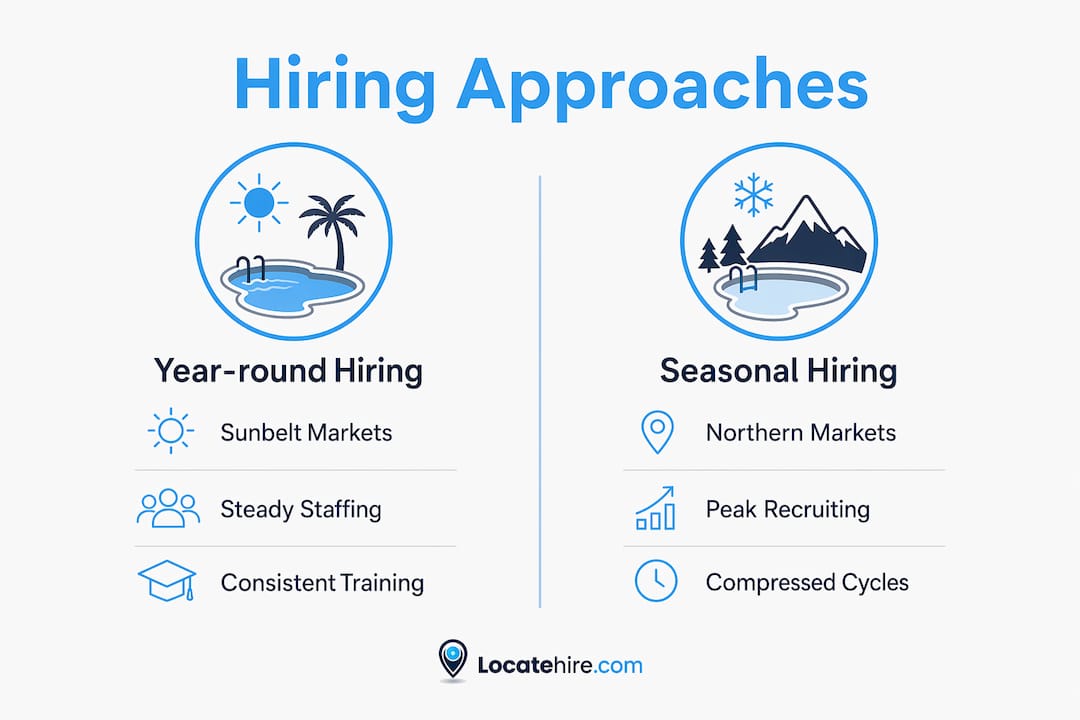
Northern markets operate on a compressed version of this cycle. Companies in Ohio, Michigan, and the Northeast open pools in May and close them in October, which pushes the recruiting window to February and March. Sunbelt operators in Texas, Florida, and California face a different problem: their season never fully stops, which means hiring pressure is constant rather than predictable.
Pro Tip: Post your job listings on Indeed and ZipRecruiter no later than the first week of January. Candidates who apply in January are more serious and have more options to evaluate, which means they are more likely to accept an offer before your competitors do.
Year-round vs. seasonal hiring: what pool companies actually do
Pool companies do not all hire the same way, and the difference comes down to climate and business model. The table below captures the two dominant patterns you will see across the industry.
| Factor | Year-round hiring (Sunbelt) | Seasonal hiring (Northern markets) |
|---|---|---|
| Primary markets | Texas, Florida, California, Arizona | Ohio, Michigan, New York, Illinois |
| Hiring frequency | Continuous, driven by route growth | Annual surge in late winter |
| Retention challenge | Poaching by HVAC and landscaping | Workers leave for winter employment |
| Benefits obligation | ACA compliance year-round | ACA applies if season exceeds 120 days |
| Rehire rate | Lower, more new hires needed | Higher, same workers return annually |
The ACA seasonal worker rule is one of the most overlooked compliance issues in the industry. Companies with 50 or more full-time employees must offer health coverage to staff working 30 or more hours weekly, unless the seasonal spike lasts fewer than 120 days. For most Northern operators, that threshold is close enough to create real legal exposure if they are not tracking hours carefully. A workforce compliance workflow built before the season starts prevents costly surprises.
The structural technician shortage makes this harder for every operator regardless of geography. Pool companies compete directly with HVAC, landscaping, and plumbing trades for the same labor pool. Those trades often offer more stable schedules, indoor work, or year-round employment. Unless you are actively building a career path and not just offering a summer job, you will lose candidates to those industries every single time.
Compensation trends shaping pool technician hiring in 2026
Pay is the first filter every candidate applies, and the numbers have moved significantly. Pool technician wages have increased 8 to 12% since 2023, which means the rates you posted two years ago are now below market. Entry-level technicians currently earn $14 to $17 per hour. Experienced techs with two or more years of route experience command $24 to $32 per hour. Lead technicians who manage other staff or oversee multiple routes earn $32 to $42 per hour or $60,000 to $80,000 on salary. These are not ceiling numbers. They are the floor in competitive markets.

Total compensation adds another 20 to 30% on top of base wages when you factor in payroll taxes, workers' compensation, and any benefits you offer. That math matters when you are calculating whether a new route can support a new hire financially.
| Role | Hourly rate | Annual salary equivalent |
|---|---|---|
| Entry-level technician | $14 to $17/hr | $29,000 to $35,000 |
| Experienced technician | $24 to $32/hr | $50,000 to $67,000 |
| Lead technician | $32 to $42/hr | $67,000 to $87,000 |
| Salaried lead/manager | N/A | $60,000 to $80,000 |
Creative compensation tactics are closing the gap where base pay cannot compete. Four-day workweeks, tool allowances, vehicle use, and performance bonuses tied to customer retention are all being used by pool companies to win candidates away from HVAC and landscaping. These perks cost less than a wage increase but carry significant weight with candidates who are comparing multiple offers.
Pro Tip: When posting a job, list the total compensation package including vehicle use, phone stipend, and any bonuses. Candidates compare take-home value, not just hourly rates. A $22/hr job with a company truck often beats a $26/hr job with no vehicle.
Effective recruitment and onboarding for pool service companies
Reactive hiring, posting a job when you are already overwhelmed, is the most expensive way to staff a pool company. The companies that consistently hire well do five things differently.
-
Build a candidate database year-round. Maintaining an active talent pool reduces time-to-hire by 55% and cost-per-hire by 92% compared to starting from scratch each season. Keep a running list of past applicants, former employees, and referrals. When January arrives, you are calling warm contacts, not posting cold ads. Understanding what a candidate pipeline actually means for your business is the first step toward building one that works.
-
Use multiple recruiting channels simultaneously. Indeed and ZipRecruiter reach active job seekers. Facebook and Nextdoor reach passive candidates who are not actively looking but would consider a change. Employee referral programs, where you pay $200 to $500 for a hire who stays 90 days, consistently produce the highest-quality candidates at the lowest cost.
-
Run a structured screening process. A phone screen eliminates candidates who cannot communicate clearly with customers. An in-person or video interview assesses reliability and attitude. A paid ride-along, typically 2 to 4 hours, is the single best predictor of whether someone will last past 30 days. Candidates who show up for the ride-along and stay engaged almost always convert to strong hires.
-
Implement a 90-day onboarding plan. Structured onboarding with phased training and CPO certification dramatically reduces early turnover. Phase one is shadowing an experienced tech. Phase two is supervised solo stops. Phase three is independent route management with weekly check-ins. Skipping phases to fill routes faster is the single most common cause of first-year tech turnover.
-
Use technology to attract younger workers. Gen Z technicians actively avoid companies that still run paper logs and verbal instructions. Digital dispatch, mobile apps for chemical readings, and route management software shorten onboarding time and signal that your company is worth building a career at. Companies that build a structured hiring process before the season starts close candidates faster and lose fewer to competing offers.
When to hire and how to manage the financial risk
The calendar is not the right trigger for hiring. Route capacity is. The two clearest signals that you need to hire now are turning down new accounts and watching your best tech's retention slip because they are overloaded. Both signals mean you are already behind.
Operational indicators that hiring is overdue:
- You or your lead tech are personally covering routes more than two days per week
- Customer complaint volume has increased in the past 30 days
- You have declined three or more new service accounts in the past 60 days
- A current technician has reduced their availability or mentioned looking elsewhere
The financial side of hiring is where many small operators get into trouble. A new technician does not generate net revenue on day one. They generate cost. New hires need 8 weeks of payroll coverage before they can service enough stops to cover their fully loaded cost plus a buffer. That means you need 8 weeks of cash reserves set aside before you make the offer, not after. Operators who hire reactively in May often cannot make payroll in June because they did not plan for the ramp-up period.
Balancing route growth with staffing costs requires treating each new hire as a small business investment with a defined payback period. If a technician's fully loaded cost is $3,500 per month and your average monthly revenue per route stop is $150, you need that tech managing at least 25 stops before they break even. Build that math into your hiring decision before you post the job.
Key takeaways
Pool service companies that hire in January, build year-round talent pipelines, and plan 8 weeks of cash reserves before each new hire consistently outperform those that hire reactively in spring.
| Point | Details |
|---|---|
| Start recruiting in January | The 6 to 8 week training buffer before April is non-negotiable in most markets. |
| Build a talent pipeline year-round | Active candidate databases cut time-to-hire by 55% and cost-per-hire by 92%. |
| Pay at current market rates | Entry-level wages start at $14 to $17/hr; experienced techs now command $24 to $32/hr. |
| Use structured 90-day onboarding | Phased training with CPO certification is the most reliable way to reduce early turnover. |
| Plan 8 weeks of cash before hiring | New techs cost before they earn; financial readiness prevents payroll shortfalls. |
What I've learned watching pool companies hire badly for years
I have watched a lot of pool service operators make the same mistake: they wait until they are drowning in work before they post a job. By then, the best candidates are already placed, the training window is gone, and they end up hiring whoever is left. That is not a hiring strategy. That is a rescue operation.
The companies I have seen grow cleanly, adding routes without chaos, all share one habit. They treat their candidate database the same way they treat their customer list. They add to it constantly, stay in touch with past applicants, and make offers before they are desperate. When January arrives, they are not starting from zero.
The other thing I would push back on is the assumption that pool work cannot compete with HVAC or plumbing for talent. It absolutely can, but not on wages alone. The operators winning the talent competition are selling a career, not a job. They are offering CPO certification, route ownership incentives, and a clear path to lead tech or operations manager. That pitch lands with younger workers who want to know where they will be in three years, not just what they will earn next week.
Technology is the piece most small operators underestimate. A Gen Z candidate who walks into an interview and hears "we use paper logs and you will learn the routes by riding with Mike" is already mentally out the door. Show them a route management app, a digital chemical log, and a mobile dispatch system, and you have their attention. The cost of that software is a fraction of one bad hire.
— Jeff
How Locatehire helps pool companies hire smarter
Locatehire is built specifically for small businesses with ongoing hiring needs, including pool service companies that recruit every season and cannot afford to start from scratch each January.
Locatehire's AI-powered recruitment platform automates candidate sourcing, tracks applicants through every stage of your screening process, and keeps your talent database active year-round so you are never recruiting cold. For pool companies managing multiple routes and seasonal surges, that means shorter hiring cycles, better candidate quality, and less time spent on administrative work that pulls you away from running your business. If you want to reduce your time to hire before next season's crunch, Locatehire is where to start.
FAQ
When should pool companies start hiring for peak season?
Pool companies should begin recruiting in January and February to allow 6 to 8 weeks of training before peak service demand starts in April. The national average time-to-fill for trades roles is 44 days, so posting in March is already too late in most markets.
How much do pool technicians earn in 2026?
Entry-level pool technicians earn $14 to $17 per hour, experienced techs earn $24 to $32 per hour, and lead technicians earn $32 to $42 per hour or $60,000 to $80,000 on salary. Wages have increased 8 to 12% since 2023.
Why do pool companies struggle to find and keep technicians?
The technician shortage is structural. Pool companies compete with HVAC, landscaping, and plumbing trades that offer more stable or year-round work. Companies that offer CPO certification, career paths, and modern technology retain staff at significantly higher rates.
How do I know when it's time to hire another technician?
The clearest signals are turning down new accounts and watching your existing techs show signs of burnout or reduced availability. Do not wait for the calendar to tell you. Route capacity and customer retention are the real indicators.
What is the ACA rule pool companies need to know about seasonal staff?
Companies with 50 or more full-time employees must offer health coverage to workers logging 30 or more hours weekly, unless the seasonal period lasts fewer than 120 days. Northern operators running longer seasons need to track hours carefully to stay compliant.