
If your overtime hours keep climbing, appointment windows keep slipping, and callback rates are creeping up, you're looking at the symptoms that strongly suggest a plumbing company is understaffed. Missed service windows and rising callbacks rarely happen because a crew got careless. They happen because there aren't enough hands to do the work at the pace customers expect.
Check two numbers first: your overtime percentage and your average response time. If overtime hours have grown over the past two or three pay periods and response times have stretched past what you promised customers, you likely have a staffing gap, not a bad week.
Here's the fast-scan checklist:
- Overtime hours trending up for three or more consecutive pay periods
- Response times or service windows missed on a regular basis, not just during storms
- Callbacks or comeback jobs increasing as a share of completed work
- Absenteeism or last-minute call-outs rising among your field team
- Difficulty filling open technician roles, with time-to-hire stretching past 45-60 days
- Dispatchers or supervisors working past their shift just to keep the day's schedule from collapsing
If three or more of these apply to your shop right now, treat it as confirmed. The rest of this article walks through the plumbing-specific version of each sign, the KPIs to track, and what to do about it this week and over the next year.
Key Takeaways
Rising overtime paired with slipping response times is the clearest sign a plumbing company is understaffed, and both are measurable within a week.
| Point | Details |
|---|---|
| Check overtime first | Sustained overtime above 10% for three or more pay periods signals a staffing gap, not a busy week. |
| Watch response times | Missing your promised service window consistently points to overloaded dispatch. |
| Track callbacks | A rising trend in callbacks per 100 jobs usually means rushed techs, not careless ones. |
| Act on referrals now | Referral hires convert 4 to 8 times better and cost far less than job board postings. |
| Use Locatehire to stay ahead | A continuous candidate pipeline through Locatehire shortens time-to-hire before the next vacancy hits. |
Run the overtime versus billed-hours check this week, and post a referral bonus internally today. That single move often surfaces a candidate faster than a job listing would in a month.
Table of Contents
- Operational Signs Your Plumbing Staff Is Stretched Too Thin
- How to Confirm Understaffing Fast: KPIs to Check This Week
- What to Do Once Understaffing Is Confirmed
- Why Plumbing Companies Are Short-Staffed in the First Place
- What Actually Fixes Understaffing (And What Doesn't)
- A Practical Way to Stop Falling Behind on Hiring
- Sources
Operational Signs Your Plumbing Staff Is Stretched Too Thin
Generic understaffing symptoms show up differently in a plumbing shop than they do in an office or a retail store. Here's what each one actually looks like on your schedule board, your invoices, and your safety log.
1. Overtime keeps climbing without a clear seasonal reason
A tech who occasionally works late during a summer AC-adjacent plumbing rush is normal. A tech who's logged 10+ hours of overtime every week for six weeks straight, with no storm event or holiday spike to explain it, is a symptom of insufficient staff covering your call volume. Watch the trend line, not the single paycheck.
2. Response times and appointment windows are slipping
This is often the most visible symptom of plumbing service delays to customers. A two-hour response window for an emergency hot-water call stretching into "we can get someone out there in two days" tells you dispatch has more jobs than trucks. If your CRM shows average time-to-arrival growing month over month, that's not a scheduling glitch. It's evidence of plumber overload across your whole team.
3. Callbacks and quality complaints are creeping up
Rushed techs make more mistakes. A crew working back-to-back jobs with no buffer time skips diagnostic steps, reuses parts they should replace, or leaves a job half-explained to the customer. Track callbacks per 100 completed jobs. A jump from, say, 4 per 100 to 9 per 100 over a quarter is one of the clearest indicators of insufficient staff quality control.
4. Safety incidents or near-misses are increasing
Fatigue drives mistakes on ladders, in crawl spaces, and around pressurized lines. If your near-miss reports (or informal "that almost went bad" conversations) have picked up alongside longer shifts, that's not coincidence. Overworked techs cut corners on lockout procedures and PPE checks because they're racing to the next call.
5. Absenteeism and unplanned leave are climbing
Burned-out techs call in sick more often, not less. If unplanned absences have doubled over the last two quarters, or if the same two or three people are suddenly using more sick time than they ever have, that's often understaffing showing up as attrition before it becomes attrition. This is one of the earliest indicators of a plumbing workforce shortage, because it usually precedes someone quitting outright.
6. Dispatch and supervisors are drowning
If your dispatcher is fielding angry calls about late arrivals all day, or your field supervisor is grabbing a wrench because there's no one else free, your overhead staff has become emergency labor. That's a sign the org chart has fewer working layers than your call volume requires.

Pro Tip: Pull one representative week's technician schedule and compare it against actual billed hours for that same week. That gap is a scheduling symptom of understaffing that a simple performance review will miss entirely.
How to Confirm Understaffing Fast: KPIs to Check This Week
You don't need a six-month audit to find out why your plumber is slow to respond or why complaints are up. A handful of numbers, checked over a single week, will usually confirm or rule out understaffing as the root cause.
| KPI | What it tells you | Red flag threshold |
|---|---|---|
| Overtime percentage | Share of total hours worked as overtime | Above 10% sustained for 3+ pay periods |
| Average response time | Time from call to technician arrival | Consistently missing your published SLA by a significant margin |
| Callbacks per 100 jobs | Rework and quality slippage | Rising trend over 2+ consecutive months |
| Time-to-hire | Days from job posting to signed offer | Exceeding 45-60 days for journeyman roles |
| Vacancy fill rate | Percentage of open roles filled within 60 days | Below 50% |
Run these three checks before you do anything else:
- Schedule audit: Pull technician calendars for one representative week and flag any day where a tech worked more than 10 hours or covered more than six service calls.
- 7-day dispatch snapshot: Log every call that came in over a week, note the promised window, and mark how many missed it by more than 30 minutes.
- Payroll vs. billed hours: Compare total hours paid against total hours billed to customers for the same week. A widening gap points to inefficiency from overload, not laziness.
Ask your team directly, too. Two questions surface more than a dozen KPIs ever will: "Do you feel like you have enough time to do each job right?" and "In the last month, has your workload made you consider looking for another position?" Honest answers to those two questions often confirm what the spreadsheet is already telling you.
What to Do Once Understaffing Is Confirmed
Once you've confirmed the gap, the response splits into three timelines: what stops the bleeding today, what rebuilds capacity over the next month, and what prevents this from happening again next year.
- Cap overtime and redistribute triage. Set a hard weekly overtime ceiling per tech and have dispatch re-sort the day's calls by urgency instead of arrival order.
- Reassign non-emergency work. Push routine maintenance calls out a few days to protect capacity for emergency and same-day jobs.
- Activate your referral network immediately. Referral hires convert 4 to 8 times better than paid job board postings and typically cost 60-70% less to source, according to industry hiring data. A $500-1,000 bonus posted internally this week can move faster than any job ad.
- Open temp-to-hire and quick-sourcing channels. Trade schools, staffing agencies that specialize in the trades, and local career-tech programs can supply short-term coverage while you run a full search.
- Standardize a short onboarding checklist. New techs ramp faster when they get a defined first-week schedule instead of getting thrown into the truck cold. Locatehire's guide on onboarding new techs walks through a practical version of this.
Beyond the first month, the fix stops being tactical and starts being structural. Build a relationship with a local trade school or career-tech program for a steady apprentice pipeline. Publish a clear pay ladder so techs can see exactly what it takes to move from apprentice to journeyman to lead, since ambiguity about advancement is one of the top reasons skilled techs jump ship for a competitor's offer. Improve PTO and benefits where you can, and start tracking capacity against booked work quarterly instead of reacting to the calendar week to week.
| Timeframe | Action |
|---|---|
| Today | Run the overtime vs. billed-hours check; cap new overtime approvals |
| Week 1-4 | Launch referral bonus program; open temp-to-hire sourcing; audit dispatch triage rules |
| Months 2-6 | Publish a pay ladder; formalize onboarding checklist; start apprentice or career-tech outreach |
| Months 6-12 | Build a standing apprenticeship partnership; review benefits package; set quarterly capacity reviews |
For a deeper framework on hiring tactics specific to small shops, Locatehire's guide on competing for plumbing talent and its staffing best practices for 2026 both cover this in more depth.
Why Plumbing Companies Are Short-Staffed in the First Place
Your staffing challenges often reflect a broader labor shortage affecting the trade industry.
The Bureau of Labor Statistics projects a shortage of roughly 550,000 skilled trades workers nationally, with plumbers making up a substantial share of that gap. Retiring journeymen are leaving faster than apprenticeship programs can replace them, and every empty seat stretches your remaining crew thinner.
Wage pressure makes retention harder on top of that. ADP Research's 2026 reporting found that construction job changers received an average 12.9% pay increase when they switched employers, meaning your best tech has real financial incentive to walk if a competitor calls. That churn risk compounds the original shortage.
This matters more for plumbing than most trades because labor is such a large share of the cost structure. Industry estimates put labor at 40-50% of residential job cost and 60-75% of service-call revenue. When understaffing forces overtime pay or emergency staffing agency rates, that cost increase hits margin directly, not just morale.
The good news: shops that treat this as structural rather than seasonal are finding real traction. High-school and career-tech partnerships are feeding new apprentices into plumbing shops that commit to the pipeline instead of hoping the job board delivers. Continuous recruiting, referral programs, and visible pay ladders aren't nice-to-haves anymore. They're becoming the baseline for any shop that wants to stay staffed through the next retirement wave. Locatehire's overview of why plumbing companies face a skills shortage breaks this down in more detail if you want the full picture.
What Actually Fixes Understaffing (And What Doesn't)
Most owners treat understaffing as a hiring problem. It's really a retention problem wearing a hiring problem's clothes. Every plumbing shop I've watched deal with this well shares one habit: they recruit continuously, whether or not a position is open. They don't wait for a tech to quit before posting a job. By the time you're actively backfilling, you're already three weeks behind and paying emergency rates or overtime to cover the gap.
The second habit that separates shops that stabilize from shops that keep bleeding techs is a published pay ladder. Ambiguity about advancement drives good people to competitors faster than pay alone does. A tech who can see exactly what it takes to move from apprentice to lead journeyman, in writing, has a reason to stay through a rough quarter.
If you can't hire immediately, protect your best people first. Rotate emergency and after-hours duty across the team instead of always calling the same reliable tech, because that person will eventually burn out or leave, and they're the hardest one to replace.
A Practical Way to Stop Falling Behind on Hiring
Continuous recruiting only works if you're not doing it by hand between service calls. An applicant tracking system built for trade businesses keeps a pipeline of qualified candidates moving even when you don't have an open req, so you're not starting from zero the moment someone gives notice.
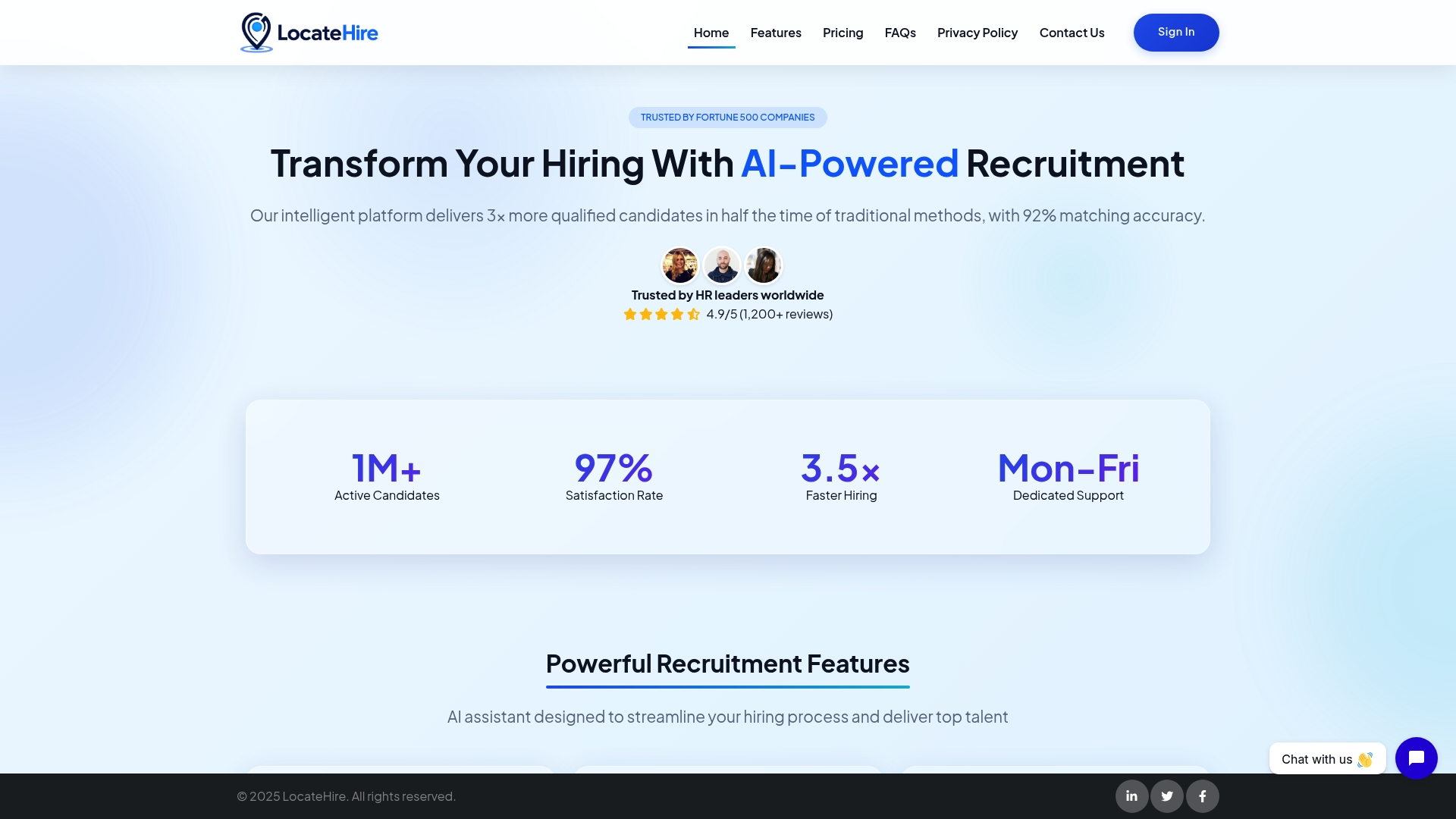
For a plumbing shop specifically, that means three things matter more than generic hiring software features:
- Referral tracking that doesn't rely on sticky notes. When a tech refers a friend, the system logs it and alerts you automatically instead of losing the lead in a group text.
- Resume parsing built for trade experience. Locatehire reads licenses, certifications, and years in the trade instead of flagging a great candidate because their resume doesn't look like a corporate one.
- Alerts the moment a qualified candidate applies. You find out the same day, not a week later when the applicant has already taken another offer.
If overtime and vacancy numbers have you concerned about your team's capacity, a free trial of Locatehire lets you see how a live candidate pipeline changes your time-to-hire before your next tech gives notice.
Sources
- Bureau of Labor Statistics — Plumbers, Pipefitters, and Steamfitters (Occupational Outlook)
- Why Skilled Technicians Are Harder Than Ever to Keep — Plumbing & Mechanical
- Plumbing industry staffing costs 2026 Guide — Stealth Agents
- High school students could be the answer to staffing issues — Plumber Magazine
- Plumber Hiring in 2026 — PipelineOn blog