

The fastest way to keep plumbing staff during busy season is an ATS-first hiring workflow: search your past applicants, match qualified candidates in minutes, and send outreach within the hour. Centralizing hiring into an ATS speeds matching and cuts the owner screening time that lets top candidates walk to a competitor. Log into your ATS right now, pull applicants from the last 12 months, and set a 24-hour outreach SLA before you read another section.
Key Takeaways
An ATS-first hiring workflow is the single most effective way to keep plumbing staff during busy season, cutting time-to-fill to 7–10 business days when every stage runs on a 24-hour SLA.
| Point | Details |
|---|---|
| Search past applicants first | Your ATS holds warm leads; tag and outreach within 24 hours before posting externally. |
| Set 24-hour SLAs at every stage | Screen, interview, offer, and acceptance each need a 24-hour target to prevent candidate drop-off. |
| Publish pay range upfront | Listing compensation in the job headline reduces unqualified applications and speeds matching. |
| Load 30–60–90 plan before day one | Pre-built onboarding milestones shorten time-to-productivity and reduce early turnover. |
| Locatehire automates the full cycle | AI matching, smart scoring, offer generation, and preboarding templates run the workflow end-to-end. |
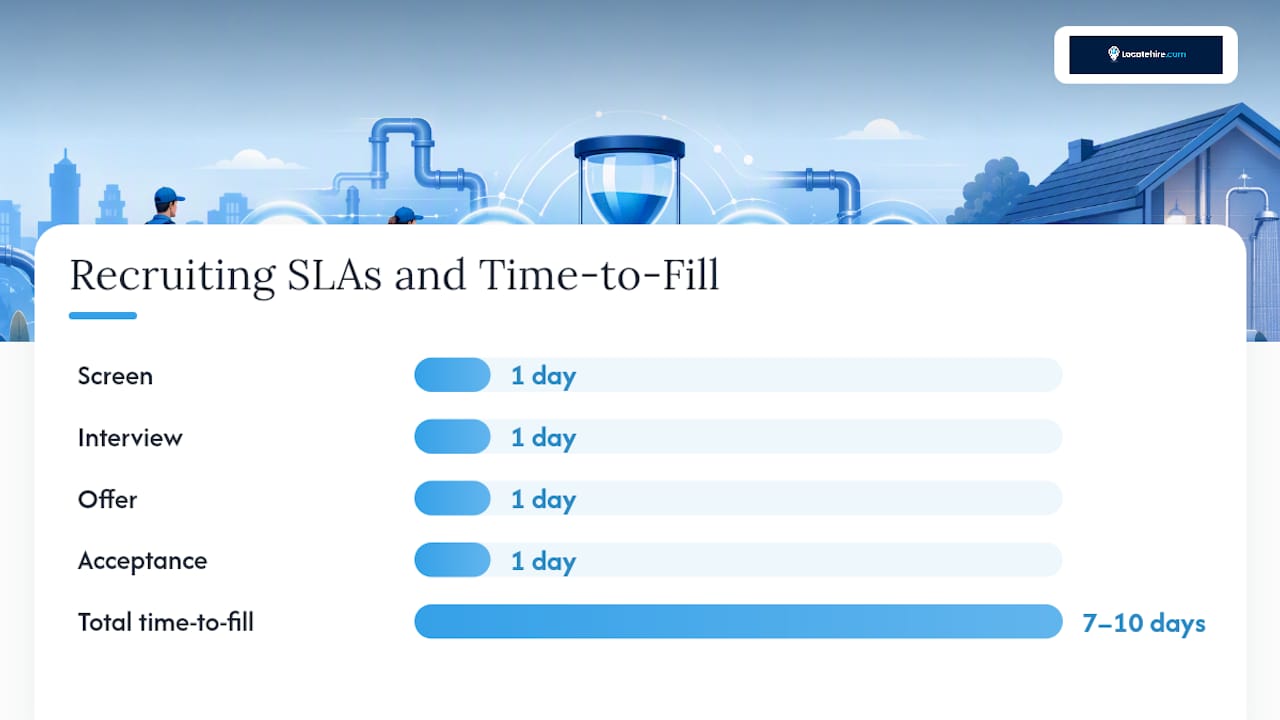
Table of Contents
- How do you keep plumbing staff during busy season in 72 hours?
- The ATS hiring workflow: from sourcing to first shift
- What makes a plumbing job post convert during peak hiring?
- What are the right time-to-hire benchmarks for busy season?
- How does ATS-to-dispatch integration prevent staffing gaps?
- Which KPIs tell you your staffing pipeline is healthy?
- What hiring mistakes slow you down during busy season?
- What small plumbing owners gain from an ATS-first approach
- Locatehire gives you the full workflow in one place
- Sources
How do you keep plumbing staff during busy season in 72 hours?
This checklist is timeboxed. Work through it in order and skip nothing marked must-do.
Day 0–1 (must-do)
- Open your ATS, filter past applicants by license level and service area, tag every match "busy-season-2026," and send a personalized re-engagement message within the same session.
- Publish one optimized job post to Indeed, ZipRecruiter, and your Google Business Profile. Three boards, one post, one hour.
- Turn on new-candidate alerts so every fresh application triggers an immediate notification.
Day 1–2
- Run automated smart scoring to surface the top 20% of applicants. Schedule 15-minute phone screens or one-way video responses for everyone who clears the filter.
- Delegate first-round screens to your senior tech or office manager, not yourself.
Day 2–3 (must-do)
- Make verbal offers the same day as the final interview. Set a 24-hour written acceptance window and auto-generate the offer letter through your ATS.
- Trigger preboarding tasks immediately on acceptance: I-9, direct deposit, uniform order, dispatch account setup.
Pro Tip: Set a recurring 8 AM calendar block labeled "ATS review" for the next 14 days. Five minutes of daily pipeline review prevents the 48-hour response gaps that kill candidate interest.
The ATS hiring workflow: from sourcing to first shift
Follow these steps in sequence. Each one feeds the next.
-
Source. Pull saved searches from your ATS for applicants who applied in the past 18 months and were not hired due to timing. Post the role automatically to job boards using your ATS's board-distribution rules. A plumbing technician job posting that leads with pay range and license requirements cuts unqualified applications before they reach your queue.
-
Match and score. Set hard filters: valid plumbing license, correct service area, physical requirements met. Weight scoring for years of experience and immediate availability. Candidates who clear hard filters move automatically to the screen stage.
-
Screen. Use one-way video responses or a structured Typeform linked to a GPT scoring rubric. Small shops can build this pipeline using Typeform, Make or Zapier, GPT-4, and Calendly for roughly $50–$150/month. Automation handles the first filter pass; you review only the shortlist.
-
Interview. Sync your ATS calendar with Calendly. Candidates self-schedule a 30-minute live interview or a paid working interview. Decision criteria: license verified, shows up on time, communicates clearly with a homeowner. Decide within 24 hours of the interview.
-
Offer and e-sign. Pre-approved offer templates inside your ATS let you generate and send an offer in under five minutes. Set the acceptance window at 24 hours. Waiting longer than 48 hours after a final interview loses most candidates in a tight market.
-
Onboard. A 30–60–90 onboarding plan loaded before day one gives new techs clear milestones and shortens time-to-productivity. Auto-create the task list on offer acceptance: day-one orientation, week-one ride-along, day-30 solo job, day-60 performance check. Dispatch credentials and job templates provision automatically.
Automation triggers to configure now:
- "Application received" → smart score + tag
- "Score above threshold" → send screen invite
- "Screen passed" → calendar invite for interview
- "Offer accepted" → preboarding task list + dispatch account creation
Pro Tip: Pre-approve two offer packages (apprentice rate and journeyman rate) with your accountant before busy season starts. Removing the approval step cuts offer lag from days to minutes.
What makes a plumbing job post convert during peak hiring?
Job description structure that works:
- Headline: Pay range first. "Licensed Plumber — $28–$38/hr, paid weekly" outperforms "Experienced Plumber Needed."
- Non-negotiables: State license level, service area, and physical requirements in the first three lines.
- A day in the role: Two sentences on what the tech actually does (residential service calls, drain cleaning, water heater installs). Candidates self-select accurately.
- Speed signals: Mention paid working interviews, fast onboarding, and dispatch tool access. Plumbers who are actively job-searching want to know they will be earning within days, not weeks.
Re-engagement message for past applicants: Cold-to-warm SMS for new job-board applicants: Dos and don'ts:
- Do publish compensation ranges upfront. Upfront pay transparency reduces unqualified applications and speeds matching.
- Do mention your dispatch and field tools by name (ServiceTitan, Housecall Pro, etc.). Techs want to know the shop runs professionally.
- Don't write job posts longer than 300 words. Long, generic copy loses mobile readers.
- Don't list 15 "requirements." Three non-negotiables filter better than fifteen nice-to-haves.
Pro Tip: Add a career page to your plumbing website so candidates who find you through Google land somewhere that sells the role, not just a job board listing.
What are the right time-to-hire benchmarks for busy season?
Speed is a competitive advantage. Here are the stage targets to hit:
Total target: application to first shift in 7–10 business days. Anything longer risks losing the candidate to a shop that moves faster.
Pro Tip: Send a "we're excited to have you" text the same evening an offer is signed. That single touchpoint reduces offer withdrawals before day one.
How does ATS-to-dispatch integration prevent staffing gaps?
Hiring a tech and getting them on a revenue-generating shift are two separate events. Close the gap with these integration steps.
On offer acceptance, trigger automatically:
- Create dispatch user account with role-based permissions
- Assign job templates matching the tech's license level
- Tag the new hire "onboarding" in dispatch to prevent solo assignment before day 30
Operational steps for the PM or dispatcher:
- Confirm dispatch credentials are active before day one.
- Assign ride-along shifts for days 1–7 using a paired senior tech.
- Move the "onboarding" tag to "independent" on day 30 after a performance check.
- Audit job templates weekly during the first 60 days to catch mis-assignments early.
When job templates, pricing logic, and dispatch rules are pre-configured, onboarding a new tech is a training exercise, not a setup project. That distinction cuts the time between "hired" and "billable" by days. See the dispatch-hiring alignment guide for a full integration checklist.
Which KPIs tell you your staffing pipeline is healthy?
Track these five metrics. Review the first two daily during busy season; the rest weekly.
Daily:
- Scheduled shift coverage % for the next 14 days. Below 85% triggers an expedite-sourcing workflow immediately.
- Open pipeline count (applicants in screen or interview stage). Zero open pipeline with coverage below 100% is a red flag.
Weekly:
- Time-to-fill (job posted to offer accepted). Target: 7–10 business days.
- Pipeline conversion rate (applications to offers). A rate below 10% usually signals a job post or screening filter problem.
- Time-to-productivity (offer accepted to first solo job). Target: 30 days.
AI-driven onboarding automation often delivers higher retention ROI than sourcing tools alone, so watch time-to-productivity as closely as time-to-fill.
What hiring mistakes slow you down during busy season?
Top pitfalls and their fixes:
- No prebuilt job template. Fix: build one template per role (apprentice, journeyman, master) before the season starts. Posting takes 10 minutes instead of an hour.
- Owner is the single screening point. Fix: delegate first screens to a senior tech using a structured scorecard (license verified, availability confirmed, communication clear).
- Slow offer process. Fix: pre-approve two offer packages. Generate and send via ATS in under five minutes.
- Missing preboarding. Fix: auto-trigger the preboarding task list on offer acceptance. I-9, direct deposit, and uniform order should be complete before day one.
Emergency fill-in triage (when you need someone this week):
- Search ATS for past applicants tagged "strong, not hired" from the last 24 months.
- Call the top three directly. Offer a paid working interview starting within 48 hours.
- Post a "start this week" job to Craigslist and Facebook Jobs with pay range visible.
- Contact your local plumbing apprenticeship program for near-graduates available for supervised work.
What small plumbing owners gain from an ATS-first approach
The clearest benefit owners report is time returned to revenue-generating work. When automated screening handles the first filter pass, you review a shortlist of qualified candidates instead of a raw pile of applications. Plumbing staffing best practices for 2026 from Locatehire confirm that shops using ATS-based workflows reach dispatch readiness faster and maintain higher scheduled coverage during peak weeks. The second gain is candidate quality. Structured scoring and hard filters surface techs who actually hold the right license and live in your service area. The third is onboarding speed. A 30–60–90 plan loaded before day one means new hires arrive knowing what week one looks like, which cuts early turnover and gets them to their first solo job faster.

Locatehire gives you the full workflow in one place
Busy season does not wait for a slow hiring process. Locatehire's AI-powered ATS is built for small trade shops that need to go from "we're short-staffed" to "first shift covered" in days, not weeks. AI candidate matching surfaces your best-fit applicants from past and new sources automatically. Smart scoring filters on license, service area, and availability before you see a single resume. Automated offer generation and preboarding templates cut day-one admin to near zero.
The result: faster shortlists, shorter offer cycles, and new hires who arrive dispatch-ready. Start your free trial at Locatehire and run your first 72-hour hiring sprint this week.