
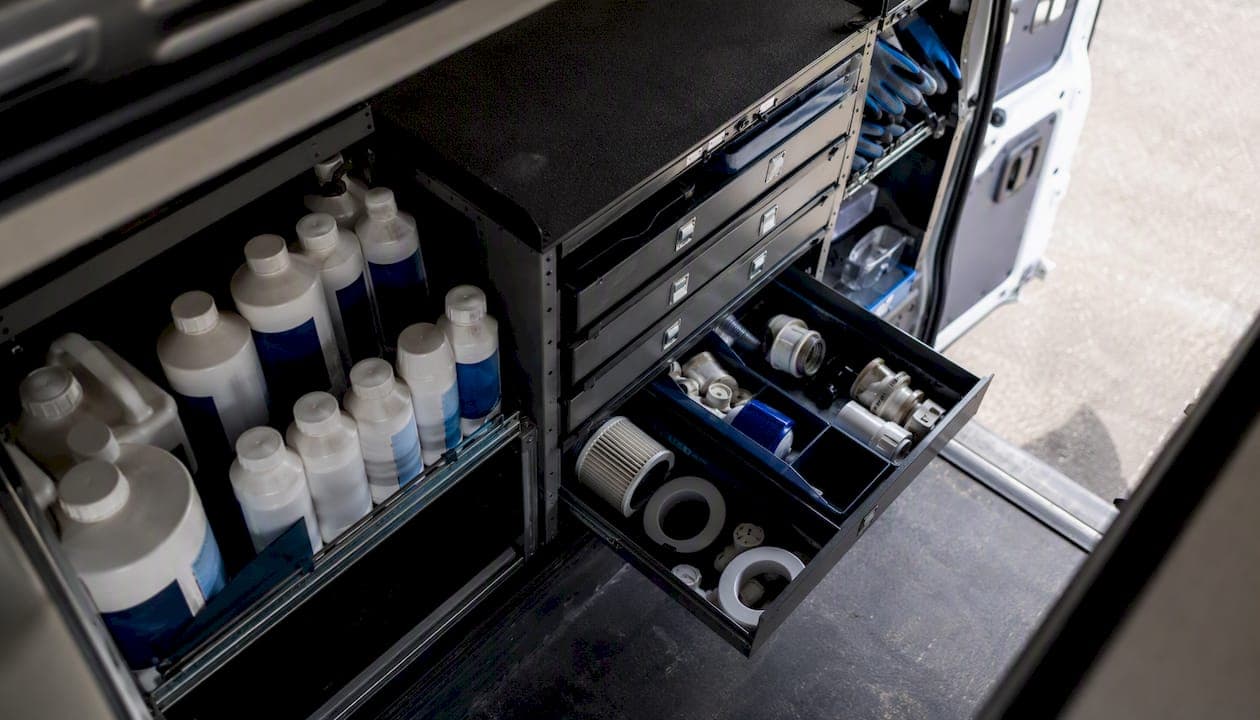
A truck inventory pool technician is a route-based pool service professional who maintains water chemistry, performs equipment checks, and manages all chemicals, parts, and tools carried on a service vehicle. The industry term you'll see on municipal job postings is aquatics technician or pool service technician, but the "truck inventory" framing captures the full scope of the role: this person is equally responsible for what's on the truck as for what happens at the pool.
Core responsibilities at a glance:
- Inventory control: Maintain par levels of chemicals, test reagents, and replacement parts on the truck at all times
- Daily truck checks: Conduct a 3-minute morning inspection before the first stop
- Chemical handling: Safely store, transport, and apply pool chemicals following OSHA and local health department standards
- On-route servicing: Test water chemistry, brush surfaces, clear baskets, and check equipment at every stop
- Parts management: Record part usage at the job level and restock at end of day
Industry surveys show technicians without managed truck inventory systems average 2–3 unplanned supply runs per week, each costing 30–60 minutes. That adds up to 75–150 hours of lost productivity per year. Getting the inventory side of this role right is not a secondary concern.
Key Takeaways
A truck inventory pool technician's effectiveness depends as much on what's on the truck as on what happens at the pool. Inventory discipline, certification compliance, and job-level documentation are the three levers that separate high-performing route teams from ones that bleed time and parts.
| Point | Details |
|---|---|
| Run the morning check | A 3-minute daily truck inspection prevents the 75–150 hours of annual lost productivity from unplanned supply runs. |
| Stock to par levels | Carry 2–4 days of common consumables; assign one technician as the owner of each truck's inventory. |
| Record parts at the stop | Log every part used at the job level before leaving the property to prevent the 8%–15% annual shrinkage common in unmanaged field service. |
| Verify certifications before hire | CPO or AFO certification is required for commercial pools and strongly preferred for residential routes. |
| Locatehire for hiring and onboarding | Locatehire's ATS lets pool service employers post jobs, match certified candidates, and assign truck-checklist onboarding workflows in one platform. |
Table of Contents
- What does a truck inventory pool technician do each day?
- How to manage truck inventory: what to carry and how to organize it
- What tools, chemicals, and parts should you keep on a service truck?
- What does a typical route day look like for a pool technician?
- What skills and certifications does this role require?
- Chemical safety, storage, and compliance on the truck
- How to hire, onboard, and measure performance for this role
- What does a pool technician earn, and where can the role lead?
- Job description template and truck checklist you can use today
- What actually separates a strong truck inventory pool technician from an average one
- Locatehire helps you hire and onboard pool technicians faster
- Sources
What does a truck inventory pool technician do each day?
The role centers on four primary duty categories: water chemistry, physical cleaning, mechanical checks, and inventory actions. Each stop on a route requires all four, and skipping any one of them creates problems that compound over time.
A typical stop runs like this. The technician arrives, skims and brushes the pool, empties pump and skimmer baskets, then tests water chemistry using a digital or reagent-based test kit. Based on results, they dose the appropriate chemicals, adjust pH or alkalinity, and add sanitizer. They check the pump, filter pressure, and any automated equipment. Before leaving, they log the service, record any parts or chemicals used, and note anything that needs a follow-up visit.
Routine maintenance tasks at each stop include:
- Brushing walls, steps, and tile lines
- Testing free chlorine, pH, total alkalinity, calcium hardness, and cyanuric acid
- Emptying pump baskets and skimmer baskets
- Backwashing or cleaning filters on schedule
- Checking pressure gauges and flow rates
- Dosing chemicals and recording amounts used
Repair and diagnostic tasks are different. Replacing a pump impeller, rewiring a timer, or diagnosing a heater fault typically requires a licensed technician or a separate service call. The truck inventory technician's job is to identify the problem, document it accurately, and escalate it. Attempting licensed electrical or gas work without credentials creates liability for the employer.
Pro Tip: Before leaving each stop, do a 30-second visual scan of the equipment pad. Catching a slow leak or a cracked fitting on the first visit prevents a callback and a parts run later in the week.
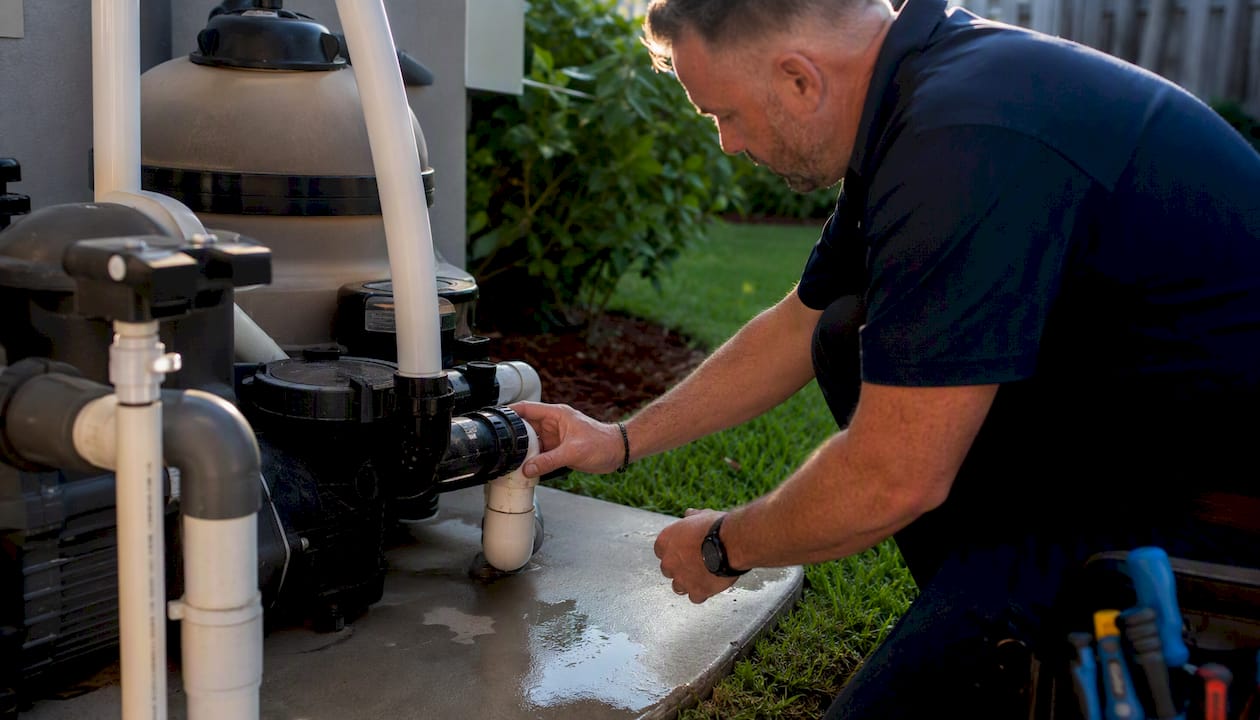
How to manage truck inventory: what to carry and how to organize it
Poor truck inventory management is the single biggest source of avoidable downtime in pool service. Technicians without a managed system average 2–3 unplanned supply runs per week, each burning 30–60 minutes of drive and shop time. Multiply that across a team of five techs and you're looking at hundreds of hours of lost revenue annually.
The fix is a structured organization system, not just a fuller truck.
Truck organization by category
Group everything on the truck into five zones: chemicals, testing supplies, tools, replacement parts, and safety gear. Each zone gets a fixed location. Chemicals go in a ventilated, locked compartment. Test kits and reagents stay in a temperature-controlled area away from direct sunlight. Tools go in a labeled drawer or bin. Spare parts sit in a separate tray, organized by frequency of use.
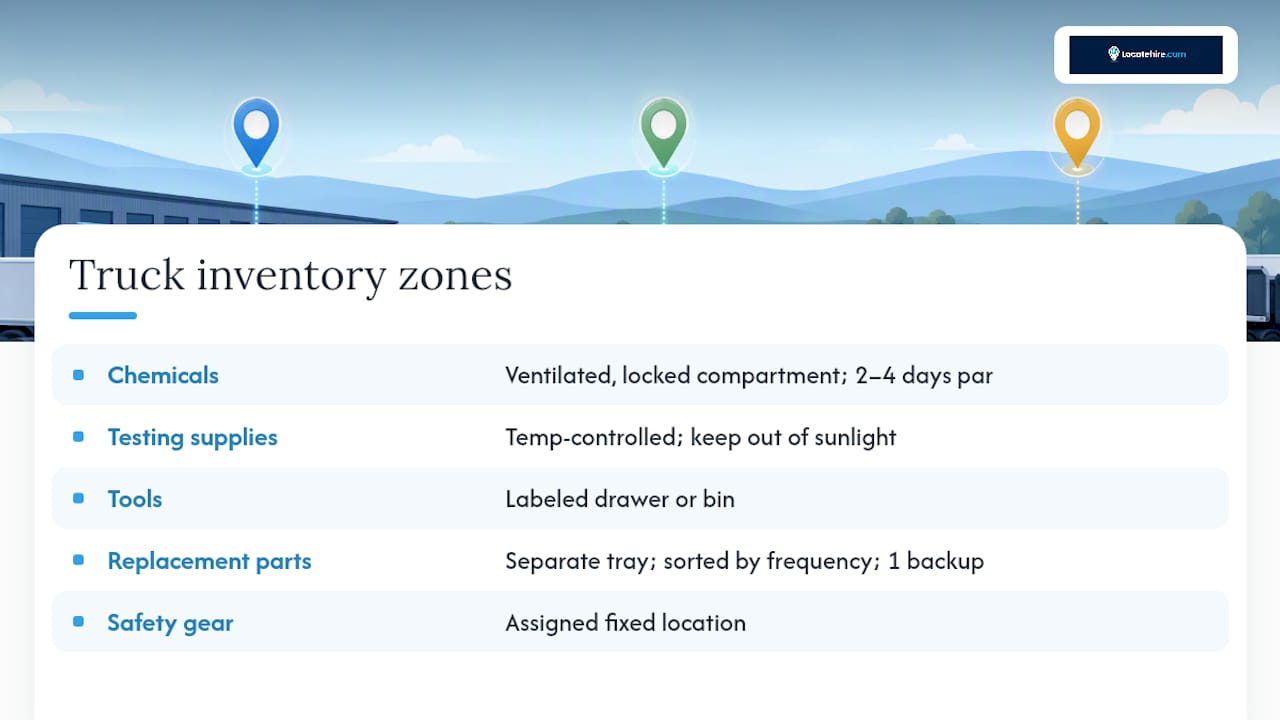
Set par levels for every item. A par level is the minimum quantity you need to finish a full day's route without a supply run. For chemicals, that typically means 2–4 days of common consumables on busy routes, per PoolDial's truck setup guidance. For parts, it means one backup of every high-failure item: pump baskets, O-rings, test reagents, and common fittings.
Daily and weekly inventory checks
- Morning (3 minutes): Verify chemical levels, test kit reagents, and critical spare parts before leaving the shop
- End of day: Restock anything below par; log what was used and where
- Weekly cycle count: Count high-use SKUs against the par list; flag discrepancies immediately
Effective truck inventory workflows follow three stages: capture usage, trigger replenishment, and audit regularly. The key is keeping each step fast. If the process takes more than a few minutes, techs stop doing it.
Unsystematic tracking leads to annual parts shrinkage of 8%–15% in field service, with consumable chemicals showing the highest loss. Weekly cycle counts on high-use items catch problems early; quarterly full counts miss short-term losses entirely.
Pro Tip: Rotate stock seasonally. Pre-stock algaecide and shock in late spring before demand spikes. Pull heavy, low-use items like specialty equipment off the truck in the off-season to reduce fuel costs and handling wear. See how pool industry hiring season affects both staffing and supply planning.
What tools, chemicals, and parts should you keep on a service truck?
A well-structured truck inventory groups items into five categories: chemicals, testing supplies, tools, replacement parts, and safety gear. The split between daily-carry and shop-only items matters because overstocking adds weight and cost, while understocking causes supply runs.
Test kit reagents have expiration dates. Check them monthly and replace any reagent past its date. An expired reagent gives a false reading, which leads to incorrect chemical dosing, which leads to a callback.
What does a typical route day look like for a pool technician?
A residential route technician completes 8–20 stops per day, depending on pool size, service level, and drive time between stops. Commercial routes run fewer stops but more time per stop. Route dispatch patterns for pool service share similarities with other field service trades, as discussed in plumbing dispatch and route planning.
Start-of-day routine (before the first stop)
- Run the 3-minute truck inspection: chemicals at par, test kit reagents present, critical spare parts loaded
- Confirm the day's route order in your service software
- Check for any flagged accounts from the previous day's notes
At each stop
- Skim and brush the pool
- Empty pump and skimmer baskets
- Test water chemistry and record results
- Dose chemicals as needed; record type and quantity used
- Check equipment: pump, filter pressure, automation settings
- Document the service and any issues observed
- Log any parts removed or installed before leaving the property
Step 7 is where most shrinkage originates. Recording parts at the moment of use, not at end of day, cuts reconciliation errors dramatically. End-of-day self-reporting relies on memory, and memory is unreliable after 15 stops.
End-of-day restock
- Compare what was used against par levels
- Restock from the shop before the next morning
- Flag any item that hit zero during the route for a par-level review
Pro Tip: Sequence your route to put pools with heavy chemical demand (large commercial pools, pools with algae history) early in the day when your truck is fully stocked. Save lighter residential stops for the afternoon.
What skills and certifications does this role require?
The technical core of the job is water chemistry. A technician needs to understand how chlorine, pH, alkalinity, calcium hardness, and cyanuric acid interact and how to adjust each one without overcorrecting. Beyond chemistry, the role requires basic mechanical troubleshooting: reading pressure gauges, identifying pump and filter problems, and knowing when a repair exceeds their scope.
Technical skills employers look for:
- Water chemistry testing and treatment (all standard parameters)
- Pump, filter, and valve maintenance
- Basic plumbing: replacing fittings, unions, and valves
- Basic electrical familiarity: reading timers, identifying tripped breakers
- Parts identification and inventory logging
Certifications commonly required
The Certified Pool Operator (CPO) credential, issued by the Pool & Hot Tub Alliance (PHTA), is the most widely recognized certification in the U.S. The Aquatic Facility Operator (AFO), issued by the National Recreation and Park Association (NRPA), is its primary alternative. Municipal aquatics technician specifications commonly require CPO or AFO certification for public and commercial work. Residential employers often prefer it but may not require it for entry-level hires.
State and local health departments add their own layers. Some states require a separate contractor's license for chemical application above certain volumes. Check your state's Department of Health and local jurisdiction before posting a job description. For a full breakdown of certification requirements by role type, see certifications in hiring pool techs.
Soft skills and physical demands:
- Clear customer communication: clients ask questions at every stop.
- Time management: 8–20 stops per day leaves no room for delays
- Physical fitness: lifting 50-lb chemical containers, working in heat
- Attention to detail: a missed chemical reading or an unlogged part creates downstream problems
Chemical safety, storage, and compliance on the truck
A cluttered or poorly organized truck increases the risk of storing incompatible chemicals together. Chlorine and muriatic acid stored in the same compartment without separation is a serious hazard. Contact between oxidizers and acids can produce chlorine gas. OSHA and local health departments treat this as a compliance violation, not just a safety concern.
Chemical storage rules for service trucks:
- Store chlorine products and acids in separate, ventilated compartments
- Never stack chemical containers; secure them against movement during transit
- Keep SDS (Safety Data Sheets) accessible for every chemical on the truck
- Check containers for leaks or damage before loading each morning
PPE requirements
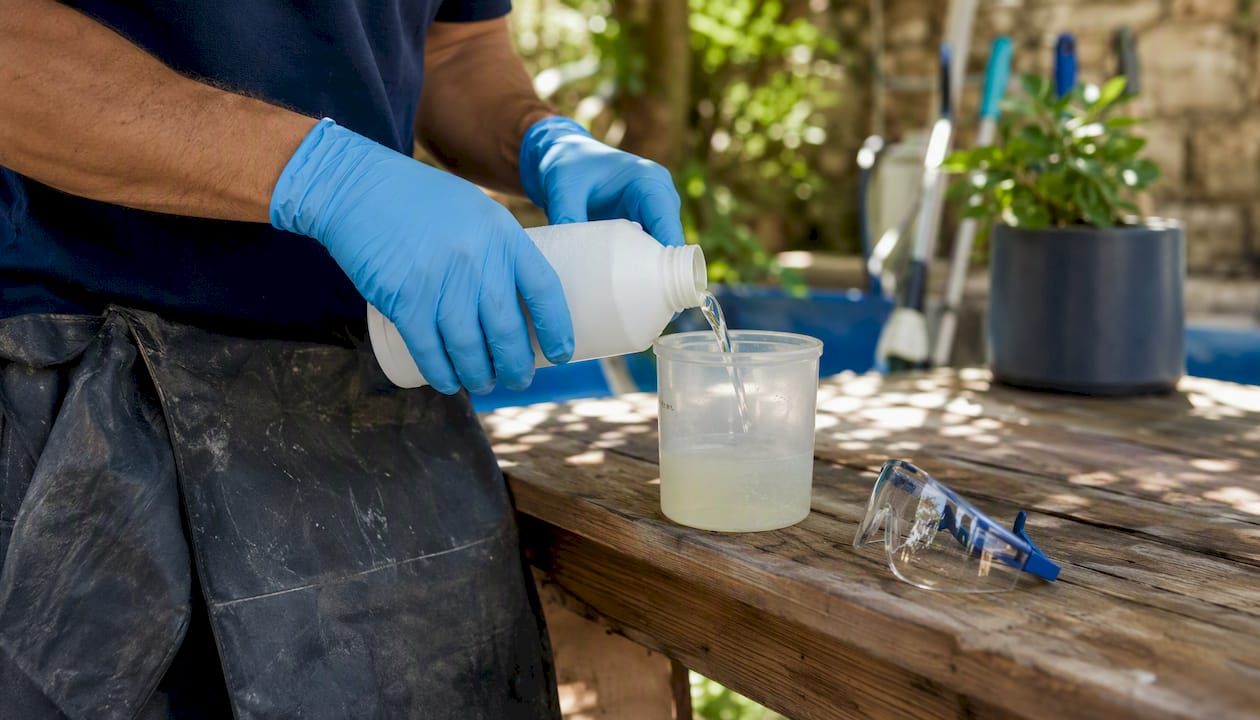
Technicians must wear nitrile gloves and safety glasses when handling any pool chemical. For acid work, a face shield and chemical-resistant apron are appropriate. Chemical safety training requirements for pool service roles cover both OSHA standards and state-level health department expectations.
Recordkeeping for commercial pools
Commercial pool operators are required to maintain service logs that document water chemistry readings, chemical additions, and equipment status. The truck-level record is the source document for those logs. A technician who doesn't record accurately at the stop creates a compliance gap for the facility operator.
Emergency procedures:
- Chemical spill on the truck: use the onboard spill kit, neutralize acid spills with baking soda, contain and absorb chlorine spills, ventilate the vehicle
- Spill at a customer's property: follow the SDS protocol, notify the customer, document the incident
- Exposure to chemicals: flush with water immediately, call Poison Control (1-800-222-1222) if ingestion or significant skin/eye contact occurs
Pro Tip: Mount the spill kit at the rear of the truck, not buried under equipment. In an emergency, you need it in seconds, not after moving three bags of salt.
How to hire, onboard, and measure performance for this role
Hiring a pool technician who can manage truck inventory well requires testing for inventory discipline during the interview, not just after the hire. Ask candidates to walk you through how they'd handle a part that ran out mid-route. Their answer tells you more than a resume.
Hiring checklist
- Verify CPO or AFO certification (or confirm candidate is enrolled)
- Confirm valid driver's license and clean driving record
- Check physical ability to lift 50 lbs repeatedly
- Ask one scenario question about inventory discrepancy handling
Onboarding milestones (7/30/60 sprint)
The 7/30/60 sprint structure for pool service hires gives hiring managers a clear framework:
Week 1 (Day 1–7):
- Complete truck orientation: chemical storage zones, par levels, morning inspection routine
- Shadow a senior tech for two full route days
- Pass a written water chemistry test
Weeks 2–4:
- Complete two independent route days with supervisor check-ins
- Conduct first solo inventory cycle count and reconcile against par list
- Review service documentation for accuracy
Day 30–60:
- Demonstrate consistent job-level parts logging
- Route completion rate at or above team average
- Zero unplanned supply runs in the most recent two-week period
For a detailed training plan, see how to train new pool service hires effectively.
Performance metrics to track
- Route completion rate: percentage of scheduled stops completed per day
- Unplanned supply runs: target zero per week after the first 30 days
- Inventory shrinkage: measure monthly as (expected inventory minus actual inventory) divided by cost of goods used; target under 2%
- On-time restock: percentage of mornings the truck passes the par-level check
- Service documentation accuracy: percentage of stops with complete chemistry records and parts logs
Pro Tip: Assign clear ownership of each truck's inventory to one technician. When shrinkage is shared across the team, no one is accountable. When it's assigned, it drops.
What does a pool technician earn, and where can the role lead?
Indeed reports an average base pay for pool technicians in the U.S., compiled from thousands of salaries. Entry-level techs without certifications typically start below this figure; experienced technicians with CPO credentials and commercial pool experience often earn above it.
Factors that raise pay:
- CPO or AFO certification
- Commercial pool experience (higher chemical volumes, more complex equipment)
- HVAC or electrical skills that allow the tech to handle heater and automation repairs
- Emergency call availability (weekend and after-hours response)
- Willingness to manage truck inventory and train newer techs
Career progression
The typical path runs from route technician to lead or repair technician, then to service manager or independent contractor. A lead tech handles the more complex repairs that a standard route tech escalates. A service manager oversees a team of route techs, manages scheduling, and owns the inventory system for the whole fleet. The contractor path requires a state contractor's license, which varies by state but generally requires documented experience and a written exam.
Seasonal demand affects both pay and hours. Spring and summer bring full-time hours and overtime. Fall and winter in colder markets mean reduced routes or off-season work in equipment repair and renovation.
Job description template and truck checklist you can use today
Pool service technician job description template
Job title: Pool Service Technician (Route/Truck Inventory)
Summary: Perform scheduled pool maintenance on a residential or commercial route, manage all chemicals and parts on an assigned service vehicle, and maintain accurate service records at every stop.
Core responsibilities:
- Test and balance water chemistry at each stop (chlorine, pH, alkalinity, calcium hardness, cyanuric acid)
- Brush, skim, and vacuum pools; empty pump and skimmer baskets
- Inspect and maintain pumps, filters, and automation equipment
- Manage truck inventory: conduct morning par-level checks, log part usage at the job level, and restock at end of day
- Maintain accurate service records and chemical logs for every account
- Follow all OSHA and local health department chemical handling and storage requirements
- Communicate service findings and recommendations to customers professionally
Required qualifications:
- CPO or AFO certification (or enrollment within 60 days of hire)
- Valid driver's license with clean record
- Ability to lift 50 lbs repeatedly and work outdoors in heat
- 1+ year of pool service experience preferred
Preferred qualifications:
- Experience with pool service software (route management and inventory tracking)
- Basic plumbing or electrical skills
- Commercial pool experience
Daily truck checklist
Daily carry (verify every morning):
- Chlorine (tablets or granular): at par level
- Muriatic acid: at par level
- Sodium bicarbonate: at par level
- Algaecide: 1 bottle minimum
- Test kit with current reagents (check expiration dates weekly)
- Backup test strips
- Telepole, brush, leaf net, vacuum head
- Basic hand tools (screwdrivers, pliers, wrench)
- Pump baskets (2 common sizes)
- O-ring and gasket kit
- Nitrile gloves and safety glasses
- Chemical spill kit
- SDS binder or digital access
Shop-only (restock as needed, not daily carry):
- Specialty pump impellers
- Replacement automation components
- Bulk chemical stock
- Specialty fittings and unions
Integrate this checklist into your ATS or a mobile form so techs can complete it digitally each morning. A completed digital check creates a timestamped compliance record and flags any tech who skips the inspection.
What actually separates a strong truck inventory pool technician from an average one
Most hiring managers focus on water chemistry knowledge during interviews. That matters, but it's not where the performance gap shows up in the field. The gap shows up in inventory discipline.
A technician who logs every part at the moment of use, runs the 3-minute morning check without being reminded, and flags a discrepancy before it becomes a shrinkage problem is worth significantly more than one who knows chemistry but treats the truck like a storage unit. The inventory side of this role is where operational costs either stay controlled or quietly bleed out.
The other underestimated factor is customer communication. Route techs interact with homeowners and facility managers at every stop. A tech who can explain a chemistry reading in plain language, set expectations about a repair timeline, and leave the customer confident in the service builds retention. A tech who avoids the conversation creates churn.
When you're interviewing candidates, give them a scenario: "You arrive at a stop and realize you're out of the chemical you need. What do you do?" The answer reveals their inventory habits, their problem-solving instincts, and their communication approach all at once. Test for common hiring challenges before they become turnover problems.
Locatehire helps you hire and onboard pool technicians faster
Filling a truck inventory pool technician role takes more than posting a job. You need to screen for CPO certification, verify driving records, assign onboarding checklists, and track whether new hires are completing their morning truck inspections. Doing that manually across multiple hires slows everything down.

Locatehire is built for exactly this kind of ongoing, role-specific hiring. Post to major job boards and social media in one step, use AI candidate matching to surface applicants with the right certifications, and assign onboarding checklists directly inside the platform. Certification tracking, service documentation reminders, and hiring analytics are all included. If you prefer manual checklists for now, those work too. But when you're ready to reduce unplanned supply runs and build a team that stays, start with Locatehire to see how the ATS handles the full hiring and onboarding workflow for pool service teams.
Sources
- Free Pool Service Truck Inventory Checklist Spreadsheet (Excel & Google Sheets) | PoolDial
- Pool Service Truck & Van Setup | PoolTechTools
- AQUATICS TECHNICIAN I - 1737 (City of San Diego class spec)
- Pool Service Technician Job Duties and Daily Responsibilities | Pool Tech Careers
- Field Inventory Across Trucks and Warehouse in Pool and Spa Service | Simply Connected Systems
- Pool technician salary in United States - Indeed