
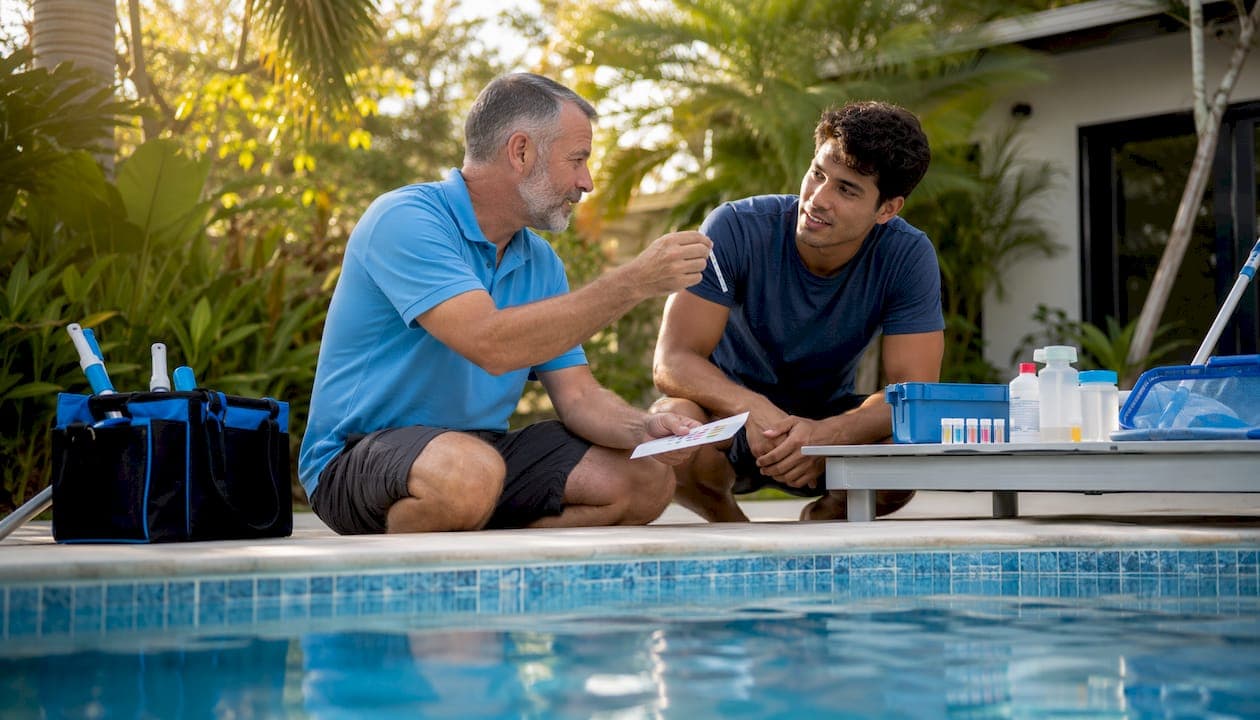
Training new pool service hires is a structured, phased process that moves from shadowing to solo route operation while building safety, water chemistry, and customer service skills simultaneously. The industry term for this approach is technician onboarding, and when done right, it transforms a raw hire into a reliable route tech within 90 days. People-related expenses consume roughly 35% of a pool service budget, with onboarding costs ranging from $2,500 to $10,000 per hire. That figure alone makes structured training one of the highest-return investments a small pool business can make. Skip the structure, and you pay those costs twice when the hire quits.
What do you need before you train new pool service hires?
Preparation before day one determines whether training succeeds or collapses. The most common mistake small business owners make is hiring reactively, when they are already overwhelmed, and then rushing the new tech onto a route before they are ready.
Start with financial readiness. Entry-level pay runs $18–$24 per hour in 2026, with experienced techs earning up to $30 per hour. Add taxes, vehicle costs, and insurance, and the loaded cost of a new hire is significantly higher than the base wage. Know that number before you post the job.

Use the "N+1" staffing formula as your hiring trigger. If your current route load fills one tech completely, hire the second tech before you are desperate. Desperation leads to skipping screening steps, which leads to bad fits and early turnover. Timing your hire to pool industry hiring season gives you a larger candidate pool and more time to train before peak demand hits.
Before your new hire arrives, have these items ready:
- Written job description with physical demands, schedule expectations, and route size
- Offer letter that confirms pay, start date, and any probationary period
- Safety kit including gloves, goggles, chemical info sheets, and an emergency contact card
- Routing software access so the new tech can follow digital stop-by-stop instructions from day one
- Chemistry reference app or laminated dosing guide for field use
A lead tech who can co-train also matters. Using a lead tech to run new hire training lets you scale without burning yourself out as the owner. If you do not have a lead tech yet, plan to be present for the first four weeks yourself.
| Preparation Item | Why It Matters |
|---|---|
| Written job description | Sets physical and schedule expectations before the hire starts |
| Offer letter | Reduces misunderstandings about pay and probation |
| Safety kit | Meets compliance requirements and signals a safety-first culture |
| Routing software | Replaces memorization with guided digital workflows |
| Lead tech or owner mentor | Provides consistent supervision during the critical first month |
How to implement a phased 90-day training program for pool technicians
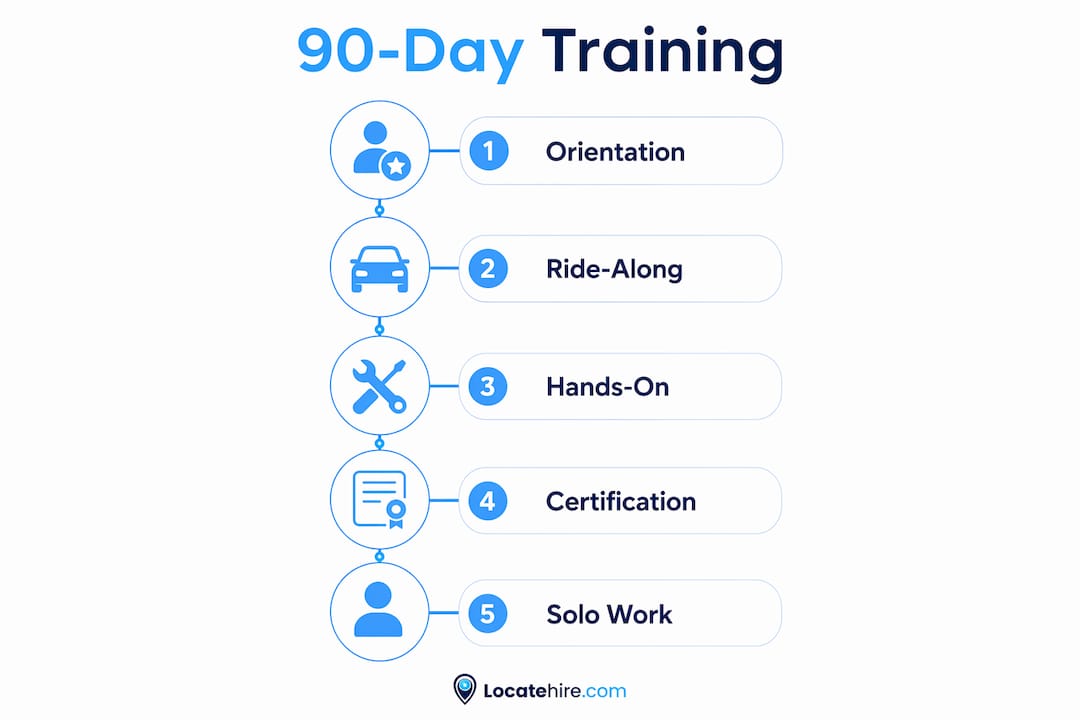
The 90-day training progression is the industry standard for onboarding pool technicians. It works because it builds competence gradually, giving new hires time to absorb water chemistry, route logistics, and customer interaction without being overwhelmed.
-
Weeks 1–2: Shadowing and ride-alongs. The new hire rides with you or a lead tech and watches every stop. They learn how to greet customers, read pool conditions visually, and handle basic chemical adjustments. They do not touch anything without supervision. This phase also functions as an extended interview. You see how they communicate, whether they ask good questions, and how they handle physical demands.
-
Weeks 3–4: Supervised route operation. The new tech begins performing tasks at each stop while you or the lead tech observes. They test water, dose chemicals, and complete checklists. You correct technique in real time. Feedback at this stage must be immediate and specific, not saved for a weekly review.
-
Weeks 5–8: Solo stops on prepared routes. The new hire takes over low-maintenance stops independently. These are pools with predictable chemistry and no complex equipment issues. You check their work at the end of each day using photo logs and digital reports. This phase builds confidence without exposing customers to unacceptable service risk.
-
Weeks 9–12: Full route responsibility. The tech manages a complete route with periodic spot checks. By week 12, they should handle routine chemical adjustments, basic equipment troubleshooting, and customer communication without prompting.
Pro Tip: Schedule the Certified Pool Operator (CPO) certification exam by day 60. The CPO credential from the Pool & Hot Tub Alliance covers water chemistry, equipment operation, and safety regulations. Passing it mid-program reinforces what the tech has learned in the field and fills in knowledge gaps before they go fully solo.
Operators benefit from treating the ride-along phase as an extended interview. If a hire shows poor attitude, unreliability, or resistance to feedback in weeks 1–2, ending the relationship then costs far less than carrying them through 90 days and losing customers in the process.
What safety and technical skills should new pool service hires master?
Safety is not a module you cover in week one and move on from. It is a daily practice that new hires must internalize before they operate independently.
The core safety skills every new pool tech needs include:
- Chemical handling: Proper storage, mixing sequence (never add water to acid), and spill response procedures
- Personal protective equipment: Gloves and goggles at every chemical stop, no exceptions
- Vehicle safety: Securing chemical containers during transport, checking tire pressure, and following load limits
- Emergency protocols: What to do if a chemical exposure occurs, including eye wash procedures and when to call 911
- Incident reporting: How to document accidents, near-misses, and customer property damage immediately
Effective training includes prioritizing employee physical and mental well-being after incidents. According to Austin Gardiner, CEO of GL Pools, a care culture is critical in high-hazard roles. Providing safety kits, chemical info sheets, and protocol training reduces risk and prepares technicians for field emergencies. Regular inspections and incident reporting build the safety culture that keeps good techs on the job long term.
On the technical side, new hires must develop competency in water chemistry fundamentals: reading test strips and photometers, understanding free chlorine versus combined chlorine, adjusting pH and alkalinity, and calculating cyanuric acid levels. Equipment basics matter too. A new tech should be able to identify a dirty filter, check pump pressure, and recognize when a motor is running hot before it fails.
Hiring great people and keeping them is the single most important strategy in pool service. Safety training is the foundation of that retention. A tech who feels protected and supported stays. One who feels thrown into hazardous conditions without preparation leaves fast.
How can small businesses use technology to speed up training?
Digital tools cut technician onboarding time from 8 weeks to 3 weeks when implemented correctly. Field management software replaces the need for new hires to memorize customer quirks, gate codes, and chemical preferences. Instead, the app delivers that information at each stop, letting the tech focus on execution rather than recall.
The tools that make the biggest difference in pool service training include routing apps with turn-by-turn stop instructions, photo logging features that capture before-and-after pool conditions, Bluetooth water testers that sync readings directly to service records, and digital chemistry calculators that recommend dosing based on current test results. Each of these reduces the cognitive load on a new hire and creates a documented record you can review for quality control.
Pro Tip: Show your digital tool stack during the job interview. Gen Z pool tech hires expect modern tools and autonomy. Demonstrating that your company uses apps, digital logs, and structured workflows signals a forward-thinking operation. That signal alone improves your offer acceptance rate with younger candidates.
Technology also supports building a repeatable hiring process that scales. When your training materials live in a digital system, your second and third hires benefit from the same quality onboarding as your first, without you rebuilding the program from scratch each time.
What are the most common pool service training mistakes?
Most training failures share a single root cause: moving too fast. Onboarding failures happen when owners rush hires onto solo routes before they are ready, then lose them to resignation within the first 60 days.
The specific mistakes that cause early churn include:
- Skipping the shadowing phase because the owner is too busy to ride along for two weeks
- Underestimating physical demands and failing to warn new hires about heat, chemical exposure, and the pace of a full route day
- Delaying feedback until problems compound, rather than correcting technique at each stop
- Hiring for skills instead of attitude, which fills the seat faster but produces techs who resist learning your systems
- Ignoring early warning signs during ride-alongs, such as poor customer communication or careless chemical handling
The fix for most of these is a structured interview process that includes a 5-minute phone screen and a 20-minute in-person meeting before any ride-along begins. Catching red flags early saves the cost of a bad hire. Pair that with honest conversations about the physical and mental demands of the job, and you set realistic expectations that reduce shock-driven resignations in the first two weeks.
Hiring for attitude and training for skills is the principle that separates pool businesses with low turnover from those that constantly recruit. You can teach water chemistry. You cannot teach reliability or a customer-first mindset.
Key Takeaways
A structured 90-day onboarding program is the most reliable method to turn a new pool service hire into a competent, retained technician while controlling training costs.
| Point | Details |
|---|---|
| Prepare before day one | Have safety kits, routing software, and a written job description ready before the hire starts. |
| Use the 90-day phased model | Progress from shadowing to supervised stops to solo routes to build skills without overwhelming new hires. |
| Prioritize safety training | Chemical handling, PPE, and incident reporting must be daily practices, not one-time orientation topics. |
| Use digital tools to cut onboarding time | Field management apps reduce onboarding from 8 weeks to 3 weeks by guiding techs at each stop. |
| Hire for attitude, train for skills | Screen for reliability and communication first; technical skills develop within the 90-day window. |
What I have learned from watching training programs succeed and fail
The pool service owners I respect most share one habit: they treat the first 90 days as a mutual evaluation, not just a training period. They are assessing the hire as much as the hire is learning the job. That mindset changes everything about how you run ride-alongs and give feedback.
The biggest mistake I see is owners who skip the shadowing phase because they are slammed with work. They hand a new tech a route map and a bag of chemicals and call it training. Then they wonder why the person quits in week three. The shadowing phase is not optional. It is where the new hire learns your standards, your customer relationships, and your safety culture. Cutting it to save time costs you far more time when you have to rehire.
The other thing I believe strongly: common hiring challenges in pool service are almost always training problems in disguise. When a tech fails, the question is not "why did they fail?" It is "where did the training process break down?" That reframe puts the solution in your hands, not theirs.
Build a culture where new hires feel safe asking questions and making mistakes in a supervised setting. That culture produces techs who stay for years, not weeks.
— Jeff
Locatehire helps pool businesses hire and train with less friction
Hiring and training pool technicians is a repeatable process, and repeatable processes work better with the right systems behind them. Locatehire is an applicant tracking system built specifically for small businesses with ongoing hiring needs, including pool service companies that hire every season.
Locatehire gives you templates for job postings, offer letters, and onboarding checklists so your next hire starts with the same quality process as your best hire. When people-related expenses represent 35% of your operating budget, a system that reduces bad hires and shortens onboarding time pays for itself quickly. Visit Locatehire to see how small pool service businesses use it to build reliable teams without rebuilding their hiring process from scratch every spring.
FAQ
How long does it take to train a new pool service technician?
Most new pool technicians require up to 90 days to develop core skills in water chemistry and customer service. A phased program moving from shadowing to solo routes makes that timeline manageable for small businesses.
When should I schedule the CPO certification for a new hire?
Schedule the Certified Pool Operator exam by day 60 of the onboarding program. That timing reinforces field experience with formal chemistry and safety knowledge before the tech takes full route responsibility.
What is the biggest cause of early turnover in pool service?
Rushing new hires onto solo routes before they are ready is the leading cause of early resignation. A structured 90-day program with gradual autonomy reduces that risk significantly.
Do I need digital tools to train pool technicians effectively?
Digital tools are not required, but they cut onboarding time from 8 weeks to 3 weeks by replacing memorization with app-based guidance at each stop. They also help attract younger workers who expect modern workflows.
How do I know if a new hire is the right fit during training?
Use the ride-along phase as an extended interview. Watch for how the hire communicates with customers, handles feedback, and responds to physical demands. Poor attitude or careless chemical handling in weeks 1–2 is a reliable predictor of early failure.