
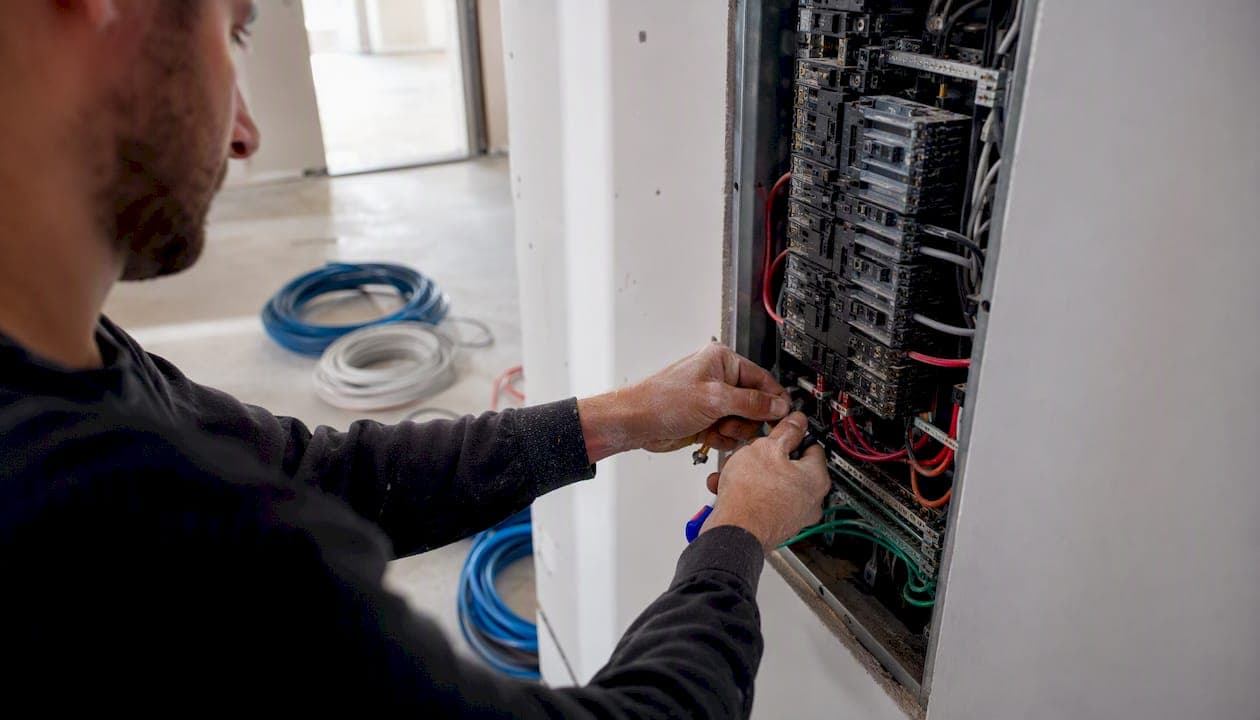
Most electrical contractors can't find enough qualified electricians because retirements, a thin training pipeline, and higher-paying mission-critical projects have created a structural supply gap that outpaces standard recruiting tactics. The shortage is real, it's measurable, and it's getting worse for small and mid-sized shops that can't match hyperscaler wages.
Three moves you can start this week:
- Audit your posted wage against your local market. If you're more than 5% below the prevailing rate, you're screening yourself out before candidates even apply.
- Open one registered apprenticeship slot. The federal Registered Apprenticeship Program gives you a structured, subsidized path to grow your own talent rather than compete for a shrinking pool of journeymen.
- Launch a crew referral campaign. A structured payout to current employees for successful hires closes faster than any job board and costs less per hire.
Key Takeaways
The electrician shortage is structural, not cyclical. Fixing it requires a combination of market-rate wages, a continuous recruiting habit, and a long-term apprenticeship pipeline built before the next vacancy hits.
| Point | Details |
|---|---|
| Shortage is confirmed by data | BLS projects above-average growth and sustained annual openings; a large majority of contractors report hiring difficulty. |
| Top three actions this quarter | Audit your posted wage against market rate, open one apprenticeship slot, and launch a structured crew referral program. |
| Retention starts on day one | Tool readiness, a named mentor, and a published career path reduce early turnover before a wage increase is needed. |
| Multi-channel sourcing is required | Referrals, registered apprenticeships, trade schools, SkillBridge, and adjacent-trade sourcing each produce different candidates at different speeds. |
| Locatehire removes the admin burden | Locatehire's AI matching, job distribution, and candidate alerts let small electrical contractors run a continuous hiring process without manual overhead. |
Table of Contents
- Why electrical companies struggle to find workers: what the data shows
- Root causes: why electrical companies have trouble finding qualified electricians
- How the shortage changes project delivery, margins, and risk
- High-impact recruiting tactics contractors can use right now
- Retention and development: how to keep electricians once you hire them
- Channels and partners that reliably produce electrician candidates
- A practical hiring checklist for electrical contractors
- Policy and long-term solutions contractors and industry groups can support
- The hiring mindset that actually changes outcomes
- Locatehire helps small electrical contractors hire faster
- Sources
Why electrical companies struggle to find workers: what the data shows
The Bureau of Labor Statistics Occupational Outlook Handbook projects above-average employment growth for electricians over the coming decade, with tens of thousands of annual openings driven by both new demand and the need to replace workers who retire or leave the occupation. That combination of growth and replacement pressure creates a persistent gap that current training output cannot close.
A large majority of contractors reported difficulty finding qualified craft workers in the AGC 2024 Workforce Survey, with electrical and mechanical trades among the hardest to fill.
The ManpowerGroup 2026 U.S. Talent Shortage Survey confirms the pattern extends well beyond construction: a majority of U.S. employers across sectors report difficulty filling skilled roles, which means electricians are being recruited from multiple directions simultaneously.
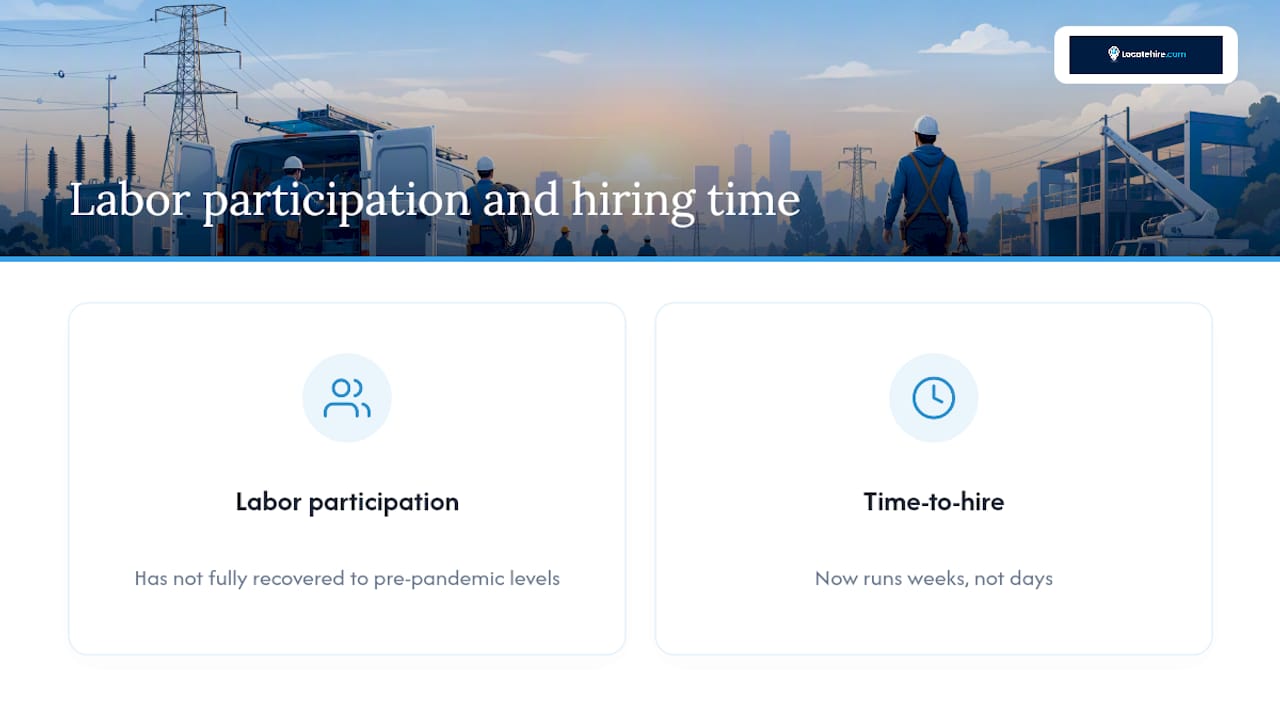
For a small shop running two or three crews, even one open journeyman position can stall a project or force expensive overtime. The BLS labor-force participation data show that participation among prime working-age adults has not fully recovered to pre-pandemic levels, compressing the available supply further. Apprenticeship programs graduate a limited number of new journeymen each year, and those graduates are absorbed quickly. The result: time-to-hire for a licensed journeyman electrician in most metro markets now runs weeks, not days.
Root causes: why electrical companies have trouble finding qualified electricians
Several forces are working against contractors at the same time. Understanding which ones apply to your market helps you match the right fix to the right problem.
- Retirement wave. A large share of the current electrician workforce entered the trade in the 1980s and 1990s. Those workers are now retiring faster than apprenticeship programs can replace them, and they take institutional knowledge, customer relationships, and foreman-level judgment with them.
- Demand-pull from higher-paying sectors. Data centers, solar farms, EV charging infrastructure, and grid modernization projects are competing directly for the same licensed electricians your shop needs. As Utility Dive reports, workforce capacity has become a limiting factor for infrastructure delivery, and those projects pay rates that residential and small-commercial contractors often can't match.
- Long apprenticeship timelines. A registered apprenticeship typically runs four to five years. Even if every shop in your market opened a slot today, the pipeline wouldn't produce licensed journeymen for years. The Georgetown CEW skills-shortage analysis projects this mismatch between retirees and new entrants continuing through 2032.
- Perception gap with Gen Z. Younger workers are not automatically choosing trades. Without active outreach to high schools and community colleges, and without a clear career-earnings story, electrical work competes poorly against white-collar marketing from four-year universities.
- Recruiting-process failures. Many contractors post vague job ads with no pay range, rely on a single job board, and take two weeks to respond to applicants. In a tight market, qualified candidates accept other offers in 48–72 hours. Common job posting mistakes electrical contractors make include omitting the wage, burying the license requirement, and writing ads that read like legal disclaimers rather than job offers.
- Licensing and regulatory friction. State licensing requirements vary significantly. A journeyman licensed in one state may need to retest or complete additional hours to work in another, which limits geographic mobility and shrinks the effective candidate pool for shops near state lines.
Pro Tip: Check whether your state has reciprocity agreements with neighboring states. If it does, you can recruit across that border without requiring candidates to re-license, which meaningfully expands your pool.
The Hechinger Report's coverage of projected worker shortages notes that retirement waves and strong sectoral demand are the two most cited structural drivers. You can't fix retirements, but you can build a pipeline before the next vacancy hits.
How the shortage changes project delivery, margins, and risk
An open electrician position isn't just an HR problem. It shows up in your P&L within weeks.
When a crew runs short-handed, productivity drops and overtime costs climb. For small contractors, those two effects often hit simultaneously, compressing margins on fixed-price jobs.
The business impacts stack up quickly:
- Schedule slippage. A two-person crew doing three-person work misses milestones. General contractors notice, and repeat bids suffer.
- Higher labor costs. Overtime premiums, per-diem expenses for out-of-area hires, and inflated agency fees all raise your effective cost per labor hour. The BLS CPI and employment data tracks wage inflation that has pushed prevailing rates higher across most trades markets.
- Quality and safety exposure. Rushing onboarding or placing underqualified workers on complex jobs increases the likelihood of rework and incidents. Both carry direct costs and insurance implications.
- Growth ceiling. If you can't staff a third crew, you can't bid a third project. For a small shop, that's not a staffing problem; it's a revenue cap.
The AGC 2024 Workforce Survey found that hiring difficulty was directly linked to project delays and lost bids among construction contractors, confirming that workforce gaps translate into measurable revenue impact. Your electrical company workforce planning checklist should account for these downstream effects, not just headcount.
High-impact recruiting tactics contractors can use right now
Single-channel recruiting fails in a tight market. The PipelineOn 2026 electrician hiring guide recommends a minimum of five concurrent sourcing channels for contractors operating in competitive metro markets. Here's how to prioritize them for a small shop:
- Referral programs. Structure a payout of $500–$1,000 for a successful hire, split between a payment at 30 days and a second payment at 90 days. This keeps the referring employee invested in the new hire's success and reduces early turnover. Run the campaign actively, not passively. Remind your crew at every Monday morning meeting.
- Registered apprenticeship sponsorship. Sponsoring through IBEW/NECA, ABC, or IEC gives you a trained, vetted candidate who is already committed to the trade. The Apprenticeship walk you through the sponsorship mechanics. For a small shop, one or two apprentice slots per year compounds into a reliable supply of journeymen within five years.
- Adjacent-trade sourcing. Solar installers, low-voltage technicians, and industrial maintenance workers carry transferable skills. A compressed retraining path of 60–90 days can bring them up to speed on your core work. This channel is underused by most small contractors.
- Military SkillBridge. Active-duty service members in their final 180 days of service can work for you full-time at no labor cost through the DoD SkillBridge program. Many have electrical or systems maintenance backgrounds. This is a steady, underutilized channel.
- Staffing partners for short-term gaps. When you need a body on a job this week, temp agencies that specialize in electrical trades can fill the gap. Use them for surge capacity, not as a primary pipeline.
Experienced journeymen rarely find their next job on Indeed. They hear about openings through foremen networks, union chapter bulletin boards, and apprenticeship graduation events. If your recruiting strategy is built around national job boards alone, you're fishing in the wrong pond.
Pro Tip: Post your open roles at local IBEW chapter halls and at community college electrical programs, not just on national boards. A printed flyer at the right bulletin board often outperforms a sponsored digital ad.
For ad copy, always include the pay range, the truck and tool benefit, the schedule structure, and one sentence about career advancement. Trade staff recruitment best practices consistently show that pay transparency and schedule predictability are the two factors that move electricians to apply.
Retention and development: how to keep electricians once you hire them
Hiring is only half the problem. Electricians who leave within 90 days cost you the full recruitment investment with nothing to show for it.
The first week matters most. New hires who show up to find a disorganized truck, missing tools, or no clear supervisor often start looking for their next job before the end of week two. Tool readiness and equipment quality are significant early retention signals. Have the truck stocked, the PPE ready, and a named mentor assigned before day one.

Career path design is a retention lever most small shops ignore. Publish a clear progression: apprentice to journeyman to foreman, with the hours, certifications, and performance criteria for each step. When workers can see the path, they stay on it.
Retention priorities in order of impact:
- Onboarding readiness. Truck, tools, PPE, safety orientation, and a named mentor on day one.
- Published career path. Written criteria for advancement from apprentice to journeyman to foreman.
- Skills development. Micro-training for higher-value work (data center fit-out, EV charging installation, solar integration) increases both worker earning potential and your shop's bid range.
- Schedule predictability. Consistent start times, predictable overtime, and advance notice of project rotations reduce the lifestyle friction that drives turnover.
- Compensation beyond hourly rate. Teaching bonuses for journeymen who mentor apprentices, tool allowances, and health benefits close the gap with larger employers without requiring you to match their base rate.
Pro Tip: A journeyman who mentors an apprentice is less likely to leave. Formalize the mentorship role with a small monthly stipend and make it part of the foreman track. You get retention and succession planning in one move.
Small shops can compete with larger contractors on lifestyle and predictability even when they can't compete on base pay. How HVAC companies compete for talent offers parallel tactics that translate directly to electrical shops, including schedule guarantees and tool-allowance programs that cost less than a wage increase but carry more perceived value.
Channels and partners that reliably produce electrician candidates
Not all sourcing channels produce the same quality or speed. Here's how to think about each one:
- Trade schools and community colleges. Relationship-based. Visit the program director, offer to guest-speak, and post your openings on their job board. Yield is lower than apprenticeship programs, but candidates are motivated and local. Build the relationship before you need the hire.
- Registered apprenticeship programs (IBEW/NECA/ABC/IEC). The highest-quality pipeline for licensed journeymen. IBEW union electrical hiring requires understanding the local chapter's dispatch process, but the candidates are vetted and trained. Time-to-hire is longer, but quality is higher.
- Employee referrals. The fastest channel for a small shop. Structured payouts and active promotion (not a passive mention in the employee handbook) are what make referral programs work. Current crew members know who in their network is good and available.
- Industry-specific staffing firms. Best for temp-to-perm and surge capacity. Cost per hire is higher, but speed is faster. Use when a project start date is fixed and you can't wait for a referral or apprenticeship hire to materialize.
- Adjacent-trade and military sourcing. Slower to convert but produces candidates with strong work habits and transferable skills. Worth building as a secondary pipeline alongside your primary channels.
| Channel | Best for | Typical time-to-hire |
|---|---|---|
| Employee referrals | Journeymen, foremen | 1–3 weeks |
| Registered apprenticeship | Entry-level, long-term pipeline | 4–5 years to journeyman |
| Trade schools / community colleges | Entry-level, motivated candidates | 2 weeks |
| Staffing firms | Surge capacity, temp-to-perm | 1–2 weeks |
| Military SkillBridge | Mid-level, no labor cost | 2–4 weeks to start |
| Adjacent-trade sourcing | Mid-level with retraining | 4 weeks |
A practical hiring checklist for electrical contractors
A structured process reduces time-to-hire and improves quality. Here's a workflow you can copy.
Job ad essentials
Every posting should include:
- License or apprenticeship level required (journeyman, apprentice, helper)
- Pay range (never omit this)
- Truck and tool benefit, or tool allowance amount
- Schedule structure (hours, overtime policy, weekend expectations)
- One sentence on career advancement
- How to apply and expected response time
Phone screen questions
- What's your current license level and state?
- What type of work have you done most recently (residential, commercial, industrial)?
- What's your availability and preferred start date?
- What's your current pay rate, and what are you looking for?
- Do you have reliable transportation to our shop location?
In-person interview questions
- Walk me through a job where something went wrong. What did you do?
- How do you handle a situation where a GC's schedule conflicts with safe work practices?
- What tools do you own, and what do you expect the employer to provide?
- Describe the most complex panel or service work you've completed independently.
- What would make you leave a job within the first 90 days?
The last question is the most revealing. Candidates who answer honestly tell you exactly what you need to provide to retain them. Candidates who say "nothing" are either not self-aware or not being candid.
Reference and background check steps
- Call at least two professional references, not personal ones.
- Ask references specifically about attendance, safety behavior, and how the candidate handled conflict with supervisors.
- Run a license verification through your state's contractor licensing board.
- Conduct a background check appropriate for electrical hires, including driving record if the role includes a company vehicle.
- Red flags: gaps in employment with no explanation, multiple short tenures at the same type of employer, and references who are vague about specific work performed.
Pro Tip: Use structured electrician candidate screening criteria before the interview, not after. Score candidates on license level, relevant experience type, and availability before you invest time in a phone screen.
90-day onboarding timeline
| Milestone | Apprentice hire | Junior journeyman | Lateral journeyman |
|---|---|---|---|
| Day 1 | Safety orientation, tool issue, mentor assigned | Safety orientation, truck walkthrough | Safety orientation, project briefing |
| Week 1 | Shadow journeyman, site safety review | Supervised first job | Independent first job with check-in |
| Day 30 | First performance check-in | Skills assessment, feedback session | Full project assignment |
| Day 60 | Apprenticeship hours logged, training review | Foreman evaluation | Performance review |
| Day 90 | Advancement criteria reviewed | Wage review eligibility | Retention conversation |
Policy and long-term solutions contractors and industry groups can support
Individual recruiting tactics solve today's vacancy. Structural solutions reduce the frequency of future vacancies.
- Sponsor registered apprenticeship slots. The GAO analysis of apprenticeship programs confirms that employer-sponsored programs are among the most effective mechanisms for filling in-demand trades occupations. One slot per year, compounded over five years, produces a reliable internal pipeline.
- Build community college partnerships. Offer to co-develop curriculum, provide guest instructors from your crew, and fund small tool scholarships. The contribution is modest; the relationship gives you first access to graduates.
- Engage your local AGC chapter. The AGC workforce survey data drives federal and state workforce-funding decisions. Contractors who participate in surveys and chapter advocacy have more influence over how apprenticeship funding is allocated locally.
- Advocate for high school trades programs. Attend school board meetings, offer paid summer internships, and connect with career and technical education (CTE) coordinators. A student who spends a summer on your crew is a candidate four years later.
- Support reciprocity expansion. If your state doesn't have reciprocity agreements with neighbors, advocate through your trade association for expansion. Broader reciprocity directly increases your available candidate pool without any change to your recruiting process.
The plumbing sector faces the same pipeline constraints, and the policy levers that work there apply equally to electrical contracting. Collective action through trade associations moves faster than individual advocacy.
The hiring mindset that actually changes outcomes
The contractors who consistently staff their crews well share one habit: they recruit continuously, not reactively. They keep a short waitlist of two or three vetted candidates who have expressed interest, so when a vacancy opens, the first call goes out within 24 hours rather than a job posting going up three days later.
That shift, from crisis recruiting to continuous recruiting, is the single highest-leverage change a small shop can make. It doesn't require a large budget. It requires a weekly 30-minute habit: check in with one referral source, follow up with one candidate in the pipeline, and review one open application. Over a quarter, that routine builds a bench.
The mindset shift worth making: treat your candidate pipeline the same way you treat your material supply chain. You wouldn't wait until you're out of wire to order more. Don't wait until you're short a journeyman to start recruiting.
Locatehire helps small electrical contractors hire faster
Posting jobs manually, tracking candidates in a spreadsheet, and chasing references by phone works until it doesn't. When you're managing more than two hires a year, the administrative load starts costing you time you don't have.
Locatehire is an AI-powered applicant tracking system built specifically for small businesses with ongoing hiring needs, including electrical contractors. It posts your jobs to major boards and social media in one step, sends you new candidate alerts the moment someone applies, and uses AI candidate matching and smart scoring to surface the strongest applicants first. You get structured screening, custom career pages, and hiring analytics that show you which channels are actually producing qualified candidates. No more spreadsheets, no more missed applications, no more guessing which job board is worth the spend.
When you're ready to run the hiring checklist above without the manual overhead, start with Locatehire and see how fast a structured process moves.
Sources
These sources provide the data and guidance referenced throughout this article. Each is worth bookmarking for ongoing workforce planning.
- Electricians - Occupational Outlook Handbook | Bureau of Labor Statistics
- AGC 2024 Workforce Survey (PDF)
- Apprenticeship