

Background checks are essential for every critical electrical hire. Workers who access substations, control rooms, or energized equipment create safety and liability exposure that no employer can afford to ignore. Before granting unescorted access to any safety-sensitive role, take three steps: obtain written FCRA disclosure and consent, verify the candidate's state electrical license, and order a county criminal search covering at least seven years.
- Get written consent first. No check can legally proceed without a standalone disclosure and signed authorization under the Fair Credit Reporting Act (FCRA).
- Verify the license immediately. A lapsed or fraudulent electrical license is a disqualifier before any other review.
- Run the county criminal search before access. County courts provide the most current and detailed criminal records available for trade hires.
According to a First Advantage report, 7 in 10 candidates say screening increases their trust in an organization when handled fairly. That means a well-run check protects your organization and strengthens your offer.
Table of Contents
- What does a background check actually include for electrical hires?
- Why screening matters specifically for electrical and utility hires
- Detailed checklist: what checks should you run for critical electrical roles?
- How to run background checks legally and fairly in the U.S.
- When regulations require deeper screening: NERC CIP-004 and beyond
- Common red flags and how to weigh them for electrical hires
- Typical timelines, costs, and logistics for ordering checks
- How to choose a background-check provider for critical electrical hires
- Step-by-step screening workflow for small electrical contractors
- Key Takeaways
- The part most small contractors get wrong
- Locatehire makes background check compliance easier for electrical contractors
- Useful sources and further reading
What does a background check actually include for electrical hires?
A background check is a structured verification of a candidate's identity, history, and credentials designed to support a defensible hiring decision. For electrical and utility roles, the scope goes well beyond a basic criminal search.
Core components employers typically order for trades and safety-sensitive positions:
County criminal search. The primary source for criminal records. County courts hold current, detailed case data that national databases often miss or lag on. Most electrical employers start here.
National criminal index. A broad database sweep across multiple jurisdictions. Useful as a supplement, not a replacement, for county-level searches.
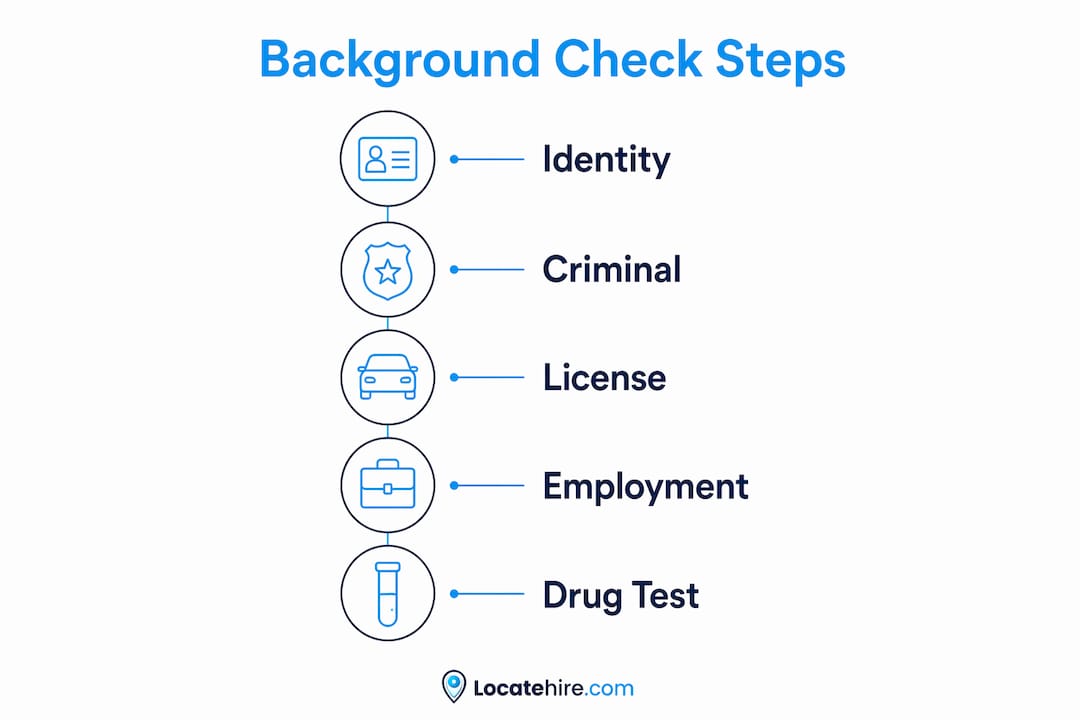
Identity and SSN trace. Confirms the candidate is who they say they are and surfaces address history to guide jurisdiction selection for criminal searches.
Employment and education verification. Confirms past employers, job titles, and credentials claimed on the application. Gaps or discrepancies in a trades resume often signal safety-relevant issues.
License and certification verification. Confirms state electrical license status, journeyman or master credentials, OSHA 10/30 cards, NCCER certifications, and contractor bond status. This is non-negotiable for any licensed trade role.
Drug and alcohol testing. Standard for safety-sensitive and vehicle-operating roles. Typically ordered pre-employment, post-incident, and as part of a random pool.
Motor vehicle records (MVR). Required for any role involving a company vehicle, bucket truck, or service van. Most employers use a three-to-five year lookback window.
Sex-offender registry and sanctions checks. Relevant for workers entering residential properties or secure government sites.
Fingerprint-based FBI checks. Required for certain federal contractor roles and utility positions that trigger NERC CIP-004 obligations. Identity proofing at this level is more rigorous than a standard SSN trace.
Role risk drives check selection. A general field technician needs a county criminal search, license verification, and drug test. A critical-access engineer working near bulk electric system cyber assets needs the full stack, including a seven-year criminal lookback and possibly fingerprinting. Understanding how background checks work in hiring helps you match the right checks to each role tier.
Why screening matters specifically for electrical and utility hires
Electrical work carries physical consequences that most industries do not. A worker who falsified credentials, is impaired on the job, or has a history of theft or violence does not just create an HR problem. They create a live-wire hazard for coworkers, customers, and the public.

Access to substations, control rooms, and fleet vehicles amplifies that risk considerably compared with a typical retail or office hire. An uncredentialed worker who gains unescorted access to a substation can trigger outages affecting thousands of customers or cause irreversible equipment damage. A driver with a poor MVR assigned to a bucket truck is a foreseeable accident waiting to happen. These are not hypothetical edge cases. They are the scenarios regulators and insurers specifically ask about when auditing utility employers.
The contractual and regulatory consequences of skipping thorough screening are real and specific. Utilities operating under NERC CIP-004 face mandatory audits. Federal contractors face debarment risk. Insurers can deny claims when an employer knew or should have known about a worker's disqualifying history. The legal doctrine of negligent hiring holds employers accountable when a foreseeable harm results from an inadequately screened worker. Thomson Reuters notes that proper screening both exposes relevant information and reduces legal exposure when done correctly.
Detailed checklist: what checks should you run for critical electrical roles?
The right checks depend on the role, but the following covers the full range hiring managers should understand and apply by tier.
- County criminal search (all roles). Start here. County searches are the most reliable primary source for criminal records in trade hiring. Run searches in every county where the candidate has lived or worked in recent years for critical-access roles.
- Seven-year criminal lookback for NERC-covered roles. NERC CIP-004 requires a minimum seven-year criminal history review before granting unescorted access to critical cyber assets. This is a hard floor, not a guideline.
- License and certification verification. Confirm the state electrical license is active and in good standing. Check journeyman or master status, OSHA 10/30 cards, NCCER credentials, and contractor bond. State licensing boards publish lookup tools. For guidance on what to collect, job posting best practices for electrical contractors can help you standardize required documents upfront.
- Drug and alcohol testing. Pre-employment testing is standard. Post-incident and random pool participation should be written into your safety policy for all safety-sensitive roles and vehicle operators.
- MVR check for drivers and operators. Use a three-to-five year lookback. Flag DUI convictions, license suspensions, and at-fault accidents. Any role involving a bucket truck, service van, or aerial lift requires this check.
- Employment verification. Confirm job titles, tenure, and reason for separation. Gaps longer than 90 days in a trades resume warrant a direct conversation.
- Education verification. Confirm trade school completion, apprenticeship program graduation, or any degree claimed on the application.
- Sanctions and sex-offender registry. Required for workers entering residential sites, federal facilities, or secure utility infrastructure.
- Fingerprint-based FBI check. Apply when the role requires deep-credential access or when a federal contract or utility directive specifically mandates it. This goes beyond a standard SSN trace and requires a credentialed channeling agency.
Pro Tip: When time or budget forces prioritization, run the license verification and county criminal search first. These two checks catch the most disqualifying findings for electrical roles and take the least time to complete.
How to run background checks legally and fairly in the U.S.
The EEOC and the FCRA set the legal floor for every employer running background checks, regardless of industry. Violating either creates liability that can dwarf the cost of the check itself.
- Provide a standalone FCRA disclosure. Before ordering any check through a consumer reporting agency, give the candidate a clear, separate document explaining that a background check will be conducted. It cannot be buried in an employment application.
- Obtain written authorization. Get signed consent before the check begins. No consent, no check. Keep this document in the candidate's file.
- Order the check post-conditional offer. Best practice is to make a conditional job offer first, then order the check. This reduces disparate-impact risk and aligns with EEOC guidance.
- Apply consistent standards. The EEOC requires that you apply the same screening criteria to all candidates for the same role, regardless of race, national origin, sex, religion, disability, or age. Inconsistent application is evidence of discrimination.
- Run an individualized assessment before adverse action. If a criminal record surfaces, do not automatically disqualify. SHRM research confirms that employers commonly give applicants a chance to explain convictions. Document the offense type, how long ago it occurred, and its relevance to the specific role.
- Send a pre-adverse action notice. Before rejecting a candidate based on a background check, send a pre-adverse notice with a copy of the report and a summary of rights. Allow a reasonable waiting period (typically five business days) for the candidate to dispute.
- Send the final adverse action notice. If you proceed with rejection, send the final notice including the reporting agency's name, address, and phone number, and confirm the candidate's right to dispute.
- Check state and local law. Ban-the-box laws, conviction-record limitation statutes, and record-sealing rules vary by state and city. Employers must verify what applies in each jurisdiction where they hire.
For surge or emergency hiring, there are no FCRA carve-outs. Regulators expect checks to be completed before access is granted, even under compressed timelines. Pre-event credentialing remains the only reliable solution.
When regulations require deeper screening: NERC CIP-004 and beyond
Not every electrical hire triggers a regulatory mandate, but utility and critical-infrastructure employers face a compliance stack that demands attention.
NERC CIP-004 applies to personnel with unescorted physical or electronic access to bulk electric system cyber assets. The standard requires a minimum seven-year criminal history lookback and mandates that checks be completed before access is granted. There are no exceptions for contractors or mutual-aid workers. Satisfying NERC CIP-004 does not substitute for FCRA compliance. Both apply simultaneously to the same hire.
- TSA security directives apply to certain pipeline and energy-sector operators and may impose additional personnel security requirements beyond NERC.
- Federal contractor requirements on federally funded grid projects often include background check clauses written into the contract itself, sometimes requiring fingerprint-based checks or specific lookback periods.
- State licensing board rules in many states require criminal history reviews as part of the electrical licensing process. Utah's Division of Occupational and Professional Licensing, for example, publishes a criminal history matrix that guides licensing decisions for electricians with prior convictions.
Practical compliance checklist for utility and critical-access roles:
- Complete all required checks before granting any unescorted access.
- Document individualized assessments for every adverse finding, including offense type, recency, and role relevance.
- Verify checks for contractors and mutual-aid workers, not just direct employees.
- Maintain audit-ready records: consent forms, check results, individualized assessment notes, and access authorization dates.
- Schedule renewals or continuous monitoring for roles with ongoing sensitive access. Continuous screening is an industry best practice for utilities because regulators audit access logs against credentialing records.
Common red flags and how to weigh them for electrical hires
Not every finding on a background check is disqualifying. The goal is a documented, consistent, role-related assessment.
- Recent violent felony. High concern for any role. Disqualifying for most critical-access positions regardless of elapsed time.
- Theft or dishonesty conviction. Directly relevant for roles with access to customer property, secure facilities, or expensive equipment. Weigh recency and pattern carefully.
- DUI or reckless driving conviction. Disqualifying for any vehicle-operating role. For non-driving roles, weigh recency and whether the candidate has completed treatment or monitoring.
- Falsified license or credential. Automatic disqualification. This is an integrity issue with direct safety implications.
- Outstanding warrants. Treat as a current legal matter requiring resolution before hire.
- Failed pre-employment drug test. Disqualifying for safety-sensitive roles under most employer policies and DOT rules where applicable.
For findings that fall into gray areas, practitioners consistently favor individualized assessments over blanket bans. Document the offense type, time elapsed since the conviction, evidence of rehabilitation (steady employment, completed certifications, letters of reference), and the specific demands of the role. When a finding involves a high-risk role or a borderline case, involve legal counsel or HR before making the final call. The EEOC's guidance is explicit: a policy that automatically excludes people with certain criminal records can constitute disparate impact discrimination if it is not job-related and consistent with business necessity.
State licensing boards sometimes provide their own guidance. Utah's electrical licensing matrix, for instance, categorizes offenses by severity and maps them to outcomes ranging from manager review to outright prohibition. That kind of structured framework is worth adapting for your own adjudication policy.
Typical timelines, costs, and logistics for ordering checks
Realistic expectations prevent credentialing delays from becoming compliance failures.
| Check Type | Typical Turnaround | Relative Cost |
|---|---|---|
| SSN trace / identity | Minutes to 1 business day | Low |
| County criminal search | 1–5 business days | Low to moderate |
| National criminal index | Minutes to 1 business day | Low |
| MVR check | 1–3 business days | Low |
| License verification | 1–3 business days | Low |
| Employment verification | 2–5 business days | Moderate |
| Drug test (urine, lab) | 1–3 business days | Moderate |
| Fingerprint / FBI check | 3–10 business days | Moderate to high |
| Continuous monitoring | Ongoing subscription | Varies by volume |
Manual verifications, court closures, and out-of-state jurisdictions are the most common sources of delay. Fingerprint-based FBI checks require a credentialed channeling agency and add time even when the candidate is cooperative.
Cost varies by depth of search, fingerprinting requirements, and whether you subscribe to continuous monitoring. Volume discounts are available from most vendors for contractors running high numbers of checks. For surge staffing scenarios, pre-credentialing known mutual-aid workers before an event is far cheaper than expedited checks under pressure.
Logistics tips to speed credentialing:
- Pre-populate identity fields in your ATS to eliminate manual data entry errors that delay orders.
- Standardize the documents candidates must submit at the offer stage (government ID, SSN card, license copy).
- Build a pre-qualified registry of mutual-aid contractors who have passed checks within the past 12 months.
Pro Tip: Pre-event credentialing is the single most effective way to avoid noncompliance during surge hiring. Run checks on your mutual-aid roster before storm season or a major project ramp, not after the call comes in.
How to choose a background-check provider for critical electrical hires
The vendor you choose determines whether your credentialing process holds up under a NERC audit or an FCRA challenge. Evaluate providers on these dimensions.
Capabilities to prioritize:
- NERC CIP-004 experience and documented case studies with utility clients
- Fingerprint channeling and FBI check access through an approved channeling agency
- Continuous monitoring options with configurable alert thresholds
- County-search depth and direct court access (not just database pulls)
- FCRA compliance support, including sample disclosure templates and adverse-action workflow documentation
- ATS integrations that allow consent capture, order triggering, and result storage without manual re-entry
- Turnaround SLAs by check type, in writing
Suggested questions to ask any vendor:
- What is your average turnaround for a county criminal search in [your primary hiring states]?
- Do you have direct court access or do you rely on third-party database aggregators?
- Can you support NERC CIP-004 credentialing, including the seven-year lookback and audit documentation?
- What is your breach response protocol and data retention policy?
- Do you hold a SOC 2 Type II attestation or equivalent security certification?
- Can you show a sample adverse-action workflow and compliance documentation package?
Vendors worth evaluating: First Advantage is a large-scale provider with global reach and a documented focus on candidate experience. Veremark specializes in credential-heavy verification workflows. National Background Check, Inc. (NBCI) serves employers who need volume services with trade-specific depth. None of these are the only options, but each brings a different strength to the table. Review employment screening methods to understand how to match vendor capabilities to your role tiers before you issue an RFP.
Red flags in vendor responses: vague turnaround commitments, no direct court access, inability to support NERC documentation, or no SOC 2 attestation.
Step-by-step screening workflow for small electrical contractors
Small hiring teams need a process that is repeatable, audit-ready, and fast enough to keep pace with project timelines. Here is a workflow that works.
Step 1: Pre-qualification. Collect license number, SSN, and government ID at the application stage. Verify the license is active before investing further time.

Step 2: Conditional offer. Extend a written conditional offer contingent on satisfactory background check results. Do not grant access before this step is complete.
Step 3: FCRA disclosure and consent. Deliver the standalone disclosure document and collect signed authorization. Store both in the candidate's digital file.
Step 4: Order checks by role tier.
- General field technician: county criminal search, license verification, drug test.
- Driver or equipment operator: add MVR check and employment verification.
- Critical-access engineer or substation worker: full stack including seven-year lookback, national criminal index, sanctions check, and fingerprint-based check if required.
Step 5: Record results and flag findings. Log results in your ATS as they arrive. Flag any adverse finding for individualized assessment before proceeding.
Step 6: Individualized assessment. For any flagged finding, document offense type, recency, role relevance, and rehabilitation evidence. Involve legal counsel for high-risk roles.
Step 7: Access authorization. Grant unescorted access only after all required checks are complete and documented. Never grant access provisionally pending results.
ATS integration tips:
- Use Locatehire to pre-populate identity fields from the application, eliminating re-entry errors when triggering vendor orders.
- Set automated reminders for re-screening intervals (typically annual for critical-access roles).
- Maintain a pre-qualified registry of mutual-aid contractors with check dates and expiration flags.
A small contractor managing a utility restoration crew avoided a compliance failure during a post-storm surge by maintaining a pre-qualified roster of 40 mutual-aid workers. When the call came in at 6 AM, 38 of those workers had current credentials on file. The two who did not were held from unescorted access until checks cleared the following day. That preparation, not speed, kept the contractor compliant and on-site.
Key Takeaways
Background checks are not optional for critical electrical hires. Completing them before access is granted is the single most important compliance step an employer can take.
| Point | Details |
|---|---|
| Complete checks before access | NERC CIP-004 and FCRA both require checks to be finished before granting unescorted access to critical roles. |
| Seven-year lookback for critical roles | Any position with access to bulk electric system cyber assets requires a minimum seven-year criminal history review. |
| Individualized assessments reduce legal risk | Document offense type, recency, and role relevance before taking adverse action to satisfy EEOC guidance and reduce disparate-impact exposure. |
| Pre-event credentialing prevents surge failures | Building a pre-qualified roster before storm season or project ramps keeps you compliant when timelines compress. |
| Locatehire supports the full workflow | Locatehire's ATS pre-populates identity fields, stores consent documents, triggers vendor orders, and tracks re-screening intervals for audit-ready records. |
The part most small contractors get wrong
Most hiring guides treat background checks as a one-time box to check. The electrical industry does not work that way, and the compliance frameworks that govern it reflect that reality.
The gap between what small contractors think they need and what regulators actually audit is wider than most hiring managers realize. A county criminal search run at hire is a starting point, not a complete program. NERC CIP-004 auditors look at access logs and compare them against credentialing records. If a worker's check expired and no renewal was ordered, that is a finding. If a mutual-aid worker was granted unescorted access before their check cleared, that is a finding. These are not technicalities. They are the specific scenarios that generate fines and contract losses.
The other common mistake is treating individualized assessments as optional paperwork. They are not. An employer who automatically disqualifies every applicant with a conviction record is exposed to disparate-impact claims under EEOC guidance. An employer who documents nothing is exposed to negligent-hiring claims when something goes wrong. The documentation is the defense.
Speed and compliance are not opposites. Pre-credentialing, a clear adjudication policy, and an ATS that tracks check status turn a chaotic surge-hiring moment into a manageable process. The contractors who struggle are the ones who build the process after the project starts.
Locatehire makes background check compliance easier for electrical contractors
Running background checks for electrical hires involves multiple moving parts: consent documents, vendor orders, license verifications, re-screening reminders, and audit logs. Locatehire's ATS is built to handle exactly this kind of ongoing, compliance-sensitive hiring for small businesses in electrical, HVAC, plumbing, and related trades.
With Locatehire, you can pre-populate candidate identity fields directly from the application, eliminating the manual re-entry errors that delay vendor orders. Consent documents are stored digitally and tied to each candidate record. Vendor check triggers, re-screening reminders, and pre-qualified contractor registries are all managed in one place, so your team spends less time chasing paperwork and more time making good hires. When an auditor asks for credentialing records, everything is already organized and ready.
Start with Locatehire to see how the platform fits your electrical hiring workflow.
Useful sources and further reading
- NERC CIP-004: The full standard is available through the North American Electric Reliability Corporation. It defines personnel risk assessment requirements, the seven-year lookback, and access authorization rules for bulk electric system cyber assets.
- FCRA employer guidance: The Federal Trade Commission publishes employer guidance on using consumer reports, including disclosure, consent, and adverse-action requirements.
- EEOC background check guidance: The EEOC's employer guide covers nondiscrimination requirements, individualized assessments, and disparate-impact considerations.
- SHRM background check research: SHRM's practitioner report on background checks covers criminal-history check prevalence and individualized assessment practices.
- Thomson Reuters employer guide: Thomson Reuters covers negligent-hiring risk and what employers need to know about screening.
- First Advantage employer guide: First Advantage covers check components, candidate experience, and lifecycle screening.
- Utility workforce compliance: Utility workforce hiring compliance explains NERC, FCRA, and surge-hiring obligations in practical terms.
- Trades background check practices: Verified Credentials covers which checks are most common for electricians and other trades workers.
- Utah electrical criminal history matrix: The Utah Division of Occupational and Professional Licensing publishes a structured matrix for evaluating criminal history in electrical licensing decisions.
- ARC Electrical industry solutions: For electrical contractors looking at broader operational and digital solutions, ARC Electrical offers a reference point for industry-specific business approaches.