

Electrical companies use temp agencies as a direct solution to one of the industry's oldest problems: project demand never arrives on a predictable schedule. A commercial build-out lands in june, a utility upgrade gets fast-tracked in september, and your permanent crew is already committed. Temp agencies solve this by maintaining pools of pre-screened, licensed electricians ready for short-notice deployment. The result is workforce flexibility without the overhead of permanent headcount. For electrical company owners managing project-based work, understanding why electrical companies use temp agencies is the difference between hitting deadlines and losing contracts.
Why electrical companies use temp agencies for rapid scaling
The core reason electrical firms turn to agencies is speed. Agencies reduce deployment time from months to days, giving you immediate labor capacity when an urgent project lands. A traditional hire takes weeks of posting, screening, interviewing, and onboarding. An agency call can put a licensed journeyman on your job site by Monday morning.

Seasonal demand makes this even more critical. Summer construction surges, post-storm restoration work, and year-end commercial buildouts all create short windows where you need bodies fast. Permanent staff cannot absorb those spikes without creating expensive idle time in the off-season.
The specific situations where agency speed pays off include:
- Surge staffing for large commercial projects where your core crew lacks the headcount to meet the schedule
- Emergency restoration work after weather events, where delays cost client relationships
- Short-term specialty needs like high-voltage panel work or industrial control wiring that your current team does not cover
- Seasonal residential demand in markets with strong summer or winter construction cycles
Supplemental staffing has become a structural part of workforce planning in energy and industrial sectors. That shift reflects a real change in how electrical work gets done. Projects are cyclical, clients expect fast mobilization, and internal HR teams at small firms simply cannot recruit fast enough to keep pace.
Pro Tip: Engage your agency before demand peaks, not after. Building a pre-vetted pipeline of electricians means you are selecting from qualified candidates instead of taking whoever is available at the last minute.
HVAC companies face the same seasonal staffing pressure. The strategies for hiring seasonal workers in that sector translate directly to electrical firms managing cyclical demand.
What are the real cost advantages of temp staffing?
The financial case for temp agencies goes beyond just avoiding a bad hire. Temporary staffing helps electrical firms avoid unemployment tax rate increases and benefit costs tied to permanent employees. When you lay off a direct hire, your state unemployment tax rate can rise. Temp workers are employees of the agency, so that liability stays off your books.
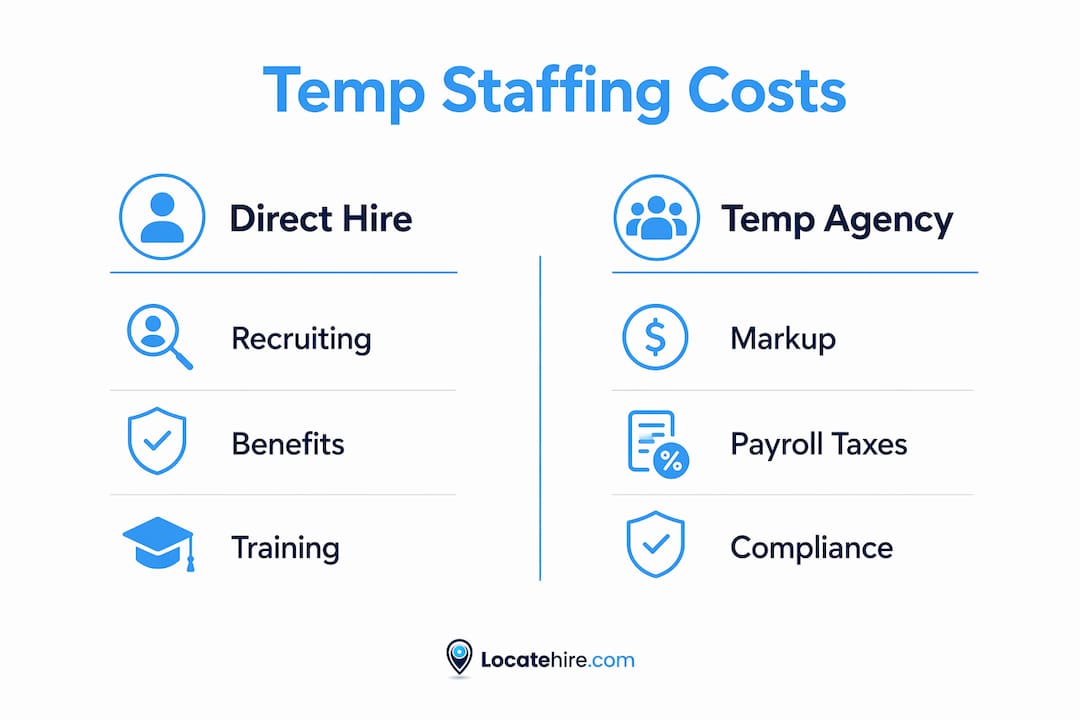
The cost comparison between direct hires and temp staffing depends heavily on project length and volume. The table below breaks down the key cost factors:
| Cost factor | Direct hire | Temp agency worker |
|---|---|---|
| Recruiting and advertising | Paid by employer | Covered by agency |
| Payroll taxes and compliance | Employer responsibility | Agency responsibility |
| Benefits (health, PTO, retirement) | Employer provides | Agency provides |
| Unemployment tax exposure | Employer absorbs | Agency absorbs |
| Agency markup | None | Typically added to bill rate |
| Long-term commitment | Required | None |
The agency markup is the tradeoff. For short-term work, the markup is worth it because you avoid benefits, recruiting costs, and unemployment exposure. Extended reliance on temp labor becomes more expensive than direct hires on long-duration projects. The break-even point varies by market and trade, but most electrical contractors find that projects running longer than six months favor direct hire economics.
Temp-to-hire is the middle path. You bring someone on through the agency, assess their work over 60 to 90 days, and convert them to permanent staff if they perform. Temp-to-hire acts as a working interview, letting you evaluate skills, attendance, and culture fit before making a long-term commitment. That evaluation period dramatically reduces the cost of a bad hire.
Pro Tip: Track your agency spend by project type. If you consistently use temps for the same category of work, that is a signal to either hire permanently for that skill set or negotiate a volume rate with your agency.
How do temp agencies handle safety and compliance?
Safety compliance is where electrical contractors sometimes get tripped up with temp staffing. Agencies verify licenses and manage payroll compliance, but the client company retains responsibility for site-specific safety training and regulatory adherence. That distinction matters enormously on a job site.
The division of responsibility works like this:
- The agency verifies that the worker holds a valid electrician's license and meets general employment compliance requirements.
- The agency handles payroll taxes, workers' compensation coverage, and federal employment law compliance.
- You are responsible for site-specific OSHA orientations, hazard communication, and any project-specific safety protocols.
- You must verify that the worker's license matches your local jurisdiction's requirements. A license valid in one state may not cover work in another.
- You conduct any equipment-specific training required for your job site, regardless of the worker's general experience level.
Agency staffing does not replace client safety protocols. Rushing a temp onto a live panel without a proper site orientation creates liability that no agency agreement will shield you from. The speed benefit of temp staffing only holds value if the worker is set up to work safely from day one.
Matching certifications to local jurisdiction requirements is a detail that catches managers off guard. Always confirm with your agency that the worker's credentials are valid in your specific municipality or state before they set foot on site.
When should you transition from temp workers to direct hires?
The temp agency model works best as a complement to your permanent workforce, not a replacement for it. Discerning managers plan transitions to permanent staff carefully, especially when projects extend beyond initial timelines.
The right time to shift toward direct hires depends on several factors:
- Project duration over six months typically makes direct hire more cost-effective once you account for agency markup accumulating over time
- Recurring skill needs that show up on every project signal a gap in your permanent team that a direct hire fills more efficiently
- High-performing temp workers who have demonstrated reliability, technical skill, and cultural fit are strong candidates for conversion
- Workforce continuity requirements on complex multi-phase projects, where institutional knowledge of the site becomes a genuine asset
- Client relationships that depend on consistent crew composition, where rotating temps creates friction
Companies increasingly lack internal HR structures to manage contract labor effectively, which makes the agency relationship valuable even when you are moving toward permanent hires. A good agency will support temp-to-hire conversions and help you manage the transition without losing momentum on active projects.
The worst outcome is becoming entirely dependent on agency labor for core functions. That creates a situation where your bill rate costs are permanently elevated and you have no workforce stability. The goal is a core permanent team that handles your baseline workload, with agency relationships that let you scale up quickly when demand spikes.
Pro Tip: When you identify a temp worker you want to convert, start the conversation with your agency early. Most agreements include a conversion fee or a required hours threshold before you can hire directly. Knowing those terms upfront prevents surprises.
Key Takeaways
Electrical companies that use temp agencies strategically gain workforce flexibility, cost control, and compliance support that permanent hiring alone cannot provide.
| Point | Details |
|---|---|
| Speed is the primary driver | Agencies deploy licensed electricians in days, not weeks, keeping projects on schedule. |
| Cost savings depend on project length | Temp staffing saves money on short projects; direct hires become more economical after roughly six months. |
| Safety compliance stays with you | Agencies verify credentials, but site-specific training and jurisdiction checks remain your responsibility. |
| Temp-to-hire reduces bad hire risk | A 60–90 day working interview lets you assess skills and fit before making a permanent offer. |
| Plan transitions before you need them | Identify conversion candidates early and know your agency's temp-to-hire terms before demand forces a rushed decision. |
What I've learned from watching electrical firms staff up and stumble
The managers who get the most out of temp agencies treat them like a standing relationship, not an emergency contact. I have watched electrical contractors call an agency the week a project breaks ground and then complain about the quality of workers they receive. That is not an agency problem. That is a planning problem.
The firms that consistently get strong results engage their agency at the bid stage. They share project timelines, skill requirements, and anticipated headcount before the contract is even signed. By the time the project starts, the agency has already identified qualified candidates. The difference in worker quality is noticeable.
The other mistake I see regularly is ignoring the safety handoff. Managers assume that because the agency sent a licensed electrician, the site orientation is optional. Rushing hires without proper screening causes project delays and safety incidents that cost far more than the time saved. A 30-minute site orientation is not a bureaucratic formality. It is the moment you confirm the worker understands your specific hazards, your lockout/tagout procedures, and your chain of command.
Temp agencies are a genuine operational tool for electrical companies. They work best when you treat them as a workforce partner rather than a last resort. Build the relationship before you need it, communicate your standards clearly, and plan your transitions deliberately. The flexibility they provide is real. So is the cost if you use them carelessly.
— Jeff
How Locatehire supports electrical staffing decisions
Managing temp agency relationships alongside your permanent hiring process creates a real administrative load. Locatehire is an applicant tracking system built specifically for small businesses with ongoing hiring needs, including electrical contractors who move between temp and direct hire depending on project demands.
Locatehire keeps your hiring pipeline organized whether you are converting a temp worker to permanent staff or posting a direct hire role to fill a recurring skill gap. You can track candidates, manage applications, and maintain records without juggling spreadsheets or losing track of where each candidate stands. For electrical companies that want to manage their hiring process without adding administrative overhead, Locatehire provides the structure to do it efficiently. The platform is built for the way trades businesses actually hire, not for enterprise HR departments.
FAQ
Why do electrical companies prefer temp agencies over direct hiring?
Temp agencies provide licensed electricians within days, which direct hiring cannot match for urgent or seasonal projects. The speed advantage is the primary reason electrical firms use agencies for short-term labor needs.
What costs do temp agencies cover for electrical contractors?
Agencies handle payroll taxes, workers' compensation, benefits, and unemployment tax liability for temp workers. The electrical company pays a bill rate that includes the worker's wage plus the agency's markup.
Who is responsible for safety training when using temp electricians?
The client company is responsible for site-specific safety orientations, OSHA compliance, and verifying that the worker's license meets local jurisdiction requirements. Agencies verify credentials but do not conduct job-site safety training.
What is temp-to-hire and how does it work for electrical firms?
Temp-to-hire places a worker through the agency for a set period, typically 60–90 days, before the client company makes a permanent offer. This model lets you assess skills and fit before committing to a long-term hire.
When does direct hiring make more financial sense than using a temp agency?
Direct hiring becomes more cost-effective when a role is needed for more than six months and the agency markup accumulates beyond the savings on benefits and recruiting. Long-term projects favor direct hires once the break-even point on agency costs is reached.