

HVAC workforce development, the industry term for the full cycle of recruiting, training, and retaining skilled technicians, is the defining operational challenge for HVAC companies right now. The HVAC industry faces a shortage of 110,000 technicians nationally, with 40,000 job openings projected annually through 2030. Understanding how HVAC companies compete for talent means going beyond job postings. It requires competitive total compensation, visible career paths, proactive candidate engagement, and a workplace culture that gives skilled technicians a reason to stay.
How HVAC companies compete for talent through compensation
Compensation is the first filter every HVAC technician applies. Get it wrong and no amount of culture or career development will close the gap. Wages have risen 16% year over year, with entry-level technicians now earning $26–$32 per hour and lead technicians commanding $38–$52 per hour. That shift means companies still benchmarking against national medians are already behind local market rates.
The right approach is local wage benchmarking. Pull data from regional job boards, trade associations, and direct competitor offers. A company in Phoenix competing against a national HVAC franchise cannot use Bureau of Labor Statistics averages as its reference point. It needs to know what the franchise down the street is paying today.
Total compensation matters more than base pay alone. Focusing solely on base pay is a mistake. Benefits including health insurance, retirement matching, and profit sharing are decisive factors for experienced technicians weighing two similar offers. Companies that add these layers to a competitive hourly rate build a package that is genuinely hard to walk away from.
The table below shows typical wage bands and bonus structures across HVAC career levels in 2026.
| Role | Hourly wage range | Retention bonus range |
|---|---|---|
| Apprentice | $18–$24 | Not typically offered |
| Entry-level technician | $26–$32 | $1,000–$3,000 |
| Journeyman technician | $32–$38 | $3,000–$7,000 |
| Lead technician | $38–$52 | $5,000–$10,000 |
| Supervisor | $52+ | Negotiated individually |
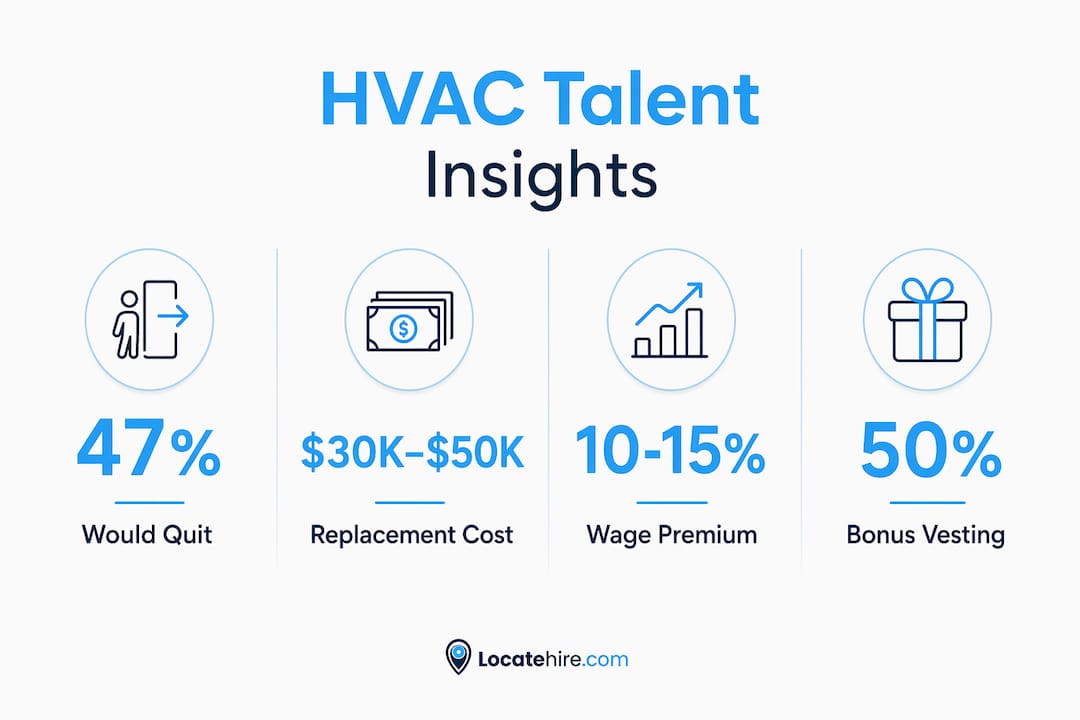
Retention bonuses of $5,000–$10,000 are cost-effective compared to replacement costs that exceed $30,000. That math is straightforward. A retention bonus paid once is far cheaper than a full replacement cycle paid repeatedly.
Pro Tip: Structure retention bonuses with a vesting schedule, such as 50% at six months and 50% at twelve months. This creates a financial incentive to stay through the critical first year when new hires are most likely to leave.
How can HVAC companies build career development pathways?
47% of operational HVAC talent would quit without a clear learning and development roadmap. That number reflects a workforce that wants to grow, not just work. A written career path from apprentice to lead technician to supervisor gives candidates a concrete reason to choose your company over a competitor offering the same hourly rate.
Career development in HVAC is not abstract. It maps directly to certifications, skill assessments, and pay increases. A technician who earns an EPA 608 certification or completes a NATE exam should see that achievement reflected in their compensation and job title. When that connection is visible and documented, technicians understand that growth is real, not a promise made during the interview.
Apprenticeship programs are one of the most effective tools for building this pipeline internally. Companies that partner with local trade schools or community colleges to sponsor apprentices gain a steady flow of candidates who are already trained to their standards. The investment pays off in lower turnover and stronger team cohesion.
The following practices define a strong career development program for HVAC companies:
- Publish a written career ladder with specific milestones, certifications, and corresponding pay increases
- Conduct quarterly development check-ins rather than annual reviews
- Reimburse NATE, EPA 608, and manufacturer-specific certifications
- Promote from within before posting external job listings
- Assign senior technicians as mentors to apprentices and new hires
Pro Tip: Share your career ladder during the interview, not after the hire. Candidates who see a clear path to $50 per hour are far more likely to accept your offer and stay long enough to reach it.
What modern recruitment strategies do HVAC companies use?
Experienced HVAC technicians rarely respond to job postings. Success relies on relationship-building and competitor poaching. That reality forces a shift in how HR managers think about recruiting. Passive methods like posting on Indeed and waiting for applications do not fill trucks. Active, relationship-driven outreach does.

The speed of your response to a candidate matters as much as the offer itself. HVAC companies lose candidates due to slow, passive hiring methods. Most technicians prefer rapid outreach via phone or text, not email. A candidate who applies on a Tuesday and hears back on Friday has likely already accepted another offer. A speed-to-lead mindset, where you contact new applicants within hours, not days, is a competitive advantage.
Building a candidate pipeline before you have an opening is the most underused tactic in HVAC hiring. Treat recruiting as an ongoing relationship-building process. Engage potential hires before openings arise. This shortens hiring cycles and prevents the costly rush that leads to poor decisions.
The following steps define a modern HVAC recruitment approach:
- Identify technicians at competitor companies through LinkedIn, supply house conversations, and industry events
- Build genuine rapport over weeks or months before making any offer
- Contact new applicants by phone or text within four hours of application
- Ask candidates directly how they prefer to communicate and how urgently they are looking
- Attend trade school career fairs and veterans' transition programs to build early relationships
- Use social media, particularly Facebook and Instagram, to showcase your team culture and job openings
Paying 10–15% above current wages plus better benefits and career paths successfully attracts technicians from competitors. That premium is not a giveaway. It is a calculated investment in avoiding the far higher cost of an empty truck during peak season.
How does company culture influence HVAC talent retention?
Company culture and flexible, predictable schedules are decisive factors in retaining HVAC employees. Nearly half the labor force prioritizes work-life balance. A technician who earns $45 per hour but works unpredictable 60-hour weeks will leave for a competitor paying $42 per hour with consistent scheduling.
Poor culture is a hidden driver of turnover that compensation alone cannot fix. A single toxic hire in a small team can trigger a chain of resignations. HR managers who move quickly to address behavioral problems protect the morale of the entire crew. Ignoring a culture problem to avoid a difficult conversation is always more expensive in the long run.
Meaningful recognition does not require large budgets. The following practices build a culture that retains skilled technicians:
- Recognize top performers publicly in team meetings and company communications
- Give technicians ownership over their service routes or specialty areas
- Offer flexible scheduling options, including four-day work weeks where operationally feasible
- Solicit feedback from technicians on equipment, processes, and scheduling
- Create clear policies on overtime so technicians can plan their personal lives
A positive culture also strengthens your employer brand. Technicians talk to each other at supply houses, trade events, and online forums. A company known for treating its people well attracts inbound interest without spending a dollar on job postings. That reputation is built one interaction at a time.
What are the costs of losing HVAC technicians?
Replacing a journeyman HVAC technician costs $30,000–$50,000 including recruiting, training, and lost productivity. That figure does not include the revenue lost from an empty service truck during peak cooling or heating season. A single unfilled role in july or august can cost a small HVAC company tens of thousands in missed service calls.
35% of contractors cite labor shortages and rising overhead as their top business risks in 2026. That concern is well-founded. The financial case for proactive hiring is clear.
The risks of poor talent competition compound quickly:
- Empty trucks during peak season generate zero revenue while fixed costs continue
- Rush hires made under pressure often fail culture-fit standards and leave within 90 days
- Paying outside established pay tiers to fill a role urgently creates internal pay equity problems
- Delayed hiring decisions signal disorganization to candidates and damage your employer brand
Building a talent bench shortens hiring cycles and prevents costly empty truck days. The companies that win the talent competition are the ones that treat recruiting as a year-round function, not a reaction to a resignation. A structured hiring process built before the need arises is the single most cost-effective investment an HVAC HR manager can make.
Key Takeaways
HVAC companies that win the talent competition combine competitive local compensation, written career paths, proactive relationship-based recruiting, and a culture that gives skilled technicians a reason to stay.
| Point | Details |
|---|---|
| Benchmark wages locally | National medians lag behind local market rates; use regional data to set competitive pay bands. |
| Use retention bonuses | A $5,000–$10,000 retention bonus costs far less than the $30,000–$50,000 to replace a journeyman. |
| Publish career paths | 47% of HVAC talent would quit without a clear development roadmap; share it during the interview. |
| Recruit before you need to | Build a talent bench year-round to avoid rush hires and empty trucks during peak season. |
| Protect your culture | Flexible schedules and meaningful recognition retain technicians that competitive pay alone cannot keep. |
The tactic most HVAC companies skip entirely
The most common mistake I see HR managers make is treating HVAC recruiting as a transactional event. A position opens, a job post goes up, and the team waits. That approach worked in 2010. It does not work now.
The companies I have seen win consistently are the ones that never stop recruiting. Their hiring managers are at supply houses, at trade school events, and in online technician communities. They know who the top performers are at competitor companies before those technicians are even thinking about leaving. When a resignation happens, they have three names ready to call.
The second mistake is confusing urgency with speed. Moving fast to contact a candidate is right. Moving fast to hire someone who does not fit your culture is wrong. A bad hire on a small team does more damage than an empty truck for two weeks. The discipline to say no to a technically qualified candidate who will poison your team culture is one of the hardest and most valuable skills in HVAC talent acquisition.
Technology like AI-powered applicant tracking can accelerate sourcing and screening. It surfaces candidates faster and reduces administrative load. But it cannot replace the judgment call on culture fit, and it cannot build the in-person relationship that convinces a competitor's best technician to take your call. Use the tools. Trust your instincts on the people.
— Jeff
Locatehire helps HVAC companies hire faster and smarter
Hiring skilled HVAC technicians is a year-round job, and managing that process manually creates gaps. Locatehire is an applicant tracking system built for small businesses with ongoing hiring needs, including HVAC, electrical, plumbing, and other skilled trades.
Locatehire uses AI to accelerate candidate sourcing and screening, so your team spends less time sorting applications and more time talking to qualified technicians. The platform keeps your talent pipeline active between openings, which is exactly the always-on recruiting approach that separates companies that fill trucks quickly from those that scramble every summer. If you want to build a hiring process that works before the next resignation lands on your desk, Locatehire is built for that.
FAQ
What is the biggest reason HVAC companies lose new hires?
New hires most often leave because of unclear career paths, poor culture fit, or compensation that does not match local market rates. Addressing all three during onboarding reduces early turnover significantly.
How much does it cost to replace an HVAC technician?
Replacing a journeyman HVAC technician costs $30,000–$50,000 when you factor in recruiting, training, and lost productivity. That figure makes retention bonuses of $5,000–$10,000 a clear financial win.
What is the fastest way to find qualified HVAC technicians?
Phone and text outreach within hours of application, combined with ongoing relationships built at trade schools and supply houses, produces faster hires than job postings alone.
Why do experienced HVAC technicians ignore job postings?
Experienced technicians are typically employed and not actively searching. Reaching them requires direct outreach, in-person rapport, and an offer that includes better pay, benefits, and career growth than their current employer provides.
How does company culture affect HVAC retention?
Nearly half the HVAC workforce prioritizes work-life balance over maximum pay. Companies with predictable schedules, genuine recognition, and low internal conflict retain technicians even when competitors offer slightly higher wages.