

Every electrical company manager needs one thing before the next project kicks off: a clear picture of who you have, what they're certified for, and where the gaps are. This electrical company workforce planning checklist gives you that picture in a format you can use today. Copy it, print it, or paste it into your next team meeting.
Your minimum-viable workforce readiness checklist:
| Checklist Item | Owner | Lookahead Window |
|---|---|---|
| Verify current roster: skills, certifications, travel willingness | HR Manager | Weekly |
| Confirm certification expiry dates (journeyman license, OSHA 10/30, arc flash) | Safety Officer | Monthly |
| Run a 6–24 month demand forecast against confirmed and probable projects | Operations Manager | Monthly/Quarterly |
| Conduct gap analysis by skill tier and geography | HR + Operations | Monthly |
| Activate recruitment sourcing plan with budget approval | HR Manager | 4–12 weeks |
| Review apprentice intake capacity and sponsor new cohort if ratio allows | Operations Manager | Quarterly |
| Schedule training and certification renewals | Safety Officer | 6–12 weeks |
| Confirm dispatch rules and on-call rotation | Field Supervisor | Weekly |
| Update contingency staffing plan (temp agencies, bench list) | HR Manager | Monthly |
| Review KPIs: time-to-fill, turnover rate, cost-per-hire | HR + Leadership | Monthly |

The most common failure point is not the checklist itself. It's the absence of a named owner and a calendar date. Assign both before you close this page.
Table of Contents
- Why systematic workforce planning matters for electrical contractors
- What workforce planning covers for an electrical company
- Step-by-step electrical workforce planning checklist
- How to run the checklist at your company
- Research-backed metrics and operational pillars for electrical contractors
- Key Takeaways
- What actually makes workforce planning stick
- Hiring faster for electrical roles starts here
- Authority sources and quick references
Why systematic workforce planning matters for electrical contractors
Reactive hiring costs more than planned hiring. When a project ramps faster than expected and you're scrambling to find a journeyman two weeks before mobilization, you're paying premium wages, rushing background checks, and compressing onboarding. That margin erosion compounds across a project.
The structural pressure is real. Licensed electricians retire each year while apprenticeship programs add new journeymen at varying rates, creating a persistent supply gap that pushes wages up and time-to-fill out. BLS projections indicate that electrician employment is expected to grow faster than average, but the supply pipeline is not keeping pace with that demand signal. Contractors who plan several months out are positioned to absorb that pressure. Those who don't are bidding projects against labor they don't have.
Poor planning creates specific, measurable business risks:
- Change orders and project compression when understaffing forces schedule renegotiation
- Unplanned overtime costs that erode project margins
- Compliance exposure when certifications lapse and an inspector flags the crew
- Turnover acceleration when journeymen are overloaded because apprentice ratios are off
Pro Tip: Treat workforce planning as a continuous discipline, not a pre-bid task. Document your assumptions in writing, including which projects are "probable" versus "confirmed," and review them monthly. As NECA's 2025 labor planning research puts it: "Plans are worthless, but planning is everything."
What workforce planning covers for an electrical company
Workforce planning in an electrical firm is not just a headcount spreadsheet. It spans four operational pillars: roster management, demand forecasting, scheduling, and communication. Each pillar requires different data inputs and a different owner.
| Pillar | Core Data Inputs | Primary Owner |
|---|---|---|
| Roster management | Skills inventory, certifications, availability, travel willingness | HR Manager |
| Demand forecasting | Project pipeline, bid calendar, historical crew hours per project type | Operations Manager |
| Scheduling | Crew availability, project start dates, geographic zones | Field Supervisor |
| Communication | Meeting cadences, escalation rules, change notifications | Operations Manager |
Gathering this data before you run the checklist is the prerequisite step most managers skip. If your roster data lives in three different spreadsheets and your certification records are in a filing cabinet, the checklist will surface gaps you can't act on quickly. Centralize the data first, even if that means a single shared spreadsheet to start.
Step-by-step electrical workforce planning checklist
This is the complete checklist. Work through it in order. Each step has an owner, a timing window, and a practical note.
1. Verify the current roster Confirm every employee's active certifications (journeyman license, OSHA 10/30, arc flash, NFPA 70E), skill tier, and willingness to travel or work overtime. Flag anyone within 90 days of a certification expiry. Owner: HR Manager | Timing: Monthly
2. Run a 6–24 month demand forecast Pull your confirmed project backlog and probable bids. Estimate crew hours by project type and map them against your current headcount. A 6–24 month lookahead report is the practical breakpoint: short enough to act on, long enough to budget apprenticeships and inform bidding decisions. Owner: Operations Manager | Timing: Monthly, updated quarterly
3. Conduct a gap analysis Compare forecasted demand against available supply by skill tier and geography. Identify where you're short journeymen, where apprentice years don't cover the work, and which certifications are missing for specific project types. Owner: HR + Operations Manager | Timing: Monthly
4. Build a recruitment sourcing plan Define your channels: employee referrals, IBEW hall, job boards, and temp agencies for electrical contractors for surge coverage. Employee referrals outperform paid boards on hire-to-retain metrics and often close 4–8x better. Referral bonuses for electricians commonly range $1,000–$2,500 with staged payouts. Budget for this before you post. Owner: HR Manager | Timing: 4–12 weeks before need date
5. Review apprentice intake capacity Before sponsoring a new apprentice cohort, confirm your supervisory bandwidth. Training and formation capacity limit how many apprentices a contractor can sponsor. The operational sweet spot is 1 apprentice per 2 journeymen until the apprentice reaches year 3. Maintain a rolling pipeline with apprentices in years 1–4 simultaneously so someone graduates roughly every year. Owner: Operations Manager | Timing: Quarterly
6. Schedule training and certification renewals Map every expiring certification to a renewal course and calendar date. OSHA 10 renewals, arc flash recertification, and state journeyman license renewals all have lead times. Build a 90-day alert into your tracking system. Owner: Safety Officer | Timing: 6–12 weeks before expiry
7. Confirm dispatch rules and shift design Define how crews are assigned to projects: by geography, skill tier, or seniority. Document on-call rotation rules and emergency dispatch protocols. Ambiguity here causes field conflicts and overtime disputes. Owner: Field Supervisor | Timing: Weekly review
8. Activate a contingency staffing plan Maintain a bench list of pre-screened candidates and a relationship with at least one temp agency. Define the trigger conditions: what project load or attrition rate activates the contingency plan? Owner: HR Manager | Timing: Monthly review
9. Set KPI and reporting cadence Track time-to-fill, cost-per-hire, turnover rate, and actual vs. planned hours per project. Review monthly at minimum. Owner: HR + Leadership | Timing: Monthly
Role-owner summary:
| Step | Responsible Role |
|---|---|
| Roster verification | HR Manager |
| Demand forecast | Operations Manager |
| Gap analysis | HR + Operations Manager |
| Recruitment plan | HR Manager |
| Apprentice intake | Operations Manager |
| Certification scheduling | Safety Officer |
| Dispatch rules | Field Supervisor |
| Contingency plan | HR Manager |
| KPI reporting | HR + Leadership |
Cost benchmarks to budget: A journeyman hire typically carries recruiting costs of $1,000–$2,500 in referral bonuses alone, plus job board fees and onboarding time. Certification renewals for OSHA 30 run roughly $150–$250 per employee. Factor both into your annual workforce budget.
Pro Tip: Consider a small teaching bonus ($200–$500) for journeymen who actively mentor apprentices. It reduces trainer burnout and improves apprentice retention. Document it in your compensation policy so it's applied consistently.
How to run the checklist at your company
Pick one owner. That person schedules the meetings, distributes the checklist, and holds the team accountable to completion dates. Without a named owner, the checklist becomes a document that gets reviewed once and filed.
Suggested meeting cadences:
- Daily huddle (10 minutes): Field supervisor + crew leads. Covers dispatch, safety, and same-day schedule changes.
- Weekly planning meeting (30–45 minutes): Operations manager + field supervisors. Reviews upcoming project starts, crew assignments, and open positions.
- Monthly workforce review (60 minutes): HR + operations manager + leadership. Runs the full checklist, reviews KPIs, and updates the demand forecast.
- Quarterly strategic planning (2–3 hours): Leadership + HR. Reviews the 6–24 month forecast, apprentice pipeline, succession planning, and compensation benchmarks.
Templates to establish:
- SOP for apprentice sponsorship (eligibility criteria, JATC enrollment steps, supervisor assignment)
- Hiring channel scorecard (cost-per-hire, time-to-fill, and 90-day retention rate by channel)
- Onboarding checklist (day 1 paperwork, safety orientation, tool assignment, buddy assignment)
- Certification expiry calendar (shared, updated monthly)
For software, track skills, certification expiry dates, and candidate availability in a single system. An applicant tracking system that integrates with your payroll or ERP reduces duplicate data entry and surfaces expiry alerts automatically. Evaluate whether your current tools share data or require manual re-entry between systems.
"Workforce planning must be treated as strategic business planning: assess people, processes, and support before hiring to avoid chaotic intake that doesn't scale." — CEWD Workforce Planning Overview
Pro Tip: Send the monthly workforce review agenda 48 hours in advance with the updated roster and forecast attached. Managers who arrive prepared cut meeting time in half and make better decisions.
Research-backed metrics and operational pillars for electrical contractors
The four core operational pillars validated by industry research are roster, forecasting, scheduling, and communication. Firms that manage all four systematically protect margins and win better bids. Those that manage only one or two tend to operate reactively.
Metrics to monitor:
| Metric | Target Range / Benchmark | Why It Matters |
|---|---|---|
| Lookahead horizon | 6–24 months | Enables apprenticeship budgeting and bid decisions |
| Apprentice-to-journeyman ratio | 1:2 (until apprentice year 3) | Prevents trainer overload and productivity loss |
| Annual turnover rate | Track vs. prior year | Leading indicator of compensation or culture issues |
| Time-to-fill (journeyman) | Track by channel | Identifies which sourcing channels perform |
| Cost-per-hire | Track by channel | Informs referral bonus vs. board spend decisions |
| Certification compliance rate | — | Compliance and safety floor |
Approximately 25% of craft electricians are in the 55+ age bracket, meaning retirement-driven attrition is already accelerating. A five-year apprenticeship cycle means today's enrollment decisions determine your 2030 journeyman supply. Contractors who are not actively sponsoring apprentices now are already behind.
Spreadsheets and whiteboards fail as single points of truth because they don't alert you when a certification expires, don't connect to your project pipeline, and don't surface conflicts between crew availability and project start dates. Workforce management tools that forecast demand 2+ years out and monitor actual vs. planned hours give operations managers the visibility to protect margins before a project goes over budget.
SOP template outline for workforce planning:
- Document assumptions: List which projects are confirmed, probable, and speculative. Date the document.
- Define escalation rules: Who is notified when a gap exceeds X headcount or a certification lapses?
- Assign sign-off authority: Who approves a new hire requisition? Who approves a training spend?
- Set review triggers: What events (new bid, unexpected resignation, project acceleration) trigger an off-cycle review?
For trade staff recruitment best practices that complement your SOP, including trade-specific candidate assessment frameworks, external resources from recruitment specialists in the trades can supplement your internal process.
Key Takeaways
A systematic electrical company workforce planning checklist reduces reactive hiring, protects project margins, and keeps certifications current by assigning named owners and fixed review cadences to every planning task.
| Point | Details |
|---|---|
| Assign named owners | Every checklist item needs a specific role accountable for completion and a calendar date. |
| Run a 6–24 month lookahead | Forecast demand against your project pipeline monthly to budget apprenticeships and inform bids. |
| Maintain a 1:2 apprentice ratio | Target 1 apprentice per 2 journeymen until year 3 to avoid overloading trainers and harming productivity. |
| Track four core metrics | Monitor time-to-fill, cost-per-hire, turnover rate, and certification compliance monthly. |
| Locatehire centralizes hiring | Locatehire's ATS tracks skills, certifications, and candidate availability in one place to shorten time-to-fill for electrical roles. |
What actually makes workforce planning stick
The contractors who get the most out of a workforce planning checklist are not the ones with the most sophisticated software. They're the ones who made the monthly workforce review non-negotiable. One meeting, same time every month, same attendees, same agenda. That consistency is what turns a checklist into a system.
The behavioral change that matters most is making the roster sign-off visible. When leadership sees the certification compliance rate and the time-to-fill number every month, workforce planning stops being an HR task and becomes a business metric. That shift in visibility changes how quickly decisions get made.
For the first 90 days, track one KPI: time-to-fill for your most critical role. If it's trending down, your sourcing and screening process is working. If it's flat or rising, the checklist is telling you where to look.
Hiring faster for electrical roles starts here
Filling skilled-trade positions takes longer than most managers budget for. When you're short a journeyman on a project that starts in three weeks, the gap between "we need someone" and "they're on site" is where margin disappears.
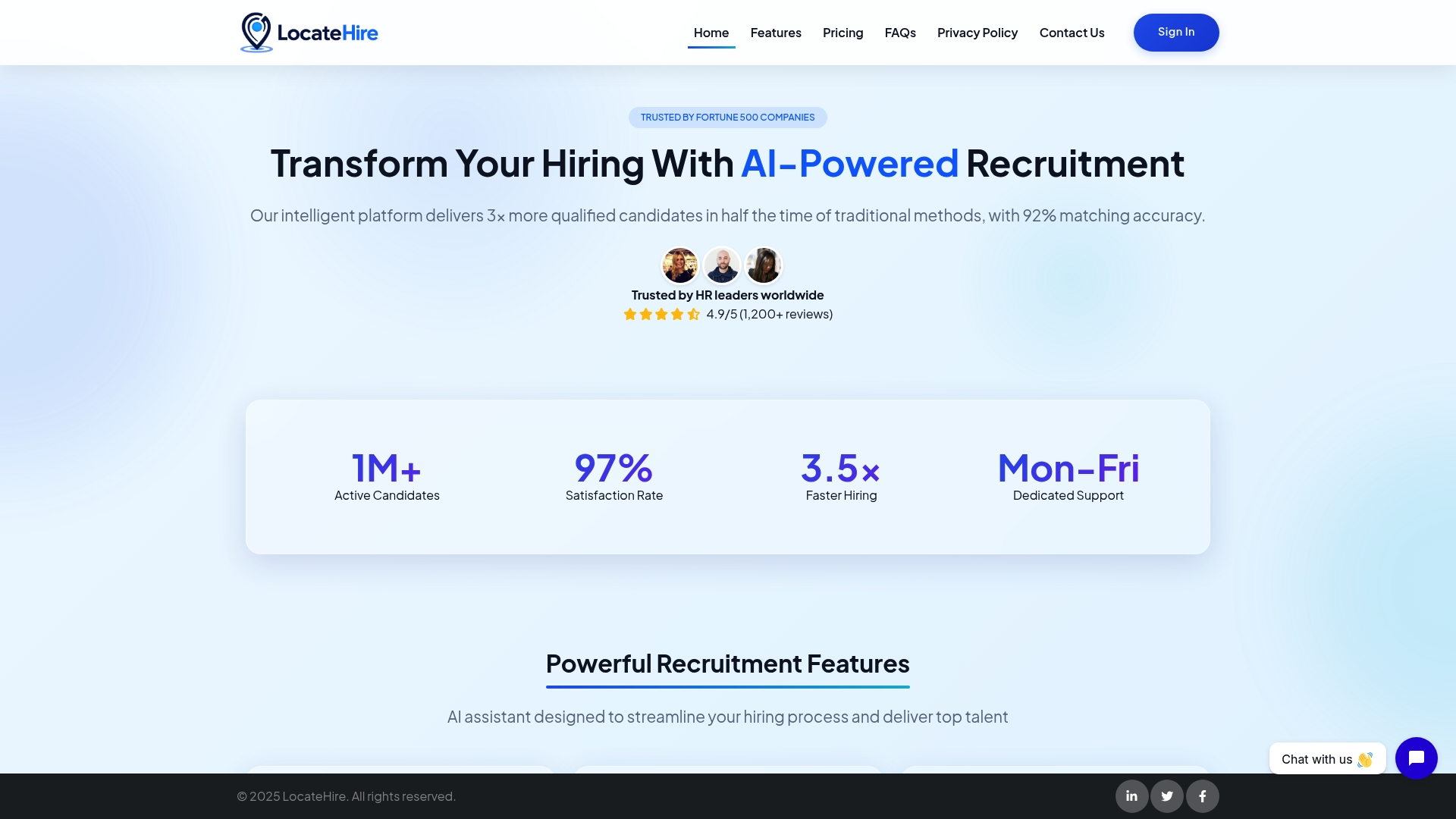
Locatehire is an AI-powered applicant tracking system built specifically for small businesses with ongoing hiring needs, including electrical contractors. It centralizes candidate skills, certification data, and availability in one place, so your team isn't chasing information across spreadsheets when a position opens. Features like AI candidate matching, smart scoring, job posting to major boards, and new candidate alerts cut the administrative work out of sourcing. You post once, track everything in one dashboard, and get matched candidates faster.
For electrical contractors running the workforce planning checklist in this guide, Locatehire handles the recruitment leg: sourcing, screening, and tracking candidates from application to offer. Start with a free trial and see how much faster your next journeyman hire moves.
Authority sources and quick references
These are the primary sources used throughout this guide. Each one is worth bookmarking for ongoing reference.
| Source | What It Covers | Why It Matters |
|---|---|---|
| NECA 2025 Labor Planning Research | Four core pillars, SOP discipline, planning as continuous practice | Industry authority on contractor workforce operations |
| CEWD Workforce Planning Overview | Strategic workforce planning framework for utilities and contractors | Foundational framework for the planning process |
| PipelineOn Electrician Hiring Insights | Retirement rates, apprentice ratios, referral bonus data, retention strategy | Practical hiring data specific to the electrical trades |
| RIVET Workforce Management | Lookahead reporting, demand forecasting, actual vs. planned hours | Software benchmarks and reporting best practices |
| IECI Beyond Recruitment | Formation capacity constraints and apprentice sponsorship limits | Explains why recruiting alone doesn't close the gap |
| AlphaHire Workforce Intelligence Lab | Apprenticeship pipeline gap analysis, retirement cohort data | Structural supply-side context for long-range planning |
A note on state-level compliance: Apprentice ratios, journeyman licensing requirements, and supervision rules vary by state. Confirm the current requirements for your state with your state electrical licensing board or your local IBEW/NECA JATC before finalizing your apprentice intake plan. This guide provides general operational guidance and is not a substitute for legal or regulatory advice specific to your jurisdiction.
For electrician candidate screening best practices that align with the checklist steps above, including assessment templates and background check guidance, the Locatehire blog covers the full hiring workflow for electrical contractors. Use the printable checklist from this guide in your next monthly workforce review, and contact Locatehire if you want to automate the recruitment and tracking steps.