

Time to hire is defined as the number of calendar days between a candidate entering your hiring pipeline and accepting a job offer. This metric reveals how efficiently your team moves candidates through the evaluation process, from application review to final decision. For HR professionals and hiring managers at small businesses, understanding the time to hire metric is the first step toward building a faster, more competitive recruitment process. Unlike broader measures, this metric focuses on what your team directly controls.
What is the time to hire metric and how does it work?
Time to hire measures the speed of your candidate evaluation process, not your entire recruiting cycle. The standard formula is simple: subtract the date a candidate entered your pipeline from the date they accepted your offer. That result, in calendar days, is your time to hire for that candidate.
The "entry point" matters more than most hiring managers realize. Some teams start the clock at application submission. Others start it at first recruiter contact. Whichever you choose, you must apply it consistently across every hire. Inconsistent starting points produce numbers that cannot be compared month over month, which makes the metric useless for spotting trends.

When you aggregate time to hire across multiple hires, use the median, not the average. A single hire that took 90 days because of a candidate's personal delay will inflate your average and make your process look slower than it actually is. The median gives you a truer picture of typical performance.
Pro Tip: Track time to hire in a shared spreadsheet or your applicant tracking system from day one. Retroactively rebuilding this data from email threads is painful and error-prone.
Small businesses often skip this metric entirely because it feels like extra administrative work. That is a mistake. Without a consistent measurement, you cannot tell whether a slow quarter reflects a broken process or a tight labor market.
How to calculate time to hire accurately
The calculation itself is straightforward. The challenge is in the data discipline required to make it reliable.
Here is the core formula:
Time to Hire = Date of Offer Acceptance − Date Candidate Entered Pipeline
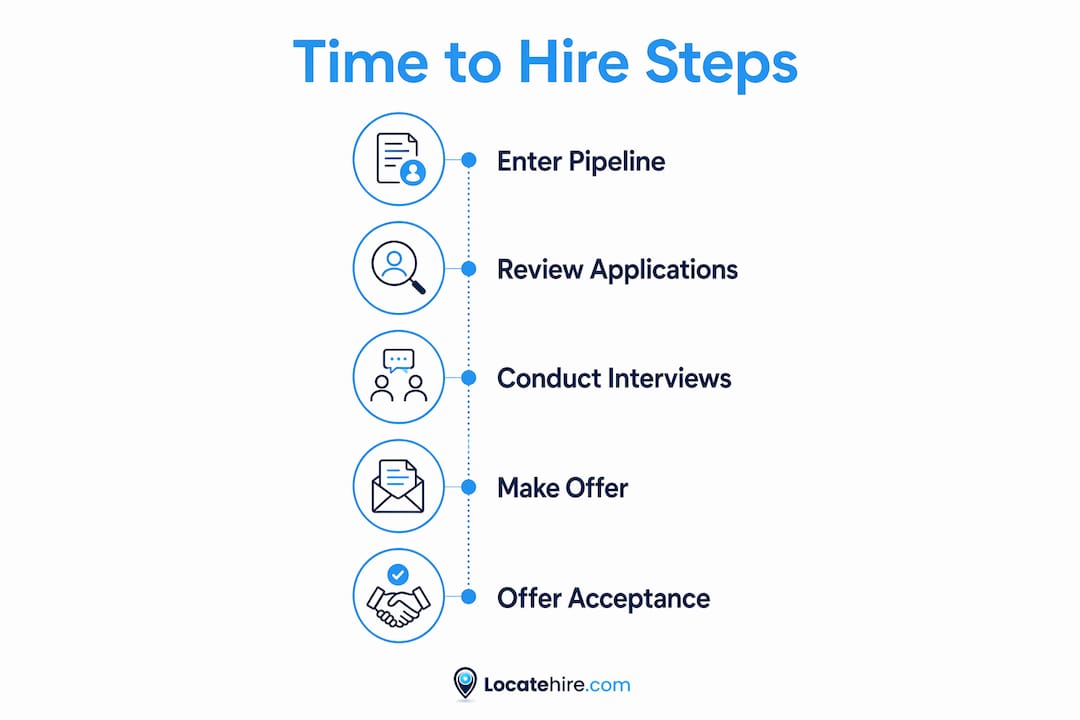
To calculate a team-wide number, collect this figure for every hire over a set period, then find the median value across all results.
Common measurement variations that affect accuracy:
- Pipeline entry date: Application date, recruiter outreach date, or phone screen date. Pick one and document it in your process.
- Offer acceptance date: The date the candidate verbally accepts, or the date they sign the written offer. Verbal acceptance is more common in practice.
- Withdrawn candidates: Exclude candidates who withdrew before receiving an offer. Including them distorts the metric.
- Roles with unusual timelines: A seasonal hire for a pool service company in march may move faster than a mid-level HVAC technician role. Segment these separately.
| Measurement Decision | Recommended Practice |
|---|---|
| Pipeline entry point | Application submission date (consistent and documented) |
| Aggregation method | Median across all completed hires |
| Withdrawn candidates | Exclude from calculation |
| Reporting period | Monthly or quarterly for trend visibility |
| Role segmentation | Separate entry-level from technical or senior roles |
The median aggregation method protects your data from outlier distortion. One unusually fast or slow hire should not define your team's performance picture.
How does time to hire differ from time to fill?
Time to hire and time to fill are related but measure different things. Confusing them leads to misdiagnosed problems and wasted effort.
Time to fill starts when a job requisition is approved, not when the job is posted. Time to fill ends at offer acceptance and captures the entire recruiting cycle, including sourcing, job posting, and waiting for budget approval. Across industries, the median time to fill runs between 36 and 44 days. For leadership roles, it can exceed 90 days.
Time to hire starts when a specific candidate enters your pipeline. It ends at offer acceptance. It excludes sourcing delays and budget approval lags, focusing only on how fast your team evaluates and decides on candidates already in front of them.
The practical difference is significant for small business hiring managers:
- Time to fill reflects organizational and sourcing factors, many of which are outside a hiring manager's direct control.
- Time to hire reflects process speed under your control, including interview scheduling, feedback turnaround, and decision-making speed.
- A long time to fill with a short time to hire signals a sourcing problem, not a process problem.
- A short time to fill with a long time to hire signals internal bottlenecks in evaluation and decision-making.
For a janitorial services company or a retail operation with ongoing hiring needs, time to hire is the metric that tells you whether your team is moving fast enough once candidates show up. Time to fill tells you how long it takes to get candidates in the door at all. Both matter, but they answer different questions.
Pro Tip: If your time to fill is long but your time to hire is short, invest in sourcing channels and job visibility, not interview process changes.
What counts as a good time to hire for small businesses?
Benchmarks give you a reference point, but they are not universal targets. Industry averages for time to hire range between 23 and 29 days overall, with significant variation by role type and seniority.
Role-based benchmarks:
- Entry-level roles (retail associates, janitorial staff, pool technicians): 15–25 days
- Mid-level roles (HVAC technicians, experienced electricians, team leads): 25–35 days
- Senior or executive roles: 35–60 days
- Technical specialty roles: 30–45 days
These ranges reflect general market data. Your actual target should be grounded in your own historical performance and the specific labor market you recruit in. A plumbing company in a city with a tight skilled trades market will naturally see longer times than one in a market with more available candidates.
The most useful benchmark is your own data from the previous six to twelve months. If your time to hire for entry-level roles was 22 days last quarter and it climbs to 31 days this quarter, that shift tells you something changed. It might be a process problem. It might be a market shift. Either way, you now have a question worth investigating.
A rising time to hire in a competitive labor market sometimes reflects candidates taking longer to decide, not a broken process. Candidate deliberation is a real factor, especially when job seekers are fielding multiple offers. Context matters as much as the number itself.
How to use time to hire data to improve your hiring process
Tracking the metric is only half the work. The other half is acting on what it tells you.
-
Segment by role and department. A company-wide average hides the real story. Segmenting time to hire by role type or department reveals which teams move fast and which ones stall. Your electrical division might hire in 18 days while your administrative team averages 40.
-
Map where time is lost. Break your pipeline into stages: application review, phone screen, in-person interview, offer. Calculate how many days candidates spend in each stage. Most small businesses find the biggest delays happen between the in-person interview and the offer, often because managers delay feedback.
-
Fix scheduling before anything else. Interview scheduling delays are the single most common cause of inflated time to hire at small businesses. A candidate who waits five days for an interview slot is already talking to your competitors. Use a scheduling tool or designate specific interview windows each week.
-
Set a feedback deadline for hiring managers. Require interview feedback within 24 hours of the interview. This one change alone can cut days off your time to hire without changing anything else in your process.
-
Communicate with candidates throughout. Candidates who hear nothing after an interview often accept other offers out of uncertainty. A brief update email keeps them engaged and reduces drop-off before you reach the offer stage. You can find more practical tactics in this guide on screening applicants efficiently.
-
Track trends, not just snapshots. A single month's number means little. A three-month trend tells you whether your process is improving or degrading. Review time to hire alongside your offer acceptance rate to get the full picture of hiring health.
The goal is not to hit a specific number. The goal is to understand your process well enough to make deliberate improvements. For more on reducing hiring time at small businesses, the tactics above apply across industries from pool service to retail.
Key Takeaways
Time to hire is the most actionable recruitment metric for small businesses because it measures exactly what hiring managers control: the speed of candidate evaluation from pipeline entry to offer acceptance.
| Point | Details |
|---|---|
| Core definition | Time to hire counts calendar days from pipeline entry to offer acceptance. |
| Calculation method | Use median, not average, to avoid distortion from outlier hires. |
| Metric distinction | Time to hire measures evaluation speed; time to fill measures the full requisition cycle. |
| Benchmark ranges | Entry-level: 15–25 days; mid-level: 25–35 days; senior roles: 35–60 days. |
| Improvement focus | Segment by role and department to find the specific stages where time is lost. |
Why time to hire deserves more attention than most small businesses give it
Most small business owners I talk to track revenue, job completion rates, and customer complaints. Almost none of them track time to hire. That gap costs them real money.
Here is what I have seen repeatedly: a plumbing company loses a strong candidate to a larger competitor not because the competitor paid more, but because they moved faster. The small business took 12 days to schedule a second interview. The competitor made an offer in 6. The candidate was not holding out for more money. They just went with whoever showed up first.
Time to hire is a leading indicator of recruitment agility. When it starts creeping up, it usually signals one of three things: a scheduling problem, a feedback bottleneck, or a market shift. The businesses that catch those signals early fix them before they lose candidates. The ones that ignore the metric keep wondering why their offer acceptance rate is dropping.
The most common mistake I see is tracking a single company-wide number and calling it done. That number hides everything. A 28-day average looks fine until you realize your HVAC division is at 18 days and your retail team is at 42. The retail team has a problem. The HVAC team has a process worth copying.
My honest recommendation: start simple. Track time to hire for your three most common roles. Review it quarterly. Compare it to your own prior quarters before you compare it to any industry benchmark. The hiring metrics that matter most are the ones you actually use to make decisions, not the ones that look good in a report.
— Jeff
Locatehire helps small businesses track what matters in hiring
Small business HR teams rarely have time to build custom tracking systems from scratch. Locatehire is an applicant tracking system built specifically for businesses with ongoing hiring needs, including pool service, HVAC, janitorial, electrical, plumbing, and retail operations.
Locatehire centralizes candidate data, tracks pipeline stages, and gives hiring managers the visibility they need to spot delays before they cost them a hire. Instead of piecing together timelines from email threads, your team gets a clear view of where every candidate stands and how long they have been there. If you are ready to start measuring and improving your recruitment process, explore Locatehire and see how it fits your team's workflow.
FAQ
What is the time to hire metric?
Time to hire is the number of calendar days between a candidate entering your hiring pipeline and accepting a job offer. It measures the speed of your candidate evaluation process, not the full recruiting cycle.
How is time to hire calculated?
Subtract the date a candidate entered your pipeline from the date they accepted your offer. Aggregate results using the median across all hires to avoid distortion from unusually fast or slow outliers.
What is a good time to hire for small businesses?
Industry benchmarks range from 15–25 days for entry-level roles to 35–60 days for senior positions, with an overall average of 23–29 days. Your best target is based on your own historical data and the specific roles you hire for most often.
How is time to hire different from time to fill?
Time to fill starts at job requisition approval and covers the entire recruiting cycle, with a median of 36–44 days across industries. Time to hire starts when a specific candidate enters the pipeline and focuses only on evaluation speed.
What causes time to hire to increase?
The most common causes are slow interview scheduling, delayed manager feedback, and poor candidate communication. In competitive labor markets, candidates taking longer to decide can also extend time to hire without reflecting any process failure.