

Screening job applicants efficiently is the process of quickly identifying the best candidates through clear criteria, structured evaluation, and smart use of automation. For small business owners in pool service, HVAC, electrical, plumbing, and retail, a slow or inconsistent screening process means losing top candidates to faster competitors. The industry standard for responding to top applicants is 48 hours. Miss that window and your best candidates are already talking to someone else. This guide covers the exact methods that cut screening time without cutting quality.
How to screen job applicants efficiently before you post the job
The most overlooked step in efficient applicant screening happens before a single application arrives. Hiring managers and recruiters must agree on 3–5 must-have criteria before the job goes live. Skipping this step floods your inbox with applicants who look fine on paper but fail on the one thing that actually matters for the role.
The intake call between the hiring manager and whoever is posting the job determines everything downstream. Without it, you end up with a bloated "nice-to-have" list that attracts the wrong people and wastes hours of review time. The goal is a short, non-negotiable list of requirements that every qualified candidate must meet.
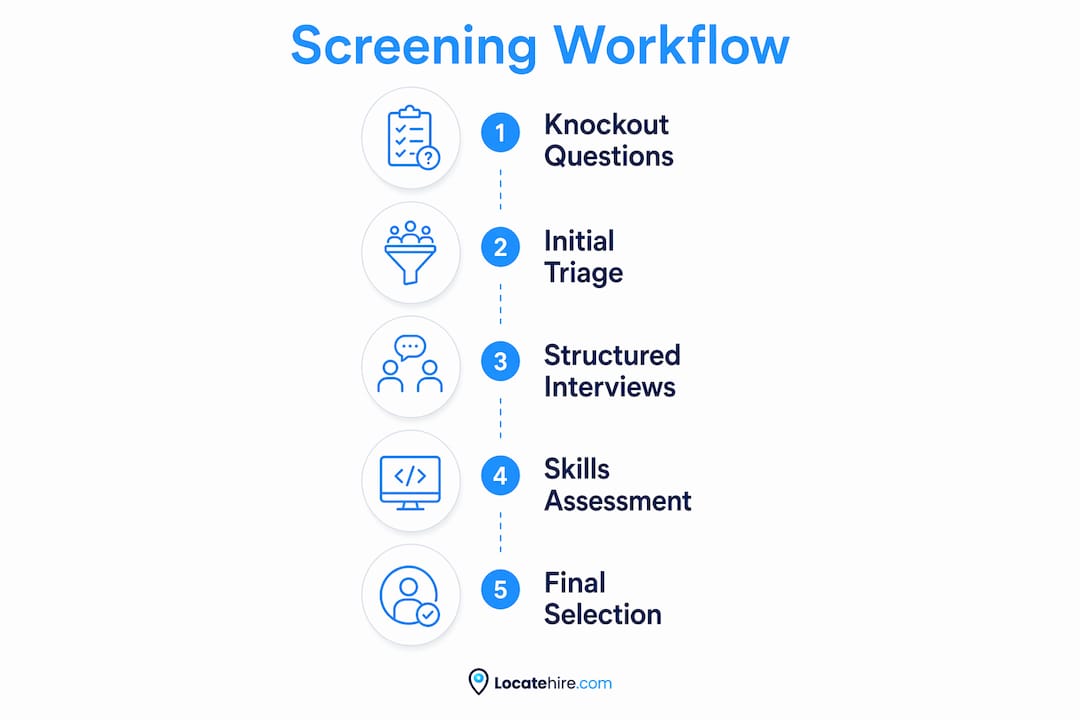
Knockout questions act as an application firewall. These are binary yes/no questions placed at the start of the application that disqualify candidates automatically. Examples include:
- "Do you have a valid driver's license?" (for field service roles)
- "Are you available to work weekends?" (for retail positions)
- "Do you have at least 2 years of HVAC installation experience?"
- "Can you pass a background check?"
An application firewall can eliminate up to 90% of unqualified applicants before formal review begins. That is not a minor efficiency gain. For a small business owner reviewing applications between service calls, it is the difference between a 20-minute task and a two-hour ordeal.
Pro Tip: Write your knockout questions so that a "No" answer is an automatic disqualifier. If you find yourself making exceptions, the question is not a true knockout criterion.
What does an effective screening workflow look like?
The signal-vs-noise framework treats initial applicant review as sorting, not rejecting. The goal at this stage is to move candidates into three buckets quickly, not to make final decisions. Manual 3-category sorting with a checklist enables 2-minute resume screens, which is the right pace for small business hiring managers.
The three categories are:
- Yes. The candidate meets all must-have criteria and shows relevant experience. Move to phone or video screen immediately.
- No. The candidate fails one or more knockout criteria. Send a polite decline within 24 hours.
- Maybe. The candidate meets most criteria but has one gap. Hold this group until the Yes pile is exhausted.
Once your Yes pile is sorted, respond to the top 5% within 48 hours. This is the single most impactful action you can take to improve offer acceptance rates. Top candidates in trades and service industries receive multiple offers fast. Speed signals that your business is organized and worth working for.
Structured interviews with standardized scoring rubrics come next. Every candidate in the Yes pile gets the same questions in the same order. Consistent scoring rubrics reduce evaluator variance and support legal defensibility. This matters especially for small businesses that lack an HR department to catch inconsistencies.
| Screening stage | Time investment | Purpose |
|---|---|---|
| Knockout questions | 0 minutes (automated) | Eliminate unqualified applicants |
| Resume sort (3 categories) | 2 minutes per resume | Identify top candidates |
| Async video or phone screen | 15–20 minutes per candidate | Assess communication and fit |
| Structured interview | 30–45 minutes per candidate | Score against rubric |
The table above shows where your time actually goes. Most of the heavy lifting happens in the first two stages, which is exactly where automation and clear criteria pay off the most.
Which tools make candidate evaluation faster and fairer?
Async video pre-screening is the single biggest time saver available to small business hiring managers. Candidates record answers to set questions on their own schedule. You review them when it fits your day. Async video pre-screening reduces pre-screening time by 85–90% compared to phone interviews. For a business owner juggling service routes and staffing at the same time, that reduction is significant.

Skills assessments are the second most effective filter. The best assessments take 15 minutes or less and measure job-relevant abilities directly. A plumbing company can test pipe fitting knowledge. A retail business can test cash handling accuracy. These tests surface candidates who perform well on paper but struggle with the actual work, and they do it before you invest interview time.
AI scoring and automated ranking tools handle the initial triage for high-volume roles. They sort applications by keyword match, experience level, and assessment scores. Automation provides consistent scoring and ranking but should never replace human judgment on culture fit or final decisions. This is a hard limit. No algorithm knows whether a candidate will mesh with your crew on a job site.
Pro Tip: Use AI triage to build your Yes/Maybe/No piles, but always have a human review the top 10 before scheduling interviews. Automation catches volume; humans catch nuance.
For a deeper look at how these methods compare for small service businesses, the screening methods guide from Locatehire breaks down each approach by role type and business size.
AI resume matching tools have also improved significantly. Understanding how AI resume scoring works helps hiring managers set realistic expectations for what automated triage can and cannot catch.
How do you fix common screening mistakes that slow hiring down?
The most common screening mistake is misaligned expectations between the person posting the job and the person making the hire. This produces a flood of "Maybe" candidates that clog the pipeline and delay decisions. The fix is the intake call described earlier, done before every new posting, not just the first one.
Unclear screening metrics are the second most common problem. If you cannot answer "What does a qualified candidate look like in 60 seconds?", your criteria are too vague. Measurable thresholds work better than subjective descriptions. "3 years of licensed electrical work" beats "experienced electrician" every time.
Watch for these specific pitfalls:
- Skipping the decline email for No candidates. This damages your employer reputation and reduces future applicant quality.
- Letting the Maybe pile grow without a deadline. Set a 5-business-day rule: if the Yes pile fills your interview slots, archive the Maybes.
- Using different questions for different candidates in the same role. This creates legal exposure and makes comparison impossible.
- Ignoring response time data. Track how long it takes from application to first contact. If that number exceeds 48 hours consistently, your process has a bottleneck.
Tracking screening KPIs gives you the data to fix problems before they become hiring crises. The metrics that matter most are time-to-first-contact, Yes-to-interview conversion rate, and offer acceptance rate. For small businesses with ongoing hiring needs, these numbers reveal whether your screening process is working or quietly costing you good hires.
Bias is a real risk in manual screening. Standardized rubrics and structured questions reduce it. Document your scoring for every candidate you interview. If a hiring decision is ever challenged, that documentation is your defense.
Key takeaways
Efficient applicant screening requires clear knockout criteria, a 3-category sorting system, and a 48-hour response window for top candidates to consistently win quality hires.
| Point | Details |
|---|---|
| Set knockout criteria first | Agree on 3–5 must-haves before posting to eliminate unqualified applicants automatically. |
| Sort, don't judge | Use Yes/No/Maybe buckets to move fast without making premature final decisions. |
| Respond within 48 hours | Contacting top candidates within 48 hours is the strongest predictor of offer acceptance. |
| Use async video screening | Async video pre-screening cuts pre-screening time by 85–90% versus phone interviews. |
| Track your KPIs | Measure time-to-first-contact and offer acceptance rate to find and fix bottlenecks. |
What I've learned about screening that most guides won't tell you
The intake call is the most valuable 20 minutes in the entire hiring process. I have seen small business owners spend weeks reviewing applications for a role that was never properly defined. The result is always the same: a hire that looks right on paper and fails in the field within 90 days.
Most hiring advice focuses on the tools. The tools matter, but they amplify whatever criteria you feed them. Garbage criteria in, garbage candidates out. The intake call forces clarity. It makes the hiring manager say out loud what they actually need, not what sounds good in a job posting.
The other thing most guides skip is the culture fit conversation. No automation touches this. A candidate can pass every skills test and structured interview and still be wrong for your team. That judgment call requires a human who knows your business. For a five-person HVAC crew or a small retail team, one bad cultural fit disrupts everyone. The applicant screening process for small businesses has to account for this in a way that enterprise hiring playbooks simply do not.
My honest recommendation: automate everything you can in the early stages, then slow down for the final two candidates. The time you save in triage is time you can invest in getting the final decision right.
— Jeff
Locatehire makes efficient screening practical for small businesses
Small businesses in trades and services hire constantly. Seasonal demand, turnover, and growth mean the screening process never really stops. Locatehire is built specifically for this reality.
The Locatehire platform includes application firewall tools, AI-powered applicant triage, and structured scoring features that put the methods in this article into practice without requiring a dedicated HR team. You set the knockout criteria once, and the system filters applicants automatically. Your Yes pile is ready when you are. For pool service companies, janitorial businesses, electrical contractors, and retail operators who need a repeatable hiring process, Locatehire removes the manual work that slows everything down.
FAQ
What is the fastest way to screen job applicants?
The fastest method combines knockout questions at the application stage with async video pre-screening. Knockout questions eliminate up to 90% of unqualified applicants automatically, and async video cuts pre-screening time by 85–90% compared to phone interviews.
How many must-have criteria should I set before screening?
Set 3–5 non-negotiable criteria before posting the job. More than five creates noise; fewer than three leaves too many unqualified candidates in the pipeline.
When should I contact top candidates after they apply?
Contact the top 5% of applicants within 48 hours of receiving their application. The 48-hour window is a key predictor of whether top candidates will accept your offer.
Can automation replace human judgment in screening?
Automation handles consistent scoring and high-volume triage effectively. It cannot replace human judgment for culture fit assessments or final hiring decisions.
What screening KPIs should small businesses track?
Track time-to-first-contact, Yes-to-interview conversion rate, and offer acceptance rate. These three metrics reveal where your screening process loses good candidates.