

A hiring budget is the total financial plan covering every cost required to bring a new employee from job posting to full productivity. Most small business owners underestimate this number significantly. Small business average cost-per-hire runs $3,200–$4,000, but micro-businesses regularly exceed $7,500 per role. When you set a hiring budget for your small business, you need to account for base salary, employer taxes, benefits, recruiting fees, onboarding, equipment, and a contingency reserve. Skip any of those categories and you risk running short mid-hire or, worse, losing a new employee in the first 90 days and paying the whole bill twice.
What goes into a small business hiring budget?
A complete hiring budget separates into two categories: recurring compensation costs and one-time recruiting expenses. Keeping them separate makes forecasting far more accurate over time.
Salary and the true employment cost multiplier
Base salary is the starting point, not the finish line. Small businesses should budget 1.25x–1.4x the base salary to cover payroll taxes and benefits fully. That means a $45,000 annual salary actually costs you $56,250–$63,000 per year once you factor in Social Security, Medicare, unemployment insurance, and any health or retirement benefits you offer.

This multiplier is the single most important number to internalize before you post a job. Many owners budget for the salary and then get surprised by the employer-side tax bill at the end of the quarter.
Recruiting expenses: direct and indirect
Direct recruiting costs for small businesses with 5–50 employees range from $800 to $3,500 per hire. When you add indirect costs like founder time spent reviewing resumes and conducting interviews, plus the cost of the vacancy itself, total recruiting costs can reach $8,000 per hire. Here is what typically makes up that number:
- Job board fees: Paid listings on platforms like Indeed or ZipRecruiter typically run $200–$500 per posting.
- Referral bonuses: Employee referral bonuses of $500–$2,000 are almost always cheaper than agency fees and produce better retention.
- Staffing agency fees: Agencies typically charge 15%–25% of first-year salary, which can add $7,000–$12,000 on a $50,000 role.
- Background checks and assessments: Budget $50–$200 per candidate depending on the role.
- Founder or manager time: If you spend 20 hours on a hire at an effective rate of $100 per hour, that is $2,000 in indirect cost that most owners never track.
Onboarding, training, and equipment
Onboarding is where most small business budgets fall apart. New employees typically reach full productivity in 6–12 months, operating at roughly 25% capacity in their first month. That ramp-up period represents a real cost of 2.5%–5% of salary per month in lost output. For a $50,000 role, that is $1,250–$2,500 per month in productivity you are not getting.
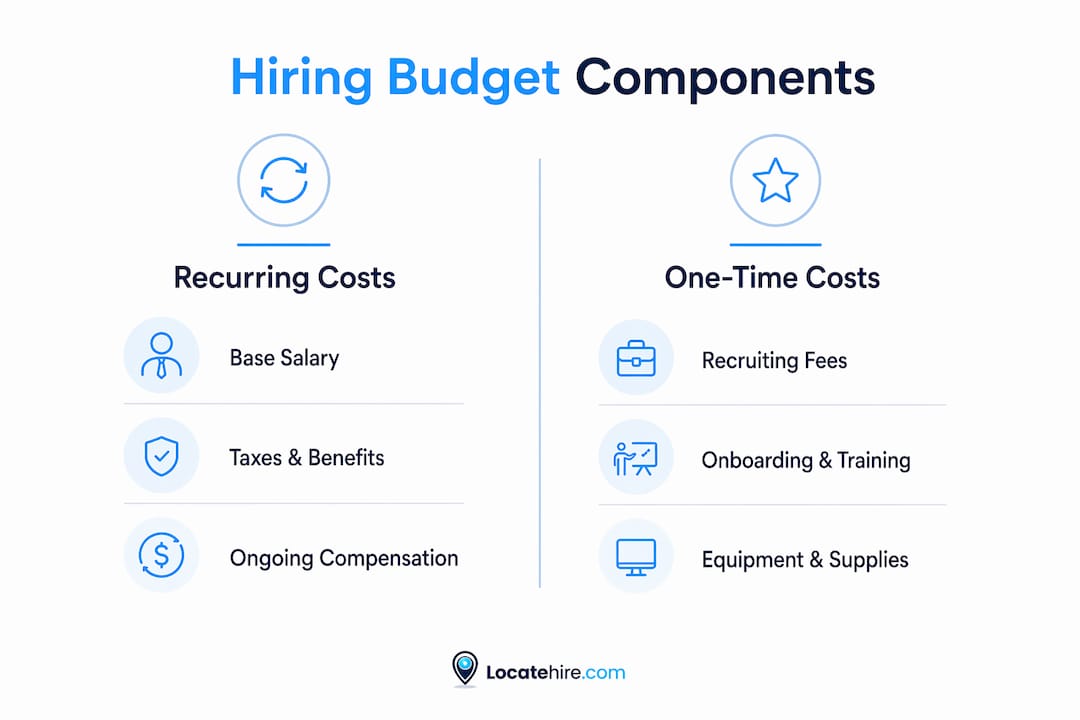
Training materials, licensing, uniforms, tools, and equipment add another $500–$3,000 depending on your industry. A pool service company outfitting a new technician faces different costs than a retail store onboarding a cashier.
Pro Tip: Always add a 10%–15% contingency reserve to your total hiring budget. Unexpected costs like extended vacancy periods, failed background checks, or a declined offer that restarts the process are common, not rare.
| Budget Category | Estimated Cost Range |
|---|---|
| Base salary (annual) | Varies by role and market |
| Employer taxes and benefits | 25%–40% of base salary |
| Job board and recruiting fees | $800–$3,500 direct |
| Onboarding and training | $500–$3,000 |
| Equipment and setup | $200–$2,000 |
| Contingency reserve | 10%–15% of total budget |
How do you calculate a hiring budget you can actually afford?
Calculating a hiring budget starts with your current cash flow, not the salary you want to offer. A hire you cannot sustain for 12 months is a hire you cannot afford.
Follow these steps to build a budget grounded in your financial reality:
- Pull your last 6 months of operating cash flow. Identify the monthly surplus after all fixed costs. This is your hiring capacity ceiling.
- Apply the 1.25x–1.4x salary multiplier. If your surplus supports $4,500 per month in new payroll, your maximum sustainable salary is roughly $38,000–$43,000 annually.
- Add one-time recruiting costs as a separate line item. These are not recurring, so treat them as a capital expense. Budget $2,000–$5,000 for a typical small business hire.
- Model the ramp-up period. Assume the new hire contributes 25% productivity in month one, 50% by month three, and 75%–100% by month six. Your revenue projections should reflect this delay.
- Set a go or no-go threshold. If the total first-year cost exceeds 18 months of projected value from the role, reconsider the timing or the scope of the position.
Pro Tip: Use a simple spreadsheet with three columns: salary cost, one-time recruiting cost, and ramp-up productivity loss. Totaling these three gives you the true first-year cost of any hire before you commit.
Adjusting your budget based on market conditions matters too. Labor markets shift. If you are hiring HVAC technicians or electricians in a tight market, expect to pay 10%–20% above your initial salary estimate or extend your time-to-fill significantly. Build that flexibility into your plan from the start.
| Budget Approach | Best For | Risk Level |
|---|---|---|
| Fixed salary-only budget | Stable, predictable roles | High (misses hidden costs) |
| Multiplier-based total cost budget | Most small businesses | Low |
| Dynamic market-adjusted budget | Competitive or seasonal hiring | Low to medium |
What are the most effective ways to reduce hiring costs?
Cutting hiring costs without cutting candidate quality is possible. The key is knowing where money gets wasted versus where it creates value.
Start with free and low-cost sourcing channels. Free job boards and social media can significantly reduce recruiting expenses when used with a clear job description and consistent follow-up. LinkedIn organic posts, Facebook community groups, Nextdoor, and your own website career page cost nothing. For trade roles like plumbing or janitorial services, local trade school job boards are often free and highly targeted.
Build a referral program before you need it. Referral bonuses of $500–$2,000 consistently outperform paid job boards on both cost and retention. Learn more about why referral programs work for businesses like yours. Your current employees know your culture and can pre-screen candidates informally before you spend a single hour interviewing.
Fix your job descriptions. Vague job descriptions attract lower-quality candidates and increase turnover, which can set a business back tens of thousands of dollars and months of lost productivity. A precise job post that lists specific duties, required certifications, and realistic pay ranges filters out poor fits before the first phone call. Review common job posting mistakes to avoid the most expensive errors.
Invest in onboarding, not just recruiting. Structured onboarding reduces turnover by improving new hire connection and competence. The biggest cost reduction in hiring does not come from cheaper job boards. It comes from keeping the people you hire. Optimizing onboarding processes delivers larger cost reductions than cutting any single recruiting line item.
The most expensive hire is the one you make twice. Replacement costs can equal 33% of annual salary plus double your original recruiting expense, according to data on early turnover within the first 90 days.
Use hiring software to cut founder time costs. Applicant tracking systems built for small businesses automate resume screening, interview scheduling, and candidate communication. That time savings directly reduces your indirect recruiting cost, which is often the largest hidden expense in the budget.
How do you track and adjust your hiring budget over time?
A hiring budget is not a one-time document. It is a living tool that gets more accurate every time you use it.
Tracking cost-per-hire and first-year turnover enables small businesses to improve budget accuracy over time. These metrics tell you which recruiting channels deliver the best return and where your onboarding process breaks down. The key metrics to track for every hire include:
- Cost-per-hire: Total recruiting spend divided by number of hires. Track this by channel to see which sources are worth the investment.
- Time-to-fill: Days from job posting to accepted offer. Longer time-to-fill increases vacancy costs and founder time.
- 90-day retention rate: The percentage of new hires still employed after 90 days. This is your early warning system for onboarding problems.
- First-year productivity milestones: Did the new hire reach expected output by month three and month six? If not, your ramp-up cost assumptions need updating.
Set a quarterly review of your hiring budget assumptions. If your cost-per-hire is consistently running 20% over budget, the issue is usually one of three things: your salary offer is below market, your job description is attracting the wrong candidates, or your screening process is inefficient. Each problem has a different fix, and tracking the data tells you which one you are dealing with.
Use a simple dashboard in Google Sheets or a built-in report from your applicant tracking system. You do not need expensive software to track four numbers. You need consistency.
Key takeaways
Setting a hiring budget for your small business requires accounting for every cost category from salary multipliers to onboarding, not just the number on the offer letter.
| Point | Details |
|---|---|
| Use the salary multiplier | Budget 1.25x–1.4x base salary to cover taxes and benefits accurately. |
| Separate recurring and one-time costs | Track compensation and recruiting expenses separately for cleaner forecasting. |
| Invest in onboarding | Structured onboarding reduces turnover and avoids costly rehiring cycles. |
| Track cost-per-hire by channel | Measure which sourcing methods deliver the best return and cut the rest. |
| Build a contingency reserve | Add 10%–15% to your total budget for unexpected delays or failed hires. |
Where most small business owners get this wrong
I have seen hundreds of small business owners go through the hiring process, and the pattern is almost always the same. They budget for the salary, maybe add a rough number for job boards, and call it done. Then the first payroll tax bill arrives and they are scrambling.
The mindset shift that changes everything is treating a new hire as a capital investment, not a monthly expense. When you buy a piece of equipment for your HVAC or electrical business, you calculate the total cost of ownership. You factor in installation, maintenance, and the time before it pays for itself. A new employee deserves the same analysis.
The other mistake I see constantly is cutting onboarding to save money. It feels logical. The person is hired, the hard part is over, and you want to get them working fast. But early turnover within the first 90 days is the single costliest hiring mistake a small business can make. You lose the recruiting investment, pay replacement costs, and absorb the salary of a vacancy all over again. A structured first 30 days costs you a few hours of planning. A failed hire costs you months.
The businesses that get hiring right are the ones that track their numbers. They know their cost-per-hire, they know their 90-day retention rate, and they adjust their process when those numbers move. That is not complicated. It is just discipline.
— Jeff
How Locatehire helps you hire within budget
Locatehire is an applicant tracking system built specifically for small businesses with ongoing hiring needs, including pool service companies, HVAC contractors, janitorial services, electrical and plumbing businesses, and retail operations.
AI-powered recruitment through Locatehire automates sourcing, screening, and interview scheduling, which directly cuts the founder time cost that inflates most small business hiring budgets. Instead of spending 20 hours per hire on manual tasks, you spend a fraction of that time reviewing pre-screened candidates. For businesses that hire repeatedly throughout the year, that time savings compounds into a significant budget reduction. Explore how Locatehire can help you reduce time to hire while keeping your recruiting costs under control.
FAQ
What is the average cost to hire a new employee for a small business?
Small business cost-per-hire averages $3,200–$4,000, but micro-businesses often exceed $7,500 per role. The national average across all business sizes is $5,475.
How do i calculate the true cost of a new hire beyond salary?
Multiply the base salary by 1.25x–1.4x to estimate total annual employment cost including payroll taxes and benefits. Then add one-time recruiting and onboarding expenses separately.
What is the biggest hidden cost in small business hiring?
Early turnover within the first 90 days is the costliest mistake. Replacement costs can equal 33% of annual salary plus double the original recruiting expense.
How often should i review my hiring budget?
Review your hiring budget quarterly and after every completed hire. Comparing your actual cost-per-hire to your budgeted estimate improves forecast accuracy for every future role.
Can free job boards actually replace paid recruiting for small businesses?
Yes, for many roles. Free platforms and social media can replace paid boards when paired with a precise job description and a consistent follow-up process. Employee referrals with modest bonuses often outperform both.