
An applicant-tracking system (ATS) built for trades hiring gives small HVAC businesses one place to post jobs, screen candidates, and contact applicants the same day — producing measurable results where it counts most. Locatehire is built precisely for this: AI-powered matching, built-in texting, and flat pricing designed for shops with 5–50 employees.
The three outcomes HVAC owners care about most:
- Shorter time-to-hire — centralized pipelines and instant candidate alerts cut days off every open role
- Better 90-day retention — structured onboarding workflows keep new hires past the point where most quit
- Predictable cost-per-hire — flat pricing and built-in analytics replace guesswork with real numbers
Key Takeaways
An ATS built for trades hiring shortens time-to-hire, reduces dispatcher and technician vacancies, and makes a 5-year Build/Buy/Borrow workforce plan executable for small HVAC shops.
| Point | Details |
|---|---|
| Prioritize texting and speed | Same-day candidate contact is the single biggest lever on time-to-hire for trades roles. |
| Budget for real cost of ownership | Model 12 months of hires and texting volume before comparing vendor pricing plans. |
| Plan a 6–10 week ramp | Office hires need 6–10 weeks to reach full productivity; build that into your onboarding timeline. |
| Use the 3B framework | Map each role to Build, Buy, or Borrow across a 5-year window before a vacancy forces a reactive decision. |
| Locatehire fits small HVAC shops | Flat pricing, AI matching, and built-in texting make Locatehire a strong ATS option for 5–50 employee shops. |
Table of Contents
- Why hiring is a make-or-break risk for small HVAC shops
- What ATS features actually move the needle for HVAC hiring
- How ATS vendors price and what it really costs your shop
- What deployment looks like for a small HVAC shop
- How to run a vendor demo and score your options
- A 5-year hiring plan using the Build/Buy/Borrow framework
- How Locatehire has helped small HVAC shops hire faster
- The most practical next step for HVAC owners deciding now
- Locatehire is built for exactly this kind of hiring
- Sources
Why hiring is a make-or-break risk for small HVAC shops
Staffing is one of the top operational risks a small HVAC firm faces. One open technician role can leave a truck idle, delay service calls, and push revenue directly into a competitor's pocket. The problem compounds when experienced techs retire and take years of tribal knowledge with them.
CSR and dispatcher turnover adds a second layer of pain. HVAC owners consistently report that office staff are the hardest positions to fill and retain — and a vacant dispatcher seat disrupts scheduling for every tech on the roster. Office hires typically need 6–10 weeks to reach full productivity as they learn dispatch workflows, trade terminology, and peak-call handling without supervision.
The fix is not reactive hiring. A long-term HVACR hiring strategy includes workforce forecasting, training plans that capture institutional knowledge before retirements hit, and a multi-year Build/Buy/Borrow framework. Small shops that move faster on offers and leverage local trade groups and vocational schools consistently outcompete larger contractors for qualified candidates.
Pro Tip: Start workforce planning before a vacancy forces your hand. Map retirements and role needs across a 5-year window and assign a Build, Buy, or Borrow action to each role before the seat goes empty.
What ATS features actually move the needle for HVAC hiring
For trades hiring, prioritize features that shorten time-to-contact and improve candidate response rates above everything else. A platform with broad job-board reach and built-in texting will outperform a feature-heavy system that buries candidates in a slow workflow.
Core features to require:
- Broad job-board distribution — Indeed reach is non-negotiable; syndication to multiple boards from one post saves hours per hire
- Built-in candidate texting — candidates respond to texts faster than email; same-day contact is the single biggest lever on time-to-hire
- One-click job posting — reduces friction so managers actually post roles the day they open
- AI resume parsing and matching — surfaces qualified candidates without manual screening of every application
- Smart scoring and candidate alerts — notifies you the moment a strong applicant applies
- Hiring pipelines and interview scheduling — keeps every candidate visible and moving
- Basic assessments — screen for reliability and trade aptitude before the phone call
- Career page and branded postings — builds credibility with candidates who research you before applying
- Analytics for KPIs — time-to-hire, applicant-to-phone-screen rate, and 90-day retention must be trackable
Integration needs to confirm: background check providers, payroll or HRIS systems, calendar tools, and single sign-on. Ask about these in every demo.
Pro Tip: Make texting and same-day candidate contact a hard requirement in your demo checklist. If a vendor cannot show you that workflow live, move on.
How ATS vendors price and what it really costs your shop
Watch for four pricing models: flat monthly plans, headcount-based billing, per-job or per-post fees, and freemium tiers with paid add-ons. The sticker price rarely tells the full story.
Common add-ons that inflate real costs:
- Texting charged per message or per month as a separate line item
- Job-count caps that require upgrades during seasonal hiring bursts
- Paid board syndication billed separately from the base plan
- Per-seat fees that grow as you add hiring managers or office staff
- Background-check or assessment charges billed per candidate
A concrete example: a $99/month entry plan with texting billed at $0.05 per message costs more than a $149 flat plan for a shop that sends 1,200 texts during a seasonal hiring push. Trades-focused ATS platforms built for SMBs typically include job-board syndication and texting in base plans and entirely avoid headcount-based pricing traps.
Pro Tip: Model your next 12 months of hires before signing anything. Estimate open roles, hires per month, and expected texting volume, then run three vendor price scenarios side by side.
What deployment looks like for a small HVAC shop
Expect a 6–10 week path to full productivity for office hires and a 90-day onboarding plan for technicians and CSRs. That timeline is not a software limitation — it reflects how long it takes a new hire to internalize trade workflows and handle calls independently.
Implementation steps in order:
- Week 0–2: Account setup, job posting templates, career page configuration, and first live postings
- Week 3–6: Candidate screening, texting workflows activated, first phone screens and interviews scheduled
- Week 7–10: First hires onboarded, performance tracking live, pipeline KPIs reviewed
- 90-day review: Retention check, time-to-hire analysis, and plan adjustments for the next hiring cycle
Pro Tip: Assign one owner-level decision-maker to approve offers immediately during launch. Fast-moving candidates accept the first reasonable offer they receive.
How to run a vendor demo and score your options
Use a short demo checklist and a numeric scorecard to compare options consistently. Generic labels keep evaluations honest.
Questions to ask live during every demo:
- "Walk me through a candidate applying and receiving a text within the hour."
- "Show me the analytics dashboard — specifically time-to-hire and 90-day retention."
- "Can I post a real job during this demo and see where it appears?"
- "Do you have a reference from a shop with 10–30 employees in a trades business?"
Pro Tip: Ask to see sample analytics dashboards before the demo ends. A vendor that cannot show you time-to-hire data in a live environment probably cannot track it in production either.
A 5-year hiring plan using the Build/Buy/Borrow framework
The 3B Strategy maps each role to the most cost-effective sourcing action per year. An ATS supports all three paths.
How ATS features plug into each action:
- Build — internal mobility pipelines, career pages, and assessments identify and develop existing employees for senior roles
- Buy — job-board reach, fast texting, and candidate scorecards fill external hires quickly and at lower cost-per-hire
- Borrow — contractor pools and temporary hires flagged in the ATS keep capacity flexible without permanent headcount
Sample role map:
| Role | Year 1 | Year 3 | Year 5 |
|---|---|---|---|
| CSR/Dispatcher | Buy (urgent hire) | Build (promote from within) | Build + Borrow (peak coverage) |
| Residential service tech | Buy (job boards + referrals) | Buy + Build (apprentice pipeline) | Build (internal promotion) |
| Lead tech | Borrow (contractor) | Buy (external hire) | Build (promote service tech) |
| Shop foreman | Build (develop lead tech) | Build | Build |
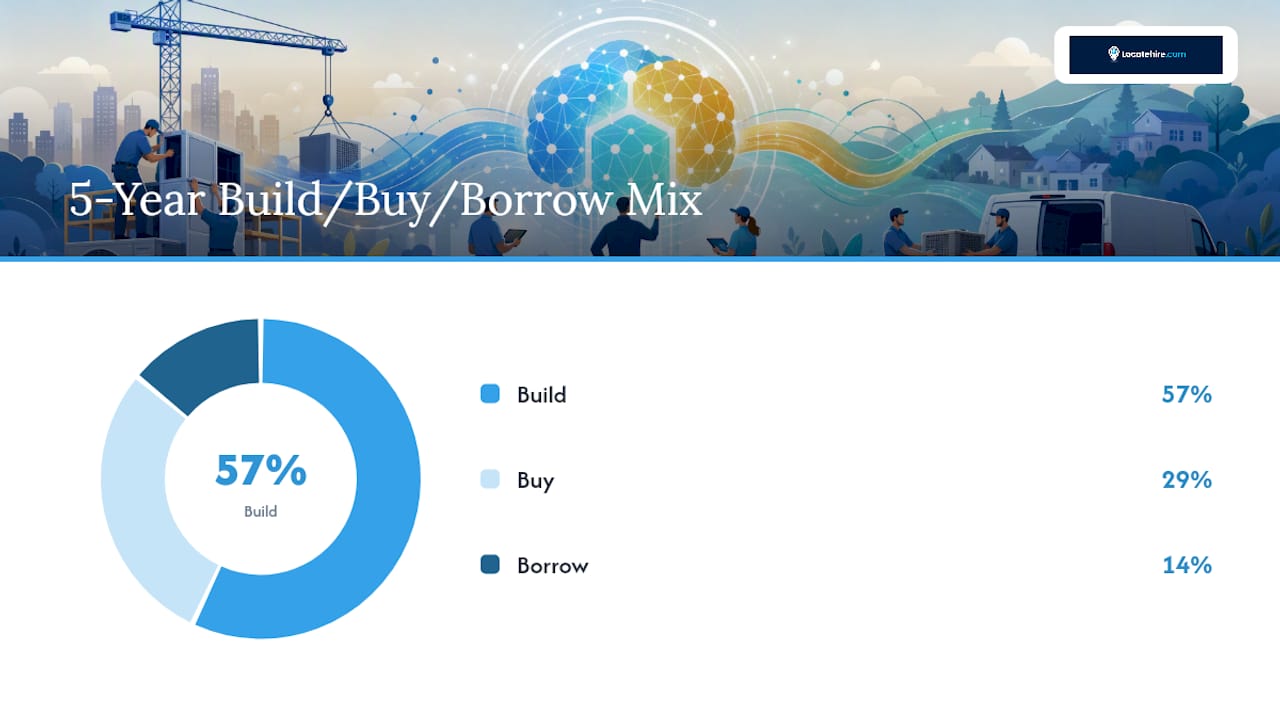
Referral programs with payouts at the 90-day mark in the $500–$1,500 range reliably increase referral yield for technician roles. Pair referrals with trade association boards, vocational school partnerships, and local lead-generation campaigns timed to seasonal hiring bursts.

Pro Tip: Review and update the plan quarterly. Link every hire to ATS KPIs — time-to-hire, offer-accept rate, and 90-day retention — so the plan reflects what is actually happening in your pipeline.
How Locatehire has helped small HVAC shops hire faster
A structured recruiting process backed by an ATS can materially shorten time-to-fill and improve retention when paired with consistent hiring workflows. Locatehire clients in small trades businesses have reported measurable reductions in average time-to-hire after activating job-board syndication, built-in texting, and structured onboarding pipelines.
What a typical Locatehire implementation includes for an HVAC shop:
- Job-board syndication live within 48 hours of account setup
- Built-in texting activated so candidates receive contact the same day they apply
- Demo-based scorecard used to evaluate and rank candidates before the first call
- 90-day onboarding pipeline tracking retention milestones for every new hire
How HVAC companies compete for talent increasingly comes down to speed and consistency — two things a well-configured ATS delivers from day one.
The most practical next step for HVAC owners deciding now
Evaluate an ATS that prioritizes texting and job-board reach, run a 30-day pilot, and measure time-to-contact and 90-day retention from the first hire. Those two KPIs tell you whether the system is working before you commit to a full year.
The revenue risk is concrete: one unfilled tech role for four weeks costs a shop real service revenue. A dispatcher vacancy disrupts every truck on the schedule. An ATS does not eliminate hiring difficulty, but it removes the friction that turns a two-week search into a six-week one.
Bring three things to your first vendor demo: the three roles you need to fill right now, your expected hire count for the next 90 days, and the name of the person authorized to approve offers. That preparation turns a demo into a decision.
Locatehire is built for exactly this kind of hiring
Locatehire gives small HVAC shops AI-powered candidate matching, built-in texting, and job-board syndication in one flat-rate platform — no headcount-based pricing, no texting add-ons, no surprise fees at the end of the month.
Getting started takes less than a week:
- Run a 30-minute demo — see candidate texting, job-board posting, and analytics live
- Start a trial — post your first real job and measure applicant response rates before you commit
- Request a 5-year hiring-plan workshop — map your Build/Buy/Borrow strategy with a Locatehire specialist
Visit Locatehire to book a demo or start your trial today.
Sources
- How to build a long-term hiring strategy for your HVACR business - ACCA HVAC Blog
- The 7 best applicant tracking systems for home service businesses in 2026: HVAC, Roofing, Plumbing & Electrical | Onrec
- How to hire HVAC technicians when nobody’s applying | Heat Pump Network
- Recruiting HVAC technicians: 7 strategies that work | Reins