
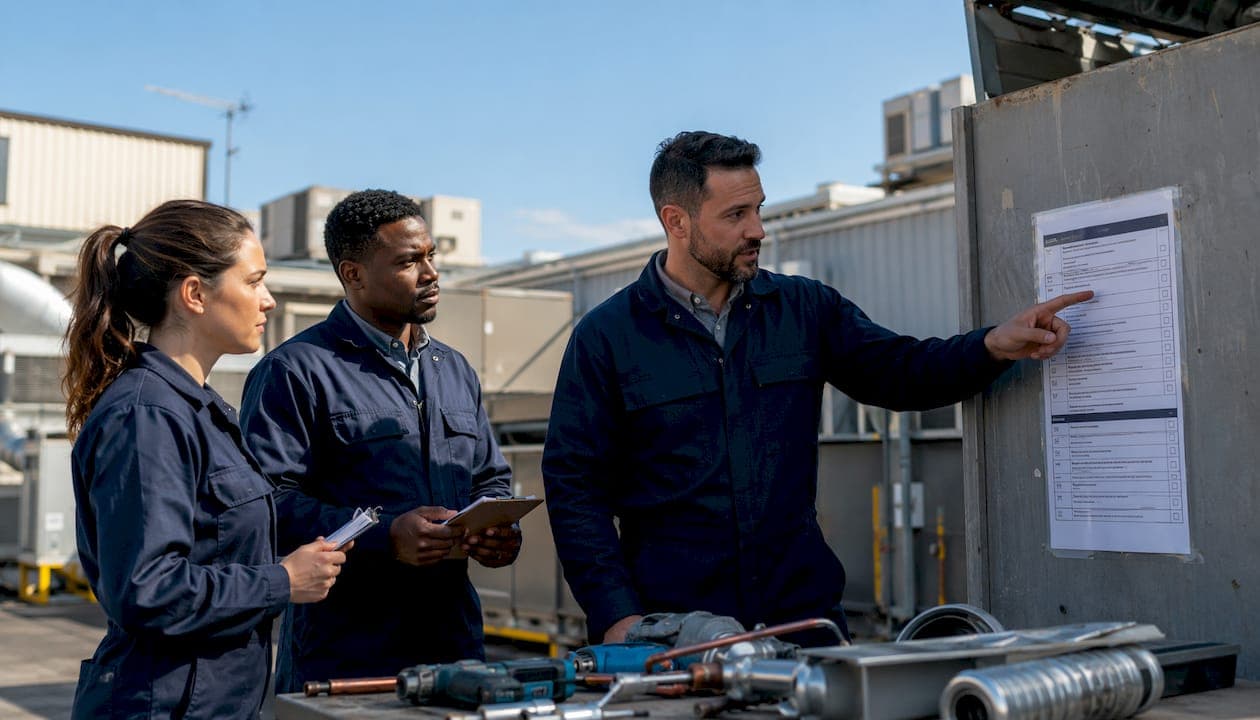
The most effective HVAC employee onboarding program is a structured, measurable 90-day plan that combines zero-day workspace readiness, safety certification, tell→show→do field training, assigned mentorship, and documented competency signoffs. Get this right, and you reduce callbacks, cut early turnover, and lower your insurance exposure. Get it wrong, and 90% of new hires are willing to quit within 30 days.
Your program needs six core components working together:
- Zero-day readiness: Uniforms, vehicle keys, software logins (ServiceTitan, FieldEdge, or your dispatch platform), and payroll setup complete before Day 1
- Safety and compliance: EPA Section 608, OSHA basics, lockout/tagout, and PPE verification before any solo fieldwork
- Tell→show→do training: Structured skill walkthroughs followed by supervised practice and documented signoffs
- Mentorship: A technician with at least 12 months of tenure assigned before the start date
- 30/60/90 milestones: Measurable benchmarks at each checkpoint (first-time-fix rate, safety checklist completion, time-to-first-solo-job)
- KPI tracking: Callbacks per tech, safety incidents, and 90-day retention logged in your LMS or ATS
Three actions you can execute today: build a zero-day readiness checklist and assign someone to complete it 48 hours before the hire's start date; assign a mentor from your current team; and schedule the start date for Tuesday through Thursday so leadership is available and engaged.
Table of Contents
- Why structured onboarding is a business-critical investment
- What every HVAC onboarding program must include
- How to use the day-1 through 90-day onboarding timeline
- Training methods that produce real skill retention
- Which systems and tools support a consistent onboarding program?
- Safety and compliance requirements before solo fieldwork
- How to measure whether your onboarding program is working
- Treat every training step as risk control
- Key Takeaways
- What actually separates good HVAC onboarding from costly failures
- Locatehire cuts the admin work so you can focus on field training
- Authoritative sources and standards for HVAC onboarding
Why structured onboarding is a business-critical investment
Structured onboarding is not an HR formality. It is one of the highest-ROI decisions an HVAC owner makes, directly affecting callbacks, warranty claims, safety incidents, and whether your new hire is still on the payroll in 90 days.

Companies with strong onboarding programs improve new-hire retention by 82% and productivity by over 70%. For an HVAC business, that productivity gap shows up immediately: an undertrained technician generates callbacks, misdiagnoses, and warranty claims that cost far more than the time spent training.
Early turnover is the most expensive outcome. Replacing a skilled technician costs thousands of dollars in recruiting, lost productivity, and rework. The risk window is short: 90% of new hires decide whether to stay or leave within 30 days if expectations aren't met, and the triggers are often operational, not personal. Missing credentials, uniforms, or software access on Day 1 is a leading cause of early resignations. A new hire who shows up and cannot log into dispatch software or find their assigned vehicle reads that as a signal about how the company operates.
Onboarding also has a direct line to your insurance costs. Structured training and competency verification lower injury frequency and claims severity, and documented programs give you leverage when negotiating commercial liability premiums.
Pro Tip: Schedule new hires to start on a Tuesday, Wednesday, or Thursday. Mid-week start dates increase the likelihood that you and your lead techs are present, focused, and available — not recovering from a Monday rush or heading into a weekend.
What every HVAC onboarding program must include
Before you build your program, understand the distinction: orientation is a one-time welcome event, typically a single day. Onboarding is a months-long integration into your technical standards, safety culture, and operating procedures. Conflating the two is one of the most common mistakes HVAC managers make.
Here are the eight components every program needs:
- Pre-onboarding (zero-day readiness): Complete all admin before the hire arrives. Payroll setup, tax forms, uniform orders, vehicle assignment, and software credentials. Send the employee handbook and safety protocols at least 48 hours before Day 1 so the first day focuses on culture and technical orientation, not paperwork.
- Day 1 orientation: Company values, team introductions, facility walkthrough, communication expectations, and a review of the 90-day plan. Keep it human and specific to your shop.
- Technical training: Role-specific modules covering the systems your techs actually work on. Residential versus commercial, refrigerant handling, electrical troubleshooting, and preventive maintenance procedures.
- Hands-on shadowing: Pair the new hire with their assigned mentor for real jobs. No solo work until competency is documented.
- Competency signoffs: A skills matrix that records what the technician has been trained on, observed doing, and cleared to perform independently.
- Safety and compliance verification: EPA Section 608, OSHA basics, PPE, lockout/tagout, and any state licensing requirements confirmed and documented before solo fieldwork.
- Culture integration: Explicit conversations about your service standards, customer communication expectations, and how your team handles callbacks and escalations.
- Documentation: Every training step, signoff, and certification stored in a digital system accessible for insurer audits.
Compact competency signoff template:
| Skill | Trained | Observed | Cleared for Solo | Date | Trainer |
|---|---|---|---|---|---|
| Refrigerant recovery (EPA 608) | ☐ | ☐ | ☐ | ||
| Electrical troubleshooting | ☐ | ☐ | ☐ | ||
| Lockout/tagout procedure | ☐ | ☐ | ☐ | ||
| Preventive maintenance checklist | ☐ | ☐ | ☐ | ||
| Customer communication protocol | ☐ | ☐ | ☐ |
Pro Tip: Tailor the program by experience level. A novice hire from a trade school needs full technical walkthroughs and extended shadowing. An experienced technician with five years in the field needs your systems, your SOPs, and your service standards — not a refresher on refrigerant basics. Running the same program for both wastes time and signals poor management.
How to use the day-1 through 90-day onboarding timeline
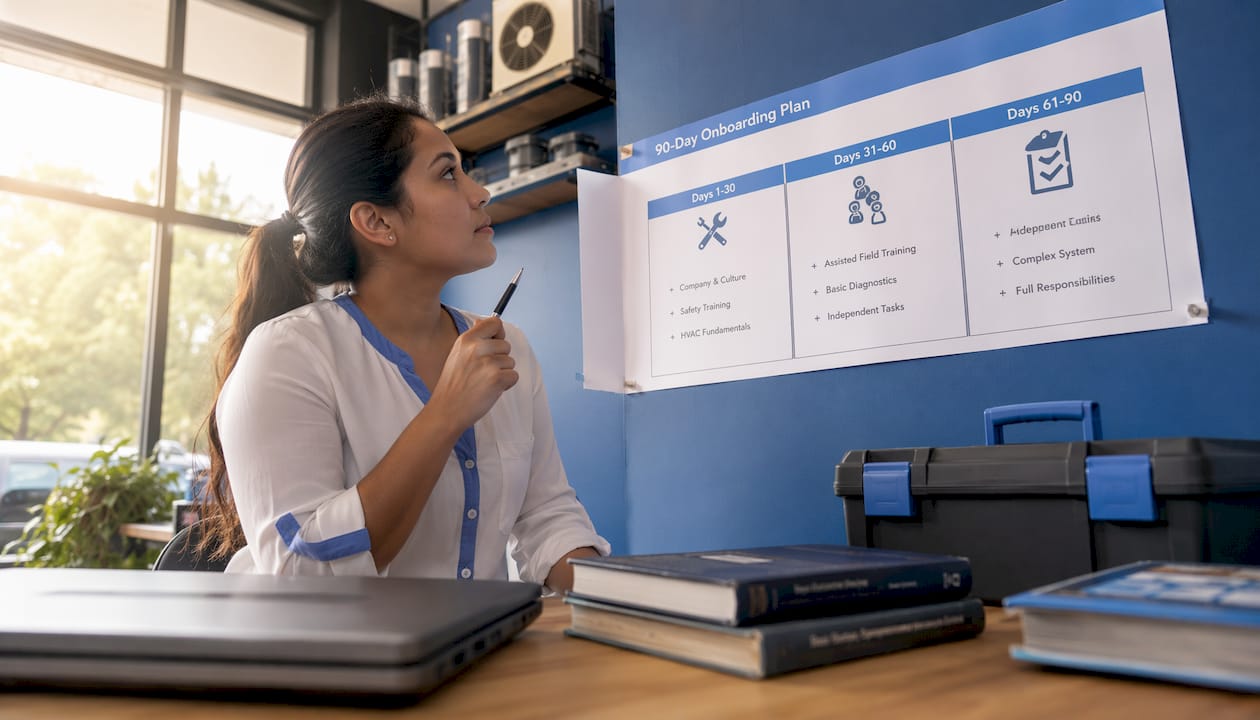
Use this timeline as a copyable template. Assign each task to a specific owner (manager, lead tech, or HR), and require a dated signature or digital confirmation before moving to the next phase.
| Phase | Tasks | Verification |
|---|---|---|
| Day 0 (pre-arrival) | Payroll setup, tax forms, uniform order, vehicle/tool assignment, software credentials, handbook sent | Manager checklist signed off |
| Day 1 | Orientation, team intro, facility tour, 90-day plan review, mentor introduction, safety overview | Orientation checklist signed |
| Week 1 (Days 2–5) | Shadow mentor on 3–5 jobs, review SOPs for top 5 service types, complete OSHA 10 enrollment, review dispatch workflow | Mentor daily log, SOP quiz |
| Day 30 | First competency signoff review, safety checklist completion confirmed, first-time-fix rate baseline established | Manager + mentor review meeting |
| Day 60 | Second competency review, first solo jobs logged, callback rate reviewed, training gaps identified | KPI dashboard review |
| Day 90 | Full competency signoff, 90-day retention confirmed, performance review, career path discussion | Formal written review |
Sample 30/60/90 benchmarks
- Day 30: 100% safety checklist completion, zero solo jobs without mentor sign-off, OSHA 10 enrollment confirmed
- Day 60: First-time-fix rate at or above 75% on assigned jobs, fewer than two callbacks, first solo jobs completed under mentor oversight
- Day 90: First-time-fix rate at or above 80%, time-to-first-solo-job documented, 90-day retention confirmed, EPA Section 608 certification verified
Day 0/1 checklist (copyable):
- Payroll and tax forms complete
- Uniform and PPE issued
- Vehicle and tools assigned (see tool ownership policies for your shop)
- Software logins active and tested
- Handbook and safety protocols sent 48 hours prior
- Mentor assigned and briefed
- 90-day plan printed and reviewed with hire on Day 1
Training methods that produce real skill retention
Tell→show→do, combined with immediate supervised practice, is the most effective training structure for trade technicians. Explaining a procedure, demonstrating it live, and then having the technician perform it under observation produces faster competency than classroom instruction alone.
Here is how to structure it:
- Tell: Walk through the procedure verbally, explaining the why behind each step. Use mobile-accessible SOPs and short video walkthroughs so the technician can review on the job.
- Show: The mentor performs the task on a real or simulated job while the new hire observes and asks questions.
- Do: The technician performs the task with the mentor present. The mentor scores the attempt against a competency rubric.
- Repeat with progressive autonomy: Reduce supervision incrementally as scores improve. Document each attempt and the date cleared for solo work.
Effective training plans include mobile-accessible SOPs, short videos, step-by-step guides, and role-based modules with sign-offs. For field technicians who spend most of their day in a truck or on a rooftop, mobile delivery is not optional.
Competency matrix example:
Score each skill at 30, 60, and 90 days. A technician should reach level 3 on core skills before working solo.
Short assessments work best when they combine a practical task with a brief written or verbal quiz. Example: have the technician walk through a lockout/tagout procedure on a training unit and answer three questions about when it applies. Score on a 1–4 rubric and log the result.
Pro Tip: Use micro-learning to reinforce training between jobs. A 3-minute video on refrigerant leak detection or a five-question quiz on electrical safety, pushed to a technician's phone before a relevant job type, builds retention without pulling them off the schedule.
Which systems and tools support a consistent onboarding program?
The right system stack eliminates the manual work that causes onboarding to fall apart. Without it, checklists get skipped, certifications go unverified, and managers discover gaps only after a callback or incident.
The five tools every HVAC onboarding program needs:
- Digital onboarding checklist: A structured, role-specific checklist that tracks completion of every pre-arrival and Day 1 task. Assign owners and due dates to each item.
- LMS or training library: A platform where you store SOPs, video walkthroughs, and role-based modules. Technicians access training on mobile; managers see completion status. Options range from purpose-built trade platforms to general tools like Trainual.
- ATS with onboarding workflows: An applicant tracking system that carries the hire from offer acceptance through Day 1 admin. Pre-hire paperwork, credential provisioning, and training assignment should trigger automatically when a candidate is marked hired.
- Field-service software integration: Your dispatch platform (ServiceTitan, FieldEdge, or similar) should be part of zero-day setup. A technician who cannot access dispatch on Day 1 cannot shadow effectively.
- Digital competency logs: Store every signoff, certification copy, and assessment score in a system that is searchable and exportable for insurer audits.
Common workflows to automate first: pre-hire paperwork (I-9, W-4, direct deposit), zero-day credential provisioning, and training module assignment triggered by job role. These three steps consume the most manager time and generate the most errors when done manually.
Pro Tip: Automate the payroll setup and tax form collection before Day 1. When a new hire spends their first morning filling out W-4s, it signals disorganization and wastes the orientation window you have to build culture and set expectations.
Safety and compliance requirements before solo fieldwork
No technician works independently until safety and compliance requirements are verified and documented. This is not a preference. It is a prerequisite for protecting your business, your customers, and the technician.
Required verifications before solo fieldwork:
- EPA Section 608 certification: Required by federal law for any technician who purchases or handles regulated refrigerants. Verify the certificate and store a copy digitally.
- OSHA 10-hour card: Many commercial clients require it. Enroll new hires in Week 1 and confirm completion by Day 30.
- Lockout/tagout (LOTO) procedure: Observed practical test required. Document the date and the trainer.
- PPE issuance and training: Safety glasses, gloves, and fall protection for rooftop work issued on Day 0. Confirm the technician knows when and how to use each item.
- Electrical safety basics: Verify understanding of arc flash risk, proper meter use, and when to de-energize before working.
- Ladder and rooftop safety: Observed practical test for any technician assigned to commercial rooftop work.
- State and local licensing: Check your state's requirements. Some states require a journeyman or contractor license for certain work types. Verify before assigning those job types.
- Refrigerant handling documentation: Log refrigerant recovery and charging training separately from EPA 608 certification.
Third-party certification and digital competency platforms show the highest impact on insurance outcomes. Internal checklists and ride-alongs are valuable but carry less weight with insurers than documented third-party credentials.
Primary sources to reference in your onboarding documentation: OSHA, EPA Section 608, and NATE for voluntary certification standards.
Pro Tip: For high-risk skills like LOTO and rooftop safety, never accept verbal confirmation. Require an observed practical test with a documented score. If an incident occurs and you cannot produce a signed, dated competency record, your liability exposure increases significantly.
How to measure whether your onboarding program is working
Measure five KPIs from Day 30 onward. These are the metrics that tell you whether your onboarding program is producing competent, safe, retained technicians.
| KPI | Definition | Measurement window | Target |
|---|---|---|---|
| First-time-fix rate | % of jobs resolved on the first visit | Monthly, per tech | ≥80% by Day 90 |
| Callbacks per tech | Jobs requiring a return visit within 30 days | Monthly | Declining trend from Day 30 to Day 90 |
| Time-to-first-solo-job | Days from start date to first unsupervised job | Single measure | Documented at Day 60 review |
| Safety incidents | Reported near-misses and injuries | Ongoing | Zero incidents in first 90 days |
| 90-day retention rate, reflecting continued employment at the end of the onboarding period | Cohort-based | Track against prior cohorts |
Track these in your LMS or ATS dashboard. A technician whose first-time-fix rate is below 70% at Day 60 needs a targeted training intervention, not a performance warning. The data tells you where the gap is.
Documented training and competency records also serve a second purpose: they are audit-ready evidence for your commercial liability insurer. Structured hiring, training, and competency verification lower claims frequency and severity over time. Bring your training logs to your next insurance renewal conversation.
Using employee feedback loops at the 30- and 60-day marks also surfaces training gaps before they become KPI problems. A short structured survey asking what the technician felt unprepared for gives you program improvement data that no callback report can provide.
Treat every training step as risk control
The most useful decision filter in HVAC onboarding is this: if a training module does not directly reduce callbacks, injuries, or confusion, simplify or remove it. This keeps your program focused, repeatable, and worth the time it takes.
Apply three questions to every module before you build or keep it:
- Does this reduce the risk of a callback or warranty claim?
- Does this reduce the risk of an injury or safety incident?
- Does this reduce confusion about a procedure, expectation, or standard?
If the answer to all three is no, cut it. If the answer to one is yes, keep it and document why.
A practical example: a new technician is assigned a residential AC tune-up on Day 45. He has completed the refrigerant recovery module but has not been cleared on the electrical diagnostic procedure. The mentor catches this during the pre-job briefing and rides along. The job reveals a failing capacitor that requires electrical diagnosis. Without the ride-along, the technician would have either missed the fault (callback) or attempted a repair outside his verified competency (safety risk). The training gap was caught because the competency matrix was current and the mentor checked it.
Pro Tip: Build the three-question filter into your monthly training review. Pull your callback log, cross-reference it with your training records, and ask which module, if it had been completed or reinforced, would have prevented each callback. That analysis tells you exactly where to invest your next training hour.
Key Takeaways
A structured 90-day HVAC onboarding program that combines zero-day readiness, tell→show→do training, documented competency signoffs, and five tracked KPIs is the most direct path to lower callbacks, fewer safety incidents, and higher 90-day retention.
| Point | Details |
|---|---|
| Zero-day readiness is non-optional | 90% of new hires are willing to quit within 30 days if credentials or uniforms are missing on Day 1; complete all setup 48 hours before arrival. |
| Onboarding spans 90 days, not one day | Orientation is a single event; onboarding is a months-long integration with documented milestones at Day 30, 60, and 90. |
| Five KPIs tell the whole story | Track first-time-fix rate, callbacks per tech, time-to-first-solo-job, safety incidents, and 90-day retention from Day 30 onward. |
| Safety verification must be documented | EPA Section 608, OSHA 10, lockout/tagout, and rooftop safety require observed practical tests and signed records before solo work. |
| Locatehire automates the admin layer | Locatehire's ATS handles pre-hire paperwork, zero-day credential provisioning, and training assignment so managers focus on field training. |
What actually separates good HVAC onboarding from costly failures
Most onboarding failures in HVAC are not training failures. They are operational failures that happen before the technician ever touches a unit.
The pattern is consistent: a manager hires a strong candidate, intends to run a solid onboarding program, and then gets pulled into a busy week. The new hire shows up to find no vehicle assigned, no software login, and a lead tech who was not told they were getting a shadow. The technician spends Day 1 waiting. By Day 5, they are updating their resume.
The fix is not a better training curriculum. It is a pre-arrival checklist with named owners and hard deadlines. The zero-day readiness steps are the ones most managers skip because they feel administrative, not technical. They are also the ones that determine whether the technician stays long enough to benefit from any training at all.
The other failure mode is the opposite: a manager who runs a thorough Day 1 orientation and then disappears. The technician gets sent on jobs without a mentor, makes mistakes, generates callbacks, and either gets frustrated or gets let go. Onboarding without a structured mentor relationship and documented competency milestones is just orientation with extra steps.
What works: assign a mentor with real tenure before the hire starts, build the 30/60/90 milestones into a written plan the technician sees on Day 1, and review KPIs at each checkpoint. The technician knows what is expected. The mentor knows their role. You have data to act on. That combination reduces callbacks, retains technicians, and builds the kind of team that competes for talent rather than scrambling to replace it.
Locatehire cuts the admin work so you can focus on field training
Every hour you spend chasing down W-4s, resending handbook links, or manually assigning training modules is an hour you are not spending on the field training that actually reduces callbacks. Locatehire is built to eliminate that gap for HVAC businesses.
Locatehire's AI-powered ATS handles the administrative layer of onboarding automatically. When a candidate is marked hired, pre-hire paperwork triggers immediately. Zero-day credentials, training module assignments, and onboarding checklists are provisioned before Day 1. Competency signoffs and training completion are tracked in one dashboard, exportable for insurer audits. The result: your manager shows up on Day 1 ready to run orientation, not still collecting tax forms.
For a small HVAC business running 5–20 technicians, that automation prevents the operational slip-ups that cause early resignations and training gaps. You get consistent onboarding every time, for every hire, without building a new process from scratch each season. Start with Locatehire and see how much of your onboarding admin can be handled before your next hire walks in the door.
Authoritative sources and standards for HVAC onboarding
Use these primary sources in your onboarding documentation, training modules, and insurer audit files. Keep digital copies of all certifications and training logs in your LMS or ATS.
- OSHA: Federal workplace safety standards, including electrical safety, fall protection, and lockout/tagout requirements. Reference OSHA 10-hour training for entry-level technicians and OSHA 30 for lead techs and supervisors.
- EPA Section 608: Federal certification requirement for technicians who purchase or handle regulated refrigerants. Verify and store certificates for every technician before they handle refrigerant.
- NATE (North American Technician Excellence): The leading voluntary certification body for HVAC technicians. NATE certification is a recognized competency benchmark and can support insurance and warranty documentation.
- UTI HVACR program: A structured trade school curriculum covering refrigeration diagnostics, electrical troubleshooting, and safety protocols. Useful as a reference for building your internal technical training modules.
- Ivy Tech HVAC program: Community college program with OSHA 10 integration and hands-on lab requirements. A useful benchmark for entry-level competency expectations.
Keep your documentation audit-ready. Store every certification, training log, and competency signoff in a digital system, not a paper folder. When an insurer, commercial client, or state licensing board asks for proof of technician competency, you need to produce it in minutes, not days. An LMS or ATS with exportable records is the only reliable way to do that at scale.
This article provides general guidance on HVAC onboarding and training practices. Confirm current OSHA, EPA, and state licensing requirements with the relevant primary sources or a qualified compliance professional for your specific situation.