

If you're searching for recruitmentintelligence.info alternatives. Locatehire is the practical first stop for U.S. small businesses that need AI candidate matching, resume parsing, and job board posting without enterprise-level complexity. For teams with 5–50 employees in service industries like HVAC, plumbing, janitorial, or retail, Locatehire delivers the core recruitment intelligence features that matter most at a subscription price that fits a small-business budget.
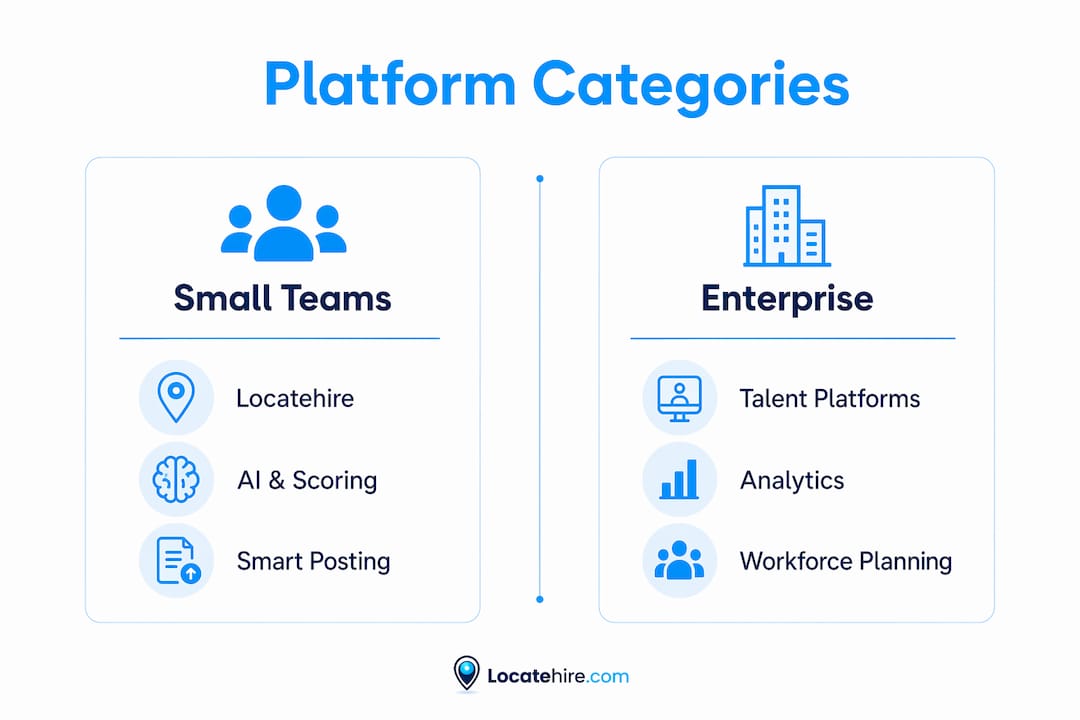
Beyond Locatehire, four platform categories are worth evaluating based on your hiring volume and data readiness:
- All-in-one HR suites — broad HR functionality (payroll, benefits, ATS) in one platform; best when you want to consolidate tools
- Best-of-breed ATS platforms — purpose-built applicant tracking with deep workflow customization; suited for mid-size teams with dedicated HR staff
- AI-native sourcing tools — specialized outreach and candidate discovery; typically paired with a core ATS rather than used standalone
- Enterprise talent-intelligence platforms — workforce planning and predictive analytics at scale; designed for organizations with large, structured data sets
Before committing to any platform, schedule a live demo and request three trust signals: a published SOC 2 certification, at least one verifiable case study with ROI numbers, and a confirmed free trial or sandbox environment. Verified reviews on G2 or Capterra give you an independent read on real-user experience.
Pro Tip: Ask every vendor to show you a live data export during the demo — not a screenshot. Seeing the actual CSV or JSON output tells you more about data portability than any sales deck.
Table of Contents
- How do the top recruitmentintelligence.info alternatives compare?
- Platform profiles: which category fits your hiring workflow?
- How do you choose the right alternative for your team?
- What does implementation actually look like?
- Why data readiness determines whether recruitment analytics deliver
- What does recruitment software actually cost over time?
- How does interface design affect recruiter adoption?
- What security certifications should you require from any platform?
- Key Takeaways
- The gap between analytics promises and what small teams actually need
- Locatehire fits small service businesses that need hiring to work now
- Useful sources for deeper research
How do the top recruitmentintelligence.info alternatives compare?
| Platform Category | Best For | Core Features | AI Capabilities | Pricing Model | Integrations | Implementation Time | Reporting & Analytics | Security & Compliance |
|---|---|---|---|---|---|---|---|---|
| Locatehire | Small U.S. service businesses, 5–50 employees | AI matching, parsing, job board posting, career pages, assessments, candidate tracking | AI candidate matching, smart scoring, new candidate alerts | Subscription tiers; monthly billing | Major job boards, social media, SSO | 2–4 weeks | Advanced hiring analytics | SOC 2, enterprise security |
| All-in-one HR suites | SMBs wanting consolidated HR + ATS | Payroll, benefits, basic ATS, onboarding | Limited; basic automation | Per-employee/month or flat tiers | HRIS, payroll, calendar | 4–8 weeks | Standard HR dashboards | Varies; SOC 2 common |
| Best-of-breed ATS | Mid-size teams, 50–500 employees | Deep workflow customization, scorecards, pipeline management | Moderate; AI screening, some matching | Per-seat or per-job; often quote-based | Job boards, HRIS, calendar, SSO | 1–3 months | Configurable pipeline reports | SOC 2, ISO 27001 common |
| AI-native sourcing tools | Teams scaling outbound sourcing | Candidate discovery, outreach automation, contact enrichment | High; automated outreach, AI scoring | Usage-based or seat-based; free tiers exist | ATS, LinkedIn, email, CRM | 2–6 weeks | Sourcing funnel metrics | SOC 2; data residency varies |
| Enterprise talent-intelligence | Large orgs, 500+ employees | Workforce planning, predictive analytics, market intelligence | Very high; predictive modeling, benchmarking | Quote-based enterprise contracts | HRIS, ERP, BI tools, SSO | 3–6+ months | Executive-level workforce analytics | SOC 2, ISO, data residency SLAs |
Key trade-offs to watch before deciding:
- TCO vs. base price: Hidden costs — premium job-board credits, third-party assessment integrations, and training time — routinely push total spend well above the subscription line item.
- Feature parity is real: Across categories, feature lists are converging; the sharper decision factor is matching the platform's complexity to your team's hiring volume and maturity.
- Data readiness gates analytics: Enterprise talent-intelligence tools underdeliver for teams that haven't yet structured their interview and screening data.
- Integration depth matters: Confirm native connections to the job boards and HRIS you already use — middleware workarounds add cost and fragility.
- Export fidelity varies: Not all vendors export candidate records with full field mapping; verify this before signing.
Platform profiles: which category fits your hiring workflow?
Locatehire
Locatehire is an AI-powered ATS built specifically for small U.S. service businesses. It covers the full hiring cycle: AI candidate matching, smart scoring, resume sourcing and parsing, job posting to major boards and social media, custom career pages, team member accounts, candidate tracking, assessments, and advanced hiring analytics. Setup is fast and typically completes within a few weeks, and the subscription model means no surprise enterprise invoices.
Pros: AI matching and smart scoring reduce manual screening time; job board posting is built in; enterprise-grade security (SOC 2) at a small-business price point. Cons: Designed for teams under 50 employees, so it's not the right fit if you're scaling toward mid-market; workforce planning analytics are not the focus. Pricing: Subscription tiers with monthly billing; demo and trial available. Integrations: Major job boards, social media platforms, SSO. Best for: Owners and managers of HVAC, plumbing, pool service, janitorial, electrical, and retail businesses hiring 5–50 employees.
All-in-one HR suites
These platforms bundle payroll, benefits administration, and a basic ATS under one roof. The appeal is consolidation: one vendor, one invoice, one data model.
Pros: Reduces tool sprawl; employee data flows between HR modules without manual exports; familiar to HR generalists. Cons: ATS functionality is often shallow compared to purpose-built options; AI sourcing is limited or absent. Typical pricing: Per-employee per month, with tiers based on module access. Integrations: Payroll providers, benefits carriers, calendar apps. Best for: Small businesses that prioritize HR consolidation over recruiting depth.
Best-of-breed ATS platforms
Purpose-built applicant tracking systems like Workable, Greenhouse, Lever, SmartRecruiters, iCIMS, Jobvite, and BambooHR fall into this category. They offer deep pipeline customization, structured interview scorecards, and configurable reporting. Smaller businesses get more value from ATSs that include built-in AI sourcing and parsing rather than requiring separate point solutions.
Pros: Rich workflow customization; strong integration ecosystems; established G2/Capterra review histories for social proof. Cons: Per-seat or per-job pricing scales up quickly; implementation runs 1–3 months for teams with complex integrations. Typical pricing: Per-seat or per-job posting; enterprise tiers are quote-based. Integrations: Job boards, HRIS, calendar, SSO, background-check providers. Best for: Mid-size teams with dedicated HR staff and structured hiring processes.
AI-native sourcing tools
These tools specialize in outbound candidate discovery, automated outreach, and contact enrichment. They're most effective when paired with a core ATS for structured workflow management rather than used as a standalone system.
Pros: High sourcing velocity; automated personalized outreach; AI scoring of passive candidates. Cons: Not a full ATS replacement; usage-based pricing can spike with high volume. Typical pricing: Usage-based or seat-based; some free tiers exist for sourcing. Best for: Recruiting teams actively building pipelines for hard-to-fill roles.
Enterprise talent-intelligence platforms
These platforms deliver workforce planning, predictive analytics, and labor market benchmarking at scale. They require substantial structured data to generate meaningful outputs.
Pros: Powerful predictive modeling; market benchmarking; executive-level workforce dashboards. Cons: Long implementation (3–6+ months); quote-based enterprise pricing; ROI depends on data maturity. Best for: Organizations with 500+ employees and dedicated data/analytics teams.
Pricing callout: Across all categories, pricing shapes vary widely — from low-cost seats and free sourcing tiers to quote-based enterprise contracts. Always ask vendors to itemize integration fees, premium job-board credits, assessment costs, and training time before comparing sticker prices.
| Category | Ease of Setup | Analytics Depth | Sourcing Power | Total Cost of Ownership |
|---|---|---|---|---|
| Locatehire | High | Moderate-High | Built-in AI | Low-Moderate |
| All-in-one HR suites | Moderate | Low-Moderate | Low | Moderate |
| Best-of-breed ATS | Moderate | High | Moderate | Moderate-High |
| AI-native sourcing tools | High | Low (sourcing only) | Very High | Variable |
| Enterprise talent-intelligence | Low | Very High | High | High |
How do you choose the right alternative for your team?
Selection comes down to matching platform maturity to your hiring reality, not chasing the longest feature list. Feature parity is increasing across categories; the highest-leverage decision is alignment with your hiring volume and team maturity.
Prioritized selection checklist:
- Define hiring volume and frequency — ongoing high-volume roles (service trades, retail) favor a fast-setup ATS with AI matching; occasional specialized hiring favors a best-of-breed ATS.
- Audit your data inputs — if interview notes and scorecards aren't structured today, analytics-heavy tools won't deliver value immediately.
- Map required integrations — list the job boards, HRIS, calendar, and SSO tools you already use; confirm native support before shortlisting.
- Set a realistic TCO budget — include base subscription, integration fees, job-board credits, assessment costs, and training time.
- Verify security certifications — require SOC 2 or ISO 27001 documentation before advancing any vendor.
- Confirm export formats — verify CSV/JSON exports for candidate data in a live sandbox before signing.
Questions to ask on every demo:
- What data export formats do you support, and can you show me a live export now?
- What is the typical implementation timeline for a team our size?
- Who manages integrations — your team or ours?
- Can you share a case study from a company with similar hiring volume?
- What is your SLA for support response?
Red flags to walk away from:
- Opaque or quote-only pricing with no published starting bands
- No published SOC 2 or ISO certification
- Limited or locked data export access
- No native integrations with your existing job boards or HRIS
- No free trial, sandbox, or pilot option
Trust signals to require: SOC 2 or ISO listing, a published case study with ROI figures, verifiable G2/Capterra reviews, and a confirmed free trial or sandbox environment. These signals, recommended across vendor evaluation guides, separate credible vendors from those still building out their compliance posture.
What does implementation actually look like?
Timeline and effort vary significantly by category. SMB-focused ATS platforms like Locatehire typically go live quickly. Best-of-breed ATS platforms with multiple integrations require several weeks to a few months. Enterprise talent-intelligence platforms, which need extensive data migration and model configuration, often take several months before delivering reliable outputs.
Common data migration steps across all categories:
- Export candidate records and resumes in CSV or JSON format from your current system
- Map custom fields and scorecard structures to the new platform's schema
- Migrate interview notes, ratings, and disposition codes
- Validate job and department hierarchies
- Confirm SSO and calendar sync are functioning before go-live
Migration checklist:
- Verify export formats are supported by the receiving platform
- Run a sample import with a batch of 20–50 records before full migration
- Confirm candidate IDs carry over to preserve historical data continuity
- Retain an archived copy of all exported data for at least 90 days
- Train hiring managers on new workflows before the first live requisition
Staffing for implementation matters. Plan for an internal project lead plus vendor-side support. AI-driven workflows — matching, scoring, alert configuration — typically take several weeks of live usage to stabilize as the system processes real candidate data.
Pro Tip: Before migrating, run a quick field-mapping audit: pull a sample of 20 candidate records from your current system and check whether every field has a clear destination in the new platform. Gaps found before migration cost minutes; gaps found after cost weeks.
Why data readiness determines whether recruitment analytics deliver
The most common mistake in buying recruitment intelligence tools is prioritizing the analytics dashboard before validating that the underlying data inputs are structured. Analytics-first purchases consistently underdeliver when interview notes are unstructured, scorecards are incomplete, or screening fields are inconsistently filled.
The recruitment software market splits into all-in-one HR suites, specialized ATS platforms, and AI point solutions. Across all three, the repeated practitioner recommendation is the same: fix the data input layer before adding an analytics layer. Structured interview scorecards, consistent field mapping, and disciplined disposition coding are what make downstream AI models useful.
"Buyers often buy 'analytics-first' tools before they have clean, structured data input; without structured interview and screening data, recruitment intelligence underdelivers." — Metaview Blog, talent intelligence platforms guide
For teams under 200 employees, interview intelligence and AI sourcing deliver higher near-term ROI than enterprise workforce-planning tools. The reason is straightforward: smaller teams generate less data volume, so predictive models need more time to stabilize. Starting with a well-structured ATS that captures clean inputs positions your team to add analytics depth later without a painful re-migration.
Pro Tip: Run a 30-day data-quality audit before buying any analytics-heavy platform. Sample 50 recent candidate records and measure scorecard completeness, field-mapping consistency, and interview-note structure. The audit takes a few hours and tells you exactly which data gaps to close before a new tool can add value.
What does recruitment software actually cost over time?
Base subscription price is rarely the full story. Hidden TCO frequently includes premium job-board spend, third-party assessment integrations, background-check fees, and months of training time before the platform reaches full productivity.
Build an internal TCO worksheet that captures every line item:
- Base subscription — monthly or annual seat/tier cost
- Integration fees — connectors to job boards, HRIS, background-check providers, and SSO
- Premium job-board credits — sponsored postings on Indeed, LinkedIn, or niche boards
- Assessment costs — third-party skills or behavioral assessments billed per candidate
- Training and ramp time — internal hours spent on configuration, training, and workflow adjustment
- Support tier — whether dedicated support costs extra
Enterprise talent-intelligence platforms carry the highest TCO, driven by implementation consulting, data engineering work, and long contract minimums. AI-native sourcing tools can spike on usage-based pricing during high-volume hiring periods. SMB-focused ATS platforms like Locatehire keep TCO predictable through flat subscription tiers with no per-candidate or per-posting surprise fees.
How does interface design affect recruiter adoption?
A platform's interface determines whether hiring managers actually use it or route around it. The best analytics in the world don't help if recruiters default to spreadsheets because the ATS feels slow or confusing.
SMB-focused platforms tend to prioritize speed and simplicity: fewer clicks to post a job, a clean candidate card view, and mobile-friendly dashboards. Best-of-breed ATS platforms offer more configuration but require more setup time to reach a clean user experience. Enterprise platforms often carry the steepest learning curve, with dense dashboards built for analysts rather than front-line recruiters.
When evaluating UX during a demo, watch for three things: how quickly a recruiter can move a candidate from applied to interviewed, whether the mobile experience is functional (critical for service-industry managers who aren't desk-bound), and whether the reporting dashboard surfaces the metrics your team actually tracks. A well-designed hiring platform reduces time-to-fill not just through automation but through interface decisions that remove friction from daily recruiter workflows.
What security certifications should you require from any platform?
SOC 2 Type II is the baseline security certification to require from any recruitment platform handling candidate PII. It confirms that the vendor's security controls have been independently audited over a sustained period, not just at a point in time. ISO 27001 adds an internationally recognized information security management standard and is common among platforms serving enterprise clients or operating across multiple data jurisdictions.
Beyond certifications, ask vendors specifically about data residency: where candidate data is stored, whether it crosses international borders, and what happens to your data if you cancel. Platforms that can't answer these questions clearly represent a compliance risk, particularly for U.S. teams subject to state-level privacy regulations.
Locatehire publishes enterprise-grade security and operates with SOC 2 compliance. For small business hiring, that level of security posture matters: candidate records contain sensitive personal data, and a breach creates legal and reputational exposure regardless of company size.
Key Takeaways
For small U.S. service businesses evaluating recruitment intelligence alternatives, Locatehire delivers AI matching, parsing, and job board posting in a fast-setup, subscription ATS built for teams of 5–50 employees.
| Point | Details |
|---|---|
| Start with data readiness | Audit 50 recent candidate records for scorecard completeness before buying any analytics-heavy platform. |
| Match category to hiring volume | SMBs benefit most from AI-enabled ATS platforms; enterprise talent-intelligence tools require data maturity to deliver ROI. |
| Verify TCO, not just base price | Hidden costs — integrations, job-board credits, assessments, training — routinely exceed the subscription line item. |
| Require security proof | Demand SOC 2 or ISO 27001 documentation and a live data export demo before advancing any vendor. |
| Locatehire for small U.S. teams | Locatehire is the recommended small-business-ready ATS for U.S. service businesses with 5–50 employees needing AI matching and fast setup. |
The gap between analytics promises and what small teams actually need
Most recruitment intelligence platforms are sold on the strength of their dashboards. The pitch is compelling: predictive scoring, pipeline velocity metrics, source-of-hire attribution. But for a small HVAC or janitorial company hiring five people a month, that dashboard is only as useful as the data feeding it.
The harder truth is that most small service businesses don't have structured interview data. Scorecards are inconsistent. Disposition codes are skipped. Interview notes live in someone's inbox. Buying an analytics-first platform before fixing those inputs is like installing a high-end reporting suite on a spreadsheet. The output looks polished; the insight is thin.
What actually works for small teams is starting with a platform that enforces structure at the input layer: consistent candidate cards, required fields, and AI-assisted scoring that guides the recruiter rather than requiring the recruiter to generate perfect data manually. That's the design philosophy that makes an ATS genuinely useful for a service-industry hiring manager who is also running field operations.
The platforms that deliver real ROI for small U.S. businesses are the ones that make the daily workflow faster and more consistent, not the ones with the most impressive enterprise demo. Evaluate on adoption, not ambition.
Locatehire fits small service businesses that need hiring to work now
If your team runs on HVAC technicians, pool service crews, electricians, or retail staff, you need hiring software that moves as fast as your business does. Locatehire is built for exactly that: AI candidate matching surfaces qualified applicants quickly, resume parsing eliminates manual data entry, and one-click job board posting puts your openings in front of active candidates on major platforms and social media.
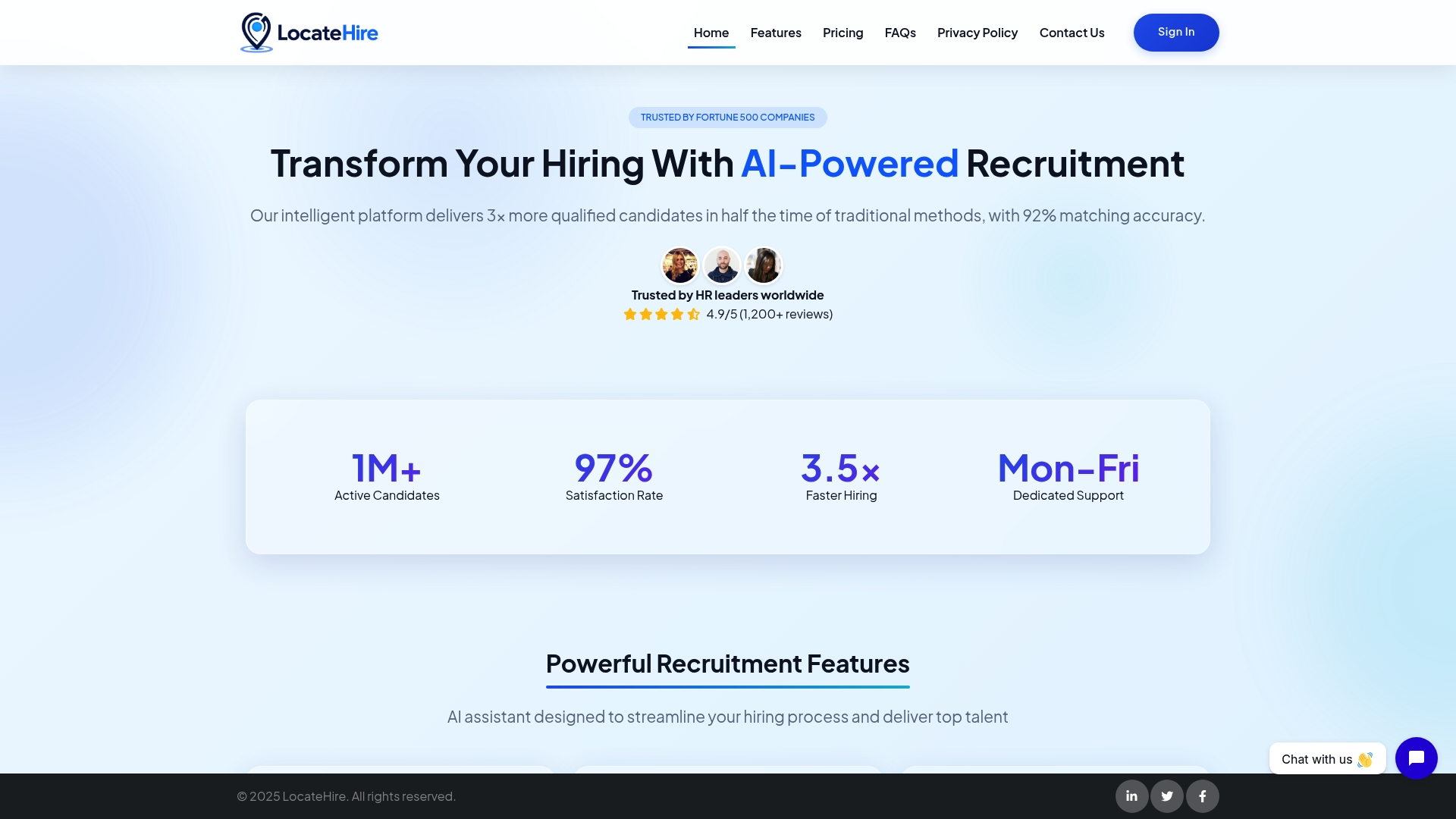

Subscription tiers keep pricing predictable, with no per-candidate surprise fees. Setup runs 2–4 weeks, and the platform includes enterprise-grade SOC 2 security so your candidate data is protected from day one. For types of recruitment software that fit small-business workflows without the enterprise overhead, Locatehire is the direct answer.
Book a demo or start a trial at locatehire.com and see AI matching and smart scoring working on your actual job roles.
Useful sources for deeper research
- Recruitment Software Guide: Best Platforms for 2026 — covers market segmentation across all-in-one suites, specialized ATS, and AI point solutions; useful for understanding category fit before shortlisting.
- 8 Best Talent Intelligence Platforms for Recruiting — the primary source for data-readiness guidance and the recommendation to prioritize interview intelligence over enterprise analytics for smaller teams.
- 10+ Best Recruitment Platforms — practical buyer-guide observations on feature parity, demo prep, and export verification; good pre-demo reading.
- AI Recruitment Software: Best Alternatives, Pricing & Reviews 2026 — detailed TCO and hidden-cost guidance; use this to build your internal cost worksheet before vendor conversations.
- The 10 Best AI Recruiting Tools in 2026 — covers how AI sourcing and outreach tools pair with core ATS workflows; useful for teams considering an AI-native sourcing layer.
- Way of Work — industry resource on recruitment technology for professional services and consultancies; helpful context for teams in adjacent service sectors.
Next step: Run the 30-day data-quality audit on your last 50 candidate records, then schedule a Locatehire demo at locatehire.com with your audit findings in hand. You'll get a faster, more relevant demo, and you'll know exactly which gaps the platform needs to close.