

Indeed is defined as the world's largest job site, connecting over 3 million employers with 300 million monthly visitors to post jobs, screen candidates, and manage hiring from a single platform. For small business owners and HR managers, understanding what is indeed for employers means recognizing it as more than a job board. It is a full recruiting system with free and paid posting options, a centralized employer dashboard, and built-in tools for screening, scheduling, and candidate communication. Whether you run a pool service company, a janitorial crew, or a retail shop, Indeed gives you direct access to a candidate pool that few platforms can match.
What are the main features of the Indeed employer platform?
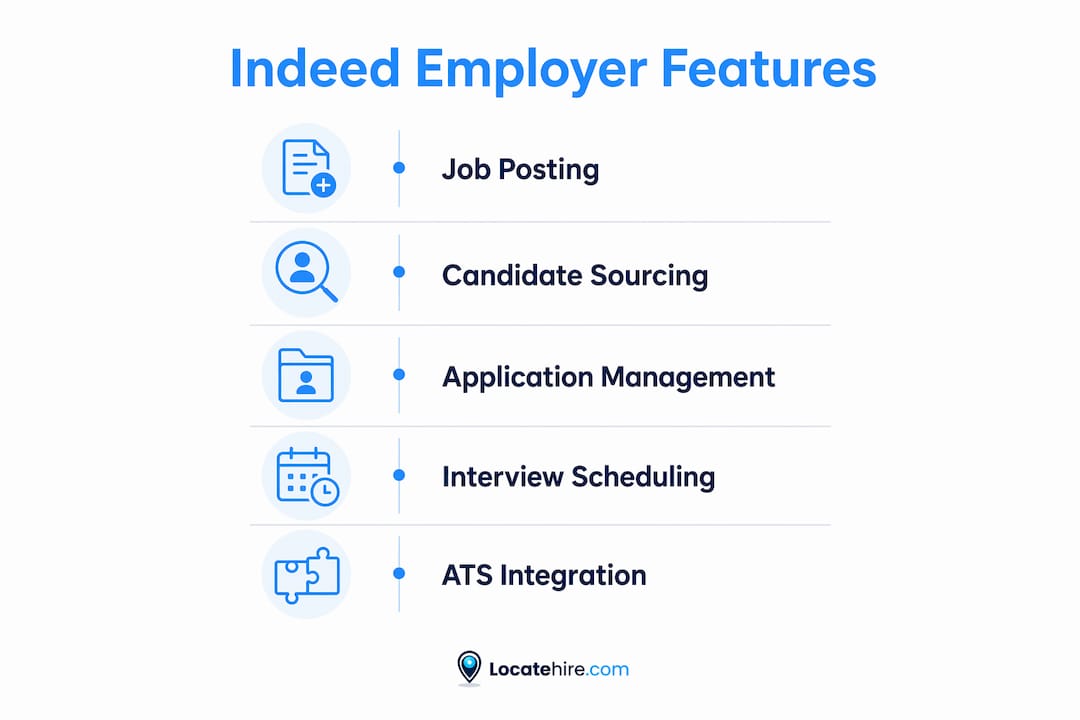
The Indeed platform for employers is built around four core capabilities: job posting, candidate sourcing, application management, and hiring analytics. Each feature connects to the others inside a single employer account, so you are not jumping between tools to move a candidate forward.
Job posting options
Indeed offers two posting models. Free listings appear in search results but decline in visibility over time as newer posts push them down. Sponsored jobs run on a pay-per-click budget model, giving your listing priority placement in front of job seekers who match your criteria. The choice between free and sponsored is not permanent. You can mix both depending on the role and urgency.
Employer dashboard
The dashboard is the control center for every open role. From one screen, you can review applications, read screener responses, message candidates, and schedule interviews. Managing the entire hiring process from this centralized view cuts the back-and-forth that slows down small hiring teams.

Smart Sourcing and virtual interviews
Indeed's Smart Sourcing feature proactively surfaces candidates who match your job requirements, even before they apply. Virtual interviewing is built directly into the platform, so you can conduct video interviews without a third-party tool. Both features reduce the time between posting and first conversation.
Indeed Apply and ATS integration
Indeed Apply lets candidates submit applications without leaving the platform. Jobs using Indeed Apply are 2.4 times more likely to lead to a hire than those without it. That number reflects how much friction removal matters in recruiting. If your business already uses an applicant tracking system, Indeed syncs with it to automate job feeds and keep candidate records in one place.
Pro Tip: Turn on Indeed Apply for every role you post. The drop-off rate between "interested" and "applied" shrinks significantly when candidates do not have to leave the platform to complete an application.
How does the job posting and visibility system work on Indeed?
Visibility on Indeed is not guaranteed. It is earned through posting type, post quality, and ongoing management. Understanding how the system works helps you spend less and get more applicants.
- Free listings go live immediately but begin losing search rank within days as newer posts appear. A free listing for a plumber posted today will likely sit below newer listings by next week.
- Sponsored jobs use pay-per-click pricing, meaning you set a daily or total budget and pay only when a job seeker clicks your listing. Sponsored jobs receive more impressions and applications, making them effective in competitive or urgent hiring situations.
- Post quality affects visibility directly. Indeed's algorithm favors complete, accurate, and policy-compliant listings. Vague titles, missing salary ranges, or misleading descriptions reduce your reach.
- Indeed's Trust and Safety policies require transparency in job posts. Compliance with posting policies improves visibility and prevents listings from being hidden or removed.
- Budget rotation is a proven tactic for small businesses. Rather than sponsoring every open role, focus paid budget on the hardest-to-fill positions. Rotate sponsorship as priorities shift. This approach stretches a limited recruiting budget without sacrificing applicant volume on critical roles.
Pro Tip: Write your job title exactly as a candidate would search for it. "HVAC Technician" outperforms "Field Service Pro" every time. Clarity in the title is the single fastest way to improve click-through on any listing.
Avoiding common errors in your listings also protects your visibility. A guide on job posting mistakes small business owners make covers the specific errors that tank performance on platforms like Indeed.
How does Indeed assist employers in managing candidates and hiring workflows?
Indeed consolidates the tasks that normally scatter across email, spreadsheets, and phone calls into one place. For a small business owner who is also the hiring manager, that consolidation is the real value.
The employer dashboard lets you move candidates through stages, from applied to reviewed to interviewed to offered. You can see every applicant's resume, screener answers, and communication history in a single view. This eliminates the "where did I put that resume" problem that costs small teams real time.
Key workflow features include:
- Screener questions: Add custom questions to your application to filter out candidates who do not meet basic requirements. A pool service company can ask whether an applicant has a valid driver's license before reviewing a single resume.
- Interview scheduling: Candidates can self-schedule interviews based on your available time slots. This removes the back-and-forth of coordinating calendars by email.
- Direct messaging: Send and receive messages with candidates inside the platform. All communication stays attached to the candidate record.
- Virtual interviews: Conduct video interviews without leaving Indeed. This is especially useful for initial screening rounds when you have a high volume of applicants.
- ATS integration: Syncing your ATS with Indeed automates job postings and maintains a unified candidate database for compliance and audit trails. Manual data entry errors disappear, and every candidate record stays current across both systems.
The result is a hiring workflow that a two-person HR team can manage without losing track of candidates or missing follow-ups.
What are the benefits and best practices for using Indeed as a small business employer?
The benefits of using Indeed for small businesses come down to three things: reach, cost control, and time savings. The platform's massive candidate volume makes it the go-to choice for roles requiring rapid volume hiring, particularly in retail, hospitality, and local services. A janitorial company hiring ten cleaners in one month needs that kind of reach.
Cost control comes from the free-and-sponsored mix. You do not have to pay for every application. Free listings handle steady-state hiring. Sponsored listings handle urgent or competitive roles. The pay-per-click model means you only pay when someone engages with your post, not just for the listing to exist.
Best practices for small business employers on Indeed:
- Use screener questions on every post. Screener questions reduce low-intent applicants who apply without reading the requirements. For high-volume roles like retail or field service, this filter alone can cut review time in half.
- Write complete job descriptions. Include pay range, schedule, location, and physical requirements. Candidates who apply with full information are more likely to show up for interviews.
- Review Indeed Analytics regularly. The platform shows you how many people viewed your post, how many clicked, and how many applied. Use that data to adjust your title, description, or budget before a posting goes stale.
- Post jobs on multiple platforms alongside Indeed to maximize reach. A guide on posting jobs across platforms for free explains how to do this without adding significant time to your process.
- Enable Indeed Apply on all listings. The 2.4x hire rate improvement is not a small margin. It reflects a real behavioral shift in how candidates complete applications when friction is removed.
Understanding how applicant screening works for small businesses gives you a framework for building screener questions that actually filter the right candidates, not just the fastest ones.
Key Takeaways
Indeed is the most effective job platform for small businesses that need high-volume local hiring, combining free listings, sponsored pay-per-click posts, and a centralized dashboard to manage the full hiring workflow.
| Point | Details |
|---|---|
| Two posting models | Free listings lose visibility over time; sponsored posts use pay-per-click for priority placement. |
| Indeed Apply drives hires | Jobs with Indeed Apply are 2.4 times more likely to result in a hire than those without it. |
| Dashboard centralizes hiring | One screen handles applications, screener responses, messaging, and interview scheduling. |
| Screener questions save time | Custom filters remove low-intent applicants before you review a single resume. |
| ATS integration prevents errors | Syncing your ATS with Indeed automates postings and keeps candidate records accurate across both systems. |
Why I treat Indeed like a paid ad channel, not a job board
Most small business owners post a job on Indeed and wait. That passive approach works until it does not, usually right when you need to fill a role fast. The shift that changed how I think about the platform was treating it like a performance marketing funnel, not a static listing board.
Viewing Indeed as a marketing funnel means you watch the numbers. If your post gets 200 views and 3 applications, the problem is not the platform. It is the post. You fix the title, add a salary range, or tighten the description. Then you check again in 48 hours.
The other mistake I see constantly is sponsoring every open role at once. That burns budget fast and rarely produces better results than a focused approach. Rotate your sponsored budget to the roles that are genuinely hard to fill or time-sensitive. Let free listings handle the rest. A retail store hiring seasonal help does not need to sponsor a cashier role in january. It does need to sponsor a shift supervisor role in october when every competitor is hiring at the same time.
The employer dashboard is underused by most small business teams. The screener question feature alone can eliminate 40% of unqualified applicants before you open a single resume. Set it up once per role type and reuse it. The time savings compound quickly when you are hiring at volume.
— Jeff
How Locatehire fits into your hiring process alongside Indeed
Indeed gives you reach. Locatehire gives you control over what happens after the applications arrive.
Locatehire is an applicant tracking system built specifically for small businesses with ongoing hiring needs, including pool service, HVAC, electrical, plumbing, janitorial, and retail. It handles the workflow that Indeed does not: organizing applicants across multiple job boards, tracking candidates through your pipeline, and keeping your hiring process consistent whether you are filling one role or twenty. If you are already using Indeed to attract candidates, Locatehire connects that inbound flow to a structured process so nothing falls through the cracks. Visit Locatehire to see how it works for businesses like yours.
FAQ
What is Indeed for employers?
Indeed for employers is a hiring platform that lets businesses post jobs, screen applicants, schedule interviews, and manage the full hiring process from one dashboard. It connects employers with over 300 million monthly visitors.
How much does it cost to post a job on Indeed?
Free job postings are available at no cost but lose visibility over time. Sponsored jobs use a pay-per-click model where you set your own budget and pay only when a candidate clicks your listing.
How does Indeed Apply help employers get more hires?
Indeed Apply removes the step of redirecting candidates to an external site. Jobs with Indeed Apply are 2.4 times more likely to result in a hire compared to listings without it.
Can small businesses integrate Indeed with their ATS?
Yes. Indeed integrates with most applicant tracking systems via Indeed Apply, automating job feeds and keeping candidate records synchronized to prevent manual errors and maintain audit trails.
What types of businesses benefit most from using Indeed?
Indeed is especially effective for businesses that hire at volume or need to fill roles quickly, including retail, hospitality, field services like HVAC and plumbing, and janitorial companies. Its large candidate pool makes it the strongest option for local, high-frequency hiring.