
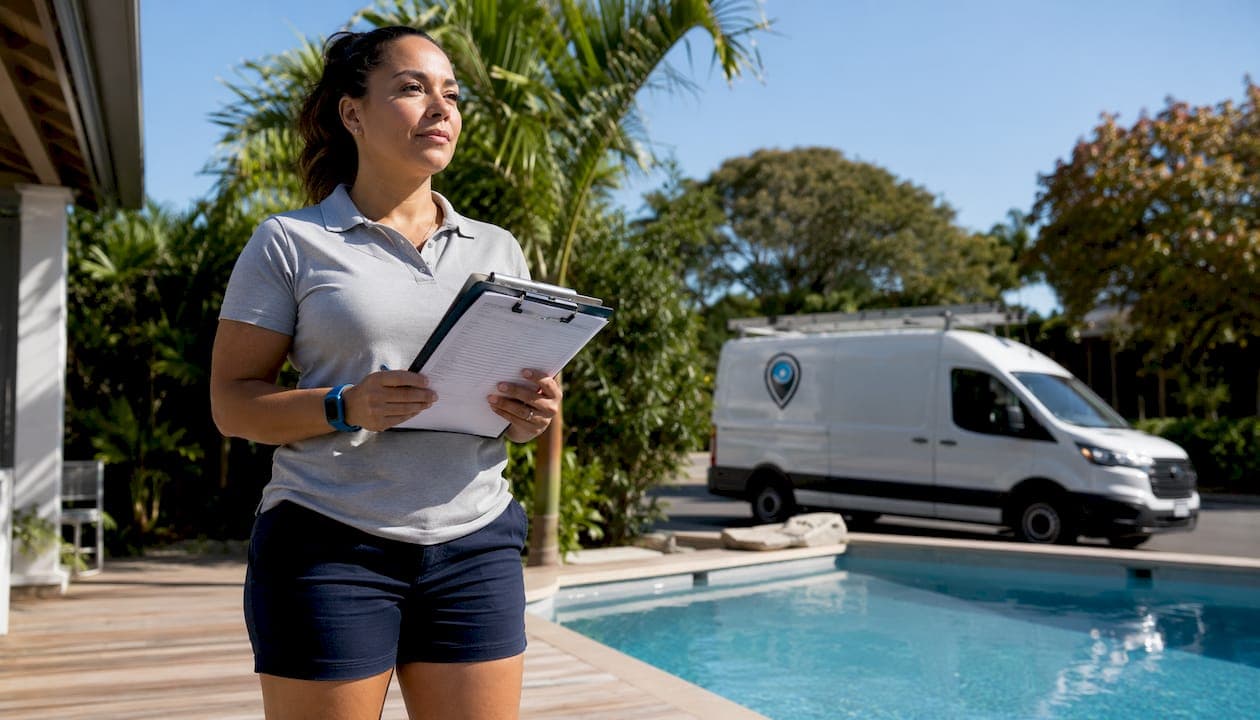
The fastest way to hire pool service technicians fast is to launch a 7-day hiring sprint today: post a pay-first job ad across multiple boards, activate an employee referral bonus, and schedule paid ride-alongs within 72 hours. The national average time-to-fill is 44 days according to industry reports, but owners who run a structured sprint with an ATS like Locatehire to centralize posts and automate screening report faster hires. Run this sprint when your solo route consistently hits 60–80 pools and you're turning away work.
Table of Contents
- What's your fastest path to hire pool techs right now?
- Where do you find qualified pool technicians quickly?
- How do you screen pool tech candidates fast without cutting corners?
- How does recruitment software speed up every step of this process?
- How do you make offers fast and get new hires productive in 30 days?
- Which KPIs tell you whether your hiring is actually getting faster?
- What mistakes slow your hiring or produce bad hires?
- What's the single next step if you need hires right now?
- Key Takeaways
- Why this playbook works for small pool-service businesses
- Locatehire cuts your time-to-hire without adding admin work
- Useful sources and further reading
What's your fastest path to hire pool techs right now?
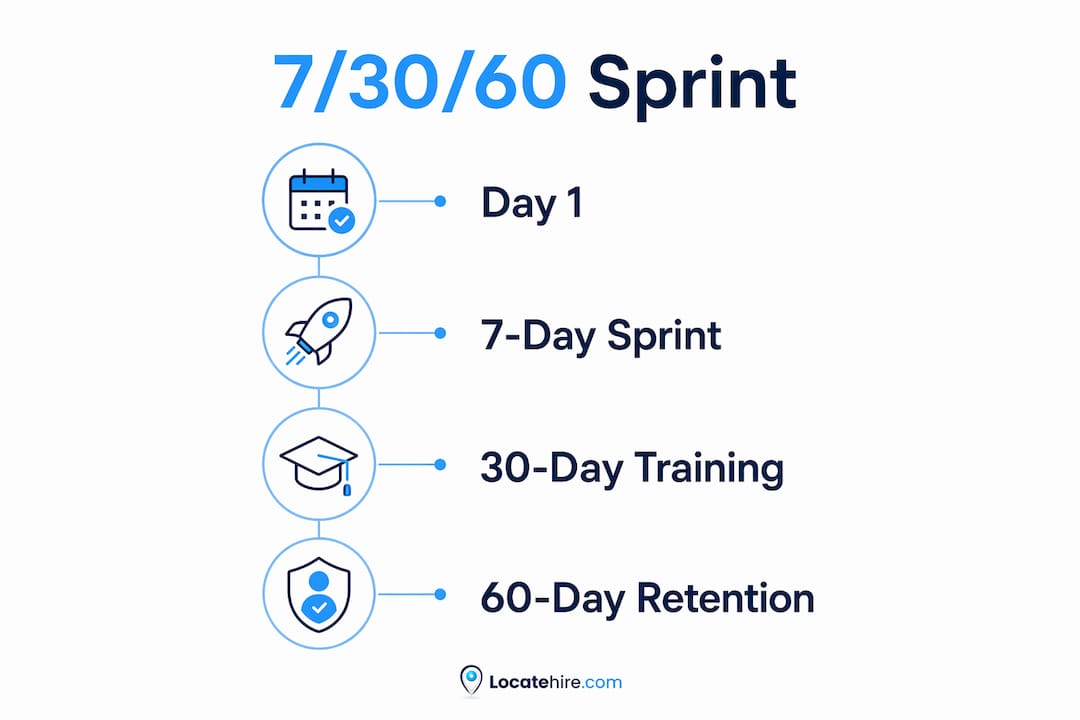
Start here. This 7/30/60-day plan gives you a clear sequence from first post to solo-route-ready hire.
Days 1–7: The hiring sprint
- Write and post a pay-first job ad (lead with hourly rate, top 3 benefits, "paid ride-along included") on Indeed, Facebook local job groups, and Craigslist.
- Text every employee and your top 10 customers a one-line referral message: "We're hiring a pool tech. Know someone reliable? We pay a $300 referral bonus if they stay 90 days."
- Phone screen every applicant within 24 hours. Five minutes. Three questions. Done.
- Schedule a paid full-day ride-along for every qualified candidate within 48 hours of the screen.
- Run a background check and driving-record check the same day as the ride-along offer.
Days 8–30: Structured onboarding
- Complete I-9, W-4, direct deposit, and equipment provisioning on Day 1.
- Weeks 1–2: new tech shadows every stop.
- Weeks 3–4: tech runs the route; you ride along and correct privately.
- Make the final offer the same day the ride-along ends. Good candidates disappear fast.
Days 31–60: Route independence and retention
- Assign a small solo route (8–10 easy stops) in Week 5.
- Set a 60-day deadline for the CPO exam (roughly $300, 16 hours of self-study).
- Schedule a formal 60-day performance review and a pay raise tied to CPO completion.
- Begin mentorship pairing if you have a second tech on staff.
Milestone table:
| Milestone | Target Day |
|---|---|
| Job ad live on 3+ boards | Day 1 |
| First phone screens complete | Day 2–3 |
| First paid ride-along scheduled | Day 3–4 |
| Background check initiated | Day 4–5 |
| Conditional offer made | Day 5–7 |
| Onboarding paperwork complete | Day 8 |
| Tech runs assisted route | Day 15 |
| Tech runs solo subset | Day 30 |
| CPO exam deadline | Day 60 |
Where do you find qualified pool technicians quickly?
Referred hires tend to stay longer than those hired through job boards, making your employee and customer network the highest-ROI channel. Pair referrals with high-volume boards for speed.
| Channel | Cost | Applicants/30 Days | Quality | Best Use |
|---|---|---|---|---|
| Employee referrals | $300 bonus | 2–5 | Highest | First call every time |
| Indeed | — | 15–30 | Medium | Volume and speed |
| Facebook local groups | Free | 5–15 | Medium | Passive candidates |
| Craigslist | Free–$25 | 5–10 | Variable | Smaller markets |
| Trade schools / community colleges | Free | 2–5 | High | Quality over speed |
| Cross-trade outreach (HVAC, landscaping, pest control) | Free | 3–8 | High | Fastest ramp time |
| Temp staffing | Agency fee | Immediate | Variable | Emergency coverage only |
Posting tips that get responses:
- Lead the first line with pay range using marketing strategies for home services that highlight pay transparently, as listings that hide pay get fewer quality applicants.
- List the top three benefits in the first three lines (pay, schedule, paid ride-along).
- Keep the description under 400 words with a clear call to action.
- Mention "paid ride-along" explicitly. It signals fairness and filters serious candidates.
Cross-trade candidates from HVAC, landscaping, and pest control tend to ramp faster than candidates without any trade background. They already understand route-based outdoor work and homeowner interaction.
Pro Tip: Post to multiple job boards simultaneously using a single ATS submission rather than logging into each platform separately. That alone saves 45–60 minutes per open role.
How do you screen pool tech candidates fast without cutting corners?
Speed and safety are not opposites here. A tight three-step workflow gets you from applicant to conditional offer in under a week.
Step 1: 5-minute phone screen. Ask these six questions:
- Are you comfortable working outdoors in heat for 6–8 hours?
- Do you have a valid driver's license and clean driving record?
- Can you start within two weeks?
- What were your last three jobs and why did you leave each one?
- Do you have reliable transportation to our service area?
- Are you available Monday through Friday, 7 AM–4 PM?
Step 2: Paid full-day ride-along. An 8-hour ride-along reveals reliability, work ethic, and instruction-following more accurately than any interview. Pay the candidate for the day. It's an audition for both sides. Use the ride-along to verify references informally by asking about past supervisors and job situations.
Step 3: Background and driving checks. Pool technicians access private residential property. Skipping background checks is a major liability risk. Run a criminal background check, driving-record check, and complete I-9 verification before the first solo shift.
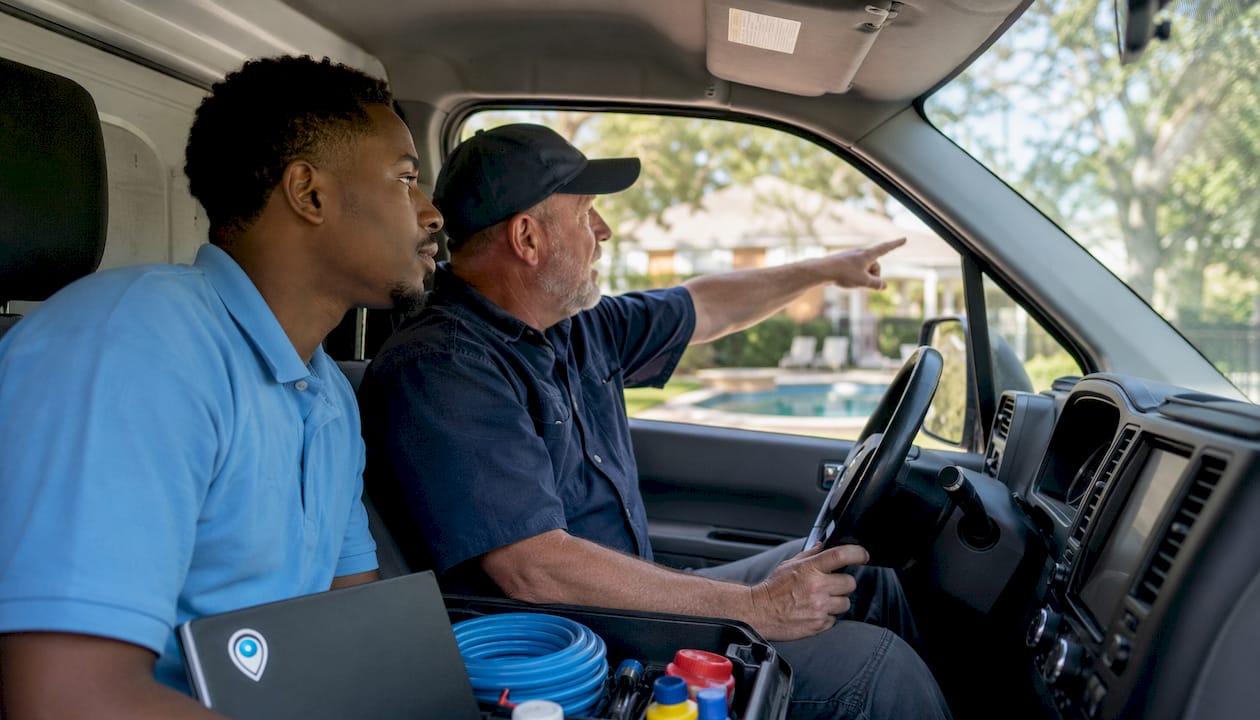
Pro Tip: Watch for three ride-along red flags that predict early failure: arriving late to the meeting point, leaving tools dirty at the end of the day, and asking to skip a stop "just this once." Any one of these warrants a pass.
Complete EEO-compliant hiring practices apply throughout. Ask only job-relevant questions during screens and ride-alongs.
How does recruitment software speed up every step of this process?
Centralizing posts and automating screening removes the administrative bottlenecks that stretch time-to-hire past 30 days. Here's what each automation does:
- Multi-board posting: One submission pushes your ad to Indeed, Facebook, and other boards simultaneously.
- Resume parsing: Candidate data populates automatically. No manual data entry.
- Automated pre-screen messages: Qualified applicants receive a phone-screen invitation within minutes of applying.
- Interview scheduling: Candidates self-schedule ride-alongs from a calendar link. No back-and-forth.
- Candidate scoring: AI matching ranks applicants by fit so you review the strongest candidates first.
- New candidate alerts: You get notified the moment a strong match applies.
- E-signature onboarding: Offer letters, W-4s, and safety docs are signed digitally before Day 1.
The automation sequence runs like this: post → auto-screen message → candidate self-schedules ride-along → conditional offer template sent → e-sign onboarding complete. Each step that previously required manual follow-up now runs without you touching it. That's where applicant tracking pays off most for small pool-service operators.
How do you make offers fast and get new hires productive in 30 days?
Make the conditional offer the same day the ride-along ends. Waiting 48 hours in a competitive market often means losing the candidate. Use an e-signature offer letter with a simple one-page pay summary. No lengthy negotiation documents.
Onboarding paperwork (Day 1):
- I-9 and W-4
- Direct deposit authorization
- Vehicle and equipment assignment
- Safety and chemical handling acknowledgment
30/60/90-day training progression:
- Days 1–14: Shadow every stop. Tech observes and asks questions.
- Days 15–30: Tech runs the route; you ride along and correct privately.
- Days 31–45: Tech runs a solo subset of 8–10 easy stops.
- Days 46–90: Full route with weekly spot checks.
A structured 30-day training program significantly reduces training-related callbacks and lowers 90-day turnover compared to ad-hoc training. Deliver all equipment on Day 1. A tech who waits a week for their test kit or PPE starts looking for another job in week two. See the full onboarding checklist for a step-by-step paperwork and training template.
Pay incentive examples: $300 referral bonus for the employee who referred them, $200 completion bonus at Day 30, $300 CPO completion bonus at Day 60.
Which KPIs tell you whether your hiring is actually getting faster?
| KPI | Target | Action if Off-Track |
|---|---|---|
| Time-to-fill | Under 30 days | Broaden sourcing channels |
| Time-to-first-interview | Under 3 days | Automate scheduling |
| Ride-along-to-offer conversion | — | Tighten phone screen questions |
| Offer acceptance rate | 80%+ | Raise pay or speed up offer timing |
| 90-day retention | — | Improve onboarding structure |
| Cost-per-hire | — | Shift budget toward referrals |
Track these weekly in a simple spreadsheet or inside your ATS analytics dashboard. Low applicant volume points to a sourcing problem. Slow interviews point to a scheduling bottleneck. Low 90-day retention points to an onboarding gap.
What mistakes slow your hiring or produce bad hires?
- Hiring in panic: Grabbing the first applicant when you're burned out produces the costliest hires. Replacement cost per tech runs $4,000–$6,000. Start recruiting in January–February, 6–8 weeks before April peak season.
- Skipping background checks: Pool techs access private property. There's no acceptable shortcut here. Fix: build the check into your conditional offer workflow so it runs automatically.
- Vague job ads: Hiding pay or writing a generic description cuts applicant volume. Fix: rewrite the ad in 30 minutes with pay in line one.
- Paying below market: Entry-level techs in most U.S. markets earn $18–$24 per hour. A tech making $19 who can earn $23 across town will leave within 90 days. Fix: check local rates and match or beat them before posting.
- No ride-along: Skipping the ride-along means you're hiring on a resume and a conversation. Fix: make it mandatory and paid.
- Weak onboarding: Throwing a new tech solo after three days produces callbacks and early turnover. Fix: follow the shadow → assisted → lead → solo progression.
What's the single next step if you need hires right now?
Spend 30 minutes today on two tasks: write and post a pay-first job ad, and send a referral message to your team and top customers. That combination produces the fastest measurable result.
What to expect in 7 days:
- 10–25 applicants from Indeed and Facebook combined.
- 3–6 phone screens completed.
- 1–3 paid ride-alongs scheduled.
- At least one conditional offer ready to send.
Centralize everything in Locatehire so you're not managing applicants across three email threads and a spreadsheet. The pool industry hiring season moves fast. Every day of admin lag is a day your route stays understaffed.
Key Takeaways
Hiring pool service technicians fast requires a structured sprint, not a reactive scramble. The 7/30/60 framework cuts time-to-fill from the 44-day national average to under 30 days when executed consistently.
| Point | Details |
|---|---|
| Start the sprint immediately | Post a pay-first ad, activate referrals, and schedule ride-alongs within 72 hours. |
| Referrals outperform job boards | Referred hires tend to stay longer than those hired through job boards. |
| Ride-alongs are non-negotiable | An 8-hour paid ride-along reveals fit more accurately than any interview. |
| Structured training cuts turnover | The shadow → assisted → lead → solo progression reduces 90-day turnover by roughly 50%. |
| Locatehire centralizes the sprint | Multi-board posting, automated screening, and e-sign onboarding remove admin lag at every step. |
Why this playbook works for small pool-service businesses
Most hiring advice is written for HR departments with dedicated recruiters and weeks of runway. Pool-service owners don't have either. Jeff, who covers hiring and training for service industries on the Locatehire blog, has written extensively on why the sprint model fits route-based businesses specifically.
The 44-day national time-to-fill and the 60–80 pool hiring threshold are concrete benchmarks. They reflect the real math of a solo operator who's turning away work and running out of physical capacity. The sprint compresses the hiring cycle by eliminating the steps that don't predict job performance (lengthy interviews, multi-round callbacks) and replacing them with the one step that does: the paid ride-along.
The practical constraints are real. Running a ride-along means you're covering two routes for a day, or leaving one short. The referral bonus costs $300 upfront. But replacing a tech who quits in 60 days costs $4,000–$6,000. The math favors the sprint every time.
Locatehire cuts your time-to-hire without adding admin work
Posting to three job boards, tracking 20 applicants in your inbox, and chasing e-signatures manually adds 8–12 hours of admin per open role. Locatehire eliminates that entirely.
Locatehire's AI-powered ATS posts your job ad to major boards in one click, scores and ranks candidates automatically, sends pre-screen messages without you lifting a finger, and routes qualified applicants straight to your ride-along calendar. E-sign onboarding means your new hire's paperwork is complete before their first day. New-candidate alerts notify you the moment a strong match applies, so you're never the last to know. For pool-service operators running the 7/30/60 sprint, Locatehire is the difference between managing the process and the process managing you. Start your free trial and have your first job ad live within the hour.
Useful sources and further reading
- 2025 State of Pool Service Report: 44-day time-to-fill and seasonal hiring data
- PoolCamp: hiring threshold guidance (60–80 pools) and background-check best practices
- PoolDial: managing and scaling pool tech teams with route data
- Locatehire blog: how to train new pool service hires effectively
- Locatehire blog: common hiring challenges pool service companies face
- Locatehire blog: pool industry hiring season and timing guidance