

At-will employment is defined as a work arrangement where either the employer or the employee can end the relationship at any time, for any lawful reason, or for no reason at all. This doctrine is the default in 49 U.S. states, covering nearly every business operating in America. If you run a pool service company, a janitorial crew, or an HVAC operation, you are almost certainly hiring under this framework right now. Understanding what is at will employment, where it applies, and where it stops is one of the most practical things you can do to protect your business.
What is at-will employment and how does it work?
At-will employment means either party can terminate the job at any time, for any lawful reason, or no reason at all. No notice is required. No formal cause needs to be documented. The relationship ends when one side decides it ends.
This flexibility runs in both directions. You can let a technician go on a Tuesday because the workload dropped. That same technician can walk off the job on Friday without giving two weeks' notice. Neither action violates the law under the at-will doctrine, provided the reason is not illegal.

The U.S. model stands apart globally. Other countries mandate written contracts/2.11%3A_Employee_Rights_and_Responsibilities/2.11.05%3A_Employment_at_Will_Doctrine) that forbid unilateral termination without cause. That comparison matters because it shows how much freedom American employers actually have, and why that freedom comes with responsibility.
At-will status also covers changes to employment terms. You can adjust pay rates, shift schedules, or modify benefits without asking permission. However, unilateral changes to pay or benefits/2.11%3A_Employee_Rights_and_Responsibilities/2.11.05%3A_Employment_at_Will_Doctrine) give employees the right to reject those terms and quit. That creates real turnover risk, especially in trades where skilled workers have options.
What at-will employment means in practice:
- Employers can terminate without advance notice or stated cause, as long as the reason is lawful
- Employees can resign at any time without penalty or obligation
- Employers can change wages, schedules, or job duties unilaterally
- Employees who reject those changes can walk away without legal consequence
- Neither side owes the other a formal explanation under the doctrine
Pro Tip: Even though at-will employment does not require documentation, always write down the reason for any termination. That record becomes your first line of defense if a lawsuit follows.
Which legal exceptions limit at-will employment?
At-will employment is not unlimited. Several legal exceptions carve out situations where termination becomes unlawful, even in at-will states. Knowing these exceptions is where most employer risk actually lives.
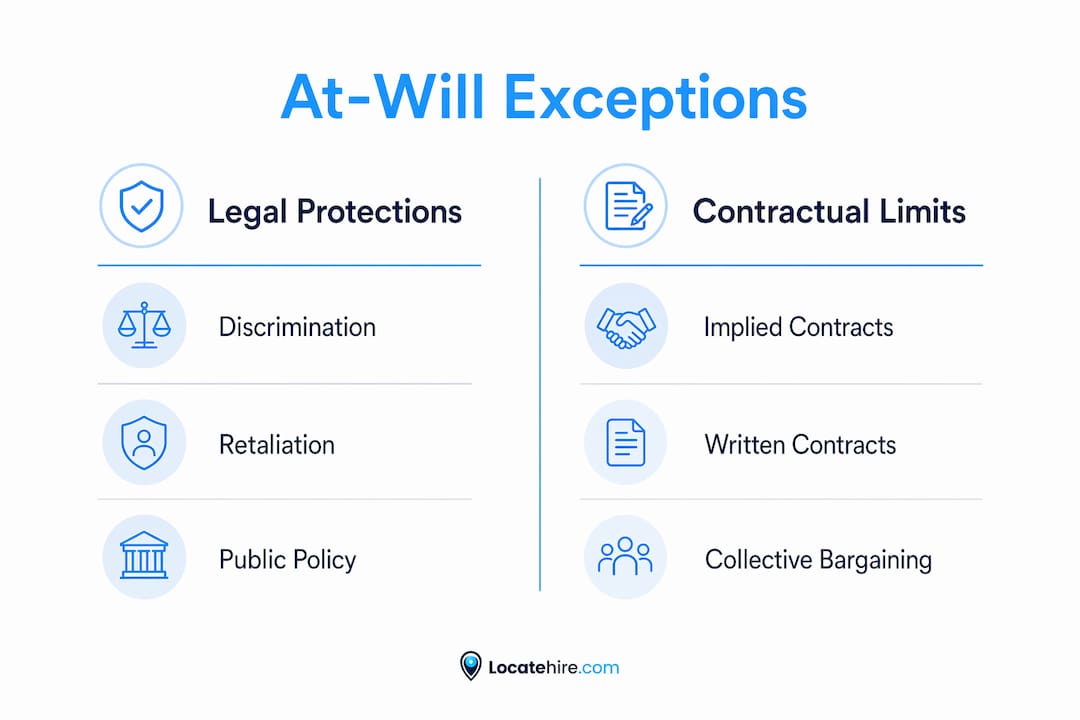
Federal and state anti-discrimination laws are the most significant constraint. Title VII of the Civil Rights Act, the Americans with Disabilities Act, and the Age Discrimination in Employment Act all prohibit firing someone based on race, sex, religion, national origin, disability, or age. These laws apply regardless of at-will status. Firing a plumber because she is pregnant is wrongful termination, full stop.
Public policy exceptions cover a different category of protection. Wrongful termination claims frequently arise when employers fire workers for refusing to commit illegal acts, for serving on jury duty, or for reporting safety violations. These are among the most common litigation triggers for small businesses, because the situations feel routine until they land in court.
Employers who fire a worker for reporting a workplace safety violation to OSHA, for refusing to falsify records, or for taking legally protected leave face wrongful termination exposure even in fully at-will states. Public policy exceptions exist precisely to prevent employers from using at-will status as cover for retaliatory or illegal conduct.
Implied contracts are a subtler trap. Courts have found that oral promises of job security, or language in an employee handbook suggesting termination only "for cause," can create an implied contract that removes at-will protection. Employers should avoid oral promises that imply long-term employment, and handbooks should include a clear at-will disclaimer on the first page.
Written contracts and collective bargaining agreements replace at-will status entirely. Employment contracts override at-will and require just cause for termination. If you sign a written agreement with an employee or operate under a union contract, the at-will doctrine no longer applies to that relationship.
Understanding employment contract types helps clarify when at-will status applies and when a formal agreement takes over.
How does at-will employment vary by state?
The at-will doctrine is nearly universal in the U.S., but state-level differences shape how it operates in practice. The most significant outlier is Montana.
Montana requires termination "for good cause" after an employee completes a probationary period. That means if you hire someone in Montana and they pass their initial probation, you cannot let them go without a documented, legitimate reason. This is a fundamentally different standard from every other state.
| State category | Termination standard | Key employer consideration |
|---|---|---|
| 48 at-will states | Any lawful reason or no reason | Document anyway to reduce lawsuit risk |
| Montana (post-probation) | Good cause required | Maintain performance records from day one |
| States with strong public policy exceptions | At-will with broader employee protections | Review state-specific whistleblower laws |
Beyond Montana, states vary in how broadly they recognize public policy exceptions and implied contract claims. California, for example, has some of the most employee-friendly interpretations of these exceptions in the country. New York applies them more narrowly. If your business operates across multiple states, your HR policies need to reflect those differences.
Pro Tip: If you hire in Montana, treat every employee as if they have just-cause protection from the start. Build documentation habits before the probationary period ends, not after.
What are the best practices for managing at-will employment?
At-will status gives you flexibility. Good management practices protect that flexibility from being taken away by a lawsuit or a misunderstanding. The following steps apply whether you run five employees or fifty.
-
Put the at-will statement in writing. Include a clear at-will disclaimer in your offer letters and employee handbook. The offer letter process is the right moment to set expectations before the employment relationship begins.
-
Document performance issues consistently. Employers must document performance problems to defend against wrongful termination claims. A written record of warnings, missed targets, or policy violations gives you a factual basis for any termination decision.
-
Avoid language that implies job security. Phrases like "permanent position," "job for life," or "as long as you perform well" can create implied contracts. Train managers to avoid these phrases in conversations and emails.
-
Apply policies consistently across your workforce. Terminating one employee for behavior you tolerate in another creates discrimination exposure. Consistency is your best defense.
-
Communicate changes to employment terms in advance. At-will status lets you change pay or benefits without permission, but giving advance notice reduces the chance that employees quit in response. Unilateral changes without notice/2.11%3A_Employee_Rights_and_Responsibilities/2.11.05%3A_Employment_at_Will_Doctrine) are a leading driver of unexpected turnover.
-
Review your handbook annually. State laws change. A handbook that was compliant two years ago may now create implied contract liability in your state. Annual reviews catch these gaps before they become legal problems.
Small businesses in trades like HVAC, electrical, and pool service face specific hiring challenges that make clear employment policies even more critical. High turnover, seasonal demand, and a competitive labor market mean that at-will flexibility is genuinely valuable, but only when managed well.
At-will employment is not a substitute for good hiring. Avoiding bad hires reduces the situations where termination becomes necessary in the first place.
Key Takeaways
At-will employment gives U.S. employers broad termination flexibility, but legal exceptions, state variations, and documentation gaps are the real risks that determine whether that flexibility holds up.
| Point | Details |
|---|---|
| Default doctrine in 49 states | At-will employment applies automatically unless a contract or law overrides it. |
| Montana is the exception | Montana requires good cause for termination after probation, unlike every other state. |
| Legal exceptions are real limits | Anti-discrimination laws, public policy protections, and implied contracts all restrict at-will termination. |
| Documentation protects employers | Written records of performance issues are the primary defense against wrongful termination claims. |
| Handbook language creates liability | Implied contract language in handbooks or verbal promises can remove at-will protection entirely. |
At-will employment: flexibility is only as good as your policies
At-will employment is one of the most misunderstood tools in the employer's toolkit. I have seen business owners treat it as a blank check to fire anyone, anytime, without consequence. That thinking is how small businesses end up in expensive litigation over terminations that seemed routine.
The doctrine genuinely does give you freedom. You can move fast when a hire is not working out. You can restructure your team when the business changes. That speed matters in trades where a bad technician in the field costs you customers, not just productivity.
But at-will is not a legal shield. It is a default position that disappears the moment you make an oral promise, write the wrong thing in a handbook, or fire someone in a way that looks retaliatory. The employers who use at-will employment well are the ones who treat it as a starting point, not a finish line. They document everything, communicate clearly, and build policies that hold up under scrutiny.
The other thing I would push back on is the idea that at-will employment means you do not owe employees clear communication. You are not legally required to explain a termination. But the businesses with the lowest turnover and the fewest lawsuits are the ones that explain anyway. Clarity costs nothing. Ambiguity costs a lot.
— Jeff
How Locatehire helps you hire and manage with confidence
Managing at-will employment well starts before someone is even hired. Clear offer letters, consistent onboarding, and documented expectations set the foundation for every employment relationship.
Locatehire is an applicant tracking system built for small businesses with ongoing hiring needs, including pool service, HVAC, janitorial, electrical, plumbing, and retail. It helps you move fast on candidates while keeping your hiring process consistent and documented. When you need to fill a role quickly or manage a high-turnover position, having a structured process protects you from the gaps that create legal exposure. Start hiring smarter with Locatehire and build the documentation habits that keep your business protected.
FAQ
What is the at-will employment definition?
At-will employment is a work arrangement where either the employer or employee can end the job at any time, for any lawful reason, or no reason at all. No advance notice or stated cause is required under this doctrine.
Does at-will employment mean an employer can fire anyone for any reason?
No. At-will employment prohibits terminations based on protected characteristics like race, sex, age, or disability, and bars firing employees for whistleblowing, jury duty, or refusing illegal acts. These exceptions apply in every U.S. state.
Which state does not follow at-will employment?
Montana is the only state that does not follow the at-will default. After an employee completes a probationary period, Montana law requires employers to show good cause for termination.
Can an employer change pay or benefits under at-will employment?
Yes. At-will employment allows employers to change wages, schedules, or benefits without prior consent. Employees who reject the new terms can quit without penalty, which creates turnover risk for employers who make changes without notice.
Does an employee handbook affect at-will status?
Yes. Handbook language that implies termination only "for cause" can create an implied contract that removes at-will protection. Every handbook should include a clear, explicit at-will disclaimer to prevent this outcome.