

Yes, HVAC companies need background checks. Your technicians enter private homes and businesses every day, and a single negligent hire can expose you to lawsuits, insurance claims, and the kind of reputational damage that no marketing budget can fix.
Three reasons to screen every hire:
- Legal exposure: The Fair Credit Reporting Act governs how employers use consumer reports, and non-compliance carries real litigation risk.
- Negligent hiring liability: Courts look at whether you took reasonable steps to vet employees before sending them into customers' homes.
- Customer trust and insurance: Screened workforces command higher customer confidence and better terms from carriers and commercial clients.
Start by selecting an accredited screening vendor, building a written policy, and running checks before any conditional offer is finalized.
Key Takeaways
HVAC companies that screen every field hire with a documented, FCRA-compliant process reduce negligent-hiring liability, protect customer trust, and build the audit trail insurers and commercial clients expect.
| Point | Details |
|---|---|
| Screening is recommended for all field roles | HVAC technicians access private homes, making criminal and MVR checks a baseline safety requirement. |
| FCRA compliance is mandatory | Written disclosure, signed authorization, and a two-step adverse-action process are required by federal law for every consumer report. |
| County criminal and MVR checks are the priority | County searches provide the most current local criminal history; MVRs are required for any role using a company vehicle. |
| Re-screen every two years | Industry guidance recommends periodic re-screening for field employees and annual MVR reviews for drivers. |
| Locatehire automates the workflow | Locatehire's ATS delivers consent forms, stores reports, applies role-based packages, and schedules re-checks automatically. |
Table of Contents
- Why background checks matter more for HVAC than most industries
- Which background checks do HVAC companies commonly run?
- What U.S. law requires: FCRA, consent, and adverse action
- How to build a fair and defensible screening process
- Screening subcontractors and temporary workers
- How background checks affect your insurance and bonding
- Pre-hire checklist and screening policy outline
- How an ATS helps you operationalize screening
- The trade-off most small HVAC shops get wrong
- Locatehire makes compliant screening repeatable for HVAC companies
- Sources
Why background checks matter more for HVAC than most industries
HVAC technicians are not office workers. They carry tools into bedrooms, utility rooms, and server closets. They work alone, often without supervision, in spaces where customers store valuables and where vulnerable people, including children and elderly residents, may be present. That access level is what makes background screening essential for HVAC employers, not just a best practice borrowed from corporate HR.
The legal concept of negligent hiring holds that an employer can be liable when an employee harms someone and the employer failed to conduct a reasonable investigation before hiring. For HVAC companies, that exposure extends beyond theft to property damage, harassment, and physical harm on customer property. Courts and insurers both ask the same question: did you do your homework?
The insurance angle is equally concrete. Carriers writing general liability and workers' compensation policies for service contractors increasingly ask whether you have a documented screening program. Commercial clients, property managers, and facilities departments often require proof of screening before adding you to a preferred vendor list. Without it, you may lose bids before the price conversation even starts.
Most consumers said they were more likely to hire a company with a background-screening certification, and a large majority viewed criminal screenings as important when choosing a service provider. (ACHR News)
Pro Tip: Display your screening certification or policy statement on your website and in your service agreement. Customers who see it before the technician arrives are more likely to trust the visit and less likely to file complaints.
Which background checks do HVAC companies commonly run?
The right package depends on the role. A field technician driving a company van and entering homes needs a different set of checks than an office coordinator. Trades employers typically layer county criminal searches with MVRs, drug screens, and license verification to build a complete picture. Here is a practical catalog:
- County criminal search: The primary source for criminal history. County courts hold the most current and complete local records. Run for every hire, in every county where the applicant has lived in the past seven years.
- Statewide and federal criminal search: Adds coverage beyond a single county. Federal records catch offenses prosecuted in federal court, such as fraud or drug trafficking across state lines. Use as a supplemental layer for all field roles.
- National sex-offender registry: A fast, low-cost check that should be standard for anyone entering customer homes. Non-negotiable for residential service roles.
- Motor vehicle record (MVR): Required for any technician or driver operating a company vehicle. Reveals license suspensions, DUIs, and reckless driving history. Run at hire and annually thereafter.
- Drug testing: Pre-employment testing is standard in the trades. Post-accident and reasonable-suspicion testing reduce workers' compensation claims and liability exposure. Random testing programs add an ongoing deterrent.
- License and certification verification: Confirm EPA 608 certification for refrigerant handling, state trade licenses, and any specialty credentials. A technician working without a required license creates regulatory and insurance exposure for your company.
- Employment verification: Confirms the candidate actually held the roles they claim and left on acceptable terms. Particularly useful for senior technicians or supervisors.
- Identity verification: Confirms the person applying is who they say they are. Catches cases where a candidate uses another person's identity to hide a disqualifying record.
- Credit check (limited use): Relevant only for roles with financial responsibility, such as a service manager handling customer payments. Subject to additional FCRA restrictions and state limits; use sparingly.
- OIG/GSA exclusion lists: Relevant if you hold government contracts or serve federally funded facilities. Checks whether an individual is barred from federally funded work.
Recommended packages by role:
- Field technicians: County criminal, statewide criminal, sex-offender registry, MVR, drug test, license/certification verification, employment verification.
- Drivers (non-technical): County criminal, MVR, drug test, employment verification.
- Office and administrative staff: County criminal, employment verification, identity verification; credit check if the role involves financial access.
For installation versus service roles, the check package may differ slightly, but the criminal and MVR components should remain consistent across all field positions.
What U.S. law requires: FCRA, consent, and adverse action
Compliance with the Fair Credit Reporting Act is not optional. Any time you order a background report from a third-party consumer reporting agency (CRA), federal law governs every step of the process. Skipping a step is not a technicality; it is a litigation trigger.
The required FCRA steps:
- Provide a standalone disclosure. Before ordering a report, give the applicant a written notice that you may obtain a consumer report. This must be a separate document, not buried in an employment application.
- Obtain written authorization. The applicant must sign a clear authorization before you run any check.
- Provide a copy of the report and a summary of rights. If you plan to take adverse action based on the report, you must first give the applicant a copy of the report and the FTC's "A Summary of Your Rights Under the FCRA" document.
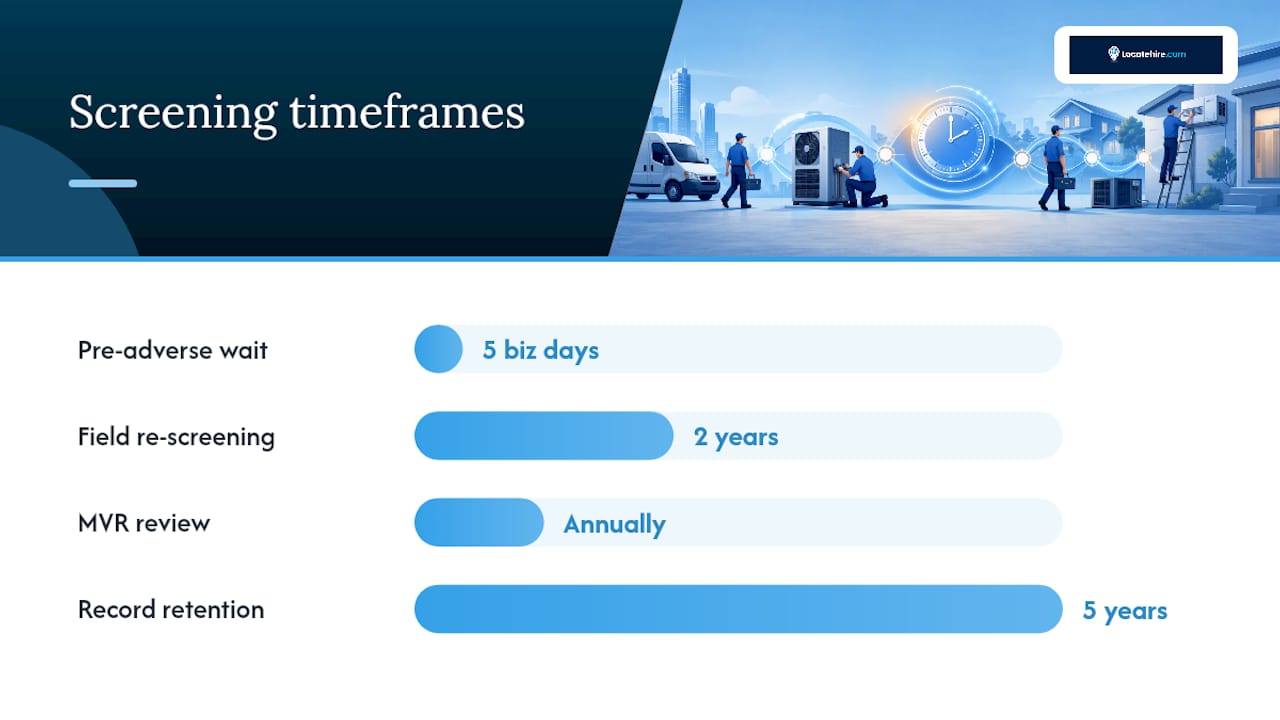
- Send a pre-adverse action notice. This gives the applicant time (typically five business days is the practical standard, though the statute does not specify an exact number) to dispute inaccurate information before you make a final decision.
- Send a final adverse action notice. If you proceed with the adverse decision, send a second notice naming the CRA, stating the CRA did not make the decision, and providing the applicant's right to dispute.
State-level variations to watch:
- Many states and cities have ban-the-box laws that restrict when you can ask about criminal history, typically prohibiting the question until after a conditional offer.
- Some states limit how far back a criminal record can be considered (commonly seven years for non-conviction records).
- California, New York, Illinois, and several other states have individualized assessment requirements that go beyond federal minimums.
Consult employment counsel or a PBSA-accredited screening vendor to confirm your state's specific rules before finalizing your policy. Texas, for example, has specific guidance for trades employers that differs from the federal baseline.
How to build a fair and defensible screening process
A written, consistently applied screening policy is your best protection against both negligent-hiring claims and FCRA litigation. The PBSA provides best-practice standards that help employers design policies that hold up under audit. Here is a sequential framework:
- Conduct a job analysis. Define the duties, access level, and risk profile for each role before selecting a check package. A technician entering homes needs a different package than a dispatcher.
- Select a check package by role. Use the role-based packages described above. Document the rationale for each component.
- Obtain consent before ordering. Provide the FCRA-required standalone disclosure and written authorization. Keep signed copies.
- Order the report through an accredited CRA. Choose a vendor that is PBSA-accredited and provides FCRA-compliant workflows. Avoid informal internet searches as a substitute for a formal report.
- Adjudicate the results consistently. Apply the same standards to every candidate in the same role. Consider the nature of the offense, how long ago it occurred, and its relevance to the job duties. Document your reasoning.
- Follow the adverse-action process if needed. Send the pre-adverse notice, wait a reasonable period, then send the final adverse notice if you proceed.
- Communicate the outcome to the candidate. Whether the decision is a hire or a decline, notify the candidate promptly and professionally.
Sample adjudication rules:
- Theft or fraud conviction within seven years: Disqualifying for any role with access to customer property or company funds.
- DUI or reckless driving within three years: Disqualifying for any role requiring a company vehicle.
- Sex-offender registry hit: Disqualifying for all residential service roles.
- Marijuana conviction only, non-recent: Evaluate individually; consider state law and job duties before disqualifying.
- License suspension: Disqualifying for driving roles until reinstatement is confirmed.
Process hygiene matters. Retain all screening records for at least five years, or longer if your state requires it. Train every hiring manager on the policy before they make a single offer. Industry sources recommend re-screening employees every two years and running drug screens at hire, for cause, and randomly to reduce accidents and workers' compensation claims.
Pro Tip: Assign one person, a hiring manager or office administrator, as your "screening coordinator" who owns every step of the process. Distributed responsibility is where compliance gaps appear.
Screening subcontractors and temporary workers
Subcontractors are not your employees, but they carry your company's name into customer homes. If a subcontractor harms a customer, your company may still face liability claims, especially if you failed to verify that the subcontracting firm screens its own workers.
The key distinction: you cannot run a background check on a subcontractor's employees yourself without their consent and a proper CRA relationship. What you can do is require proof of screening as a condition of the contract.
Practical steps for subcontractor screening:
- Include a screening clause in every subcontract. Require the subcontractor to certify that all workers assigned to your jobs have passed a criminal background check within the past 12 months.
- Require proof, not just attestation. Ask for a summary report or certification from the subcontractor's screening vendor. Self-attestation without documentation is a common pitfall that leaves you exposed.
- Verify insurance and bonding. Require current certificates of general liability and workers' compensation insurance. Confirm that the policy limits meet your minimum requirements and that your company is named as an additional insured.
- Include a right-to-audit clause. Reserve the right to request updated screening documentation at any time and to remove a worker from your jobs if documentation lapses.
- Require renewal of certificates annually. Set calendar reminders to collect updated insurance certificates and screening confirmations each year.
Onboarding checklist for subcontractors:
- Signed subcontract with screening and insurance clauses
- Current certificate of insurance (general liability and workers' comp)
- Screening certification or summary from their CRA
- Copy of any required trade licenses or certifications
- Signed acknowledgment of your company's code of conduct and customer access policies
How background checks affect your insurance and bonding
Insurers writing policies for HVAC service companies are paying close attention to hiring practices. A documented, consistent screening program signals lower risk, and that signal can affect underwriting decisions, premium calculations, and how a carrier responds when a claim is filed.

Negligent hiring lawsuits are a material risk. When an employee causes harm on a customer's property and the employer had no screening program, courts may find that the employer failed to exercise reasonable care. That finding can void coverage arguments and expose the business to damages beyond policy limits.
What carriers commonly ask for:
- A written screening policy covering all field roles
- Evidence that the policy is applied consistently (signed consent forms, adjudication records)
- The percentage of your workforce that has been screened within the past two years
- Documentation of your adverse-action process
Integrating screening evidence into your annual insurance review, not just your hiring workflow, gives your broker concrete documentation to present to underwriters. That documentation can support lower premiums or broader coverage terms.
Bonding follows similar logic. Surety companies issuing fidelity bonds for service contractors want assurance that employees with access to customer property have been vetted. A gap in your screening records can complicate a bond renewal or a claim.
The practical takeaway: treat your screening policy as a risk-management document, not just an HR document. Review it with your insurance broker annually and update it whenever your workforce size or role mix changes.
Pre-hire checklist and screening policy outline
Use this checklist and policy outline as a starting point. Adapt the language to your company size, state requirements, and role mix before adding it to your employee handbook.
Pre-hire screening checklist:
- Job posting includes notice that a background check is required as a condition of employment
- Conditional offer extended before background check is ordered
- Standalone FCRA disclosure provided to applicant (separate document)
- Written authorization signed and retained
- Role-based check package selected and ordered through accredited CRA
- Report received and reviewed by designated screening coordinator
- Adjudication applied consistently using written criteria
- If adverse action: pre-adverse notice sent with copy of report and Summary of Rights
- Reasonable waiting period observed (minimum five business days recommended)
- Final adverse notice sent if decision stands, or hire proceeds if cleared
- All documents retained in secure file for minimum five years
Policy template outline:
- Purpose: Protect customers, employees, and the company by verifying that all hires meet defined safety and conduct standards.
- Scope: Applies to all full-time, part-time, and temporary employees. Subcontractors are covered by contract clause.
- Responsibilities: Hiring manager initiates process; screening coordinator owns compliance steps; HR retains records.
- Screening packages by role: (Insert role-based packages from the types-of-checks section above.)
- Consent and disclosure: All applicants receive a standalone FCRA disclosure and sign written authorization before any check is ordered.
- Adjudication matrix: (Insert your company's specific disqualifying criteria by offense type, recency, and role.)
- Adverse action process: Follow the six-step FCRA process described in the legal compliance section.
- Re-screening: All field employees re-screened every two years. MVRs reviewed annually for driving roles. Drug screens conducted at hire, for cause, and randomly per program schedule.
- Record retention: All screening records retained for a minimum of five years in a secure, access-controlled system.
The table below shows check types commonly used in the trades and their primary purpose:
| Check Type | Primary Purpose | Roles |
|---|---|---|
| County criminal search | Most current local criminal history | All field and office roles |
| MVR | Driving history and license status | All vehicle operators |
| Drug screen | Safety and workers' comp risk reduction | All field roles |
| Sex-offender registry | Residential access safety | All residential service roles |
| License/certification verification | Regulatory compliance (EPA 608, state licenses) | All licensed technicians |
| Employment verification | Confirms work history accuracy | Senior technicians, supervisors |
How an ATS helps you operationalize screening
A written policy is only as good as the process that executes it. An applicant tracking system (ATS) turns your screening policy into a repeatable, auditable workflow, reducing the administrative risk that comes from managing consent forms, vendor reports, and re-check schedules manually.
With an ATS, the screening workflow becomes systematic:
- Automated consent forms are triggered when a conditional offer is extended, so the FCRA disclosure and authorization step never gets skipped.
- Vendor report integration pulls background check results directly into the candidate record, creating a single source of truth for adjudication.
- Role-based screening templates apply the correct check package automatically based on the position, eliminating the risk of a manager ordering the wrong checks or skipping a required component.
- Re-check scheduling sends alerts when an employee's two-year re-screen or annual MVR review is due, so periodic screening happens on schedule rather than when someone remembers.
- Audit trail storage retains every signed consent form, report, and adjudication note in a secure, time-stamped record that you can produce in the event of a claim or audit.
For HVAC shops managing ongoing hiring, the consistency an ATS provides is the real value. When every hire goes through the same documented steps, you have a defensible record that demonstrates reasonable care, which is exactly what insurers and courts look for.
Pro Tip: Use your ATS analytics to run a quarterly report on screening completion rates by role. If any role category shows gaps, that is where your next training conversation with hiring managers should start.
Reducing hiring bias at the screening stage is another benefit of systematizing the process. When the same steps apply to every candidate in the same role, subjective variation decreases and your adjudication decisions are easier to defend.
The trade-off most small HVAC shops get wrong
Small HVAC companies face a real tension: the technician shortage is acute, hiring windows are short, and a thorough background check can add three to five business days to an already tight timeline. The temptation is to skip or delay the check, especially for a candidate who comes highly recommended or who needs to start immediately.
That trade-off is worth examining honestly. A background check that takes five days costs almost nothing compared to a negligent-hiring lawsuit, a lost commercial contract, or a customer incident that generates a negative review visible to every future prospect. The math is not close.
What actually works for small shops is building screening into the conditional offer stage, not the final offer stage. When candidates know from the job posting that a check is required, and when your ATS triggers the consent form the moment you extend a conditional offer, the process runs in parallel with reference checks and onboarding paperwork rather than sequentially after everything else. That parallel workflow cuts the perceived delay significantly.
The shops that struggle with screening are usually the ones treating it as a separate, manual task. Those that have made it routine report that it rarely slows hiring in any meaningful way, and that the occasional disqualification is exactly the protection the process is designed to provide.
Locatehire makes compliant screening repeatable for HVAC companies
Hiring fast and hiring safely are not mutually exclusive when your process is built right. Locatehire is an AI-powered applicant tracking system built specifically for small businesses in the trades, including HVAC, plumbing, electrical, and janitorial companies that hire on a rolling basis.
With Locatehire, you get automated consent form delivery at the conditional offer stage, role-based screening templates that apply the right check package every time, and document storage that keeps your audit trail organized and accessible. The platform also schedules re-check alerts so periodic re-screening happens on time, without a manual reminder system. Locatehire is an ATS, not a background-check vendor; it integrates with your chosen accredited CRA to pull reports into candidate records automatically.
If your current process relies on spreadsheets, email threads, and memory, you are one missed step away from an FCRA complaint. Start a free trial at Locatehire and see how a purpose-built ATS turns your screening policy into a workflow that runs itself.
Sources
The sources below were used in this article and are worth bookmarking for ongoing compliance and policy updates:
- Fair Credit Reporting Act | Federal Trade Commission (FTC)
- Do You Know Who You're Hiring? | ACCA HVAC Blog
- Plumbers, Electricians, Carpenters, and Beyond: Which Background Checks Are Most Common in the Trades? | Verified Credentials blog
- Safe Hiring Initiatives Protect Consumers and Contractors | ACHR News
This article is general information, not a substitute for advice from a qualified lawyer. Consult a qualified legal professional about your own circumstances before acting on anything here.